- Select the pool, cleaning mission and service model before choosing a corded or cordless robot platform.
- Validate traction, brushes, pump, filtration, sealing, battery and navigation as one underwater system.
- Control tooling, firmware, app rights, production changes, waterproof revalidation and spare parts in the supplier agreement.
In this article 15 sections
A robotic pool cleaner OEM or ODM project should start with the pool, cleaning mission and service model—not a factory catalog. Buyers must define corded or cordless power, floor/wall/waterline coverage, pool surface and geometry, debris, filtration, mission time, retrieval, charging and intended use. The correct supplier is the one that can prove the complete underwater system, control production changes and support parts and failures after launch.
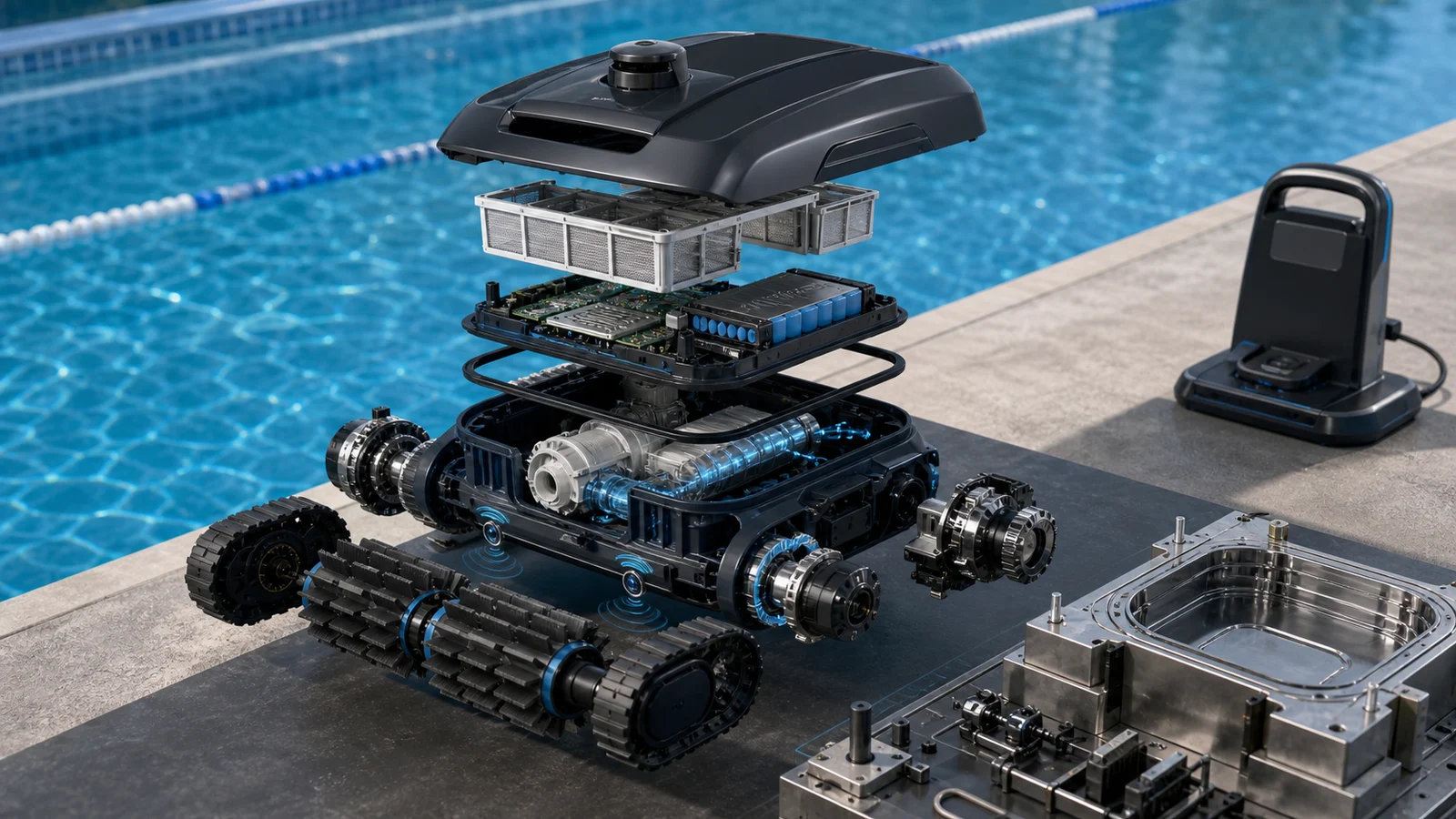
The category looks attractive because an existing platform can be recolored, branded and shipped quickly. The hidden work remains underwater: traction, brush contact, pump flow, filter loading, seals, batteries, charging, navigation, retrieval and chemical exposure.
A short demonstration can hide missed areas, marginal wall climbing, water entry, rapid filter blockage, battery imbalance or a service design that cannot be repaired in the destination market.
OEM, ODM and Private Label Are Different Control Levels
The sourcing label should describe who controls the product.
| Development route | Existing supplier platform | Buyer control | Main risk |
|---|---|---|---|
| Private label | Almost complete | Brand, packaging and limited configuration | Weak differentiation and unclear platform sharing |
| ODM customization | Core platform exists | Selected industrial design, functions, accessories, filters, software settings and packaging | Changes may disturb a validated system |
| Joint development | Shared starting architecture | Product definition, subsystem choices, tooling, software and validation | Governance, ownership and engineering coordination |
| Buyer-led OEM | Buyer specification or design | Highest control over requirements, tooling and acceptance | More capital, time and integration responsibility |
Do not rely on these words in a quotation. Put the control points into the contract:
- who owns the industrial design and molds;
- whether the platform is shared with other customers;
- which markets or channels are exclusive;
- who owns firmware, App, cloud and test data;
- who can approve component substitutions;
- who pays for retesting after a change;
- how long parts and software remain available;
- who owns product registrations, certificates and accounts.
A private-label project can be appropriate for a small market test. A long-term brand needs stronger control over the wet enclosure, battery, pump, navigation, firmware and service architecture.
Choose the Product Platform Before Choosing the Factory
Begin with a written mission profile.
Pool type and surface
Define above-ground or in-ground construction, liner, fiberglass, tile, plaster or other target surfaces. Include slopes, transitions, curves, corners, drains, ledges and steps that the robot is expected—or not expected—to handle.
Cleaning coverage
Separate these claims:
- floor cleaning;
- floor plus wall climbing;
- horizontal waterline scrubbing;
- surface skimming;
- step or bench cleaning;
- manual spot control;
- automatic parking or docking.
One successful wall climb does not prove systematic wall or waterline coverage. A surface skimmer is a different hydrodynamic product from a submerged floor robot, even if both belong to the pool-robot category.
Debris
Specify large leaves, fine dust, sand, pollen, hair, insects and the combination expected in the target market. Filter media and pump flow must work with the debris mix. A very fine filter can increase loading and reduce flow; a coarse basket can miss the particles buyers care about.
Intended use
Residential, rental, service-contractor and commercial-facility use create different duty, warranty and support requirements. A high-feature residential product is not automatically a commercial machine.
For the underlying drive, brushing, suction and filtration sequence, see How Do Robotic Pool Cleaners Work?. This guide focuses on how to develop and audit the platform.
Corded and Cordless Change the Whole System
Corded and cordless are not cosmetic variants.
A corded robot normally receives low-voltage power from a poolside supply through a floating cable. It removes the onboard traction-battery limit, but adds a cable, connector, swivel where used, power supply, plug configuration and poolside installation instructions.
A cordless robot removes the operating cable but adds a sealed battery pack, BMS, charging interface or dock, regulated transport, retrieval and battery replacement.
| Decision | Corded platform | Cordless platform |
|---|---|---|
| Energy | External supply during the mission | Onboard battery |
| Main wet-side additions | Cable entry, connector and strain relief | Battery enclosure, BMS and internal high-current path |
| Poolside system | Power supply, cable handling and protective-device instructions | Charger or dock, drying and charging workflow |
| Capacity constraint | Programmed cycle, filter and duty limits | Usable energy, load, temperature and battery condition |
| Logistics | Electrical product and destination plug configuration | Electrical product plus lithium-battery transport chain |
| Service inventory | Cable, swivel, supply, seals, drive and pump | Pack, charger/dock, seals, drive, pump and test fixtures |
The dedicated cordless vs corded robotic pool cleaner comparison covers operating trade-offs. In an OEM project, the important point is that changing power architecture changes the BOM, tooling, validation, shipping and service model.
Treat Cleaning Performance as One Architecture
Cleaning results come from subsystem interaction.
Drive and traction
Wheels, tracks, differential drive, water jets or hybrid mechanisms determine turning, obstacle crossing and wall behavior. Verify traction as filters load and surfaces change. Aggressive tread can improve climbing but mark delicate surfaces or increase wear.
Brushes
Brush material, stiffness, speed, geometry and contact pressure affect biofilm and debris release. A brush that works on tile may be too aggressive or ineffective on another surface. Define replacement intervals and compatibility by exact model.
Pump and flow path
The pump creates water flow through the inlet and filter. Housing restrictions, filter loading, leaks and debris bridges change effective pickup. Ask for pump curves or controlled test data, but approve the complete robot in a pool.
Filter and basket
Specify media, area, bypass control, basket capacity, access, debris retention during retrieval and cleaning labor. Test coarse and fine configurations separately. Confirm that replacement media will remain available.
Hydrodynamics and balance
Buoyancy, center of gravity, water exhaust and trapped air affect settling, traction, wall transition and retrieval. A battery or motor substitution can change balance even when the exterior shell is unchanged.
This is why subsystem “upgrades” need system revalidation. A higher-flow pump may reduce runtime, change water exhaust forces, overload the filter or disturb wall stability.
Battery, BMS and Charging Need a Traceable Chain
For a cordless platform, require:
- cell manufacturer, model, chemistry and lot control;
- pack configuration, capacity and mechanical restraint;
- BMS functions, thresholds and component revision;
- fusing, temperature sensors and current path;
- enclosure and feedthrough design;
- charger or dock specification;
- charge interlocks and wet-product instructions;
- cycle-life plan and end-of-life behavior;
- applicable safety reports and UN 38.3 test summary;
- transport classification and packaging configuration;
- field replacement and waterproof revalidation process.
The UNECE Manual of Tests and Criteria contains the lithium-cell and battery transport tests in subsection 38.3. IATA states that applicable cell and battery manufacturers and subsequent distributors must make the test summary available. These transport controls do not replace product safety, water-ingress, charging or chemical-aging validation.
A pack replacement should not be treated like swapping dry consumer electronics. Opening a wet enclosure can change gasket compression, cable routing, fastener torque and leak integrity. Define who may perform the repair, which seals are replaced, which torque tools are used and what leak test is required before return to service.
For EU programs extending into 2027, review the EU Batteries Regulation. Its portable-battery removability and replaceability obligations apply from February 18, 2027, with specified exceptions and related instructions and spare-part requirements. A pool product may have special water-protection considerations, but the project team should not assume an exception without product-specific legal and engineering review.
Waterproofing Is More Than an IP Code
IEC 60529 defines the IP Code framework for enclosure protection. An IP claim must map to the exact enclosure, configuration and test evidence.
For an underwater robot, add a product-specific durability plan:
- static and cyclic immersion;
- pressure or depth cycling within the declared use;
- hot-to-cold transitions;
- chlorine, salt and other declared water-treatment exposure;
- gasket compression set;
- shaft, cable and connector sealing;
- fastener torque variation;
- drop and vibration before the leak test;
- charging-contact corrosion;
- post-repair waterproof verification;
- multiple production lots, not one engineering sample.
IP evidence does not by itself prove long-term chemical resistance, dynamic seals, battery safety, impact survival or the integrity of a repaired unit.
Use leak-detection methods that can find marginal assemblies before water reaches electronics. Define the fixture, pressure or vacuum profile, stabilization time, limit, calibration and retest rule. End-of-line leak testing is only useful when the process can distinguish a real defect from fixture variation.
Navigation Claims Must Become Testable Behaviors
Pool-robot marketing uses terms such as smart navigation, mapping, AI, sonar, vision and path planning. Turn each term into an observable requirement.
Ask:
- Does the robot store a map or only respond to motion sensors?
- Is a map visible to the user, service team or neither?
- Does the product change phases for floor, wall and waterline?
- How does it detect a wall, step, drain, beach entry or end of pool?
- What happens when traction is lost?
- Can it resume after interruption?
- Does it report missed areas or only a completed cycle?
- Which functions require a phone, bridge, dock or cloud account?
App control is not one feature. Separate:
- configuration before the robot enters the pool;
- status or history after retrieval;
- live control during a submerged mission;
- map display;
- firmware update;
- remote diagnostics;
- cloud account and data processing.
Wireless design also changes regulatory scope. The EU Radio Equipment Directive establishes requirements for radio equipment, including safety, electromagnetic compatibility and spectrum use, plus manufacturer and importer obligations.
The supplier should identify radio modules, antennas, firmware, App owner, cloud operator, software bill of materials where required, supported phone platforms, update policy, data regions and end-of-service plan.
Tooling and Customization Need Engineering Gates
Customization has levels.
Level 1: commercial configuration
Color, logo, packaging, filter grade, included accessories and software defaults. Even this level needs configuration control so that the label, manual, parts and certification files match.
Level 2: appearance tooling
Outer covers, handles, baskets or cosmetic parts. Check draft, sealing interfaces, UV stability, impact, tooling ownership and whether the modified mass changes buoyancy.
Level 3: functional tooling
Brush housing, inlet, flow path, tracks, wheels, filter geometry, cable entry or charging dock. These changes can affect cleaning, thermal behavior, sealing and safety. Revalidation scope must be agreed before mold release.
Level 4: platform development
New chassis, pump, battery, sensing, electronics, firmware and App. This is a product program, not a catalog customization.
For every mold, record owner, location, cavity count, steel, expected maintenance, spare inserts, acceptance samples, modification authority and disposition at the end of the relationship. Contract language should also address industrial-design and patent clearance in the target markets.
Build a Pool Validation Matrix
One factory demonstration pool is not enough.
Pool matrix
- above-ground and/or in-ground as claimed;
- rectangular, freeform and curved geometry;
- flat floor, slope and floor-to-wall transition;
- representative liner, fiberglass, tile, plaster or other surfaces;
- drains, returns, steps, benches and obstacles;
- minimum and maximum declared pool size and depth.
Debris matrix
- large leaves;
- sand;
- fine mineral dust;
- hair;
- pollen or light floating material where relevant;
- mixed debris at realistic loading.
Mission matrix
- floor-only;
- floor and wall;
- waterline;
- high-power or fine-filter mode;
- loaded filter;
- low battery;
- interrupted and restarted cycle;
- parking, docking or retrieval.
Measure coverage, missed zones, pickup and retention, wall/waterline success, stuck events, energy used, filter loading, retrieval weight, drain time and manual interventions. Predefine pass/fail rules.
The product should be tested against its claims, not against a competitor chosen after results are known.
Compliance Requires a Product-and-Market Map
There is no single global robotic-pool-cleaner certificate.
The official scope of UL 1081 includes electric pool cleaners for use in swimming pools. IEC 60335-2-41:2024 covers household and similar electric pumps, including DC, battery-operated and submersible pumps. IEC 60364-7-702 addresses low-voltage electrical installations in swimming pools and surrounding zones.
Those sources establish relevant areas, not an automatic certification recipe for every robot. The exact path depends on the full product, power supply or charger, installation, radio functions, battery, intended use and destination.
For the EU, the responsible economic operator must determine applicable legislation and create the matching technical file and declaration. The European Commission explains that the manufacturer is responsible for conformity assessment, technical documentation, EU Declaration of Conformity and CE marking. Importers and distributors also have duties.
Build a compliance matrix with:
- country and legal manufacturer;
- exact model and variants;
- intended use and exclusions;
- power architecture and charging system;
- radio technologies;
- battery and transport configuration;
- applicable legislation and standards;
- report number, laboratory and date;
- BOM and critical components represented;
- labels, manual and traceability;
- change or retest triggers.
Certificates for a similar model are not evidence for the proposed SKU.
Pilot Production Must Use the Production-Intent System
Engineering samples prove a concept. Pilot production proves a process.
The pilot should use:
- production molds and materials;
- final gasket, adhesive and sealing process;
- approved cells, pack, BMS and charger;
- final motors, pump, filters and brushes;
- released PCB and firmware;
- production App and cloud environment where applicable;
- end-of-line fixtures and limits;
- retail packaging and transport configuration;
- final labels, serial format and instructions.
Audit yield by station. Track leak-test failures, current and flow variation, motor noise, battery balance, charging faults, cosmetic defects, software load, sensor calibration and final pool-test exceptions.
Do not hide rework inside a pilot yield number. Record first-pass yield, rework reason, retest result and unit traceability separately.
Before mass production, freeze the golden sample, BOM, drawings, firmware hash, App version, test limits and packaging specification. Any later substitution should trigger a documented risk review.
Audit the Supplier Behind the Robot
Identity and rights
- Which legal entity quotes, contracts, receives payment and holds certificates?
- Which factory assembles the robot?
- Who owns molds, industrial design, electronics, firmware, App and cloud?
- Can the supplier prove the right to offer the platform?
Underwater engineering
- Who designs the wet enclosure, feedthroughs and seals?
- How are gasket compression and fastener torque controlled?
- What leak-test method runs on every unit?
- Can repaired products be waterproof-tested locally?
- How are field ingress failures analyzed?
Battery and electronics
- Who selects cells and BMS?
- Are pack and charger revisions traceable?
- Can the proposed battery be tied to its UN 38.3 test summary?
- How are firmware and radio-module changes controlled?
Cleaning system
- Can the team explain pump, flow path, brush, traction and filter trade-offs?
- Which pool matrix supports the claims?
- What happens with a loaded filter, low battery and difficult transition?
- Are test logs connected to serial numbers and firmware?
Manufacturing and quality
- Which critical components receive incoming inspection?
- Are seals protected from contamination and over-compression?
- How are adhesives mixed, applied and cured?
- Which end-of-line tests are automated?
- Can a finished unit be traced to cells, motors, PCB, seals and software?
After-sales
- Which parts are available by model?
- What is the repair-level policy?
- Who pays regulated battery freight?
- What turnaround is planned for the swimming season?
- How are safety notices, stop-use actions and recalls executed?
The strongest evidence is a closed chain from revision-controlled design through production, end-of-line test, serial traceability, field analysis and corrective action.
RFQ Checklist and Red Flags
Send every candidate the same RFQ:
- pool types, surfaces, geometry and size range;
- debris and cleaning coverage;
- corded/cordless architecture and complete mission;
- pump, drive, brush and filter requirements;
- battery, BMS, charging and transport files;
- navigation, App, radio, firmware and cloud scope;
- tooling and customization level;
- validation pool and debris matrix;
- target-market compliance document index;
- pilot, yield and change-control requirements;
- spare parts, repair, warranty and software support;
- MOQ, tooling, sample, testing and unit-price assumptions.
Red flags include:
- an IP claim without a matching report and configuration;
- a battery report for another pack;
- navigation claims without observable acceptance tests;
- no App or cloud ownership answer;
- inability to identify the assembling factory;
- certifications that do not match the model or BOM;
- no post-repair leak test;
- no written component-substitution process;
- a quotation that excludes molds, charger, filters, test samples or service parts without saying so.
Final Buying Decision
The right robotic pool cleaner OEM or ODM partner is not the factory with the longest feature list. It is the supplier that can make the proposed platform repeatable and supportable.
Define the pool and mission. Choose corded or cordless as a system decision. Validate traction, brushing, pump, filtration, sealing, energy and navigation together. Control tooling, software, data and substitutions in writing. Use production-intent pilot units. Verify the exact compliance file, factory and service route.
That process separates a quick branded sample from a product platform that can survive a swimming season, a warranty cycle and the next production change. Buyers needing independent supplier screening, test-plan development or factory audits can use World Clean Biz’s cleaning product sourcing service.
Frequently Asked Questions
What is the difference between robotic pool cleaner OEM and ODM?
OEM usually gives the buyer more control over requirements, design and tooling. ODM usually starts from a supplier-owned platform. The practical difference depends on the contract covering ownership, platform sharing, software, changes, testing and service.
Should a new brand choose a corded or cordless pool robot?
Neither is automatically better. Corded adds a floating cable and poolside supply; cordless adds an onboard pack, BMS, charging, transport and battery service. Choose against the pool, mission, labor and service model.
Does IPX8 prove long-term pool-water reliability?
No. An IP rating addresses enclosure protection under stated test conditions. Buyers should separately validate chemicals, salt where claimed, temperature and pressure cycles, impact, dynamic seals, production variation and post-repair integrity.
What should be included in a pool-robot validation plan?
Include representative pool geometry and surfaces, floor/wall/waterline missions, declared debris, loaded filters, low battery, difficult transitions, temperature and chemical exposure, waterproofing, mechanical reliability, retrieval and complete-cycle acceptance.
What battery documents should a buyer request?
Request cell and pack specifications, BMS design information, charger or dock records, critical-component lists, safety reports, UN 38.3 test summary, transport classification, traceability and change-control evidence.
What is the biggest supplier-audit risk?
The biggest risk is a break in control: the seller cannot prove who owns the platform, which factory builds it, which BOM was tested, how seals are controlled, which battery is installed, who runs the App or how changes and failures are closed.