- A robotic pool cleaner is a self-contained cleaning machine with its own drive, brushes, pump, internal filter and control system, so it normally does not depend on the pool’s main pump while cleaning.
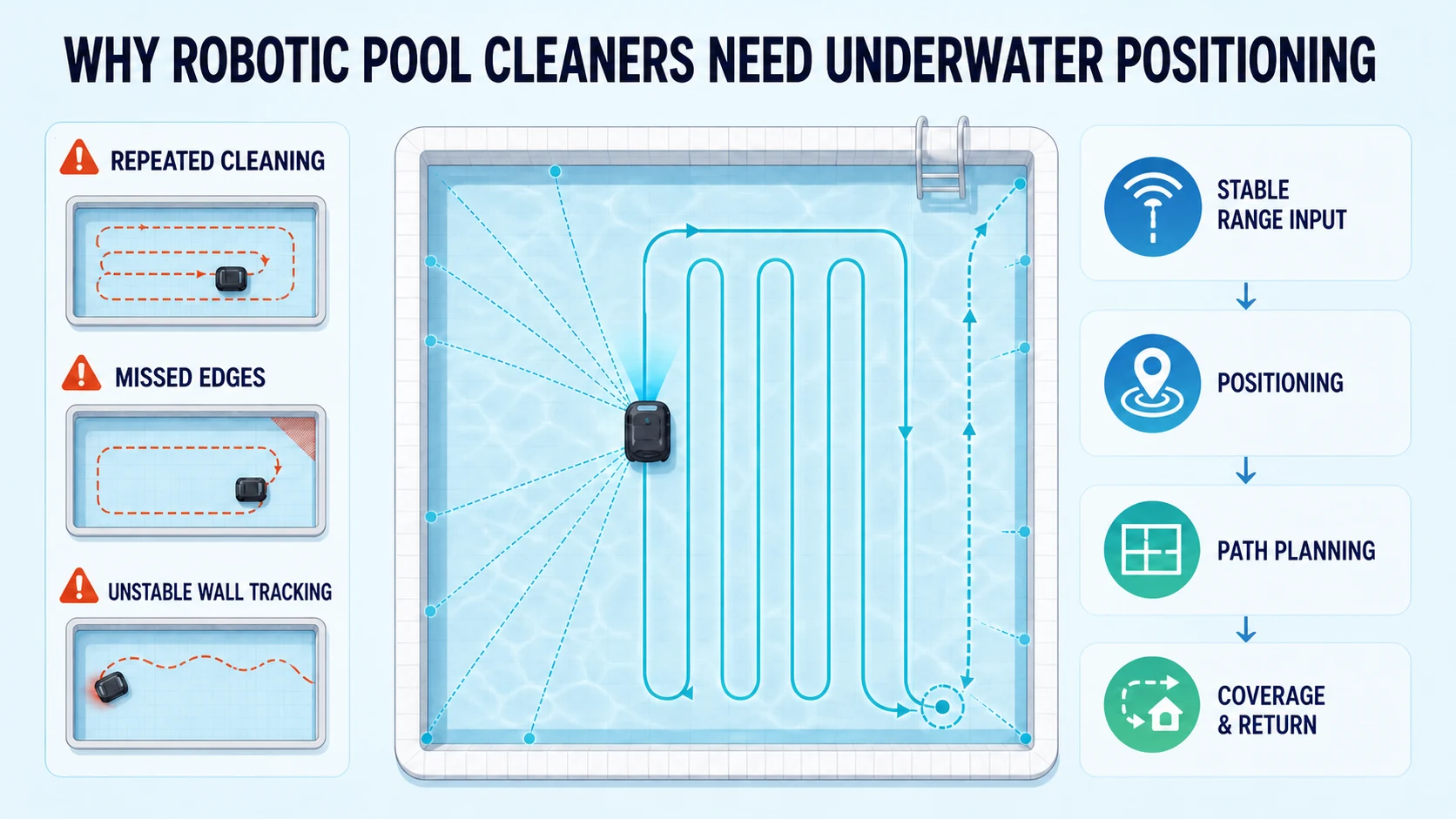
- Navigation ranges from simple sensor-driven movement to systematic paths, ultrasonic sensing, vision and user-visible maps; the word ‘mapping’ does not describe one standard capability.
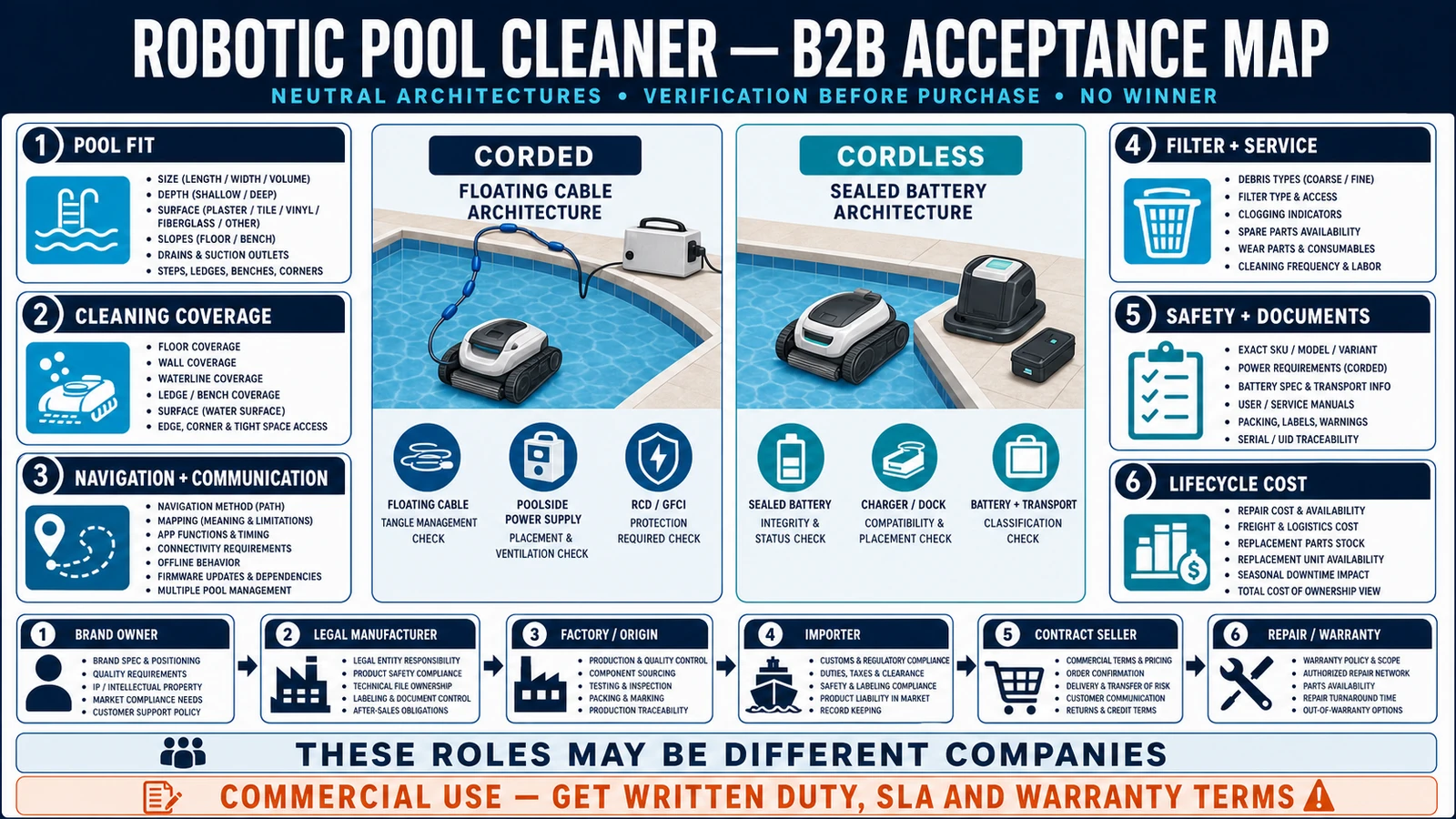
- Professional buyers should match the exact SKU to the pool, then verify power, filtration, wall and waterline coverage, communication, safety files, parts, importer, seller and written warranty.
In this article 12 sections
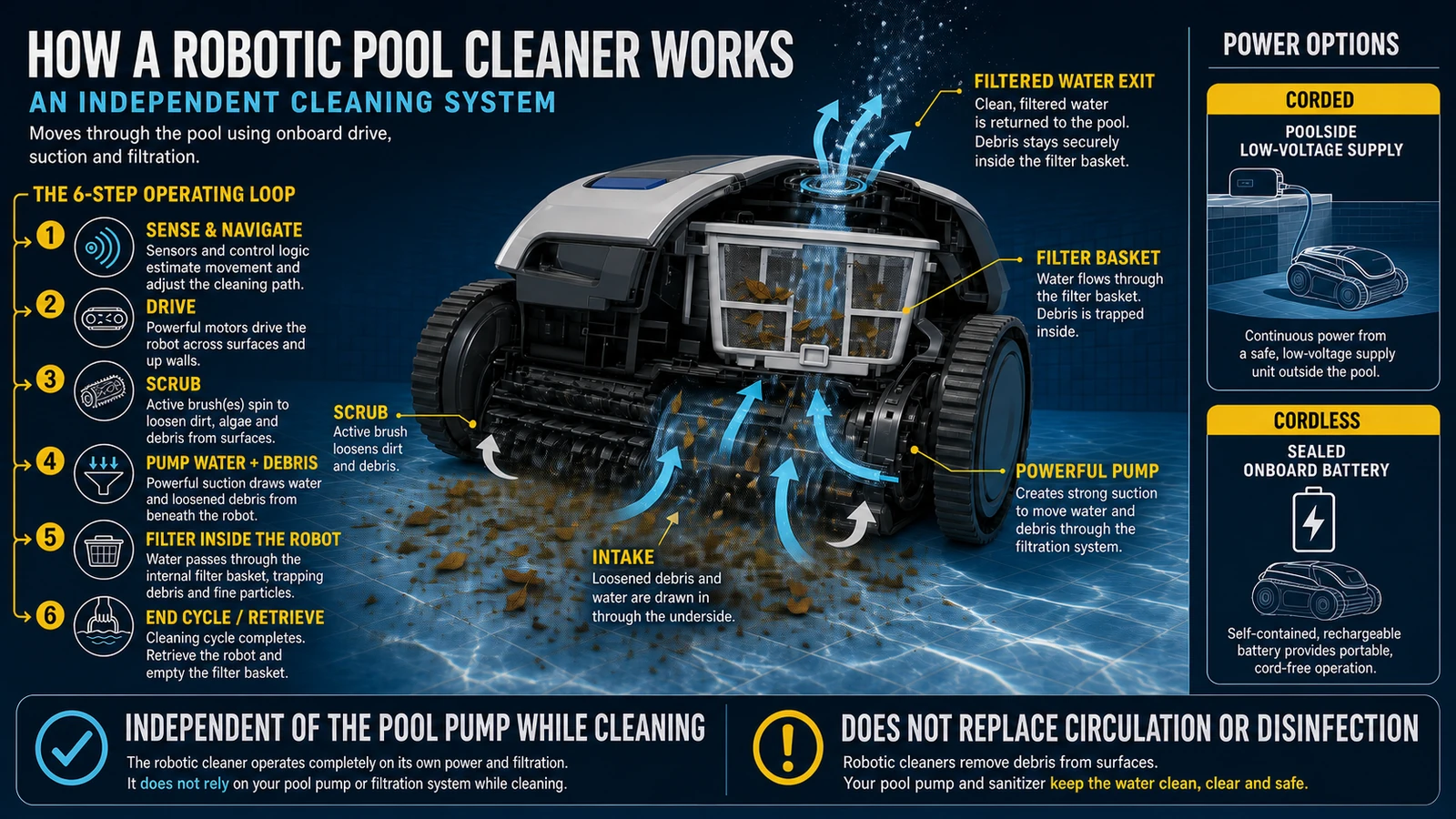
A robotic pool cleaner works as a self-contained underwater cleaning machine. Its drive system moves it across the pool, brushes loosen dirt, an internal pump pulls water and debris into a filter, and sensors or movement algorithms decide where it goes. It normally cleans without using the pool’s main circulation pump or filter.
That simple answer hides several different product architectures. A corded robot receives low-voltage power through a floating cable connected to a power supply outside the pool. A cordless robot carries a sealed rechargeable battery. Some machines follow basic sensor-driven patterns; others use ultrasonic sensors, cameras or several inputs together to build more systematic routes or display a pool map.
Floor cleaning is the baseline. Wall climbing, horizontal waterline scrubbing, step cleaning, surface skimming, automatic docking and live underwater control are model-level capabilities—not features that come automatically with the word “robotic.”
How a Robotic Pool Cleaner Works at a Glance
| System | What it does | What a buyer should verify |
|---|---|---|
| Drive and steering | Moves the robot with wheels, tracks, water flow or independently controlled drive components | Pool surface, slopes, curves, drains, corners and places where the robot can become stuck |
| Brushes | Loosen dirt and growth from the floor, walls or waterline | Brush material, active rotation, surface compatibility, wear and replacement cost |
| Internal pump | Pulls water and debris through the cleaner | Performance with leaves, sand, fine dust and a partly loaded filter—not only a headline flow claim |
| Filter basket, cartridge or bag | Keeps collected debris inside the robot | Coarse and fine media, clogging, bypass, cleaning labor and replacement availability |
| Navigation and control | Uses movement logic and available sensors to choose paths, turn and change cleaning phases | Whether the unit truly stores a map, merely optimizes a path, or repeats a programmed pattern |
| Power system | Supplies energy through a floating cable or onboard battery | Runtime, charging, cable management, RCD/GFCI instructions, battery service and destination-market configuration |
| Retrieval and service | Ends the cycle, parks or returns to an accessible position and allows the filter to be emptied | Wet weight, drain time, retrieval method, parts, repair route, freight and warranty |
The machine is therefore a compact cleaning system, not just a vacuum motor in a waterproof shell.
What Makes a Robotic Pool Cleaner Different from Suction and Pressure Cleaners?
The category name matters because several automatic devices can move around a pool.
- A suction-side cleaner connects to the pool’s suction plumbing and uses flow from the circulation pump. Debris travels toward the pool’s filtration system.
- A pressure-side cleaner uses pressurized return water, sometimes with a booster pump, to move and collect debris.
- A robotic pool cleaner carries its own electrical drive, pump and internal filter. It operates independently of the pool’s plumbing during its cleaning cycle.
Maytronics’ current robotic pool cleaner explanation describes this self-contained architecture and distinguishes it from suction- and pressure-driven equipment.
“Independent” has a limited meaning here. The robot may not need the pool pump to vacuum, but the pool still needs its normal circulation, filtration and water-treatment system. The cleaner does not become the facility’s only sanitation equipment.
What Happens During a Cleaning Cycle?
A typical cleaning cycle has six stages.
1. Setup and entry
The operator selects a mode, confirms that the filter is installed and places the robot in the water. A corded model is connected to its approved power supply. A cordless model must have sufficient battery charge.
Many machines need trapped air to escape before they settle. A deployment procedure that looks trivial can affect traction, pump priming and whether the cleaner starts correctly.
2. Movement and orientation
The drive system moves the robot across the floor. The controller uses time, motor behavior, orientation, contact events or sensor data to decide when to turn and when to change from floor cleaning to another phase.
Tracks can provide a large contact area. Wheels and guide rollers can improve turning or edge behavior. Neither design is a universal winner: surface material, floor-to-wall curvature, main drains and obstacles change the result.
3. Scrubbing
Active brushes or rollers loosen dirt before or while the pump draws water through the machine. Brush design should match the pool surface. A material that grips plaster may behave differently on smooth tile, vinyl or fiberglass.
The word “scrubbing” also needs a boundary. A robot may remove loose algae and film, but it is not proof that the machine will remove mineral scale, stains or every established growth condition without chemical and manual treatment.
4. Suction and filtration
An impeller or pump creates water flow through the cleaner. Leaves, grit and fine debris enter the robot and are retained in a basket, cartridge or bag.
Filter design matters as much as the pump. A coarse basket may accept leaves with less clogging. Fine media may capture smaller particles but add resistance and cleaning labor. Some systems combine layers or offer interchangeable media.
Cross-brand numbers are difficult to interpret without a shared test method. Pump flow, inlet geometry, brush action, filter loading and leakage around the media all affect the real result. A high gallons-per-hour figure or a small micron label does not, by itself, prove that one complete machine cleans better.
5. Wall and waterline phases
A wall-capable robot uses traction, brushing and water movement to remain against the surface as it climbs. A waterline-capable model reaches the top and moves laterally or repeats passes along the boundary between air and water.
This is where product descriptions are often compressed too aggressively. Four separate claims may be involved:
- reaches the wall;
- climbs the wall;
- scrubs the waterline;
- cleans steps, benches or shallow platforms.
One claim does not prove the next. Maytronics’ current guide likewise notes that wall, waterline and step coverage varies by model. Buyers should test each required surface rather than accept “full pool cleaning” as an acceptance criterion.
6. Cycle end, retrieval and cleaning
The robot stops after its programmed cycle. It may remain on the floor, park near an edge, climb for retrieval or return to a dock, depending on the design.
The operator then allows water to drain, removes the filter and rinses the collected debris. This handling is part of the product’s labor requirement. Wet weight, drain time, a difficult filter latch or a long walk to the charging area can matter more in daily use than an additional App mode.
How Do Robotic Pool Cleaners Navigate Underwater?
There is no single navigation system used by every pool robot.
Basic movement logic
Entry products can change direction after a contact event, elapsed time, detected wall or change in orientation. The route may look random even when the controller is applying repeatable rules.
This approach can be adequate for a small, simple floor if the cleaning cycle gives the machine enough opportunities to cross the area. It can also produce repeated passes and missed zones in a complex pool.
Systematic path planning
More advanced products combine orientation and motion data with obstacle or distance sensing to create line-like or optimized patterns. They may use gyroscope or inertial data, motor feedback, ultrasonic sensors and other inputs.
Beatbot’s current AquaSense 2 page, for example, lists ultrasonic sensing and a proprietary path-optimization system. These are manufacturer-described functions for that product—not an industry-wide definition of systematic navigation.
Mapping, vision and sensor fusion
Some current products go further. Beatbot’s AquaSense 2 Ultra describes camera, infrared and ultrasonic inputs and allows the user to view a pool map and floor path in the App. WYBOT’s S3 describes 3D mapping, real-time positioning, vision-guided cleaning and an external docking system.
These products show that user-visible mapping has entered the category. They do not make “AI mapping” a standardized specification.
A procurement team should ask:
- Is the map created once, recreated every cycle or continuously updated?
- Is it a visualization of the completed route or an input to future navigation?
- Can the operator select a mapped zone or direct the robot to a missed area?
- Is the map stored on the machine, phone, account or cloud service?
- What happens after a main-board replacement, factory reset or account transfer?
- Which functions continue without internet access?
The right question is not how many sensors are listed. It is what each sensor does during normal operation, what the robot does when confidence falls and whether service personnel can diagnose the failure.
Can an App Control a Pool Robot While It Is Underwater?
Sometimes—but the communication architecture must be checked.
A connected corded robot can use a poolside power supply or controller as part of the communication path. A cordless product may receive settings before deployment and synchronize after it returns to the surface. Other products use an additional device designed to bridge the underwater machine to the user.
Aiper’s current HydroComm is a useful example. Aiper describes selected HydroComm versions as water-monitoring and underwater-communication devices for named Scuba models, enabling functions such as status monitoring, mode changes and return-to-edge commands.
This means four claims should remain separate:
- the product has a mobile App;
- the product can be configured before a cycle;
- the product can report a map or history after a cycle;
- the product supports live commands while submerged.
An App logo does not prove all four. Buyers should also verify whether the communication accessory is included, optional, region-specific or compatible only with selected models.
Corded vs Cordless Robotic Pool Cleaners
The power architecture changes the whole operating model.
| Decision area | Corded robot | Cordless robot |
|---|---|---|
| Energy source | Poolside power supply and floating low-voltage cable | Sealed onboard rechargeable battery |
| Operating limit | Not constrained by onboard battery capacity, but still controlled by programmed cycles | Runtime varies with battery, mode, temperature, load and product condition |
| Routine handling | Deploy and manage the floating cable; store the cable and power supply | Retrieve, drain and recharge; some systems add a charging or self-emptying dock |
| Scheduling | Can support repeated or weekly schedules when the model and instructions allow | Scheduling depends on remaining charge and whether the system can return to and use a charger |
| Main service items | Cable, swivel, connector, power supply, pump, drive and seals | Battery pack, BMS, seals, charger or dock, pump and drive |
| Logistics | Electrical product requirements; usually no large onboard lithium battery | Lithium-battery testing, documentation, packaging and carrier rules also apply |
| Best starting point | Long cycles, frequent use or service structures already built around corded equipment | Cable-free handling, residential retail and pools that fit the rated battery cycle |
There is no defensible category-wide performance winner.
A corded architecture can support long or repeated cycles without stopping to recharge. A cordless architecture removes the floating cable but adds battery capacity, charging, sealing, transport and replacement questions. New docks and hybrid systems can reduce some of those differences, so the exact SKU matters more than the category label.
Professional buyers should compare the complete operating sequence: deploy, clean, retrieve, drain, empty, charge or store, diagnose and repair. “Cordless convenience” and “corded reliability” are hypotheses to test, not universal facts.
Does a Robotic Pool Cleaner Replace the Pool Filter or Chemicals?
No.
The robot’s internal filter collects the debris that passes through the machine during a cleaning cycle. The pool’s circulation system has a different job: moving and filtering water across the facility over time. Disinfection and pH control have another job again.
The U.S. CDC states that appropriate disinfectant levels and pH are the first defense against germs in residential pools and that public pool operators must maintain circulation, filtration and disinfection systems. See the CDC’s home pool treatment guidance and public pool operating guidance.
A robotic cleaner can remove leaves, sand and surface debris before they continue to load the pool system. It cannot, by itself, certify safe water, correct chemistry or replace the operating plan for a hotel, school, fitness center or public aquatic facility.
Why Residential and Commercial Pool Robots Are Not Interchangeable
A residential product is usually rated around a maximum pool length, cleaning mode and seasonal household duty. A commercial machine may need to clean a much larger pool, operate more frequently, record motor hours, support trained operators and return to service quickly.
Maytronics maintains a separate commercial WAVE range for facilities including hotels, resorts, fitness centers, water parks and large pools. That separate product system illustrates why a residential model should not be selected only because its advertised runtime appears sufficient.
Warranty is another boundary. Beatbot’s current limited warranty, for example, excludes commercial, industrial, rental and other non-household use unless Beatbot expressly authorizes it in writing.
A commercial buyer should obtain written answers for:
- permitted use and rated duty;
- pool dimensions and surfaces;
- cycles or motor hours;
- operator training;
- backup equipment;
- local parts and diagnostics;
- turnaround time and freight;
- service-level and warranty terms.
The product page is not the commercial contract.
What Safety and Compliance Documents Should Buyers Check?
Start with the exact model, market and power configuration.
Maytronics’ current corded instructions require precautions such as keeping the power supply the specified distance from the pool, using the required RCD or GFCI protection, removing the cleaner before swimmers enter and disconnecting power before inspection. Its cordless safety material adds battery-charging temperature, original-charger and damage checks. The exact instructions vary, so a generic reseller manual is not enough.
For cordless products, waterproof construction and battery safety must be treated as one system. Three official recalls illustrate the point without creating a brand-wide ranking:
- The U.S. CPSC’s 2025 Aiper Seagull Pro recall covers a specified model and identifies the named manufacturer and distributor.
- The CPSC’s 2026 WYBOTICS recall covers specified Osprey 700 Max and S1 units and identifies the manufacturer and U.S. importer.
- The UK product-safety authority’s Zodiac FreeRider notice explains how a manufacturing-process issue affected the watertightness of a battery enclosure in named batches.
These notices are model- and batch-specific. Their B2B lesson is to preserve serial traceability, charger identity, battery records, factory controls and a working corrective-action route.
Lithium-battery products also require transport diligence. The current IATA battery guidance explains the need for manufacturers and distributors to make the applicable UN 38.3 test summary available. Shipment rules still depend on battery configuration, state, carrier, transport mode and destination.
An IP rating, a certification logo or one laboratory report should never be treated as automatic authorization for every market. Buyers need the complete file applicable to the exact product and destination.
B2B Procurement and Acceptance Checklist
Pool and cleaning task
- Record pool type, dimensions, depth, shape, surface, floor-to-wall transition, drains, steps, ledges and waterline.
- Define the debris: leaves, sand, fine dust, hair, algae or mixed seasonal loads.
- Specify floor, wall, waterline, step, platform and surface-skimming requirements separately.
Product configuration
- Record the complete SKU, country version, plug, power supply or charger, battery watt-hours and included accessories.
- Confirm whether navigation creates a stored map, shows only a completed path or simply follows systematic movement rules.
- Confirm which App functions work before, during and after submersion and whether a communication accessory is required.
Test and acceptance
- Test the real pool with both light and heavy debris.
- Observe missed areas, repeated routes, drains, corners, slopes, wall transitions and retrieval.
- Repeat the test with a partly loaded filter and, for cordless products, at realistic battery levels.
- Measure operator time for deployment, draining, filter cleaning, cable storage or charging.
Safety, logistics and conformity
- Obtain the applicable electrical, charger, battery, radio, EMC, waterproofing, labeling, manual and transport documents.
- For battery products, verify the battery identity and UN 38.3 test summary against the shipped configuration.
- Confirm recall screening and serial-number traceability before distribution.
Responsible parties and lifecycle support
- Identify the brand owner, legal manufacturer, physical factory or origin, importer, contract seller, repair provider and warrantor.
- Verify authorized territory, commercial-use permission and proof-of-purchase rules.
- Price batteries, power supplies, cables, seals, pumps, drive parts, brushes, tracks and filters.
- Include return freight, replacement stock, seasonal downtime and out-of-warranty repair in total cost.
For manufacturers and sourcing routes, see Robotic Pool Cleaner Manufacturers in China. The company structures behind major platforms are mapped separately in World Clean Biz’s guides to Dolphin and Maytronics, Aiper and Fluidra, Beatbot and Xingmai and WYBOTICS.
Frequently Asked Questions
How does a robotic pool cleaner work?
It uses its own drive, brushes, internal water pump, filter and control system. The robot moves through the pool, loosens dirt, draws debris into its filter and follows a programmed or sensor-guided cleaning path.
Does a robotic pool cleaner use the pool pump?
Normally no. A true robotic cleaner has its own electrical power, pump and internal filter. Suction-side and pressure-side cleaners use the pool’s hydraulic system and belong to different automatic-cleaner categories.
Do robotic pool cleaners map the pool?
Some do, but not all. Products range from basic movement rules to systematic paths, ultrasonic sensing, vision and user-visible maps. Buyers should verify what “mapping” means for the exact model.
Can robotic pool cleaners climb walls and clean the waterline?
Selected models can. Floor cleaning, wall climbing, waterline scrubbing and step or platform cleaning are separate capabilities. Confirm each one for the exact pool surface and geometry.
Is a corded or cordless robotic pool cleaner better?
Neither is universally better. Corded robots avoid onboard battery limits but require cable and poolside-power management. Cordless robots remove the floating cable but require charging, battery care, sealing and battery-transport support.
Can I swim while a robotic pool cleaner is running?
Follow the exact product manual. Current Maytronics safety instructions require the cleaner to be removed before people enter the pool. A distributor should never replace the manufacturer’s safety instructions with a generic assumption.
Can I leave a robotic pool cleaner in the pool?
Only as allowed by the exact product instructions and operating plan. Continuous exposure to chemicals, water and sunlight can affect components, and filters still need cleaning. Cordless products also need an approved charging routine.
Does a robotic pool cleaner replace pool filtration or chlorine?
No. It collects debris during its own cycle. The pool still needs its required circulation, filtration, disinfection, testing and chemical-management systems.
Do robotic pool cleaners need Wi-Fi?
Basic cleaning may not require Wi-Fi, while setup, App control, maps, history, updates or remote functions may. Check what continues offline and whether live underwater control requires another device.
Can a residential pool robot be used in a hotel or public pool?
Do not assume so. Commercial duty, permitted use, warranty, local codes and service requirements must be confirmed in writing. Some residential warranties expressly exclude commercial use.
Final Takeaway
A robotic pool cleaner turns movement, scrubbing, suction and filtration into one self-contained underwater cycle. The visible machine is only one part of the purchase. Power, navigation, communication, filter media, retrieval, parts, software and the responsibility chain determine whether it works as a supported system.
For a homeowner, that framework helps match a robot to the pool. For a distributor, importer or facility operator, it becomes the acceptance plan: verify the exact SKU, the exact pool, the exact market and the companies responsible after the sale.