- There is no universal unit cost: corded versus cordless, cleaning zones, navigation, filtration and charging architecture change both BOM and non-recurring engineering.
- Separate recurring ex-factory cost from tooling, engineering, testing, certification and software; then amortize only against a realistic sellable volume.
- Build landed cost from quoted inputs and validate it after pilot production, because yield, warranty, battery freight and design changes can move the business case.
In this article 18 sections
A robotic pool cleaner does not have one “manufacturing cost.” A floor-only corded platform, a cordless wall-climber and an AI model with surface cleaning and a charging station are different cost architectures. The useful answer is a model: recurring unit cost + amortized non-recurring cost + logistics + duty/fees + quality and warranty risk.
No authoritative public database provides a universal BOM or factory price. Supplier quotations, tooling offers, laboratory plans and pilot yield are the inputs that turn this framework into a budget.
Define the Cost Boundary
Buyers often compare numbers that describe different stages.
| Cost term | What it should include |
|---|---|
| Direct material | Purchased parts and subassemblies in one finished unit |
| Conversion cost | Assembly labor, machine time, utilities, test and factory overhead |
| Ex-factory | Material, conversion, normal scrap, packaging and factory margin |
| FOB | Ex-factory plus agreed origin handling to the named port |
| Landed warehouse | Product, international freight, insurance, duty, fees, brokerage and inbound delivery |
| Fully burdened | Landed cost plus amortized development, warranty reserve, finance, inventory and local operations |
Write the Incoterm, currency, quantity, tax treatment and packaging configuration beside every number. “$300 per unit” is meaningless without them.
Start with the Product Architecture
Cost follows the specification.
Corded floor cleaner
The simplest architecture may use a low-voltage external power supply, floating cable, pump motor, drive motors, brushes, filter and basic control.
It avoids a traction battery and charger but adds:
- power-supply and isolation requirements;
- long buoyant cable;
- swivel or anti-tangle design;
- cable strain relief;
- storage caddy;
- continuous underwater electrical operation.
Cordless floor, wall and waterline cleaner
Cordless adds:
- lithium-ion cells;
- battery pack structure;
- BMS and protection;
- charging interface or dock;
- waterproof port or inductive system;
- runtime estimation;
- UN38.3 and dangerous-goods logistics;
- battery aging and replacement risk.
Wall and waterline cleaning also require traction, buoyancy control, sufficient pump thrust, brush contact and robust navigation.
Premium all-area platform
Surface cleaning, shallow ledges, camera mapping, app control, clarification or an automatic service station can add side thrusters, sensors, wireless modules, larger batteries, additional seals, docking hardware, pumps and software.
Specify the required zones first:
- floor;
- walls;
- waterline;
- shallow platforms;
- water surface;
- steps;
- water clarification.
Each additional zone should have a validation method and a cost owner.
Build the BOM
A useful bill of materials has part number, description, revision, quantity, supplier, unit price, tooling owner, lead time, MOQ, country of origin, compliance status and alternate source.
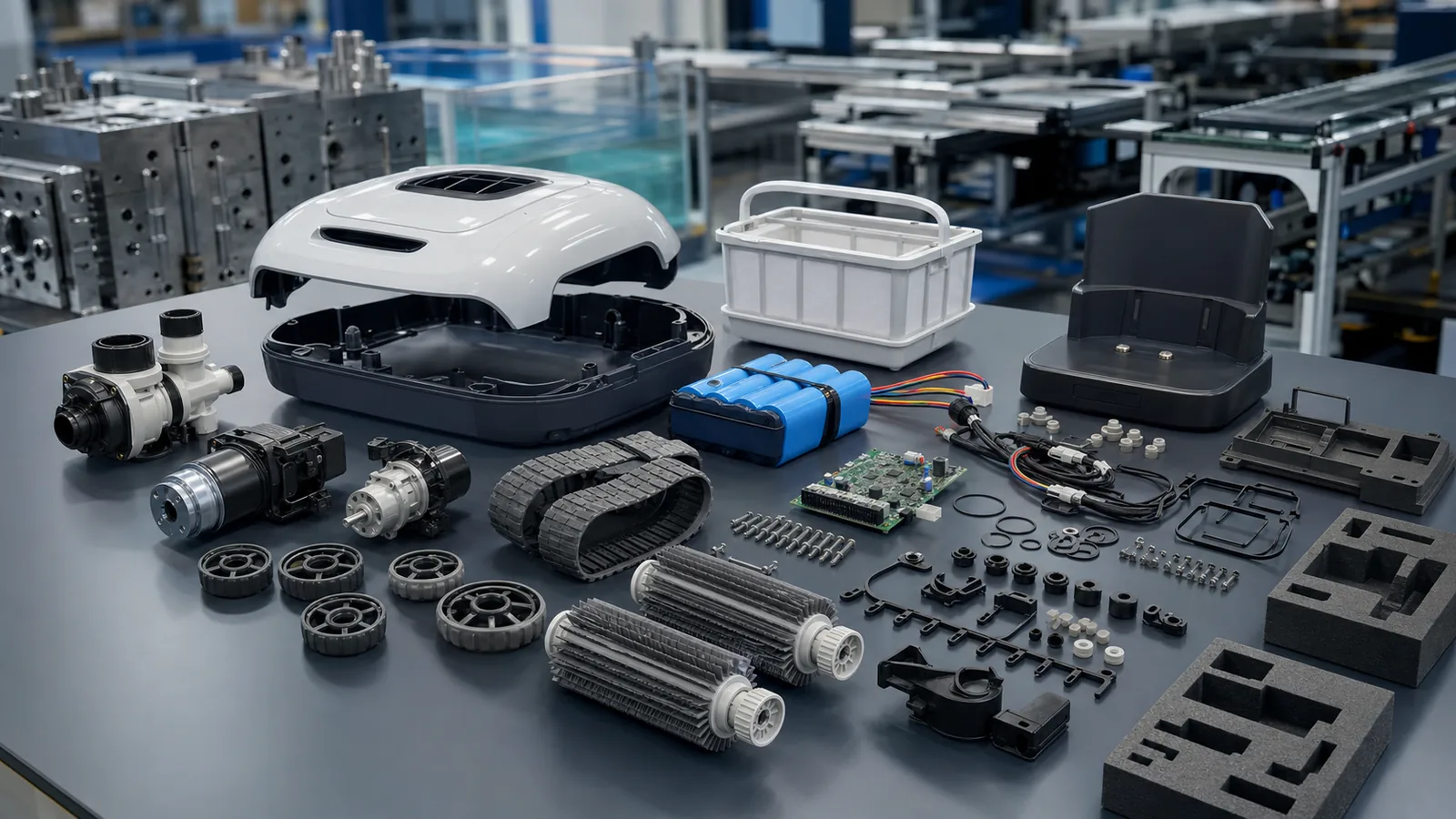
Major groups include:
| BOM group | Typical contents | Cost risk |
|---|---|---|
| Hydraulic | pump motor, impeller, volute, inlet, flow channels | performance, noise, efficiency, clogging |
| Drive | motors, gears, shafts, bearings, tracks/wheels | climbing, wear, sealing, torque |
| Cleaning | roller brushes, side brushes, intake lips | consumable life, hair, debris size |
| Filtration | basket, screens, fine media, anti-spill flap | mesh accuracy, pressure drop, cleaning |
| Power | cells, BMS, pack, charger, power supply, dock | safety, cycle life, transport, supply |
| Electronics | main PCB, motor drivers, connectors, antennas | heat, water ingress, firmware |
| Sensors | IMU, ultrasonic, infrared, pressure, camera | calibration, false detection, software |
| Structure | top shell, chassis, handles, covers | tooling, UV, chemical resistance |
| Sealing | gaskets, O-rings, potting, adhesives | leak risk, assembly control, service |
| Packaging | carton, molded pulp/foam, bags, manuals | battery marks, drop damage, volume |
Track the BOM at landed-to-factory cost, not just supplier piece price. Include incoming freight, inspection, scrap and currency where relevant.
Motors, Pump and Hydraulic Cost
Robotic pool cleaners commonly combine one or more drive motors with a pump motor. Premium designs may add surface or side propulsion.
The pump system must balance:
- flow through a clean and partially loaded filter;
- suction opening area;
- debris size;
- wall adhesion;
- energy consumption;
- noise;
- motor temperature;
- shaft and enclosure sealing.
A higher advertised flow does not automatically require a proportionally more expensive motor. Impeller, duct and filter design matter. Ask suppliers for efficiency and operating curves, not only a maximum number.
For costing, separate:
- motor;
- gearbox;
- impeller and molded volute;
- bearings and shaft;
- seals;
- driver electronics;
- mounting and acoustic parts;
- end-of-line current and flow test.
A motor price reduction that increases leak or warranty risk is not a saving.
Battery, BMS and Charging
For a cordless model, define:
- cell chemistry and format;
- series/parallel configuration;
- nominal voltage and watt-hours;
- cell manufacturer and grade;
- pack enclosure;
- BMS protections;
- temperature sensing;
- fuse and disconnect;
- charging power;
- target runtime and charge time;
- cycle-life target;
- off-season storage;
- field replacement method.
The battery cost is not only cells:
`battery system = cells + interconnect + BMS + enclosure + seals + charger/dock + tests + transport + warranty reserve`
Inductive or contactless charging can improve the user interface but adds coils, alignment, thermal design, control and dock tooling. A sealed plug can cost less but needs reliable cap, corrosion protection and insertion-cycle testing.
UN Manual of Tests and Criteria subsection 38.3 applies to lithium battery types used for transport, and a test summary must be available. Shipping a battery contained in equipment commonly uses UN3481 rules, subject to the actual pack and route. Quote air and ocean logistics separately.
PCB, Wireless and Software
The main board may include:
- microcontroller;
- motor drivers;
- power conversion;
- current sensing;
- memory;
- Wi-Fi/Bluetooth module;
- antenna;
- IMU;
- leak or pressure sensing;
- charging communication;
- diagnostic interface.
PCB assembly price is only part of the electronics budget. Add firmware, app, cloud, device provisioning, cybersecurity work, OTA infrastructure, map storage, factory calibration and long-term maintenance.
A pre-certified wireless module can reduce radio-development risk, but the final host product still needs the correct authorization and integration evidence for its market. In the United States, radio-frequency devices must satisfy FCC equipment-authorization rules before import or marketing.
Estimate annual software cost separately from unit BOM:
`annual platform cost / expected active devices = software burden per active device`
This burden rises when volume is low or support continues after sales decline.
Plastics, Seals and Tooling
Pool robots use more tooling than the visible top shell suggests.
Potential molded parts include:
- upper and lower housings;
- chassis and motor covers;
- filter basket and lid;
- impeller and volute;
- tracks, wheels and guides;
- roller cores and brush carriers;
- handle and latches;
- dock housing;
- transparent windows;
- cable parts;
- gasket and seal molds.
For each tool, record cavities, steel, expected life, cycle time, texture, color, dimensional controls, ownership, storage, maintenance and modification rights.
Tooling cost also includes:
- design for manufacture;
- mold-flow review;
- soft tools or rapid prototypes;
- fixtures;
- leak-test tooling;
- electrical test jigs;
- calibration equipment;
- gauges;
- golden samples.
Never divide tooling by a marketing forecast without a downside case.
`tooling amortization per sellable unit = total recoverable tooling / realistic lifetime sellable volume`
If a $300,000 hypothetical tool-and-fixture package is amortized over 30,000 sellable units, it adds $10 per unit. At 5,000 units, it adds $60. These are teaching inputs, not a market quotation.
Sensors and Navigation
Navigation ranges from timed/random movement to IMU paths, ultrasonic avoidance, pressure sensing, infrared, vision and multi-sensor mapping.
The hardware cost of a sensor may be small relative to:
- waterproof window;
- mounting tolerance;
- calibration;
- signal processing;
- pool data collection;
- algorithm development;
- corner cases;
- firmware regression;
- technical support.
Define measurable acceptance:
- coverage on representative pool shapes;
- obstacle avoidance;
- drain and ladder behavior;
- slope transition;
- wall and waterline time;
- recovery from losing traction;
- performance with cloudy water or reflections;
- map and app behavior without connectivity.
Do not add an AI camera to the BOM without funding the data and software lifecycle.
Assembly and Yield
Conversion cost should be based on the process.
Map each station:
- motor and drive subassembly;
- PCB and wiring;
- battery or power interface;
- seals and enclosure;
- brush and track installation;
- firmware and provisioning;
- leak or pressure test;
- functional water test;
- charging test;
- final inspection and packing.
Use:
`conversion cost = labor minutes × loaded labor rate + machine/test time + factory overhead`
First-pass yield matters:
`effective cost per good unit = total production cost / sellable units`
If 1,000 units cost $300,000 to build and only 950 are immediately sellable, the simple effective cost is $315.79 before recovery of reworked or scrapped material. This is an illustrative calculation.
Track defect pareto by station. Water leaks, charging failures and motor-current variation can create expensive rework because the unit must be reopened, resealed and retested.
Reliability and Validation
A low-volume engineering sample is not a production validation.
A plan may include:
- dimensional and material verification;
- waterproof/leak/pressure testing;
- electrical insulation and temperature;
- motor stall and overload;
- filter loading and flow;
- wall, slope, waterline and platform coverage;
- chlorine, salt and chemical exposure;
- UV and weather exposure;
- brush, track and latch endurance;
- battery cycle and storage;
- charger fault tests;
- firmware interruption and recovery;
- drop, vibration and packaging;
- field trials in different pools.
Define sample size, condition, pass/fail and responsible engineer. Failures should update design, process controls and the financial risk model.
Certification and Market Access
Certification cost depends on architecture and destination.
For the United States, determine applicable electrical-safety standards with a qualified NRTL and verify radio authorization for wireless functions. The mark, report and listing must cover the actual model, critical components and production site.
For the European Union, map all applicable legislation before testing. That may include radio, electrical safety, electromagnetic compatibility, RoHS, batteries, WEEE and general product safety obligations. CE marking is the manufacturer’s declaration that all applicable requirements are met; it is not a generic certificate bought from a laboratory.
Budget:
- pre-compliance testing;
- final laboratory testing;
- samples and destructive units;
- technical file and risk assessment;
- local-language manual and labels;
- factory inspection or surveillance;
- retest after design changes;
- responsible-person and registration costs;
- annual or per-model renewal where applicable.
Ask the laboratory for a written scope based on the final specification. Do not budget compliance from a competitor’s logo photo.
Packaging and Logistics
Packaging has safety, damage and freight functions.
Include:
- retail/master carton;
- molded protection;
- moisture and accessory bags;
- battery marks and labels;
- manuals;
- pallet pattern;
- container utilization;
- replacement-unit packaging;
- drop and vibration validation.
Landed cost:
`FOB value + international freight + insurance + duty + customs fees + brokerage + port/terminal + drayage + warehouse receiving`
For U.S. customs, CBP generally bases transaction value on the price actually paid or payable plus specified additions such as assists, packing and certain royalties. International freight and insurance are generally excluded from that customs value. Classification, duty and additional tariffs must be confirmed for the actual SKU, origin and date.
Do not copy a competitor’s tariff code. Give the broker product function, motors, battery, wireless features, power supply, materials and literature, and request a documented classification view.
Volumetric freight can make an oversized dock or caddy expensive even when its BOM is low.
MOQ, Purchasing and Price Breaks
There are several minimums:
- factory finished-goods MOQ;
- color MOQ;
- carton-print MOQ;
- cell and motor MOQ;
- wireless-module order;
- custom-tool economic batch;
- ocean shipment minimum;
- spare-part MOQ.
A low assembly MOQ does not guarantee low component MOQ.
Compare price breaks by working capital:
`price-break saving = unit reduction × units`
`inventory cost = capital + storage + insurance + aging + markdown + obsolescence`
Buying 5,000 units to save $5 each creates $25,000 gross purchase savings. It is a poor decision if excess seasonal inventory creates more than $25,000 in finance and markdown cost.
Warranty Reserve
Use:
`expected warranty cost per shipped unit = claim probability × average approved claim cost`
Average claim cost includes:
- diagnosis;
- part or replacement unit;
- inbound/outbound freight;
- labor;
- customer support;
- disposal;
- tax/duty effects;
- no-fault-found handling.
Early in development, use scenarios rather than pretending to know the field rate.
| Scenario input | Low | Base | High |
|---|---|---|---|
| Claim rate | buyer assumption | buyer assumption | buyer assumption |
| Average claim cost | quoted process | quoted process | quoted process |
| Reserve/unit | rate × cost | rate × cost | rate × cost |
Replace assumptions after pilot and every quarter. Separate technical failures from fit returns and transport damage.
ODM Platform vs Custom Development
An existing ODM platform can reduce tooling, engineering and certification time. It may constrain:
- industrial design;
- pump and battery;
- app ownership;
- sensor stack;
- accessories;
- exclusivity;
- component change control;
- margin;
- successor timing.
Custom development offers more differentiation and higher non-recurring engineering, validation and schedule risk.
Intermediate options include:
- color/logo/package change;
- accessory bundle;
- filter or brush variant;
- battery/runtime variant;
- localized app and manual;
- new upper housing on common chassis;
- new electronics on proven hydraulic platform.
Price each change in three columns: unit cost, NRE/tooling and validation/certification impact.
Illustrative Cost Model
The following fictional scenario demonstrates the mechanics for a mid-level cordless wall-climbing robot. It is not a supplier quote or market average.
| Cost block | Hypothetical input |
|---|---|
| Motors, pump and drive | $92 |
| Battery, BMS and charging | $78 |
| PCB, sensors and wiring | $43 |
| Plastics, tracks, brushes, filter and seals | $69 |
| Assembly, test and normal loss | $34 |
| Packaging and accessories | $22 |
| Factory margin/other quoted items | $30 |
| Hypothetical FOB | $368 |
| Freight, insurance, duty/fees and inbound | $52 |
| Hypothetical landed warehouse cost | $420 |
If project NRE/tooling is a fictional $240,000 and realistic lifetime sellable volume is 20,000 units, amortization adds $12 per unit. If warranty reserve is $18 and local quality/handling adds $7:
`fully burdened planning cost = 420 + 12 + 18 + 7 = $457`
Change the volume to 6,000 units and amortization becomes $40. The planning cost becomes $485 before finance and sales costs.
The lesson is not that a robot costs $457. It is that volume, architecture, warranty and logistics can move the result more than a supplier’s headline discount.
RFQ Checklist
Send one controlled specification and request:
- product architecture and cleaning zones;
- pool size, depth, surface and salt limits;
- corded/cordless details;
- motor, pump and flow specifications;
- cell, battery, BMS, charger and watt-hours;
- runtime and charge test conditions;
- filter density and capacity;
- sensors and navigation;
- App, cloud and OTA scope;
- IP/leak design and tests;
- detailed BOM or cost breakdown where commercially available;
- unit price by quantity and Incoterm;
- tooling/NRE by item and ownership;
- validation and certification plan;
- packaging size, weight and pallet load;
- UN38.3 summary and battery transport details;
- sample, pilot and mass-production lead times;
- first-pass yield and outgoing quality plan;
- warranty process and spare-part pricing;
- component-change notice;
- software and parts-support period.
Ask suppliers to state exclusions. A low quote often omits certification, app customization, molds, chargers, packaging, spares or warranty freight.
For the full development sequence, read our robotic pool cleaner OEM and ODM guide. Build a longlist with robotic pool cleaner manufacturers in China. Before choosing architecture, compare cordless vs corded robotic pool cleaners.
FAQ
How much does a robotic pool cleaner cost to manufacture?
There is no defensible universal number. Build a quote-based model for the exact cleaning zones, power architecture, battery, sensors, filtration, charging, volume and market-access requirements.
What is usually the largest BOM cost?
It varies. Motors/hydraulics, battery/charging, molded structures and electronics can each dominate depending on architecture. Use a supplier BOM and sensitivity analysis.
Should tooling be included in the unit price?
Keep it visible as non-recurring cost, then show amortization at realistic sellable volumes. Confirm ownership, maintenance, modification and end-of-project rights.
Does a cordless model always cost more?
It adds battery, BMS, charging and transport obligations. A corded model avoids those but needs a power supply, floating cable and cable-management design.
How should certification be budgeted?
Ask a qualified laboratory for a written plan against the final architecture and target markets. Include pre-tests, samples, documentation, inspections and retests.
What is the most common costing mistake?
Comparing an ex-factory quote with a landed or fully burdened competitor number. Fix the boundary, Incoterm, volume and exclusions before comparing.