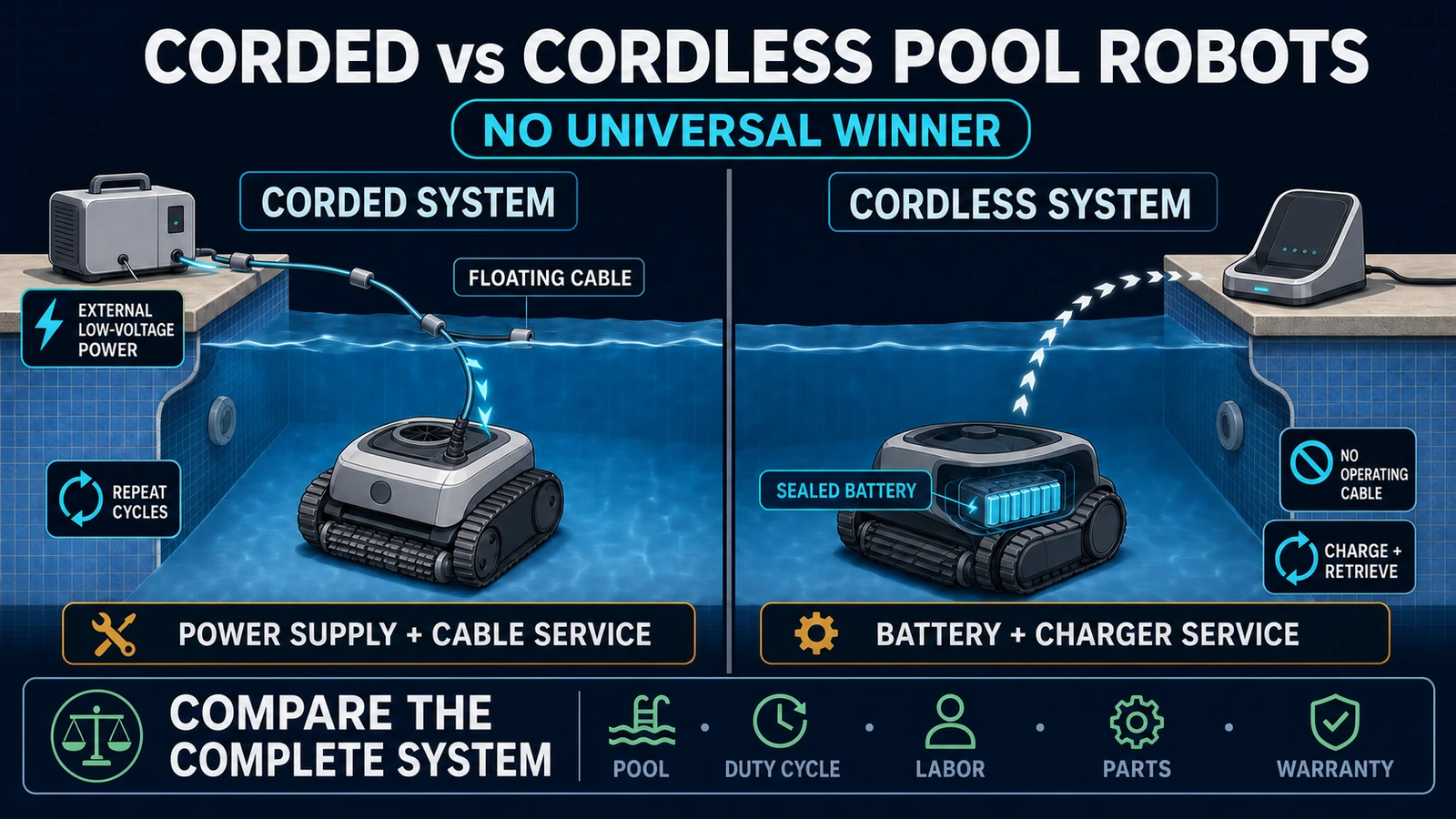
- Neither cordless nor corded robotic pool cleaners are universally better: the right architecture depends on the exact pool, operating schedule, handling workflow and service network.
- Cordless removes the operating cable but adds a sealed battery, charging, retrieval and lithium-battery logistics; corded removes the onboard battery limit but adds a floating cable and poolside power system.
- Professional buyers should compare complete missions, labor, parts, warranty and responsibility—not isolated runtime, flow-rate or convenience claims.
In this article 8 sections
Choose a cordless robotic pool cleaner when avoiding the floating cable is a priority and charging fits your routine. Choose a corded model when repeated cleaning cycles matter more and the pool has a suitable power and cable layout. Neither power system guarantees better cleaning: compare the exact models in the pool they will serve.
Picture two owners with similar pools. One puts the robot in after work, empties the filter when it finishes and stores it until the next clean. The other wants a machine ready for scheduled cycles between visits. A cordless cleaner may simplify the first routine. A corded model with a suitable timer may fit the second better.
The difference becomes clearer after the first clean. Who retrieves the robot? Where does it charge or store its cable? When will it be ready again? Those questions turn a cable-versus-battery comparison into a useful buying decision.
Cordless vs Corded Robotic Pool Cleaners at a Glance
| What matters to you | Corded robot | Cordless robot |
|---|---|---|
| Getting started | Arrange the floating cable and poolside power supply | Start with a charged battery; no operating cable in the pool |
| Cleaning performance | Depends on brushes, filter, navigation and the exact model | Depends on the same factors, with a battery energy limit |
| Another cleaning cycle | External power avoids a charging wait; cycle and duty limits still apply | Depends on remaining charge, cleaning mode and recharge arrangements |
| Work after cleaning | Empty the filter, inspect and store the system as instructed | Empty the filter, retrieve and prepare for charging as instructed |
| Repairs to plan for | Cable, connectors and power supply, plus normal robot parts | Battery, charger and seals, plus normal robot parts |
| Strong starting point | Repeated cycles with a workable power and cable layout | Cable-free handling with a manageable charging routine |
Both types carry their own cleaning equipment. A typical corded robot receives low-voltage power through a floating cable; a cordless robot carries a rechargeable battery. Neither needs to use the pool's circulation pump to collect debris. Maytronics explains these basic configurations in its robotic pool cleaner guide.
For the underlying pumps, brushes and filters, see How Do Robotic Pool Cleaners Work?.
Does Removing the Cable Actually Save Work?
The appeal is easy to understand. With a cordless robot, there is no floating lead to lay out, route around the pool or coil after use. For someone who already removes and stores the cleaner after each session, that can remove a frustrating part of the routine.
The battery introduces another task. Depending on the model, the owner must retrieve the robot, let it drain, prepare the charging interface as instructed, charge it and put it back. Parking, recall and automatic charging features can change that sequence, so the demonstration should include the end of the cycle.
A corded system also needs handling. The power supply needs an appropriate position, the cable must reach the work area, and the robot still needs filter cleaning and inspection. Its practical advantage is being able to draw external power for the next supported cycle.
Maytronics' weekly-timer instructions show how selected Dolphin models support scheduled cleaning while their power supply remains switched on. Availability and maintenance instructions depend on the model.
Before buying, ask the dealer to demonstrate one complete routine: setup, cleaning, retrieval, filter care and readiness for the next run. The handling at both ends is part of what you are paying to simplify.
Does a Power Cable Mean Better Cleaning?
A cable gives the designer access to external energy. A battery gives the designer a finite energy budget. Those constraints matter, but the cleaning result still depends on how the whole machine uses its power.
Consider a pool that collects both leaves and fine sand. A robot may lift the leaves yet let finer debris through its filter. Another may collect the sand but struggle to reach a shallow ledge. A longer runtime will not necessarily resolve either problem.
The useful comparison is whether the selected models clean the required surfaces and collect the debris found in that pool. Check floor, wall and waterline coverage separately, then look at steps, benches, slopes and transitions. A specification saying “wall climbing” does not establish that the machine will clean every feature.
A concrete example: Dolphin Explorer E50 and LIBERTY 600
Maytronics sells both power systems. Its U.S. specifications for the corded Dolphin Explorer E50 and cordless Dolphin LIBERTY 600, checked on September 6, 2026, illustrate how similar cleaning coverage can sit behind different operating routines.
| Published specification | Explorer E50 | LIBERTY 600 |
|---|---|---|
| Power system | Floating cable and external power supply | Rechargeable onboard battery |
| Listed maximum pool length | 50 ft | 50 ft |
| Listed cleaning coverage | Floor, walls and waterline | Floor, walls and waterline |
| Default cycle | 2 hours | 3 hours |
| Additional cycle information | Listed durations of 1.5, 2 and 2.5 hours; weekly timer | Advertised operation of up to 4.5 hours |
Both are listed for the same maximum pool length and surface categories. That establishes that cordless can offer wall and waterline cleaning too. The different cycle times do not establish which machine cleans faster or more thoroughly: the programs and energy budgets differ.
World Clean Biz has not conducted a matched performance test of these models. Compare complete cycles under similar conditions, including filter condition, cleaning mode and debris load. Treat flow rate, filtration size and maximum runtime as separate specifications unless the manufacturers use comparable test methods.
Why Maximum Runtime Can Mislead a Buyer
A cordless robot advertised with a long runtime may achieve it in an economy or floor-only mode. The floor-wall-waterline program you plan to use may have a different energy requirement. Battery condition, temperature and workload also affect the margin available.
The first question is whether one charge completes your pool in the required mode. The next is whether the robot will be ready when you need it again.
The LIBERTY 600 example makes the distinction visible: the product page lists a three-hour default cycle alongside an “up to 4.5 hours” runtime claim. Use the default program and the mode you intend to run when planning cleaning. The larger number alone cannot tell you how many complete pool cleans one charge will deliver.
For an owner cleaning one pool between swims, recharging between sessions may be easy. For a contractor working through several properties, each retrieval, filter clean and charging wait affects the day's schedule. A spare charged robot may help, but it belongs in the cost comparison.
Corded machines have limits too. They follow programmed cycles, their filters fill, and their manuals define intended use and care. External power does not make an ordinary residential robot suitable for unlimited operation.
Compare the number of completed, satisfactory cleans your routine permits. That tells you more than the longest cycle printed on the box.
What Happens When the Battery or Cable Needs Replacing?
The first season is only part of the purchase. Eventually a worn cable, failed charger or battery problem may interrupt cleaning during the period when the pool is used most.
With a corded robot, ask whether the cable, connectors and power supply are available separately for the exact model. A locally stocked replacement can help only if it is compatible and the required repair can be performed correctly.
With a cordless robot, ask who can replace the battery, what the repair costs and how the sealed enclosure is checked afterward. A replaceable battery is useful only if a replacement pack and a qualified repair route are available. Internal battery or wet-side repairs should follow the manufacturer's authorized service procedure.
Warranty coverage also has boundaries. Beatbot's warranty policy, for example, distinguishes covered components from consumables and describes service-center handling. Buyers need the policy applicable to their model, country and seller.
Ask for a realistic repair example before ordering: which part, which service center, who pays shipping and how long the pool could be without its cleaner? Our guide to robotic pool cleaner lifespan covers the wider maintenance question.
Which Choice Makes Sense for Your Pool?
A home pool with a simple cleaning routine
Start with cordless if cable handling is the main inconvenience and you can comfortably retrieve, drain and charge the robot. Confirm that its normal cleaning mode finishes the pool and that its retrieval method suits the pool edge and the person lifting it.
Start with corded if you prefer externally powered repeat cycles and can accommodate the cable and power supply. Check scheduling on the exact model and follow its rules for removal, storage and filter care.
A large pool or a demanding cleaning schedule
Give runtime margin and readiness between cycles more weight. Corded is a sensible starting point where external power supports the schedule. A cordless model can also qualify if its demonstrated coverage, recharge arrangements and handling fit the workload.
Large dimensions alone do not decide the answer. Pool shape, surface, debris and required cleaning frequency all affect the job.
A hotel, school or service business
Confirm commercial-use authorization before comparing convenience. A premium residential product may have appealing features while its warranty excludes the intended application.
Maytronics has a dedicated WAVE commercial range. Beatbot's standard warranty excludes commercial and other non-household uses unless expressly authorized. These examples illustrate why a facility buyer needs the exact product's written use and support terms.
Request the expected daily duty, local repair turnaround and a plan for downtime. Power architecture alone cannot establish commercial suitability.
Five Questions to Ask Before You Buy
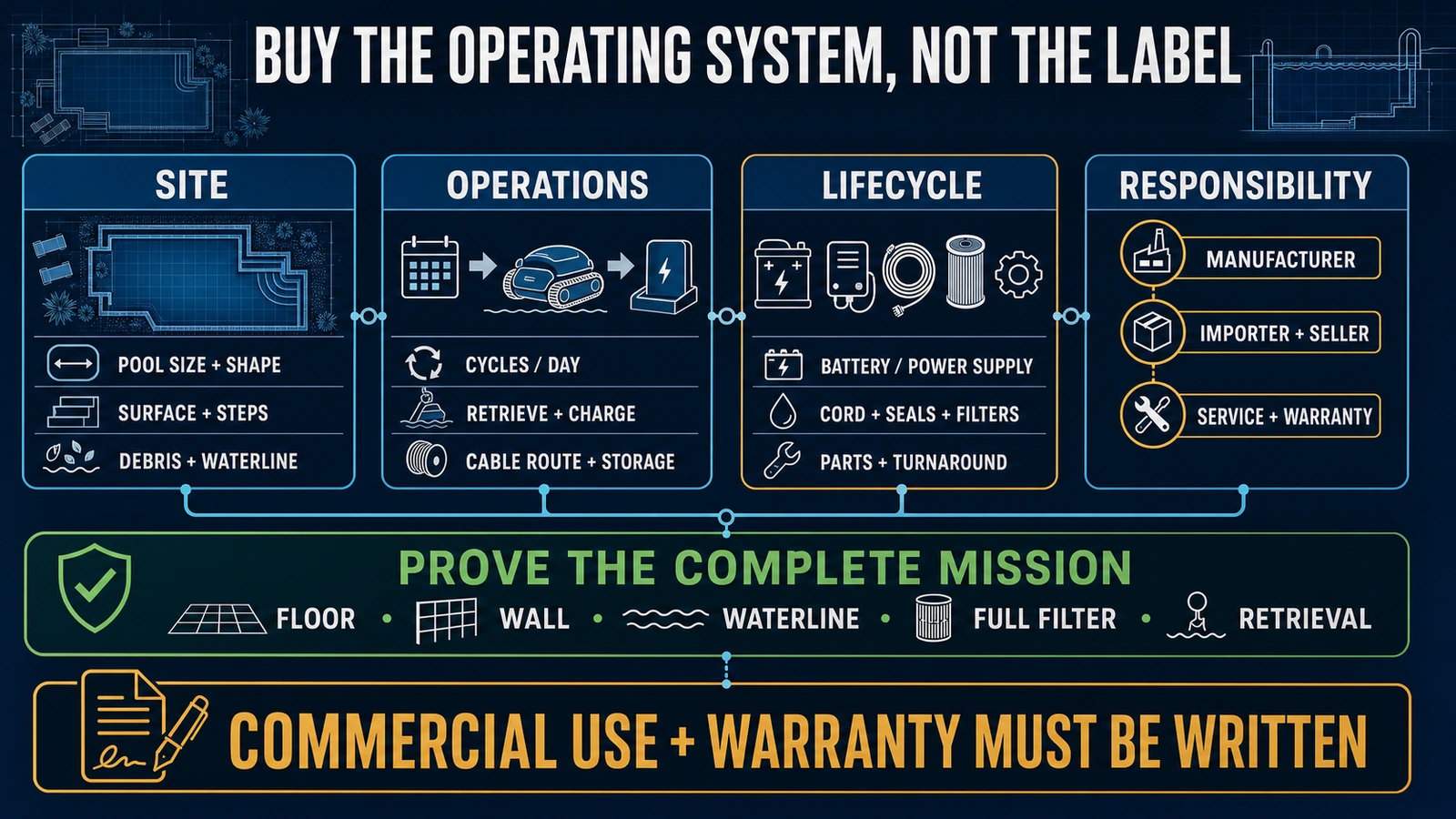
Use the comparison to narrow the shortlist, then ask:
- Will this exact model finish my pool? Show the seller the dimensions, surface, steps, ledges and usual debris. Confirm the cleaning mode used in the demonstration.
- What do I do before and after each run? Include cable handling or charging, retrieval, drainage and filter cleaning.
- When can it clean again? Check the actual schedule, charge time and any operating restrictions.
- Who repairs it locally? Obtain battery or cable pricing, compatible part numbers, warranty terms and the service contact.
- What will ownership cost beyond the robot? Include accessories, your time, consumables, repairs, shipping and any spare unit needed.
For distributors and facility buyers: keep the evidence with the order
Once a model fits the pool, record the promises that affect the cost of supporting it. A short evidence sheet is easier to use during a repair or warranty claim than a general statement that a product is suitable for professional buyers.
| What the order should establish | Evidence to retain |
|---|---|
| Exactly what is supplied | Robot model, market version and compatible battery, charger or power-supply part numbers |
| What counts as a successful clean | Pool conditions, required zones, cleaning mode and permitted manual intervention |
| How an energy-system failure is repaired | Cable or battery replacement price, local service contact, sealing checks where required and expected turnaround |
| Who pays when the robot is unavailable | Written allocation of repair labor, freight, replacement-unit support and warranty exclusions |
| Whether the intended use is covered | Exact product's commercial-use approval and expected operating duty for facilities or service fleets |
| Who handles a claim or safety notice | Contract seller, importer, warranty provider and model/serial traceability |
For a cordless shipment, also confirm battery identity, watt-hours, applicable UN 38.3 test documentation and packaging with the logistics provider. IATA's battery guidance explains the transport context; acceptance depends on the battery, packaging, route and carrier. Product compliance and transport acceptance are separate checks. Plan for warranty returns as well as the first shipment.
For distribution agreements and larger orders, continue with the robotic pool cleaner distributor guide.
The strongest purchase is the one that cleans your pool, fits the time you can give it and has a workable repair path. A convincing demonstration should show all three.
FAQ
Are cordless robotic pool cleaners better than corded models?
Not universally. Cordless removes the operating cable but adds a battery, charging and retrieval system. Corded removes the onboard battery limit but adds a floating cable and poolside power system. Compare the exact pool, mission, labor and service route.
Are corded pool robots more powerful?
Do not assume so from the cable alone. External power changes the energy constraint, but cleaning depends on the pump, brushes, filtration, traction, navigation, mode and pool conditions. Compare products under the same test.
How long do cordless pool robots run?
It varies by product and mode. A published maximum may apply only to floor cleaning, skimming or an economy mode. Verify the default full-pool cycle, charge time, battery condition and real site.
Can a corded pool robot run every day?
Selected products support weekly schedules, but the exact manual defines the cycle, pool-storage, filter-cleaning and inspection requirements. Residential products should not be treated as unlimited-duty commercial equipment.
Do cordless pool robots need to be removed after every cycle?
Many require retrieval for cleaning and charging. Some support multi-cycle modes, parking, recall or more automated charging arrangements. Confirm the exact workflow rather than assuming all cordless models operate the same way.
Which system is cheaper to maintain?
There is no category-wide answer. Corded systems can need cables, swivels and power supplies; cordless systems can need batteries, chargers, docks and sealing work. Parts availability, local repair, freight and downtime determine the result.
Are cordless robotic pool cleaners suitable for commercial pools?
Only when the exact product and contract authorize that use. Do not extend a residential specification or warranty to a hotel, school, gym, public pool, service business or rental fleet without written confirmation.
What documents should an importer request for a cordless pool robot?
Request the complete battery identity and watt-hours, applicable UN 38.3 test summary, transport and packaging information, and the destination-market product documentation. Have the logistics provider confirm the exact shipping route and carrier rules.