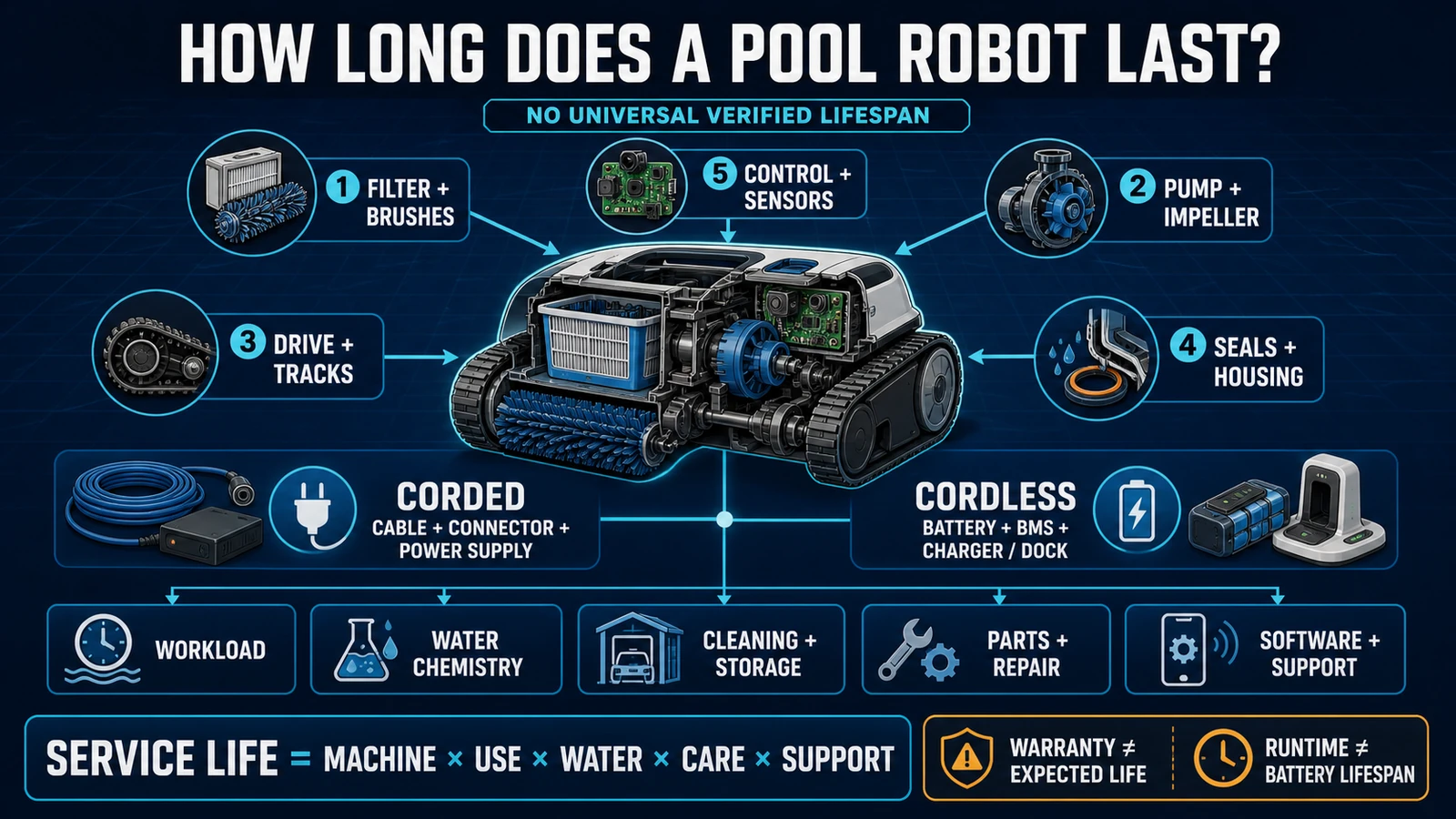
- There is no verified industry-wide lifespan for robotic pool cleaners: service life depends on the exact machine, workload, water chemistry, maintenance, storage and repair support.
- Warranty is a limited contractual coverage period—not a promise of expected life—and its terms can vary by model, component, country, seller and type of use.
- Professional buyers should price the complete lifecycle: wear parts, cable or battery service, freight, downtime, local repair, software support and serial-level corrective action.
In this article 12 sections
There is no verified industry-wide lifespan for a robotic pool cleaner. A machine can remain useful for many pool seasons when it is correctly matched, cleaned, stored and repairable, while another can become uneconomic much sooner. The decisive variables are operating cycles, water chemistry, wear parts, cable or battery condition, sealing, spare-parts access and the cost of service—not one universal number of years.
That distinction matters because online lifespan estimates often compress very different products into one answer. A corded residential cleaner used twice a week is not the same asset as a cordless unit stored at high temperature or a residential product running several cycles a day at a hotel.
The more useful question is therefore: how long can this exact SKU perform the required job at an acceptable cost, with safe parts and service available in the destination market?
Robotic Pool Cleaner Lifespan at a Glance
| Lifecycle layer | What can wear, degrade or become obsolete | What a buyer should verify |
|---|---|---|
| Routine consumables | Filter media, brushes, tracks, wheels, scrapers and small seals | Part numbers, prices, cleaning interval, replacement method and local stock |
| Water and debris path | Inlet, impeller, pump, filter housing and flow passages | Access for cleaning, blockage diagnosis, pump module availability and performance with the real debris load |
| Corded power system | Floating cable, swivel, connector and poolside power supply | Cable handling, replaceable sections, power-supply SKU, approved repair route and destination plug/protection |
| Cordless power system | Battery pack, BMS, charging contacts, charger or dock | Battery service method, charge/storage instructions, freight restrictions, price and replacement availability |
| Drive and structure | Motors, gears, tracks, wheels, brush drive, shell and fasteners | Module-level repair, water ingress evidence, test procedure and labor time |
| Control system | PCB, sensors, firmware, App, account and cloud functions | Diagnostic access, firmware policy, offline behavior and support after model discontinuation |
| Commercial operating system | Labor, cycle frequency, downtime, backup units and service logistics | Written duty rating, warranty permission, SLA, parts holding and turnaround time |
The table shows why “lifespan” is not just a motor question. A mechanically sound robot can still become unusable if its charger, proprietary battery, power supply or cloud-dependent function is no longer supported. Conversely, replacing filters, brushes, tracks or a serviceable module can keep the main machine in operation.
Why There Is No Honest One-Number Answer
The current official material reviewed for this article publishes maintenance instructions, model-specific warranty periods, parts channels and service procedures. It does not establish one category-wide expected life.
There are four reasons a fixed number is unreliable.
Different machines have different architectures
A floor-only cordless cleaner, a premium cordless wall-and-waterline robot, a corded residential cleaner and a commercial machine do not have the same battery, cable, pump, drive, sealing or service structure.
Even within one brand, warranty terms can vary by product and part. Aiper’s current U.S. refund and warranty policy, for example, lists different coverage periods for named cleaner models, accessories and filters. Beatbot’s current warranty policy likewise separates main bodies from consumable filter baskets and roller brushes.
Those tables are useful evidence that products and components are treated differently. They are not evidence that the product must fail when the warranty expires.
Calendar age and operating duty are not the same
“Three years old” can mean 60 seasonal residential cycles or several hundred high-load cycles. Run time, debris load, wall climbing, filter restriction, recovery handling and idle storage all contribute to the stress profile.
A procurement record should therefore track at least cycles or motor hours, pool assignment, recurring faults and parts replaced—not only purchase date.
The pool is part of the operating environment
Water chemistry, salt, temperature, ultraviolet exposure and chemical shocks act on plastics, elastomers, contacts and seals. Sand, leaves, hair and foreign objects load the filter, impeller, brushes and drive differently.
Maytronics’ current maintenance guide advises users to rinse the cleaner with fresh water, manage pool chemistry, protect it from strong sun and inspect abnormal behavior. It also explains that chlorine can wear plastic parts and that objects can become trapped in brushes, tracks or the filter inlet.
Parts and service determine whether a fault ends the asset’s life
A worn track is a routine repair when the correct part is stocked and the replacement procedure is known. The same fault can end a product’s economic life when the part is unavailable, the machine must be shipped internationally or opening the enclosure creates an unacceptable sealing risk.
This is why Maytronics’ current combination of parts listings, manuals, repair requests and dealer support is relevant to lifecycle evaluation. The existence of a parts page does not guarantee that every historical SKU is supported everywhere, but it shows what buyers should demand from any supplier.
Which Parts Usually Need Attention First?
There is no universal failure sequence. The best diagnostic order begins with accessible wear and flow items before assuming that the motor or control board has failed.
Filters, brushes, tracks and wheels
Filters load with debris. Brushes, tracks and wheels lose material and grip. These changes can appear as weak pickup, poor wall climbing, incomplete coverage or wandering movement.
Maytronics recommends cleaning the filter after use and checking brushes and tracks for wear. Its guidance also notes that a clogged filter restricts water flow. A buyer should therefore separate three events:
- the part needs cleaning;
- the part is worn and needs replacement;
- a deeper pump, drive or control fault remains after the first two are corrected.
Replacing consumables on schedule is not evidence of a bad machine. It is part of the operating cost. The procurement problem arises when part identity, price, supply period or replacement labor was never defined.
Impeller and pump path
Reduced suction can result from a full filter, debris around the impeller, a restricted inlet or a pump problem. Maytronics’ maintenance material recommends periodic impeller cleaning and checking for foreign objects.
An operator should not force or disassemble a sealed assembly beyond the model’s instructions. The safe boundary between user cleaning, dealer repair and factory repair must come from the exact manual and warranty terms.
Floating cable and power supply on corded robots
Corded robots avoid an onboard traction battery, but they add a floating cable, connector, swivel on some models and an external power supply. Kinks, tangles, damaged insulation, wet connectors or a failed power supply can remove an otherwise functional robot from service.
Maytronics advises coiling its cable without kinks and storing the cleaner protected from sun, rain and frost. That is model-family guidance, not proof that every corded design behaves the same. Buyers should ask whether the cable, swivel, connector and power supply are separately replaceable and whether a service center can pressure- or electrical-test the repaired system.
Battery and charging system on cordless robots
Cordless products replace the floating cable with a sealed battery system. The lifecycle question is larger than cell capacity. It includes:
- battery pack and battery-management system;
- enclosure sealing;
- charging contacts or inductive interface;
- charger, dock and firmware;
- replacement procedure and post-repair waterproof verification;
- transport and return rules for a lithium-battery product.
For one product family, Maytronics’ Dolphin Liberty storage guidance calls for off-season storage with the cleaner off, drained and the battery at least 50% charged. That instruction should not be copied blindly to another brand: the correct state of charge, temperature and recharge interval must come from the exact manual.
A claim such as “the battery lasts X years” is incomplete unless it states the product, test conditions, cycle definition, remaining-capacity threshold and whether the battery can be serviced. Current official warranty tables reviewed for this article do not create a universal pool-robot battery-life standard.
Seals, motor blocks and electronics
Waterproof equipment is still exposed to aging, impact, debris and imperfect service. A damaged housing, swollen battery, corrosion, water inside a sealed compartment, abnormal heat or burnt odor is not a normal wear-part decision.
Stop using the product and follow the manufacturer or safety authority’s instructions. Do not open a battery or sealed motor compartment merely to avoid a service charge.
Corded vs Cordless: Which Architecture Lasts Longer?
Neither architecture has a defensible universal lifespan advantage.
| Lifecycle question | Corded robot | Cordless robot |
|---|---|---|
| Energy system | External low-voltage supply and floating cable | Onboard rechargeable battery and charger/dock |
| Common handling exposure | Cable twisting, dragging, connector handling and power-supply storage | Repeated wet retrieval, drying, charging-contact handling and recharge cycles |
| Major service question | Can the cable, swivel and power supply be replaced independently? | Can the battery be replaced safely, at what level, and by whom? |
| Logistics | Usually simpler than shipping a large damaged lithium battery, but still an electrical product | Battery condition and configuration can affect carrier acceptance and return method |
| Long-duty fit | No recharge stop, subject to programmed cycle and product rating | Limited by available charge and charging workflow |
| End-of-life risk | Proprietary cable, power supply or motor-block unavailability | Proprietary battery, charger, dock, sealed-pack service or software unavailability |
The commercial answer is to compare serviceable modules and support commitments, not to award one architecture a permanent reliability label.
For a distributor, two products with similar cleaning performance can have very different lifecycle risk. One may have a replaceable power supply and stocked wear kit. Another may require complete-unit exchange for a battery or drive fault. The second product can still be a valid choice, but its exchange stock, freight and warranty reserve should be priced before launch.
What Shortens a Robotic Pool Cleaner’s Service Life?
Leaving it exposed between cycles
Maytronics’ current guidance recommends removing a cleaner after a cycle for filter cleaning and storage, while recognizing that selected weekly-timer or Eco Mode models may remain in the water for the stated program. It also advises removing the robot during chemical shocks.
The correct rule is therefore not “never leave any robot in a pool.” It is: follow the exact model’s permitted schedule and understand that prolonged exposure adds chemical, ultraviolet and material stress.
Running with a clogged filter or obstructed impeller
A restricted water path reduces cleaning performance and can create extra operating load. Empty and rinse the filter at the interval in the manual, inspect the inlet and impeller safely, and record repeated blockage by pool and debris type.
If a product needs mid-cycle filter cleaning in the target pool, that is also a selection issue. A larger coarse basket, different media or another machine may be more economical than treating constant blockage as a maintenance failure.
Poor chemical control and salt residue
Robots work in treated water, but “waterproof” does not mean chemically immortal. Fresh-water rinsing, balanced chemistry and removal during shock treatment are recurring themes in Maytronics’ official maintenance material.
Commercial buyers should record the water parameters permitted by the exact manual and compare them with actual facility logs. A warranty claim may become difficult if the product was operated outside its stated environment.
Heat, frost, direct sun and wet storage
Pool decks, sheds and service vehicles can become much hotter than the surrounding air. Off-season freezing, direct ultraviolet exposure and storing a wet machine or charger add different risks.
Use the product-specific temperature and storage instructions. Do not convert one brand’s published range into a universal specification.
Using a residential product for commercial duty
The ability to complete a large pool once does not establish commercial suitability. Maytronics markets a separate WAVE commercial range for hotels, resorts, fitness centers, water parks and larger facilities. Beatbot’s current consumer warranty excludes commercial, industrial, rental and other non-household use unless expressly authorized in writing.
That does not mean every commercial buyer needs the same machine. It means permitted duty, warranty, operator procedure and service level must be written into the transaction.
Is the Warranty the Same as Expected Lifespan?
No. A warranty is a contract, not a failure forecast.
It defines who may make a claim, during what period, for which product or component, under which use conditions and with what evidence. Coverage can depend on the country of purchase or receipt, authorized channel, proof of purchase, serial number, commercial use and whether an unauthorized party opened or repaired the machine.
Aiper’s current U.S. policy illustrates this separation clearly: named products have different warranty periods, accessories have a separate period, filters are listed separately and paid out-of-warranty service is available. Beatbot’s policy similarly distinguishes main bodies from consumables and limits service to the area where the product was purchased.
For B2B procurement, request a warranty matrix with these columns:
| Field | Required answer |
|---|---|
| Covered legal entity | The company contractually responsible for warranty performance |
| Covered SKU and serial range | The exact market version—not only a family name |
| Covered components | Main body, battery, cable, power supply, charger, dock, filter, brush and accessories |
| Start date | Shipment, delivery, resale or end-user purchase |
| Permitted use | Residential, commercial, rental, demonstration or mixed fleet |
| Remedy | Repair, refurbished replacement, new replacement, refund or parts only |
| Logistics | Who pays diagnosis, inbound freight, outbound freight, duty and dangerous-goods handling |
| Service geography | Countries and addresses where the obligation is actually performed |
| Evidence | Invoice, authorized seller, serial number, photos, logs and returned unit |
The product may continue operating after the contractual period. The more important lifecycle question is what happens next.
When Should You Repair or Replace a Pool Robot?
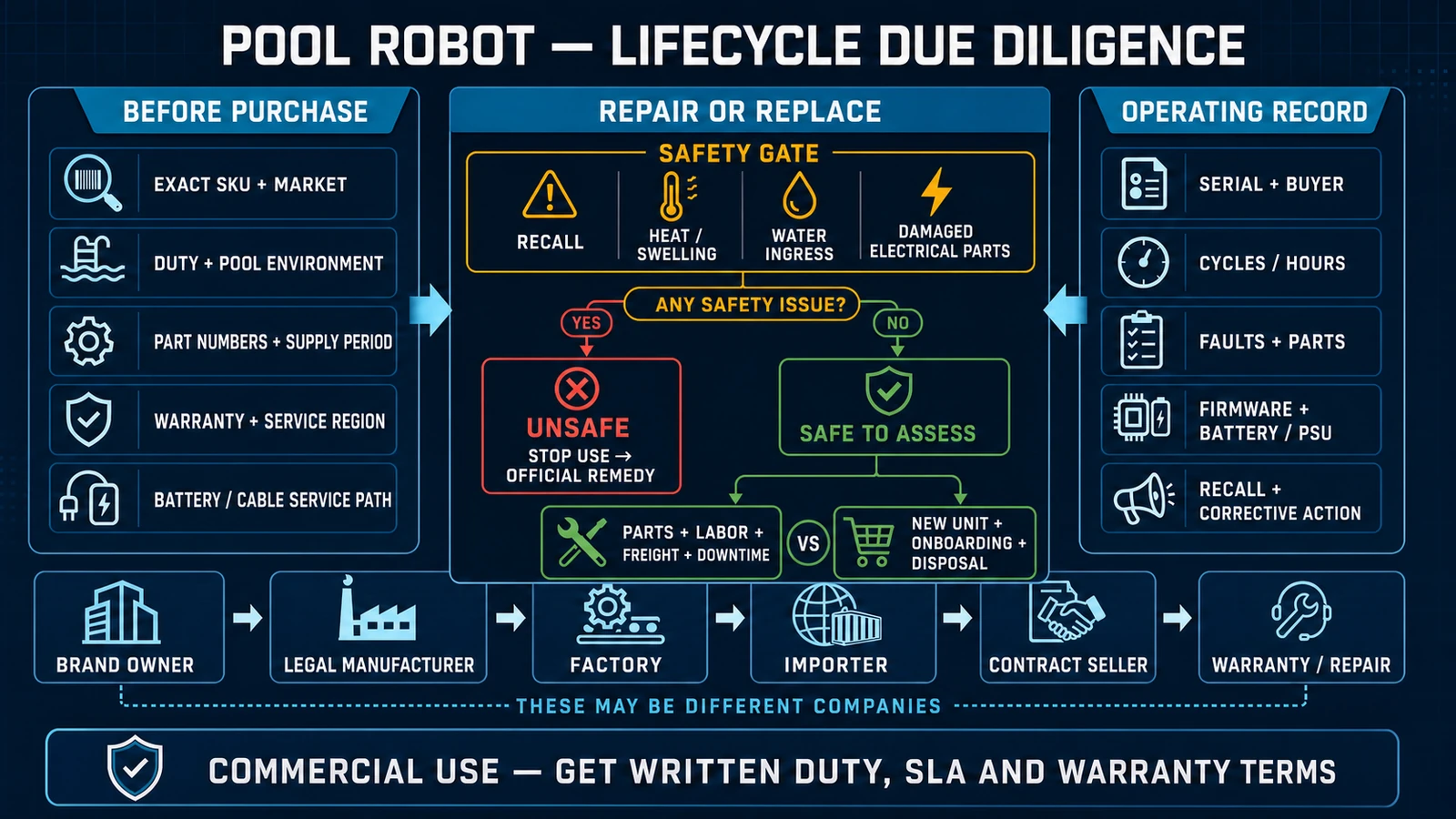
Repair is normally worth investigating when the fault is isolated, the correct part and procedure exist, safety can be restored and total repair cost is lower than the value of a working unit.
Replacement becomes more rational when several core modules have degraded, water or heat has affected a battery or sealed electronics, the necessary part is unavailable, the repair cannot be validated, or logistics and downtime make the repair uneconomic.
Use two complete cost equations:
```text
Repair cost = part + labor + diagnosis + two-way freight + downtime + post-repair testing
Replacement cost = new unit + onboarding + new spare stock + disposal + any contract change
```
Then apply a safety gate before comparing the totals:
- Is the model or serial number subject to a recall or stop-use notice?
- Is the battery swollen, leaking, unusually hot or producing an odor?
- Is there evidence of water inside a sealed electrical compartment?
- Is the charger, plug, cable or connector damaged?
- Does the manufacturer require authorized service for this repair?
If the answer is yes, follow the official safety or recall process first.
The U.S. CPSC’s April 2026 WYBOTICS recall is a useful traceability example. It covers specified Osprey 700 Max and S1 models and serial patterns, identifies the manufacturer and U.S. importer, and directs affected owners to stop use and obtain a replacement. It is not a brand-wide judgment. It shows why model, serial, buyer and remedy records must survive throughout the product lifecycle.
B2B Lifecycle and Procurement Checklist
Before supplier approval
- Record the legal manufacturer, factory, country of origin, importer, contract seller, warranty provider and repair provider separately.
- Obtain the complete model number, country version, serial-number format and charger or power-supply SKU.
- Define the pool, surface, water chemistry, debris, cleaning coverage, cycle frequency and permitted commercial duty.
- Request exploded parts views, part numbers, current prices, minimum orders and a written supply period.
- Confirm which components are user-replaceable, dealer-replaceable, factory-serviceable or non-serviceable.
- For cordless units, obtain the battery identity, Wh rating, charger, replacement route and applicable UN 38.3 test summary.
- Establish the App, account, firmware, cloud, data-transfer and offline-support policy.
During acceptance testing
- Measure performance with the real debris load and a partly loaded filter.
- Record retrieval labor, drain time, filter-cleaning time and charging or cable-handling time.
- Run repeated cycles that reflect expected duty, not only one clean demonstration.
- Inspect sealing, charging contacts, cable routing, connectors, fasteners and wear after the agreed test.
- Simulate a common fault and verify that the seller can identify the part, procedure and service contact.
- Verify serial traceability from carton and invoice to the machine and end customer.
During fleet operation
- Log cycles or motor hours, pool assignment, cleaning time, faults, maintenance and parts replaced.
- Keep proof of purchase, serial numbers, firmware version, battery or power-supply identity and service correspondence.
- Hold critical wear parts and at least one backup plan during the pool season.
- Review recall notices and supplier corrective actions by exact model and serial range.
- Compare actual cost per completed cleaning cycle, not only purchase price.
Cordless Returns and Battery Logistics
A defective cordless cleaner is not always a normal parcel return. Battery condition, watt-hour rating, whether the battery is installed, carrier policy, mode of transport and destination can change the permitted process.
The IATA 2026 battery guidance describes the transport classifications for lithium batteries and battery-powered equipment and the availability of the applicable UN 38.3 test summary.
For a distributor, this creates several practical questions:
- Can the service center legally and practically receive a damaged unit?
- Must the battery stay installed, be removed by an authorized party or not be transported?
- Which carrier accepts the shipment and under what packaging and documentation?
- Who pays dangerous-goods handling and replacement freight?
- Is a local exchange safer and cheaper than an international return?
The answers are shipment-specific. A generic “free return” promise is incomplete if the physical return route has not been designed.
Frequently Asked Questions
How long do robotic pool cleaners last?
There is no verified universal lifespan. The useful life of an exact machine depends on workload, pool chemistry, cleaning and storage, cable or battery condition, sealing, parts availability and repair cost. Treat any fixed category-wide year figure as an estimate unless it is tied to a defined model, test and use case.
Do cordless robotic pool cleaner batteries have a standard lifespan?
No category-wide official standard was found in the current manufacturer material reviewed for this article. Ask for the exact battery, service method, warranty, capacity threshold, storage instructions, replacement price and availability. Runtime when new is not the same as battery service life.
Can you leave a robotic pool cleaner in the pool?
Only as allowed by the exact model instructions. Maytronics generally recommends removal after a cycle for filter cleaning and storage, while selected weekly-timer or Eco Mode products may remain for the stated schedule. Remove the cleaner during chemical shock and before swimming when the manual requires it.
How often should the filter be cleaned?
Follow the model manual. Maytronics recommends cleaning the filter after each cleaning cycle for the products covered by its current guidance. Heavy debris may require cleaning during or between repeated cycles.
Is a corded pool robot more durable than a cordless one?
Not automatically. A corded robot adds cable, connector and power-supply risks; a cordless robot adds battery, charging and battery-logistics risks. Compare module serviceability, parts supply, duty and total cost for the exact SKUs.
Is it worth repairing a robotic pool cleaner?
Often, when the fault is isolated and a safe, supported repair costs materially less than replacement. Include diagnosis, freight, downtime and validation—not only the part price. Stop economic comparison and follow official instructions if there is a recall, battery hazard or water ingress into sealed electronics.
Does a longer warranty mean the robot will last longer?
It can improve the buyer’s risk position, but it does not prove longer physical life. Read the component, region, channel, permitted-use, remedy and freight terms. A shorter warranty also does not mean the product will fail when coverage ends.
Related World Clean Biz Guides
- Learn how robotic pool cleaners navigate, scrub and filter.
- Review robotic pool cleaner manufacturers in China for OEM and supplier context.
- Use the spare-parts and warranty sourcing guide when building a service package.
- Verify who makes Dolphin pool cleaners, who owns Aiper, who owns Beatbot and who makes WYBOT before assigning manufacturer, importer or warranty responsibility.
Final Takeaway
A robotic pool cleaner does not have one honest category-wide expiration date. Its service life is the result of the machine, pool, workload, maintenance and support system working together.
For an owner, the most valuable habits are cleaning the water path, rinsing and storing the machine correctly, following battery or cable instructions and responding early to abnormal behavior. For a professional buyer, the decisive work happens before purchase: define duty, identify every responsible party, price the parts and logistics, and obtain written warranty and service commitments for the exact SKU and market.
That is how lifespan becomes a manageable operating cost instead of a guess.