- Choose by the exact pool geometry and required coverage, not by the above-ground or in-ground label alone.
- Wall, waterline, step and ledge coverage must be verified for the exact model and pool surface.
- Dealers reduce returns by separating entry floor-cleaning SKUs from full-coverage in-ground platforms and documenting fit before sale.
In this article 12 sections
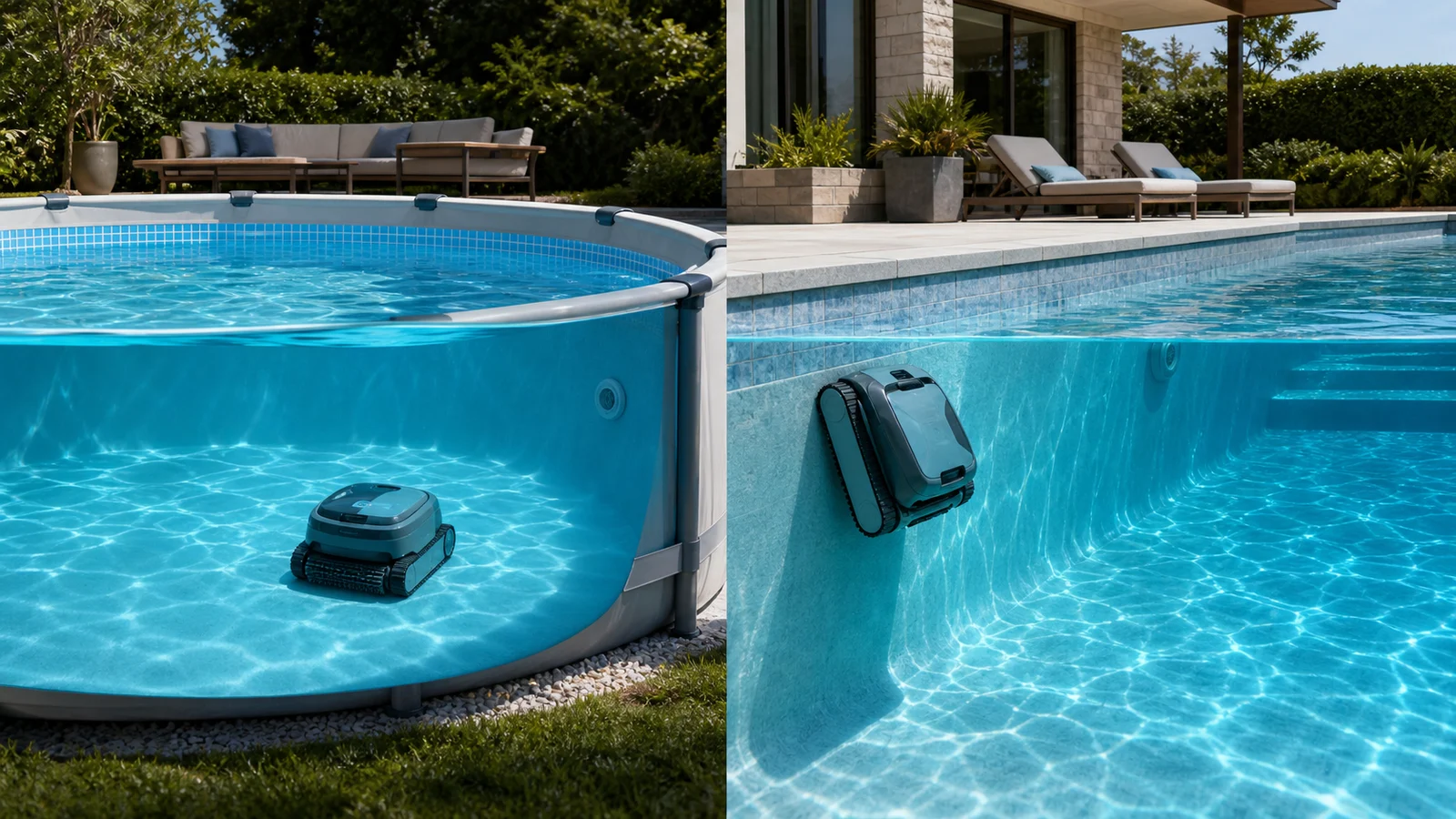
Above-ground robotic pool cleaners are generally lighter, simpler and optimized for smaller, flatter pools. In-ground models more often cover larger and irregular pools, climb walls and scrub the waterline. The labels are not absolute: buyers must verify the exact model’s pool size, floor shape, surface, wall angle, steps, ledges, filtration and cleaning modes.
That distinction matters to consumers, but it matters even more to dealers. A poorly matched robot may still move and collect debris, yet fail to reach walls, negotiate a floor transition or finish the pool within one cycle. The result is a return described as “poor cleaning” when the underlying problem is product fit.
Quick Comparison
| Buying factor | Typical above-ground platform | Typical in-ground platform |
|---|---|---|
| Pool geometry | Round, rectangular and flatter-bottom designs | Rectangular, kidney, freeform, sloped and multi-depth designs |
| Coverage | Floor-first; wall cleaning varies | Floor and walls common; waterline available on higher tiers |
| Product mass | Usually lighter and easier to lift | Often larger, with more drive, filtration or battery capacity |
| Navigation demand | Smaller, more regular area | More complex turns, slopes, drains, steps and obstacles |
| Filtration | Sized for smaller residential debris load | Larger or multi-grade systems more common |
| Price and service | Entry to mainstream | Mainstream to premium, with greater parts and support exposure |
Use this table as an assortment starting point, not a compatibility certificate.
Pool Construction Changes the Robot’s Job
Many above-ground pools have flexible liners, rounded wall-floor transitions and flat or gently dished bottoms. Their smaller area lets a compact robot finish a useful floor cycle with less cable, battery and filter volume.
In-ground pools can combine shallow and deep ends, sloped transitions, vertical walls, coves, drains, steps, benches and tanning ledges. Surface materials also vary across plaster, tile, fiberglass and liner systems. These features change traction, buoyancy, brush contact and navigation.
A buyer should record:
- maximum length, width and depth;
- floor shape and slope;
- wall-to-floor transition;
- surface material and condition;
- drains, lights and protrusions;
- steps, benches and shallow ledges;
- typical debris and fine-particle load;
- entry and retrieval access.
The Maytronics category explanation describes above-ground robots as generally compact and suited to flatter standard profiles, while in-ground models address greater area, depth and shape complexity. “Generally” is the key word.
Floor-Only, Wall and Waterline Are Separate Capabilities
Every robot sold for a pool should have a declared cleaning zone. Do not infer wall cleaning from strong suction, tracks or a photo of the machine near a wall.
Maytronics’ navigation FAQ says its robots are programmed for floor cleaning and, when equipped with the relevant feature, walls or waterline. A model that climbs may still have limits on wall angle, surface, waterline dwell or pool geometry.
The Dolphin Explorer family shows the commercial segmentation clearly: an E10 for above-ground pools up to 30 feet; an E20 for in-ground pools up to 33 feet with wall climbing; and higher models for longer pools with waterline scrubbing and app features.
Yet category labels overlap. The Dolphin Advantage is officially classified for both in-ground and above-ground pools and includes wall climbing. The correct conclusion is not “above-ground robots cannot climb.” It is “coverage must be verified by model.”
Steps and ledges need separate confirmation. A robot can cross a step without cleaning it, climb a wall but miss a shallow bench, or lose traction when part of its body leaves the water. Dealers should not turn a generic “full coverage” phrase into a promise for every feature.
Size, Runtime, Cable and Charging
The pool-length rating should be treated as an operating boundary. Compare it with the actual travel distance, shape and debris level—not only the longest straight dimension.
For corded robots, verify cable length, power-supply placement, swivel design and snag risk. The Pentair Prowler 910 manual illustrates why installation details matter: the official instructions address GFCI protection, cord placement, lifting and safe operation for an above-ground model.
For cordless robots, verify usable cleaning time, recharge time, retrieval method, charger location, battery service and performance at the end of the cycle. A stated runtime does not prove full coverage of an irregular pool.
The detailed trade-off belongs in the corded vs cordless robotic pool cleaner guide. Pool type and power architecture are two different decisions.
Navigation, Drains, Steps and Irregular Shapes
Navigation claims range from timed patterning to sensor-assisted mapping. Buyers should ask what the robot can demonstrate in the target pool.
Use a controlled coverage test:
- define the pool drawing and starting position;
- record the cleaning mode and cycle time;
- place visible markers or test debris in representative zones;
- repeat the test across several cycles;
- score floor, slopes, walls, waterline, corners and obstacles separately;
- record entrapment, repeated paths and missed areas.
Main drains, raised fittings and tight wall transitions can trap or redirect a robot. Steps may be too narrow for stable contact. Round above-ground pools can be easy for one platform and problematic for another if turning behavior is poor. Freeform in-ground pools increase the value of repeatable coverage evidence.
Surface Compatibility and Traction
“Suitable for all pools” is not a useful specification unless the manual names the supported surfaces and geometry.
Brush material, track or wheel compound, intake flow and buoyancy interact with the surface. A platform that climbs rough plaster may slip on smooth tile. A stiff brush can be inappropriate for a delicate liner. Algae, scale and worn surfaces change traction further.
Ask for the exact surface list, exclusions and replacement brush options. Dealers should record the customer’s surface before recommending a wall-climbing SKU.
Filtration and Debris Profile
Leaves, acorns, sand, pollen and fine silt require different filtration. Compare:
- inlet dimensions and blockage behavior;
- basket volume and usable capacity;
- standard and fine-filter grades;
- ease of top access and rinsing;
- debris loss during retrieval;
- pickup decline as the filter loads;
- availability and price of replacement filters.
A small above-ground pool may still face a heavy leaf load. A large in-ground pool may primarily collect fine dust. Pool class alone does not determine the filter.
Price, Service and Total Cost
Entry-level floor cleaners reduce the purchase barrier, but the dealer still needs filters, brushes, tracks or wheels, power supplies or chargers, retrieval parts and warranty procedures. Premium in-ground robots add more capability and more expensive modules.
Compare total cost across:
- purchase price and included filter sets;
- battery, cable, power supply or charger replacement;
- brushes, tracks, seals and baskets;
- seasonal service and storage;
- freight for warranty returns;
- diagnostic tools and technician training;
- expected parts availability.
Do not promise a lower return rate without dealer data. Instead, reduce preventable returns through a documented fit check and clear handover.
A Practical Dealer Assortment
A four-tier assortment can cover most residential needs without stocking multiple near-duplicates.
1. Entry above-ground floor cleaner
For smaller, standard-shape pools where easy lifting and basic floor debris are the priority. State clearly when wall cleaning is excluded.
2. Above-ground plus / crossover model
For customers who need more filtration or verified wall ability. Confirm the exact pool and surface; do not sell it only from the word “crossover.”
3. Mainstream in-ground full-coverage model
For common in-ground sizes with floor and wall coverage. Offer filtration choices and documented spare parts.
4. Premium in-ground waterline model
For larger or more complex pools, waterline cleaning, advanced modes and stronger service expectations. Train staff on steps and ledges limitations.
The assortment should make capability jumps visible. If adjacent SKUs differ only in app features or included accessories, retailers may create confusion without improving fit.
Specification and Claim Verification
For every SKU, keep a one-page evidence record containing:
- official model and region;
- supported pool class, maximum size and surfaces;
- floor, wall, waterline, step and ledge statements;
- cord length or runtime and charge time;
- cycle modes;
- filter types and basket capacity;
- robot wet weight and retrieval method;
- included accessories;
- warranty owner and service process;
- replacement-part list;
- known exclusions from the manual.
Test at least one production unit in representative pools before building sales claims. Search snippets and marketplace titles are not specification evidence.
Final Buying Decision
Choose an above-ground robot when the pool is smaller and structurally simple and the required cleaning zone matches the model. Choose an in-ground platform when the pool size, slope, wall, waterline or geometry requires stronger coverage and navigation. Use a crossover model only after confirming every relevant specification.
For dealers, the profitable assortment is the one that makes fit obvious before the box leaves the store. A short pool survey, exact-model evidence sheet and service-parts plan prevent more problems than adding another overlapping SKU. Buyers comparing cleaning technologies should also review robotic vs suction vs pressure pool cleaners, while product teams can use the robotic pool cleaner manufacturers guide.
Frequently Asked Questions
Can an above-ground pool robot clean walls?
Some can. Many entry models are floor-focused, but official above-ground and crossover models with wall cleaning exist. Verify the exact model, pool wall, transition and surface.
Can an in-ground robot be used in an above-ground pool?
Only when the manufacturer lists that compatibility. Extra capability does not guarantee suitability for a liner, wall transition, dimensions or retrieval conditions.
Is waterline cleaning the same as wall climbing?
No. A robot may climb walls without spending enough time or using the correct motion to scrub the waterline. Check for an explicit waterline-cleaning claim.
What information should a dealer collect before recommending a robot?
Collect pool type, dimensions, depth, shape, surface, floor slope, wall transition, steps, ledges, obstacles, debris and preferred power architecture.