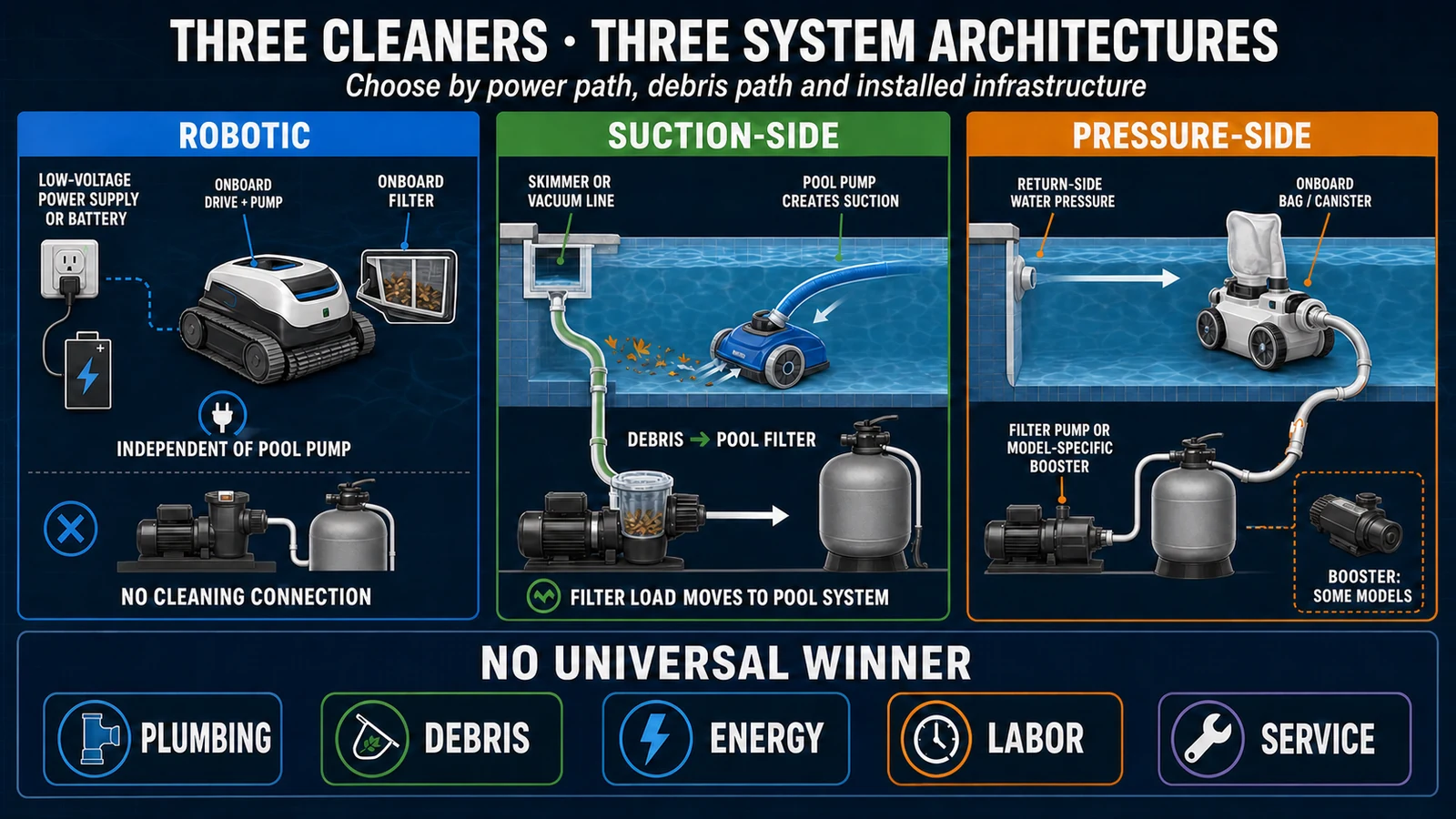
- Robotic, suction-side and pressure-side pool cleaners use different power, hydraulic and debris paths; no architecture is best for every pool.
- Robotic cleaners carry their own drive, pump and filter; suction cleaners use the pool pump and filter; pressure cleaners use return-side pressure and normally keep debris in an onboard bag or canister.
- Professional buyers should compare the installed system, pump schedule, filtration load, labor, parts, warranty and intended use—not the cleaner purchase price alone.
In this article 14 sections
A robotic pool cleaner is usually the most independent system: it carries its own drive, pump and filter. A suction-side cleaner uses the pool’s circulation pump and sends debris into the existing filtration system. A pressure-side cleaner uses return-side water pressure and normally captures debris in its own bag or canister. None is best for every pool. The right choice depends on the installed plumbing, pump schedule, debris, required coverage, labor, service parts and intended use.
The common price comparison—cheap suction cleaner, mid-priced pressure cleaner, premium robot—leaves most of the system out. A low-cost cleaner may depend on a pump, filter, return line or booster pump that changes installation, energy and maintenance. A robot costs more as a self-contained machine but separates the cleaning mission from most of the pool’s hydraulic system.
For a distributor, pool professional, facility operator or commercial buyer, the useful question is not simply which cleaner costs less at checkout. It is which complete system can finish the required job with acceptable labor, energy, service and downtime.
Robotic vs Suction vs Pressure Pool Cleaners at a Glance
| Decision area | Robotic pool cleaner | Suction-side cleaner | Pressure-side cleaner |
|---|---|---|---|
| Cleaning power | Onboard electric drive and pump | Suction from the pool circulation pump | Return-side water pressure from the filter pump or a model-specific booster pump |
| Pool-system connection | Cleaning is independent of the pool pump and main filter | Hose connects to a skimmer or dedicated vacuum line | Feed hose connects to a dedicated pressure or return line |
| Debris path | Onboard basket, cartridge or bag | Pump basket and existing pool filter, unless an optional pre-filter is added | Onboard bag or canister; water returns to the pool |
| Typical infrastructure | Low-voltage power supply or battery/charger, suitable outlet where applicable, storage and retrieval | Compatible pump, filter, valves, skimmer or vacuum line and correct flow | Compatible return line, filter pump or booster pump, controls and correct pressure/flow |
| Main maintenance load | Clean the robot filter; inspect brushes, drive, pump, cable or battery system | Clean pump basket and pool filter; inspect hose, regulator and cleaner mechanism | Empty bag/canister; inspect feed hose, swivels, valves, wheels and booster where fitted |
| Common fit | Buyers who value independent filtration, active brushing and programmable cleaning | Pools with suitable existing suction infrastructure and mainly routine debris | Pools with suitable pressure infrastructure, especially where onboard large-debris collection matters |
| Main procurement risk | Assuming every robot covers the same surfaces or can support the same duty cycle | Ignoring filter loading, pump speed and hydraulic adjustment | Assuming every model requires—or does not require—a booster pump |
The table describes system architecture. It does not rank cleaning performance. Current products in all three categories may scrub, climb walls or handle a wider debris range than their category’s typical use. Those capabilities must be verified for the exact model and pool.
For the pumps, brushes, filters and navigation inside a robot, see How Do Robotic Pool Cleaners Work?. The comparison here starts one level higher: how does the cleaner interact with the whole pool system?
What Is the Difference Between Robotic, Suction and Pressure Pool Cleaners?
The category names describe where energy and water movement come from, and where captured debris goes.
Polaris currently organizes its cleaner range into robotic, pressure-side and suction-side systems. That is useful because one established pool-equipment brand sells all three architectures. The differences cannot be reduced to one brand being more advanced than another.
Robotic pool cleaner
A robotic cleaner carries an electric drive system, a water pump and an internal filter. A corded robot receives low-voltage power from a poolside power supply. A cordless robot carries a rechargeable battery. Both architectures complete the cleaning mission without using the pool’s circulation pump or sending collected debris to the main pool filter.
Pentair’s current robotic cleaner category describes low-voltage power, independence from the pool pump and booster pump, and top-access onboard filter baskets. That independence is the robot’s main system advantage. It does not prove that every robot has better navigation, filtration or wall coverage.
Robots also create their own service chain: filter media, brushes, tracks or wheels, pumps, motors, electronic controls and either a cable/power supply or a battery/charger/seal system. The cordless versus corded robotic pool cleaner guide explains that second decision.
Suction-side pool cleaner
A suction-side cleaner works like an automatic vacuum attachment for the existing pool system. Its hose connects through a skimmer or dedicated vacuum line. The circulation pump creates the suction that moves the cleaner and pulls debris through the hose.
Polaris’ current suction cleaner explanation states the complete path: the pool pump powers movement, pump suction pulls debris into the cleaner and the existing pool filter collects it. Pentair likewise says its suction cleaners connect to a skimmer or dedicated vacuum line.
The absence of a separate cleaner bag does not remove maintenance. It relocates the debris load to the skimmer, pump basket, optional leaf canister and pool filter. Flow, valve position, hose length, filter condition and pump condition become part of cleaner performance.
Pressure-side pool cleaner
A pressure-side cleaner connects to the return side of the pool system. Filtered water—or water from a dedicated booster pump—travels through a feed hose and drives the cleaner. Captured debris normally stays in an onboard bag or canister before the water exits back into the pool.
Polaris’ current pressure cleaner explanation says water from the filter pump or booster pump powers the unit, drives its wheels and passes through the debris bag. This architecture can keep leaves, acorns and similar material from entering the main filter.
The dedicated pressure line is a real infrastructure requirement. The booster pump is model-specific.
Do All Pressure-Side Pool Cleaners Need a Booster Pump?
No.
Many pressure-side systems use a separate booster pump, but the product must be checked by exact model. The current Polaris TR28P, for example, requires a dedicated booster pump and connects to a dedicated return line.
The current Polaris Vac-Sweep 360 also connects to a dedicated pressure line, but Polaris states that it operates without a separate booster pump. It uses the existing filtration system’s return-side flow.
This distinction changes four parts of a project:
- equipment and installation cost;
- electrical and control requirements;
- combined pump energy during cleaning;
- service inventory and failure points.
A purchase order that says only `pressure-side pool cleaner` is incomplete. It should identify the cleaner, required pump, required line, controller or timer, feed hose, fittings and commissioning method.
Is a Robotic Pool Cleaner Better Than a Suction Cleaner?
A robot offers more independence from the pool’s hydraulic system. That can be valuable when the pool pump and filter should remain focused on circulation and water treatment, when active brushing matters, or when the buyer wants a self-contained cleaning cycle.
A suction cleaner can remain a practical choice where the existing pump, filter, skimmer or vacuum line already supports the required flow and the operator accepts the resulting filter maintenance. Its mechanical simplicity may also make local service easier for a channel that already understands pumps, valves and suction cleaners.
The decision changes with the site:
| Site condition | System implication |
|---|---|
| Existing suction line, adequate pump capacity and manageable fine debris | Suction-side may offer a straightforward retrofit |
| Main filter is already heavily loaded or expensive to clean | Independent robotic filtration or a pressure-side debris bag may reduce that specific load |
| No suitable vacuum or pressure line | A robot may avoid hydraulic construction, although outlet, charging, handling and storage still need planning |
| Heavy seasonal leaves or acorns | Compare real intake, bag/canister capacity, clog behavior and intervention frequency; pressure-side is often designed around this task |
| Walls and waterline are mandatory | Verify the exact model; the architecture name does not guarantee coverage |
| Multiple daily commercial cycles | Verify duty cycle, filter capacity, labor, warranty, service-level agreement and backup equipment |
The answer should be written at SKU and site level. A premium suction cleaner may outperform an entry-level robot in a specific pool. A pressure cleaner designed for heavy debris may be more operationally useful than a robot with a small fine filter. Category labels define the system, not the final result.
Which Cleaner Handles Leaves, Sand and Fine Debris Best?
Manufacturers often position suction-side cleaners for fine or sandy debris, pressure-side cleaners for large debris and robots for fine-to-medium debris plus active scrubbing. Polaris uses that general framing on its current cleaner page.
It is a useful starting point, not a universal performance rule.
The buyer should test the actual debris mix:
- sand, silt and pollen;
- leaves, seed pods, acorns and small twigs;
- hair, fibers and insects;
- algae film and attached dirt;
- debris after storms or long closure periods.
Then record:
- what enters the cleaner;
- what bypasses or clogs the intake;
- where the debris is stored;
- how capacity changes during the cycle;
- whether wall traction or water flow falls as the filter or bag loads;
- how long cleaning and reset take.
Micron claims, flow rates and suction figures should not be compared unless the test method and system boundary are the same. A pool filter’s nominal rating, a robot cartridge rating and a pressure-cleaner debris bag describe different parts of different systems.
Which Pool Cleaner Uses Less Energy?
The energy answer depends on the complete operating schedule.
A robot draws electricity through its power supply or charger while its onboard pump and drive perform the task. A suction cleaner may require the main circulation pump to run longer or at a higher speed. A booster-powered pressure cleaner can require the filtration pump and booster pump at the same time. A non-booster pressure cleaner still depends on sufficient return-side flow from the existing pump.
ENERGY STAR’s current pool pump guidance explains that filtration and pool-cleaner operation may require different pump speeds. It also identifies robotic cleaners as low-voltage systems with built-in filters rather than filter-pump- or booster-pump-powered systems.
That architecture gives robots a strong energy advantage in many residential comparisons, but a professional calculation should measure the site:
```text
incremental cleaning energy
= robot input during the mission
+ added main-pump energy above the normal filtration schedule
+ booster-pump energy where required
+ charging and standby energy where applicable
```
If a suction cleaner runs entirely inside an existing filtration schedule without increasing pump speed or runtime, its incremental energy may be smaller than a simple nameplate comparison suggests. If it forces a single-speed or variable-speed pump to run harder for hours, the pool pump belongs in the cost calculation.
Avoid universal statements such as “a robot costs a few cents per cycle.” Electricity rates, pump sizes, hydraulic resistance, schedules, cleaner loads and test methods vary too much.
Installation and Retrofit: Which System Fits the Existing Pool?
Existing infrastructure can change the economic answer before the cleaner is purchased.
Robotic installation scope
Check:
- pool dimensions, surface and geometry supported by the exact robot;
- safe and compliant outlet/power-supply position for corded products;
- charger, dry storage and retrieval workflow for cordless products;
- lifting weight, drainage, caddy and transport route;
- cable reach or battery-cycle capacity;
- app, network and regional account requirements where applicable.
Suction-side installation scope
Check:
- skimmer or dedicated vacuum-line connection;
- required hose length and balance;
- pump flow and available suction;
- valve and regulator settings;
- main drain and skimming interaction;
- pump basket, optional leaf canister and filter capacity;
- vacuum-port safety cover and local installation requirements.
Pressure-side installation scope
Check:
- compatible dedicated pressure or return line;
- required pressure and flow at the wall fitting;
- whether the exact model needs a booster pump;
- booster electrical supply, controls, interlocks and schedule where required;
- feed-hose length, swivels, back-up valve and return fitting;
- bag/canister capacity and service access.
A pool with an installed pressure line and functioning booster pump has a different replacement decision from a pool that would need new plumbing and electrical work. Procurement should separate cleaner price, installed price and lifecycle price.
Maintenance and Service: Where Does the Work Move?
Every architecture automates movement through the pool. None removes maintenance from the system.
| Service area | Robotic | Suction-side | Pressure-side |
|---|---|---|---|
| Debris removal | Empty and wash onboard filter/basket | Clean pump basket, skimmer/leaf canister and main filter as required | Empty and wash onboard bag/canister |
| Hydraulic checks | Onboard pump and filter flow | Pump speed, valves, regulator, hose, filter pressure and air leaks | Return pressure, booster where fitted, feed hose, swivels and valves |
| Wear parts | Brushes, tracks/wheels, filters, cable/swivel or battery/seals | Hose, diaphragm/turbine, shoes, wings, wheels or drive parts | Bag, tires, belts, bearings, sweep hose, backup valve and feed hose |
| Major service | Motor block, pump, electronics, power supply or battery system | Cleaner mechanism plus any pool-pump/filter problems affecting operation | Cleaner mechanism, controls and booster-pump system where fitted |
| Diagnostic risk | Confusing pool geometry or dirty filters with a robot failure | Replacing the cleaner when low flow, a dirty filter or an air leak is the cause | Replacing the cleaner when pressure, hose setup or booster performance is the cause |
The current U.S. Polaris warranty page lists different base terms for suction-side, pressure-side, booster-pump and robotic products. Its complete limited warranty separately identifies many bags, filters, tires, hoses, belts and brushes as wear items.
Those terms are one brand and one market, not an industry standard. They demonstrate why a buyer needs the exact warranty, wear-item list, replacement-part prices and service route before comparing lifecycle cost.
For robot-specific life and repair questions, see How Long Do Robotic Pool Cleaners Last?.
What Changes for Hotels, Schools and Commercial Pools?
Commercial procurement adds duty cycle and responsibility to the comparison.
Maytronics markets a separate WAVE commercial robotic range for hotels, resorts, fitness centers, water parks and large public pools. Separate commercial lines are a reminder that a residential cleaner’s pool-length claim does not prove commercial duty, warranty or service support.
A commercial specification should include:
- facility type, pool dimensions and operating hours;
- cleaning window and required cycles per day;
- bather load and debris pattern;
- floor, wall, waterline and special-area requirements;
- operator steps and maximum acceptable labor;
- filter/bag capacity at realistic loading;
- pump and energy schedule;
- service response, spare parts, backup cleaner and maximum downtime;
- written commercial-use authorization and warranty;
- seller, installer, service provider and facility responsibilities.
The lowest consumer retail price is not a sufficient tender basis. A residential product used commercially may create a warranty gap even when it can physically clean the pool.
How Should a Professional Buyer Compare the Three Systems?
Use one pool, one task and one acceptance method.
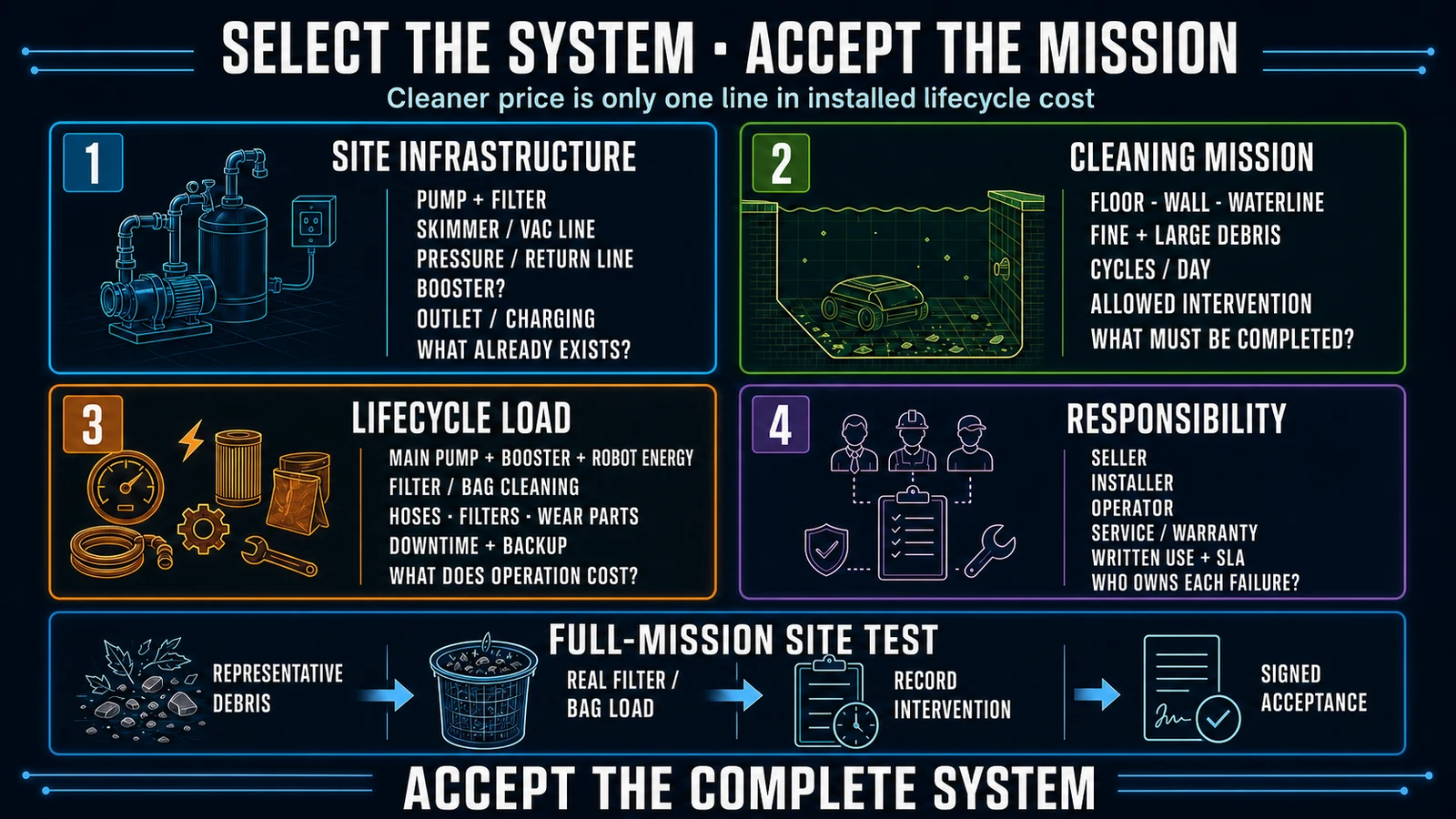
1. Survey the installed system
Record the pump, filter, skimmer, vacuum line, return/pressure line, booster pump, controls, electrical supply, drainage, storage and handling route. Do not assume a drawing matches the current site.
2. Define the cleaning mission
Specify surfaces, debris, frequency, cycle window and acceptable intervention. `Full pool cleaning` is too vague unless floor, walls, waterline, steps, platforms and known obstacles are listed.
3. Lock the exact system
The quotation should identify the cleaner SKU and every required hose, bag, filter, fitting, power supply, charger, caddy, pump, controller and installation item. Regional versions and warranties may differ.
4. Test representative loading
Run the complete mission with realistic debris. Repeat it as the robot filter, main filter or pressure bag approaches a representative service condition. A clean, empty filter demonstration is not a lifecycle test.
5. Record intervention and reset
Measure deployment, hose or cable handling, recovery, debris removal, filter cleaning, backwashing, charging and redeployment. Labor belongs in the operating-cost comparison.
6. Confirm service and responsibility
List the brand or legal manufacturer, contract seller, installer, importer where relevant, warranty provider and repair contact. Document who diagnoses hydraulic faults, who repairs the cleaner and who pays for removal, freight and downtime.
Pool Cleaner Procurement Checklist
- [ ] Pool type, dimensions, surface, geometry and required cleaning areas recorded
- [ ] Representative fine and large debris defined
- [ ] Existing pump, filter, skimmer, vacuum line, pressure line and booster audited
- [ ] Outlet, charger, storage, retrieval and operator route audited
- [ ] Exact cleaner and all supporting equipment identified by SKU
- [ ] Required pump speed, pressure, flow and schedule documented
- [ ] Debris destination and filter/bag cleaning process documented
- [ ] Installed energy and labor measured under the same cleaning mission
- [ ] Wear parts, major parts, prices, lead times and repair method obtained
- [ ] Commercial use, warranty, exclusions and service-level agreement confirmed in writing
- [ ] Full-mission site acceptance completed at representative loading
- [ ] Seller, installer, operator and service responsibilities signed off
For buyers sourcing private-label robots, the robotic pool cleaner manufacturer guide covers supplier screening, waterproofing, batteries, spare parts and after-sales systems. That sourcing decision begins only after the project has established that a robotic architecture fits the pool and channel.
FAQ
What is the main difference between a robotic and suction pool cleaner?
A robotic cleaner has its own electric drive, pump and internal filter. A suction cleaner uses the pool’s circulation pump for movement and suction, then sends debris into the existing pool filtration system.
Does a robotic pool cleaner use the pool pump?
No. A true robotic pool cleaner completes its cleaning mission with an onboard pump and filter. Corded models use a low-voltage poolside power supply; cordless models use an onboard battery. The pool circulation system still performs normal water-treatment duties separately.
Does a suction pool cleaner have its own filter?
Normally no. It sends debris through the hose toward the pump basket and pool filter. Some installations add a leaf canister or other pre-filter, but the exact plumbing and product instructions control the setup.
Do all pressure-side pool cleaners require a booster pump?
No. Many do, but some use return-side flow from the existing filtration pump. Check the exact model, required line, flow and pressure. The Polaris TR28P requires a booster; the Polaris Vac-Sweep 360 is designed to operate without a separate booster.
Which pool cleaner is best for leaves?
Pressure-side cleaners are often designed around larger debris and onboard bags, but there is no category-wide winner. Compare the exact intake, bag or basket capacity, clog behavior, coverage and intervention frequency with the pool’s real leaves, seed pods and other debris.
Which pool cleaner is cheapest to run?
It depends on the pump schedule, power, runtime, filtration work and labor. Compare the robot’s input with any additional main-pump and booster-pump energy required by hydraulic cleaners. Include filter cleaning, consumables and operator time.
Can a residential robotic pool cleaner be used in a commercial pool?
Only after the exact product’s intended use, duty cycle, warranty and service support are confirmed in writing. Commercial size and frequency can exceed residential design assumptions, and some warranties exclude residential products used commercially.
The Practical Answer
Robotic, suction-side and pressure-side pool cleaners solve the same visible task through different systems.
A robot separates cleaning from the pool pump and main filter. A suction cleaner makes direct use of existing pump and filtration infrastructure. A pressure cleaner uses return-side pressure and usually keeps captured debris in the cleaner. Their purchase prices reveal only one part of the decision.
The durable choice is the system that fits the installed pool, completes the defined cleaning mission, exposes its full energy and labor requirement, has service parts available and assigns responsibility before the first failure.
Official Sources
- Polaris: Pool Cleaners and Vacuums
- Polaris: Suction Pool Cleaners
- Polaris: Pressure Pool Cleaners
- Polaris: TR28P Pressure Pool Cleaner
- Polaris: Vac-Sweep 360
- Pentair: Suction Pool Cleaners
- Pentair: Robotic Pool Cleaners
- ENERGY STAR: Pool Pumps
- Polaris: Warranty
- Fluidra: Polaris Limited Warranty
- Maytronics: Commercial Pool Cleaners