- Current official U.S. examples range from basic floor-focused robots below $600 to premium multi-zone systems above $2,000, but coverage and service matter more than the headline price.
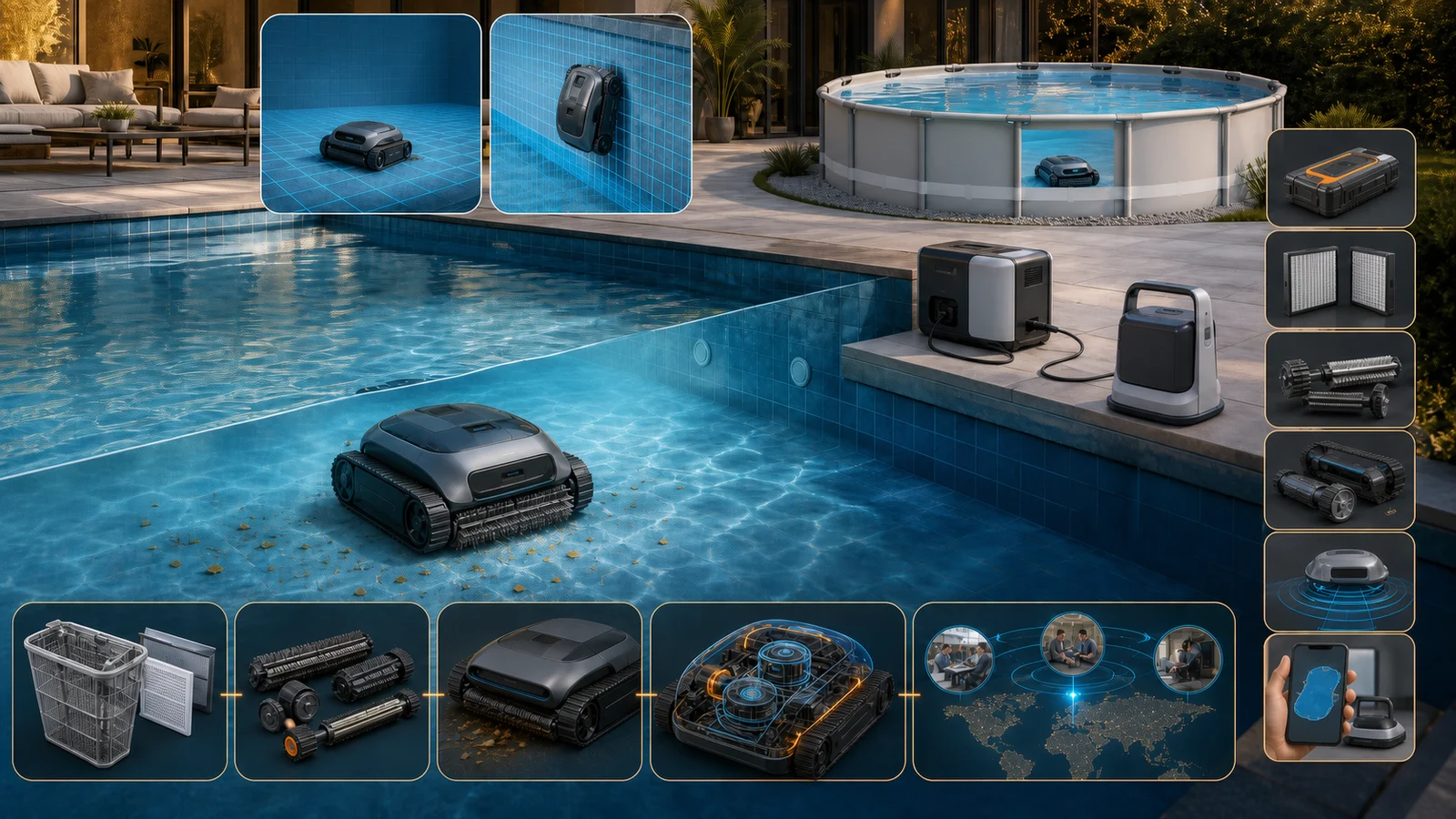
- Compare the complete package: cleaner, power supply or dock, filtration, retrieval, app functions, consumable parts, battery or cable repairs, warranty logistics and backup cleaning.
- Calculate annualized total cost over the intended ownership period and validate the exact pool, debris load and service route before selecting a price tier.
In this article 16 sections
A robotic pool cleaner can cost about $150 to $600 for basic or floor-focused cleaning, roughly $600 to $1,200 for many mainstream full-pool models, around $1,200 to $1,800 for advanced cordless or feature-rich systems, and $1,800 to $2,500 or more for premium multi-zone machines. These are observed U.S. official-site price bands checked on July 25, 2026—not permanent market averages.
The cheapest robot is not automatically the lowest-cost choice. Pool shape, surface, stairs, ledges, debris, wall and waterline expectations, cord management, battery replacement, filter availability and local service can matter more than the purchase price.
Use this guide to compare the complete ownership system rather than one checkout number.
Robotic Pool Cleaner Cost at a Glance
| Observed price tier | Typical buying position | Important limitation to check |
|---|---|---|
| About $150–$600 | Compact, above-ground or floor-focused cleaning | May not climb walls, scrub the waterline or cover complex pools |
| About $600–$1,200 | Mainstream floor-and-wall or full-pool products | Coverage, cable, app and filter packages vary widely |
| About $1,200–$1,800 | Advanced cordless, waterline or dealer-supported products | Confirm battery, retrieval, parts and warranty route |
| About $1,800–$2,500+ | Premium multi-zone, surface-capable or all-in-one systems | More features do not guarantee better performance in every pool |
Current official examples show the spread. Maytronics listed the Niya Sonar 10 at $149, the Dolphin Nautilus Pool Up at $449 and an above-ground Nautilus model at $568. Its value range showed the Dolphin Nautilus CC at a $599 sale price and the Nautilus CC Plus Wi-Fi at $749. Aiper listed its Scuba S1 (2026) at $699.99 and higher models from roughly $1,200 to $2,000. Maytronics listed the cordless Dolphin Liberty 400 at $1,429 and Liberty 600 at $1,729. Beatbot listed the AquaSense 2 Ultra at $2,499.
These examples are not like-for-like. Some are promotional prices. Pool coverage, filtration, warranty and included accessories differ. Taxes, shipping, regional availability and dealer bundles can change the final amount.
Start With the Cleaning Job
A price comparison is useful only after defining the job.
Floor only
Entry products may focus on the pool floor. This can be enough for a small flat-bottom above-ground pool with light debris and manual wall brushing.
Ask whether the robot:
- covers the full floor without repeatedly beaching;
- handles the floor-to-wall transition;
- collects leaves as well as fine particles;
- works on the stated liner or surface;
- has enough runtime for the real pool area;
- can be removed without pulling the power cable.
Floor and walls
Wall climbing requires traction, flow and a compatible transition radius. A “wall-climbing” label does not prove that the machine will handle every tile line, curved wall, drain, step or slope.
Request validation on the same surface family and geometry. A robot that climbs plaster may behave differently on smooth tile or vinyl.
Waterline
Waterline scrubbing is a distinct requirement. Confirm whether the machine merely reaches the top or travels laterally along the waterline. Also ask how much of the perimeter it cleans and whether it leaves corners or steps for manual work.
Surface cleaning
Floating leaves, pollen and insects require surface skimming. Most submerged robots do not continuously clean the surface. Premium all-in-one systems or a separate skimmer may address this task.
Do not pay for “5-in-1” or similar messaging until each included zone is defined in the test protocol.
Above-Ground vs In-Ground Pool Cost
Above-ground models can cost less because the pool is often smaller and the cleaning job simpler. But compatibility is not determined by price alone.
Check:
- flat or dished floor;
- soft liner and seam protection;
- wall material and frame geometry;
- ladder and return-jet interference;
- maximum pool length and depth;
- cable reach or battery runtime;
- safe access for lifting the robot.
In-ground pools are more likely to require wall climbing, waterline scrubbing, deep-end transitions, steps, benches and multiple surface materials. These requirements can move the buyer into a higher tier.
See above-ground vs in-ground robotic pool cleaners for the fit questions that should come before brand selection.
Corded vs Cordless Cost
Corded robots
A corded robot normally includes an external low-voltage power supply and a floating cable.
Potential cost advantages:
- no propulsion battery to replace;
- long cycles without a battery runtime ceiling;
- mature dealer and parts networks on established product lines.
Potential hidden costs:
- power-supply replacement;
- cable or swivel repair;
- caddy or storage system;
- safe outlet location;
- untangling and cable handling;
- damage from poor storage or vehicle traffic.
The cable must be long enough for the pool but managed so that excess length does not create tangles.
Cordless robots
A cordless product removes the floating power cable during cleaning. The system may use a plug-in charger, magnetic contacts, a deck dock or another charging method.
Budget for:
- battery degradation and replacement;
- charger or dock;
- charging-contact care;
- retrieval method if the battery ends away from the wall;
- turnaround time between cycles;
- storage temperature and off-season charging;
- shipping or service restrictions for a lithium battery.
Cordless convenience can justify a higher purchase price when frequent cable handling is the main barrier to use. It is poor value if runtime, recovery or battery service does not fit the pool.
For a side-by-side decision framework, read cordless vs corded robotic pool cleaners.
Filtration Changes Both Price and Labor
The filter determines what the robot can retain and how much owner work remains.
Compare:
- top-load basket, cartridge or filter panel;
- standard and ultra-fine media;
- basket volume;
- leaf intake opening;
- clogging with hair, pollen or silt;
- rinse access;
- wet filter weight;
- replacement-media price;
- availability of genuine and compatible parts.
A large basket is useful for leaves, but it does not prove fine-particle performance. Ultra-fine filtration can capture smaller material but may clog faster in heavy debris.
Ask the supplier to test the dominant debris: oak leaves, pine needles, sand, pollen, hair, acorns or another known load. The guide to robotic pool cleaners not picking up debris explains why one filter claim cannot represent every pool.
Navigation, Brushes and Pool Geometry
Navigation affects how much cleaning is completed per cycle. More sensors or an app do not automatically produce better coverage.
Evaluate:
- floor pattern and missed-area rate;
- wall and waterline transition success;
- main-drain entrapment;
- behavior on steps and sun ledges;
- obstacle recovery;
- treatment of irregular, kidney and freeform pools;
- cycle repeatability;
- response to low water temperature where specified.
Brush type also matters. Active brushes, combined brush-and-track assemblies and surface-specific materials can change scrubbing and wear.
For procurement, request a video of the full test—not only successful clips—and a written result against the target geometry.
App and Smart-Control Value
Apps can provide cycle selection, scheduling, status, manual steering, retrieval assistance or diagnostics. Verify each function on the exact model and connection method.
Ask:
- whether commands work while the robot is underwater;
- whether setup requires Bluetooth, Wi-Fi or cellular service;
- which functions are available only when the robot is out of water;
- whether scheduling is stored on the device or depends on a cloud account;
- whether more than one user can access the machine;
- what happens if the app or server is unavailable;
- how long software and security updates are supported.
An app is valuable when it removes labor or supports diagnosis. It is not worth a premium when it duplicates controls that the buyer does not use.
Parts and Maintenance Cost
Common lifecycle parts include:
- filter basket, cartridges and fine-filter panels;
- scrubbing brushes;
- tracks, wheels and rollers;
- cable and swivel;
- external power supply;
- charging contacts and charger;
- battery;
- seals, impellers and motor assemblies.
The maintenance budget depends on water chemistry, debris, cycle frequency, storage and surface abrasion. Rinse filters after use as instructed, remove hair from moving parts, inspect tracks and brushes, and store the cable without sharp coils.
Before buying, request a five-year parts list with current price, lead time, replacement procedure and warranty status. A low-cost robot that becomes unrepairable after one damaged charger can have a high annualized cost.
Electricity and Pool-System Costs
Do not assume a pool robot creates a fixed energy saving.
A corded robot uses electricity through its power supply. A cordless robot uses electricity while charging and loses some energy through the battery cycle. Measure rated input or actual charging energy and multiply by cycles per year and the local utility rate.
The robot also does not automatically replace the pool’s circulation and sanitation requirements. Pump runtime, filtration and chemistry must still follow the pool professional’s plan and local conditions.
Use:
Annual cleaner electricity = energy per cycle × cycles per year × electricity price
If the supplier claims pump-runtime savings, require a documented baseline, operating change and water-quality result. Do not count an unverified marketing claim in the payback case.
Warranty, Dealer and Service Value
Warranty should be evaluated as a service process, not only a number of years.
Verify:
- coverage for the robot, battery, cable, power supply and accessories;
- residential versus commercial-use terms;
- authorized-seller requirements;
- proof-of-purchase and registration;
- carry-in, shipment or pickup process;
- freight and diagnostic charges;
- repair turnaround;
- replacement or loaner policy;
- availability of local parts;
- water-chemistry and misuse exclusions.
Maytronics, for example, directs buyers to authorized dealers for sales, diagnosis, repair and warranty support. That service route can be worth more than a small price difference when the swimming season is short.
For a private-label program, the same issue becomes a channel obligation. The importer must define spare parts, failure diagnosis, battery handling, returns and customer support before launch. See the robotic pool cleaner OEM/ODM guide.
Calculate Total Cost of Ownership
Use a consistent ownership period—often three to five years—rather than comparing purchase prices alone.
Initial installed cost
Initial cost = robot + power supply or dock + caddy + filters and accessories + shipping + taxes + setup
Annual operating cost
Annual operating cost = electricity + filters + brushes and tracks + service + repair reserve + battery reserve + backup cleaning
Annualized total cost
Annualized TCO = (initial cost − expected residual value) ÷ ownership years + annual operating cost
Example:
- complete system: $1,200;
- additional accessories and setup: $150;
- expected residual value after four years: $150;
- annual electricity and consumables: $90;
- annual repair and battery reserve: $110.
Annualized TCO is:
($1,350 − $150) ÷ 4 + $90 + $110 = $500 per year
This is an illustrative calculation, not a market estimate. Replace every number with the buyer’s quote and usage.
Then divide annualized TCO by successful cleaning cycles or labor hours avoided. Include remaining manual brushing, surface skimming, filter rinsing and robot handling.
Which Price Tier Should You Buy?
Choose the lowest tier that passes the required test.
Basic tier can fit when:
- the pool is small and geometrically simple;
- floor cleaning is the main objective;
- debris is light;
- manual walls and waterline are acceptable;
- replacement rather than repair is an acceptable lifecycle strategy.
Mainstream tier can fit when:
- floor and wall coverage are required;
- the pool has a moderate debris load;
- reliable filtration and a serviceable design matter;
- corded operation is acceptable;
- the buyer wants established parts access.
Advanced tier can fit when:
- cordless handling has real labor value;
- waterline cleaning is required;
- stairs, ledges or complex geometry need stronger validation;
- app control or retrieval has a defined use;
- local dealer support reduces downtime.
Premium tier can fit when:
- surface, floor, wall and waterline tasks are combined;
- pool size and cleaning frequency are high;
- the buyer values automation more than the lowest initial price;
- the supplier passes a full-pool demonstration and service audit.
Do not buy a premium feature package to compensate for an untested core cleaning system.
Buyer and RFQ Checklist
Send suppliers the same pool and commercial data:
- Pool type: above-ground or in-ground.
- Length, width, depth and water volume.
- Shape, slope and floor-to-wall transition.
- Surface: vinyl, fiberglass, plaster, tile or other.
- Steps, benches, sun ledges, drains and obstacles.
- Required zones: floor, wall, waterline and surface.
- Dominant debris and seasonal peak.
- Required cycle time and weekly frequency.
- Corded or cordless preference and the reason.
- Outlet, dock and storage location.
- Filter types and included media.
- App functions and connection limits.
- Retrieval method and wet lifting weight.
- Noise and operating-hour constraints.
- Warranty by component.
- Local service, freight and turnaround.
- Five-year parts list and lead times.
- Battery, charger, cable and power-supply replacement price.
- Certifications and market documents for the target country.
- Quoted unit, accessories, shipping, taxes and validity date.
For distributors and brand owners, also request sample testing, change-control rules, traceability and reliability evidence. Market context is available in the robotic pool cleaner market guide.
Frequently Asked Questions
How much should I spend on a robotic pool cleaner?
Spend enough to meet the actual coverage, debris and service requirements. A simple floor-only pool may fit a sub-$600 product. Full-pool, cordless or multi-zone requirements can move the budget above $1,000 or $2,000. Validate the exact product rather than choosing from price alone.
Are expensive robotic pool cleaners worth it?
They can be when the added coverage, retrieval, filtration, battery design or service support removes measurable labor. They are not automatically worth it when premium features are unused or the robot still misses the pool’s difficult zones.
Is a cordless pool robot cheaper to own?
Not necessarily. It avoids cable handling but adds a battery, charger and charging process. Compare battery replacement, runtime, retrieval and service with the cable and power-supply costs of a corded model.
How long does a robotic pool cleaner last?
There is no universal lifespan. Water chemistry, storage, debris, cycle frequency, cable care, battery temperature, parts availability and repair economics all matter. Model the intended three- to five-year period and confirm parts support.
Does a pool robot reduce pump electricity?
It should not be assumed. The cleaner has its own electricity use and does not remove circulation or sanitation requirements. Count a saving only after a pool professional defines and validates a safe pump-runtime change.
What hidden cost is most often missed?
The largest missed costs are usually required accessories, filter and brush replacements, battery or cable repair, freight for warranty service, downtime and the manual cleaning that remains.
Final Buying Rule
Define the pool, the debris and the required zones first. Then compare complete packages, test the exact geometry, calculate annualized TCO and audit the service route.
The best robotic pool cleaner is not the one with the lowest price or the longest feature list. It is the lowest-cost system that repeatedly completes the required job and remains supportable through the intended ownership period.