- Buy parts by exact model, revision and serial range; similar-looking filters, cables and power supplies are not proof of compatibility.
- Separate user consumables from service parts and sealed electrical assemblies, then follow the manufacturer’s maintenance and safety instructions.
- Dealers should stock fast-moving filters, brushes and drive wear parts while controlling expensive modules through failure data and supplier lead times.
In this article 15 sections
Order robotic pool cleaner parts by the exact model, product number, revision and serial range—not by appearance. Filters, tracks and brushes may be routine user parts. Motors, sealed battery packs, cables and power supplies can require trained service. Compatibility and repair authorization matter as much as price.
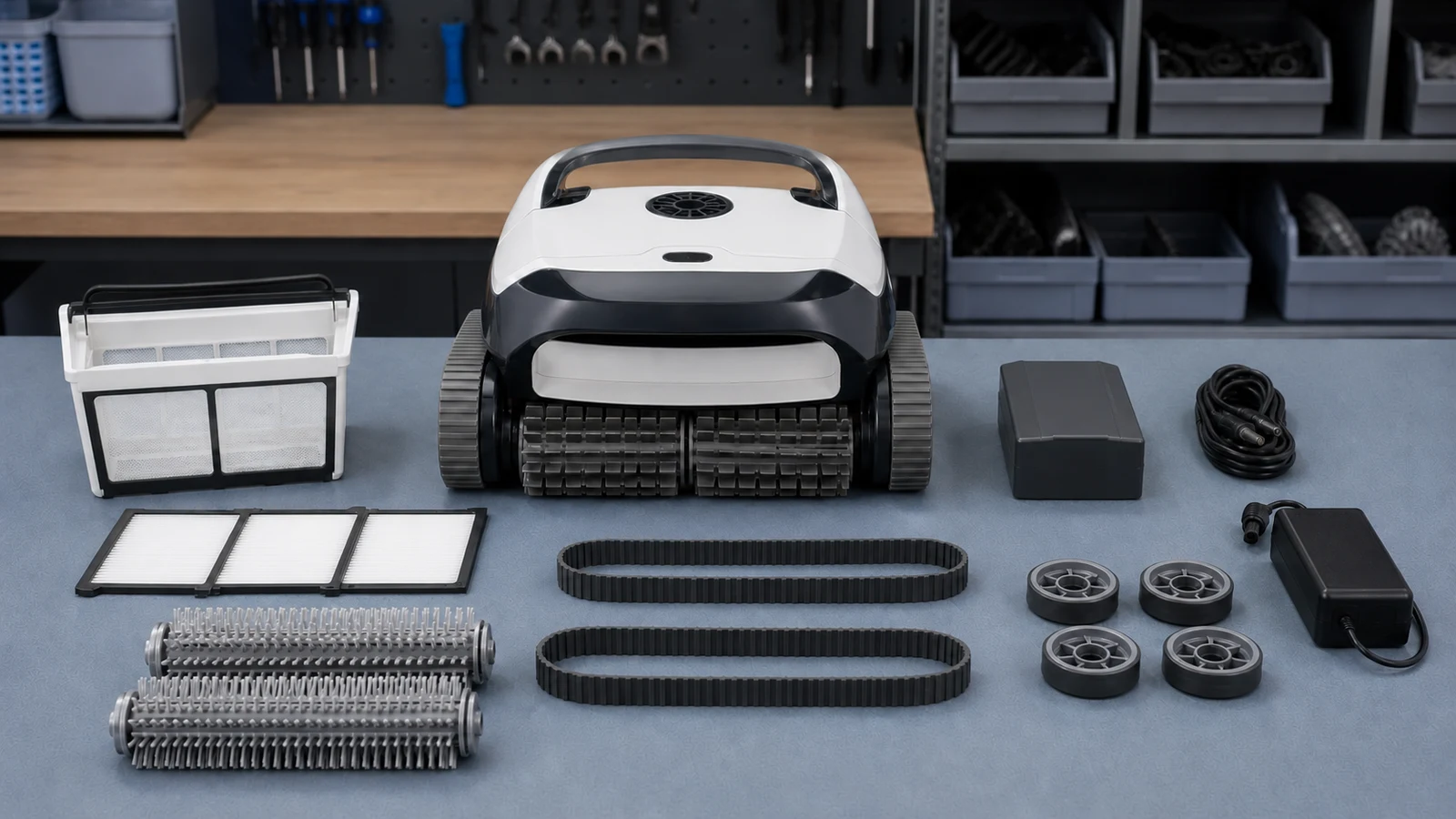
A pool robot is a parts platform. The original sale starts the relationship, but filters, brushes, drive components, charging equipment and repair support decide how long the machine remains useful.
The Main Parts Families
| Parts family | Typical role | Buying risk |
|---|---|---|
| Filter basket, panels or bag | Retains debris | Wrong fit, wrong grade or restricted flow |
| Brushes and scrubbers | Agitate pool surface | Material and geometry mismatch |
| Tracks, belts and wheels | Movement and wall traction | Similar dimensions but incompatible profile |
| Cable and swivel | Power and communication on corded robots | Connector, length and seal mismatch |
| Battery and charger | Energy system on cordless robots | Voltage, BMS, sealing and transport risk |
| Pump or impeller module | Creates water flow | Sealed assembly and diagnostic complexity |
| Drive motor or gearbox | Moves the robot | Revision and side-specific compatibility |
| Power supply | Converts and controls power | Electrical and control incompatibility |
| Housing and seals | Protects internal systems | Leak path and pressure integrity |
| Caddy, hook and storage parts | Handling | Lower technical risk but model fit still matters |
The exact architecture varies. Do not assume every cordless battery is user-replaceable or every corded cable is a simple lead.
Begin With Product Identity
Before ordering, photograph:
- product label;
- model name;
- full product or part number;
- serial number;
- charger or power-supply label;
- old part from several angles;
- connector and mounting points;
- purchase market.
Record the country. Brands can sell related models with different power supplies, names, accessories and warranty routes.
Maytronics’ official U.S. parts store demonstrates the level of specificity required. It lists power supplies and filters by part number, and its model-based parts pages connect components to exact cleaners. A generic listing that says “fits Dolphin” is not equivalent evidence.
Filters Are Not One Universal Part
Pool robots use bags, baskets, cartridges, panels, screens and layered assemblies.
The filter must:
- fit and seal correctly;
- provide enough surface area;
- retain the target debris;
- allow the required water flow;
- release debris during cleaning;
- survive repeated washing.
Maytronics currently separates fine-debris and ultra-fine filter products in its official catalog. Aiper and WYBOT also market multi-stage systems with different filter grades. These examples show why a dealer should not describe every replacement simply as “fine.”
Ask:
- Is the item a complete basket or only filter media?
- Is it for routine debris or fine particles?
- Can different grades be combined?
- Does the robot require a support frame?
- Is the filter washable?
- Which chemicals or cleaning methods damage it?
A denser filter can increase retention while loading faster. If the user installs unapproved media, flow can fall and cleaning performance can change.
Brushes and Scrubbers
Brushes loosen material from the pool surface and guide it toward the intake. Products may use:
- active rotating brushes;
- passive rollers;
- PVC or composite fins;
- foam-like brushes for selected surfaces;
- front and rear brush assemblies.
Match the brush to the model and approved pool surfaces. Diameter alone is not enough. Shaft ends, gear engagement, bearing supports and material stiffness can differ.
Replace a brush when the manual’s wear criteria are reached or when damage changes contact with the pool. Before blaming the pump for poor pickup, inspect the brush, intake and filter together.
Do not fit a more aggressive material without approval. It can affect traction, loading and surface interaction.
Tracks, Belts, Wheels and Drive Wear
Tracked robots depend on correct belt tension and profile. A worn track can:
- slip on the drive sprocket;
- reduce wall climbing;
- distort navigation;
- increase load on the motor;
- come off during operation.
Inspect both sides. Uneven wear may point to a damaged bearing, wheel, guide or drive component rather than a track-only problem.
For wheels and rollers, check:
- axle fit;
- bushings or bearings;
- tread material;
- side orientation;
- retained clips and fasteners;
- free rotation after installation.
Replace parts in pairs only when the manufacturer or wear condition requires it. Do not create a universal rule across products.
Corded Cleaner Cables and Power Supplies
A floating cable can carry power and, in some designs, communication. It may include a swivel or molded wet-environment connectors.
Cable replacement should verify:
- exact power-supply compatibility;
- length approved for the pool size;
- connector type;
- swivel generation;
- sealing components;
- routing inside the cleaner;
- strain relief;
- post-repair electrical and leak tests.
Maytronics lists multiple current power supplies with different wattage and control functions. The existence of several official units is direct evidence that “same plug” is not a safe selection method.
Unplug the power supply before maintenance. Any repair involving sealed electrical assemblies should follow the manufacturer’s service route.
Cordless Batteries and Chargers
Cordless pool robots place the battery, battery-management system and seals inside the wet machine.
The replacement decision involves:
- chemistry;
- nominal and maximum voltage;
- capacity;
- discharge current;
- BMS communication;
- temperature sensing;
- physical mounting;
- enclosure sealing;
- charger protocol;
- transport compliance.
Do not replace a sealed pack with an unverified marketplace battery. A pack that physically fits can still create charging, current or water-ingress risk.
Some brands design batteries for service replacement; others do not authorize user access. Request the exact service manual and warranty position. After any enclosure opening, the required seal replacement and leak test are part of the repair—not optional finishing steps.
Pump, Impeller and Drive Modules
Poor movement and weak pickup do not automatically identify a failed motor.
Before replacing an expensive module, check:
- blocked intake;
- loaded filter;
- hair around an impeller or axle;
- damaged brush;
- displaced track;
- cable or connector condition;
- diagnostic code;
- battery charge and charger output;
- software or mode selection.
Service centers should use the brand’s diagnostic sequence. Parts swapping without diagnosis ties up inventory and can introduce a new leak.
If a motor or pump is sold only as a sealed assembly, confirm whether opening it voids the warranty or removes the required sealing qualification.
Genuine, Compatible and Refurbished Parts
Genuine parts
Advantages can include documented fit, material consistency and clearer warranty support. Availability and price may be weaker.
Third-party compatible parts
They can expand availability, especially for older models. The seller should provide model and serial coverage, material specification and return terms. “Universal” is a warning when the original family has multiple revisions.
Refurbished assemblies
These can be useful for costly modules if the repair process, replaced components and test results are documented. Ask whether seals, bearings and cables are new or reused and what warranty applies.
Never present a third-party part as manufacturer-certified without evidence.
Dealer ABC Stock Planning
Dealers need service availability without filling shelves with slow, revision-specific modules.
A items: frequent and operationally important
- common filter baskets and panels;
- brushes;
- tracks or belts;
- approved charging accessories;
- retrieval hooks and selected handling parts.
Hold stock based on installed population and season.
B items: moderate demand
- wheels and rollers;
- cable sections or swivels;
- housings and latches;
- selected power supplies;
- service seal kits.
Hold limited quantities or supplier-backed replenishment.
C items: expensive or rare
- pump motors;
- drive assemblies;
- control boards;
- sealed battery packs;
- complete power supplies for small installed populations.
Control these through diagnostics, deposits, repair exchange or rapid supplier order.
Use:
Reorder point = average demand during supplier lead time + safety stock
Adjust safety stock before peak pool season. A part that arrives after the season has limited service value.
Compatibility Database
A serious distributor should maintain:
- brand;
- model;
- product number;
- serial range;
- market;
- part number;
- superseded part number;
- compatible replacement;
- installation authority;
- warranty effect;
- stock;
- supplier lead time;
- last verification date.
When a supplier changes a part, require a written supersession record. Do not silently merge old and new inventory.
Our robotic pool cleaner distributor guide covers the wider channel model. The general cleaning-appliance spare-parts and warranty guide explains contractual responsibility.
Supplier and OEM Questions
- Which parts are user replaceable?
- Which require an authorized service center?
- What diagnostic tools are required?
- What is the parts-support period after final production?
- Are drawings and exploded views available?
- How are serial revisions recorded?
- Which seals must be replaced after opening?
- What tests are required after repair?
- Who pays for repeat failures?
- Can the distributor buy subassemblies or only complete modules?
- Is repair software region locked?
- Are batteries shipped separately under compliant conditions?
Parts access should be negotiated before launch, not after the first warranty season.
Owner Maintenance Checklist
- Disconnect or power down exactly as instructed.
- Rinse the approved filter after use.
- Remove hair and debris from moving areas.
- Inspect brushes and tracks for damage.
- Use the retrieval method in the manual.
- Dry and store the charger or power supply correctly.
- Keep model and serial records.
- Use approved parts and fasteners.
- Stop if the enclosure, cable or connector is damaged.
- Send sealed electrical repairs to the proper service route.
For selection before purchase, use our robotic pool cleaner buying guide.
FAQ
Are robotic pool cleaner parts universal?
No. Some wear parts cover several models, but fit must be proven by official compatibility data or reliable model and serial documentation.
Can I replace a cordless pool robot battery?
Only if the manufacturer provides an approved battery and repair method for that model. Opening a wet enclosure can require new seals and leak testing.
How often should filters and brushes be replaced?
Use condition and manufacturer guidance. Debris, chemicals, cleaning method, pool surface and operating hours can make calendar-only replacement inaccurate.
Should a dealer stock motors and batteries?
Only after analyzing the installed population, failure rate, lead time and diagnostic process. Expensive modules often suit controlled order or exchange better than broad stock.
Why does the new filter reduce pickup?
Possible causes include wrong fit, excessive restriction, incorrect assembly or rapid loading. Stop and verify the exact approved configuration.
Final Decision
Parts support is a product feature. A cleaner with documented compatibility, local wear parts and a safe repair route can remain valuable long after purchase. A machine without those systems can become disposable even when the core robot is repairable.