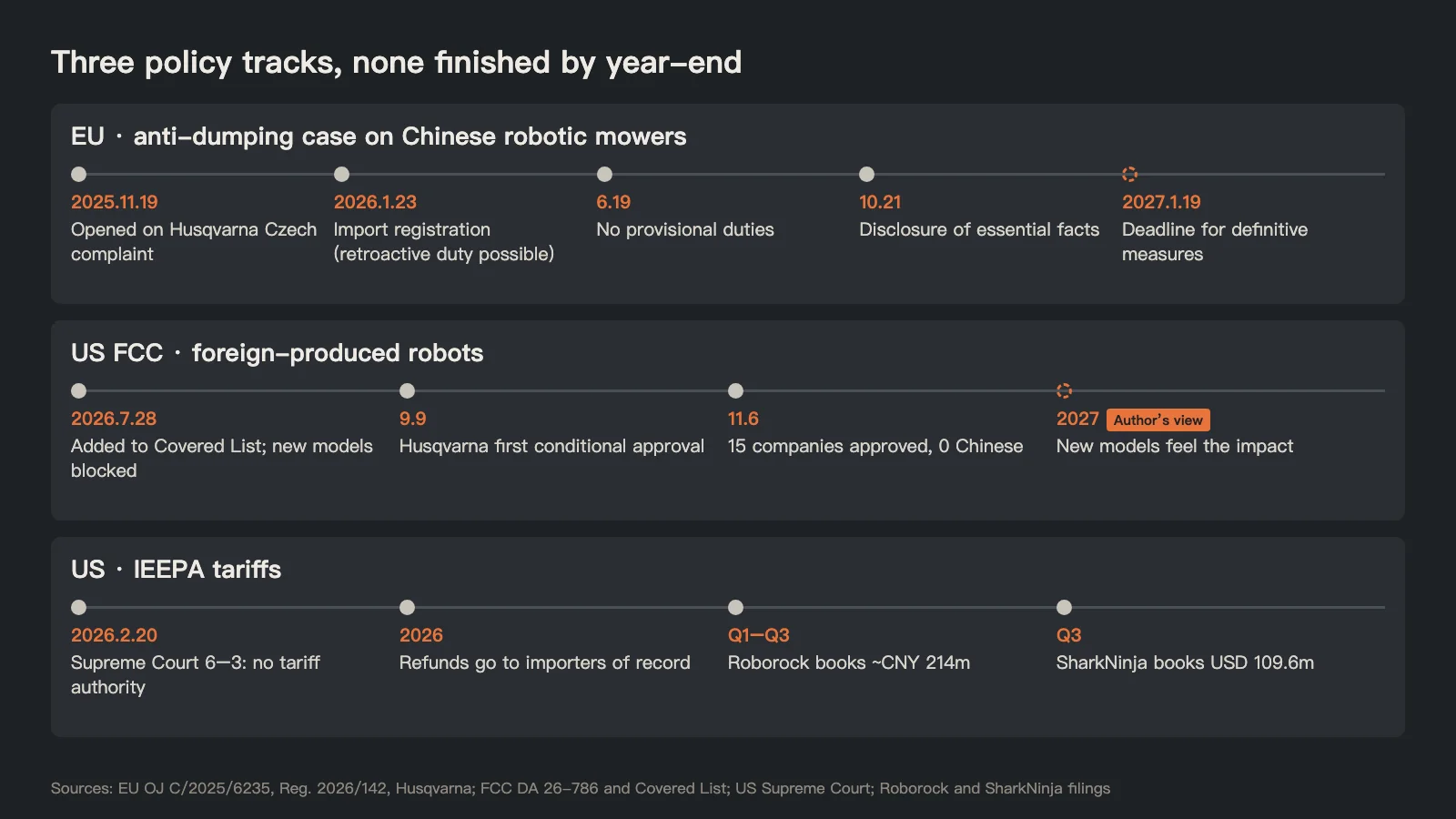
- Policy had the biggest effect on the industry in 2026: the IEEPA ruling, the FCC robot ban and the EU anti-dumping case on Chinese robotic mowers all hit the overseas markets Chinese companies rely on most, and none was resolved by November.
- Western incumbents sold, formed joint ventures or delisted while capital flowed into Chinese robotic mower and commercial cleaning robot makers.
- Robot-vacuum brands moved outdoors into mowers and pool robots; Dreame began to narrow its focus, while Dyson and Roborock entered new categories.
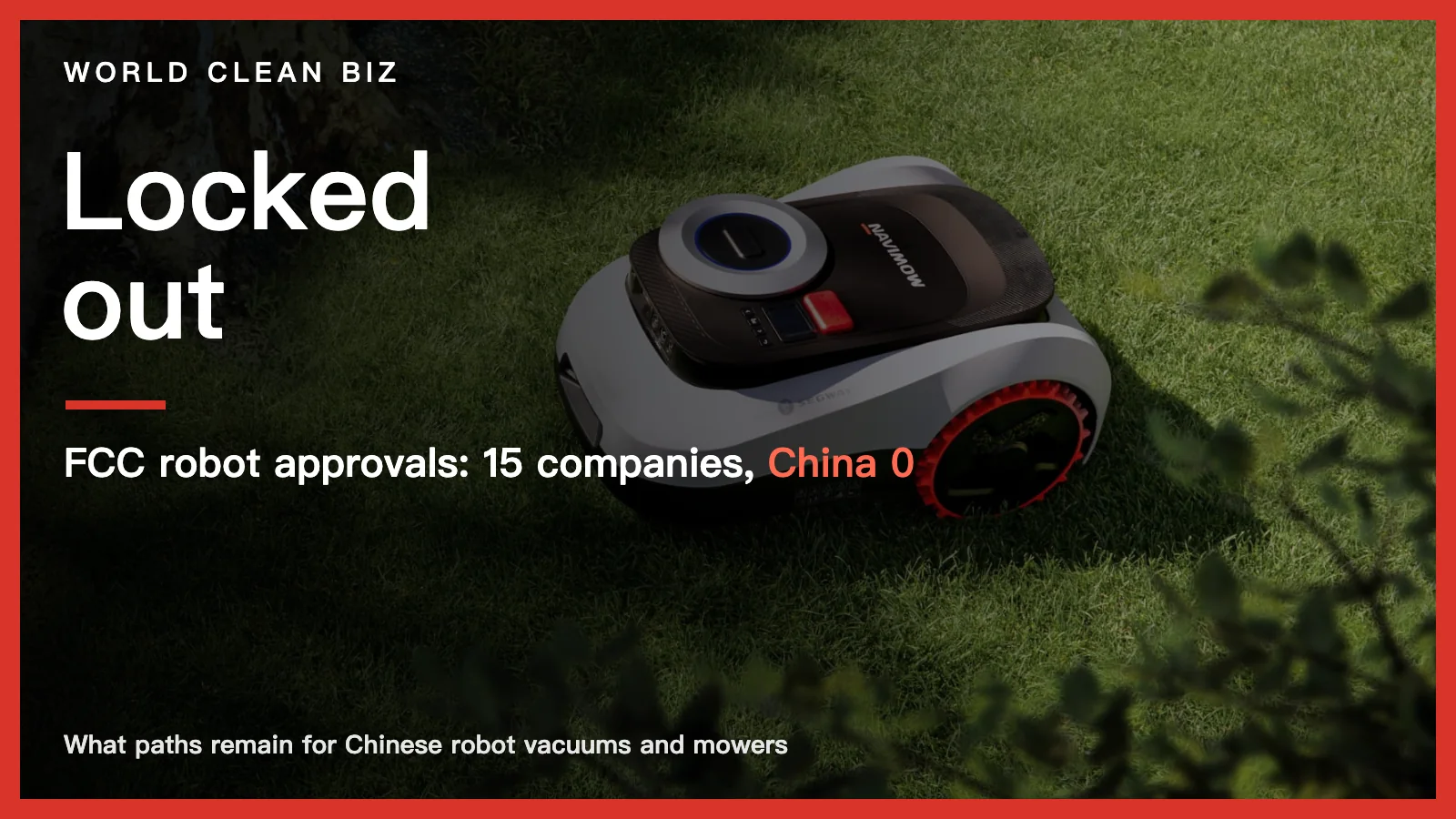
On November 6, the FCC published another batch of conditional approvals for foreign-produced robots. Since September it has approved 15 companies. Only two of them, Husqvarna and Matic, make cleaning products, and none is Chinese. Singles' Day is almost here, and there are less than two months left in the year.
I recently went back through this year's news, company results and my own notes, and picked out around thirty events I think count at industry level. The test was simple: an event stayed on the list only if it changed the competitive landscape, the policy environment or the capital map. Individual product recalls, ordinary launches and small acquisitions were left out. Put in order, this year's story turned out more complicated than I expected in January.
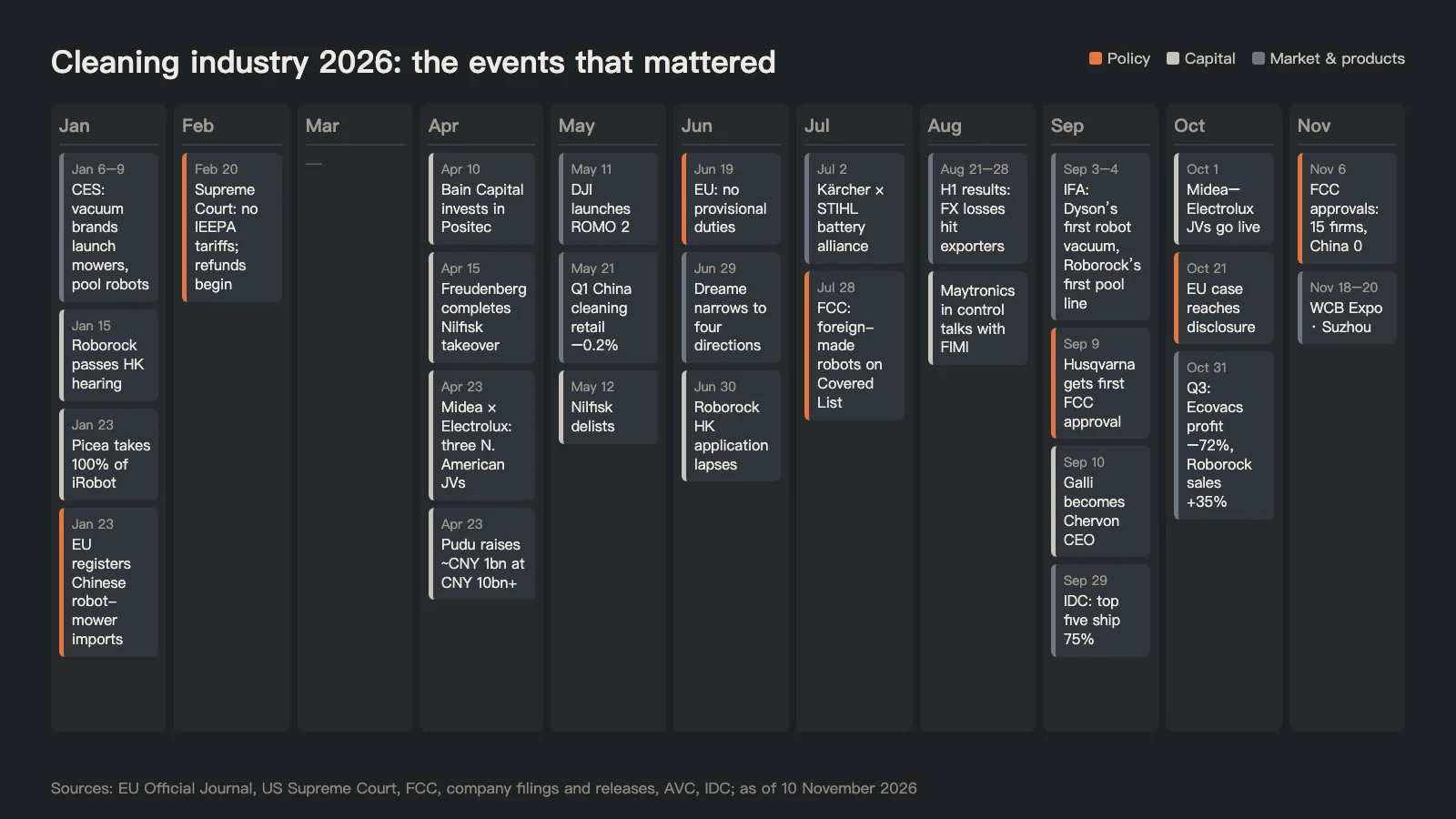
CES in January gave the first signal. Almost every robot-vacuum brand was talking about yards and pools. Dreame's stand covered more than 2,000 square metres; besides the X60 Ultra and a stair-climbing concept, it showed a robotic mower with an arm that picks up garden debris. Roborock showed Saros Rover, a wheel-leg robot that can climb stairs. Segway Navimow launched five mower ranges at once, Mammotion launched the LUBA 3 AWD, Beatbot brought a pool robot with a self-cleaning dock, and Ecovacs announced ULTRAMARINE, its first pool robot. For the past two years the competition had been over robot-vacuum docking stations; this year the brands started heading outdoors.
The reason is easy to see. Robot vacuums in China have consolidated to the point where the top five brands take most of the market, while robotic mowers and pool robots are still moving from wired to wireless and from basic to smart. They look like the next source of growth.
In the same month, the outdoor route hit its first obstacle. On January 23, the European Union published a regulation requiring registration of imports of robotic lawn mowers from China. The anti-dumping case had been opened in November 2025 on a complaint from Husqvarna's Czech plant, and it covers mowers with and without boundary wires. Registration keeps open the option of collecting duties retroactively later.
Also on January 23, Picea completed its takeover of iRobot. iRobot had filed a prepackaged Chapter 11 in December 2025. Picea was already its main contract manufacturer and a secured lender, and it took 100% of the equity. The company that built the first Roomba ended up owned by its own contract manufacturer. Coming at the start of the year, I found that symbolic: control of the robot-vacuum category has passed from American brands to Chinese brands and the Chinese supply chain. I wrote about the ownership chain in who owns iRobot.
On February 20, the US Supreme Court ruled 6–3 that the International Emergency Economic Powers Act does not authorize the president to impose tariffs. The tariffs collected under IEEPA lost their legal basis, and importers began claiming refunds.
At the time this seemed a long way from the cleaning industry, but it showed up in the results companies reported later in the year. Refunds go to the importer of record, whatever the brand's nationality. Roborock imports into the US itself and booked about CNY 214 million in the first three quarters; SharkNinja booked USD 109.6 million in the third quarter. Many factories supply retailers on FOB terms, so the retailer paid the duty and the refund lands in the retailer's accounts. If a factory cut its price at the time to share the tariff burden, it will not get that money back. Among companies selling into the US, those that run their own brands and clear their own customs gained an unexpected windfall this year.
In April, capital moved all at once. On April 10, Bain Capital announced a strategic investment in Positec, without disclosing the amount or stake. Positec, founded in 1994, owns Worx and Kress, employs more than 4,000 people and sells mainly in North America and Europe; it was one of the first Chinese companies in robotic mowing. On April 15, Freudenberg, the parent of Vileda, completed its takeover offer for Nilfisk, and Nilfisk left the Copenhagen exchange in May. Europe has one fewer independently listed commercial cleaning company.
April 23 brought two more. Midea and Electrolux announced three joint ventures in North America: a refrigerator sales company owned 50:50, a refrigerator plant in Juárez, Mexico, 65% owned by Midea, and a laundry plant in Anderson, US, 55% owned by Electrolux. All three were operating by October 1. The same day, Pudu announced it had raised nearly CNY 1 billion at a valuation above CNY 10 billion, taking total funding past CNY 2 billion. Pudu said commercial cleaning robots account for more than 70% of its revenue, that revenue more than doubled in 2025, and that cumulative shipments exceed 120,000 units.
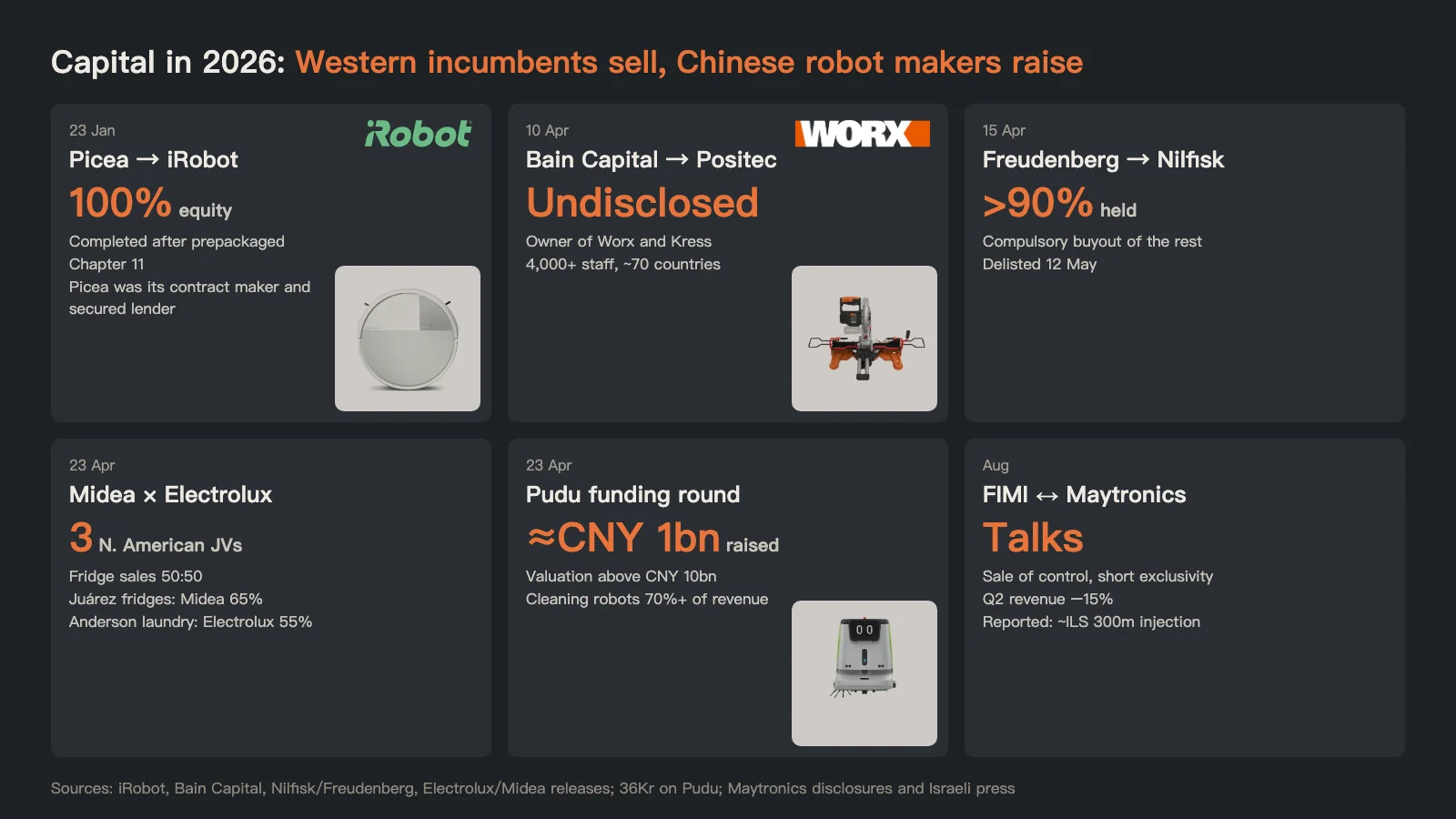
Taken together, these deals point in one direction. Long-established Western companies have been taken over and delisted, or tied their North American business to a Chinese partner, while money is flowing into Chinese robotic mower and commercial cleaning robot makers.
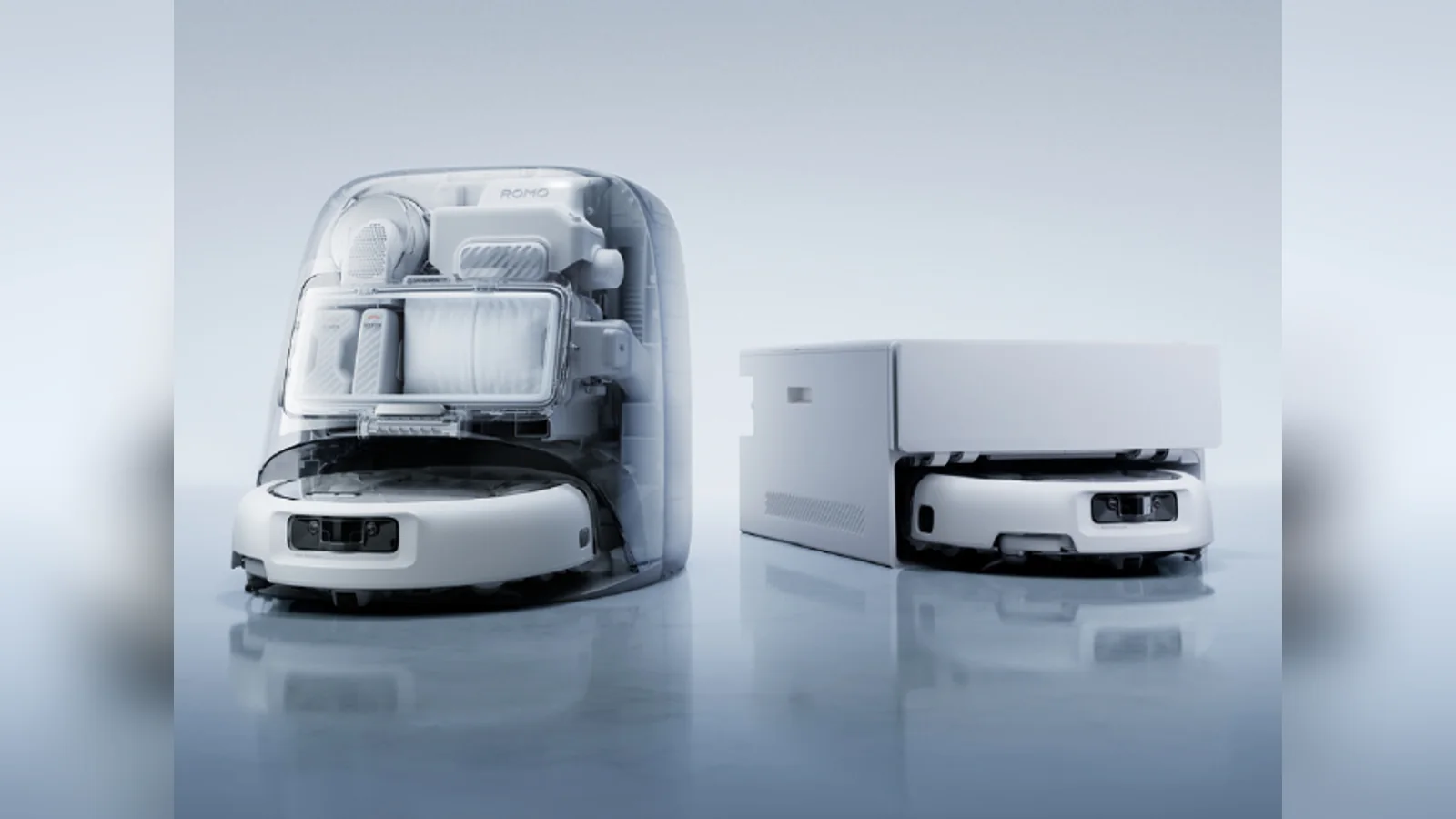
On May 11, DJI launched its second-generation robot vacuum, the ROMO 2, which went on sale on June 11 from CNY 5,499. The first ROMO came out in China in August 2025, and a second generation followed within a year, so I think DJI intends to stay in this category for the long term. ROMO 2 reached Europe in September but has still not entered the US. I looked at the product in more detail in my ROMO 2 analysis.
The Chinese market was hard going at this point. Trade-in subsidies had ended in most regions. AVC data showed first-quarter retail sales of cleaning appliances down 0.2% year on year: robot vacuums fell about 10%, and wet floor cleaners grew about 3% while their average price fell 11%.
Some companies sped up; others began to pull back. On June 29, Dreame confirmed to the media that it would concentrate on four areas: smart home, yard care, smart mobility and embodied intelligence. Media also reported job cuts in some teams, and in September Dreame said its car work would move into industrial research. Dreame has expanded faster and into more categories than anyone over the past two years, and I think the strategy of opening many categories at once is now running into cash and profit constraints.
In the capital markets, Roborock passed its Hong Kong listing hearing in January but never completed the offering. On June 30 its second application lapsed after six months, putting its dual A+H listing plan on hold. In the same month, the EU decided not to impose provisional anti-dumping duties on robotic mowers, citing the technical complexity of the case, and continued the investigation.
July brought one event from Europe and one from the US. On July 2, Kärcher and STIHL announced the ALLPRO battery alliance, under which professional equipment from both companies will share a STIHL-developed battery platform; Kärcher's batteries and tools arrive in January 2027. Europe's leaders in cleaning and in garden equipment joining forces on batteries is, as I read it, a response to the battery ecosystems built by Asian groups such as TTI and Chervon.
On July 28, the FCC added foreign-produced advanced robotic devices to its Covered List. New robot vacuums and robotic mowers made outside the US cannot be certified for the US market unless they obtain conditional approval. Models certified earlier can still be sold, so I expect limited impact on sales this year; the real test comes with next year's new models. I have written about this several times, most recently in After the FCC Robot Ban, What Paths Remain for Chinese Robot Vacuums and Mowers?, so I will not go further here.
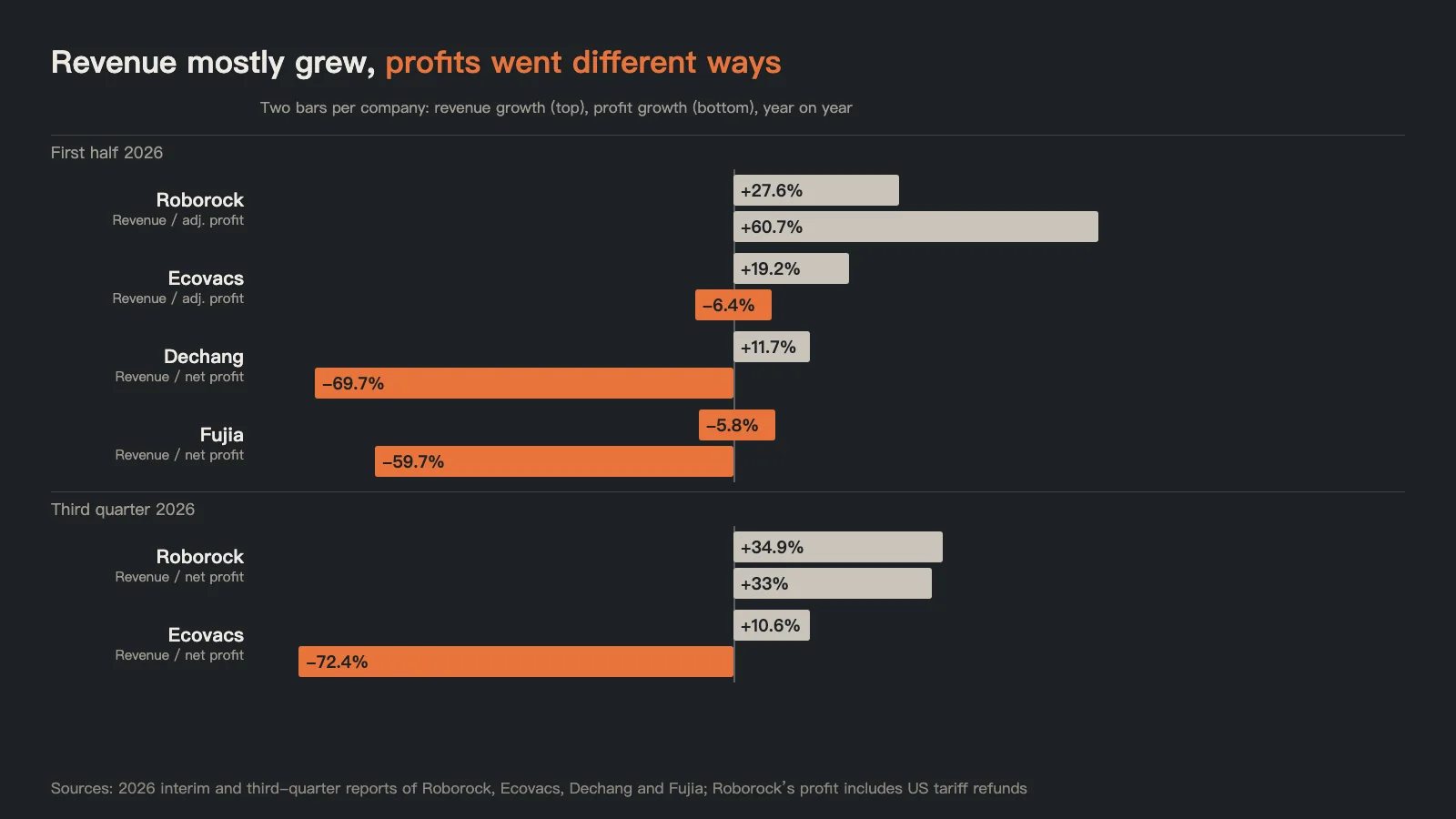
In August's interim results, profits moved in very different directions. Roborock's first-half revenue was CNY 10.08 billion, up 27.6%, with profit excluding non-recurring items up 60.7%. Ecovacs grew revenue 19.2% to CNY 10.34 billion, but its profit excluding non-recurring items fell 6.4%. Suppliers had it harder: Dechang's revenue rose 11.7% while its attributable net profit fell 69.7%, and Fujia's revenue fell 5.8% with net profit down 59.7%. LEXY booked CNY 389 million of foreign-exchange losses in the half, against a gain of more than CNY 17 million a year earlier. With the renminbi stronger, exchange rates became the biggest swing factor in exporters' profits.
In pool robots, market leader Maytronics confirmed in August that it was in talks to sell control to the Israeli fund FIMI. Maytronics' second-quarter revenue fell 15% year on year, and media reports said FIMI planned to inject about ILS 300 million in exchange for control. Many brands piled into pool robots over the past two years, and I expect another shake-out in this segment.
Just then, two leading brands moved into new categories. At IFA in September, Roborock launched RockAqua, its first pool-cleaning line, and Dyson launched its first Nurovi robot vacuums. By entering robot vacuums, Dyson now competes in the same price band as Roborock and Dreame, its long-standing rivals in cordless vacuums. By entering pool robots, Roborock walks into a market whose leader is negotiating a sale of control.
On September 9, Husqvarna received the FCC's first conditional approval, covering four Automower platforms it expects to launch in the US in 2027. Husqvarna is also the complainant in the EU anti-dumping case on robotic mowers. On both sides of the Atlantic, policy has worked in its favour this year.
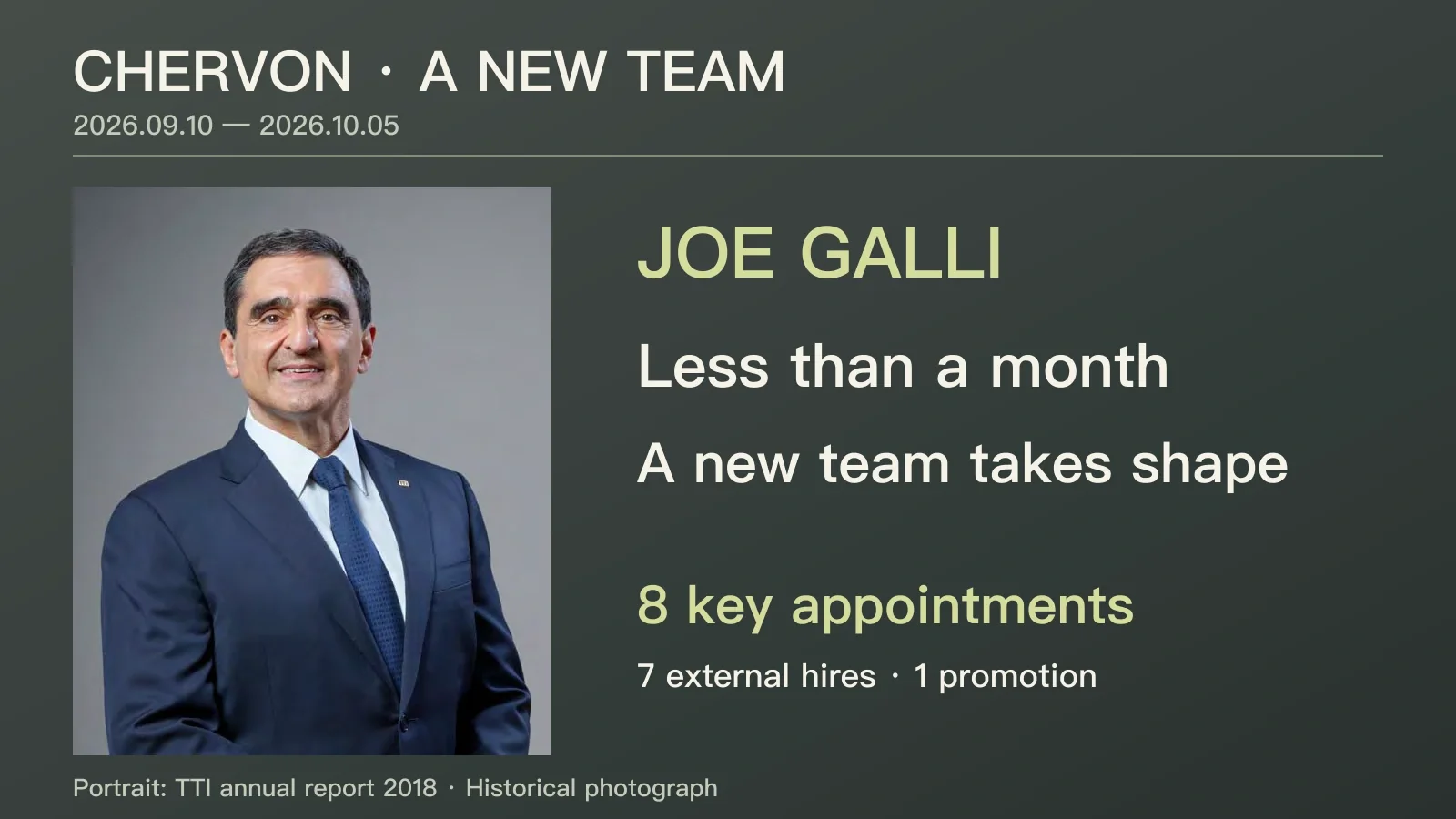
The most significant event in power tools this year, in my view, came on September 10, when former TTI chief executive Joseph Galli became chief executive of Chervon. Founder Pan Longquan remains chairman. Galli spent about 19 years at Black & Decker, where he founded the DeWalt brand, and was TTI's chief executive from 2008 to 2024, when he helped build Milwaukee into one of the world's leading professional tool brands. He now runs one of TTI's direct competitors: Chervon's EGO competes head-on with TTI's Ryobi in battery garden tools, and FLEX is fighting Milwaukee and DeWalt for professional users. I covered his first moves in Galli's new team at Chervon.
At the end of September, IDC data showed 7.885 million robot vacuums shipped worldwide in the second quarter. The top five, Roborock, Dreame, Ecovacs, Xiaomi and MOVA, took 75% of shipments and 82% of revenue, and Roborock's own shipment share rose from 20.8% a year earlier to 23.7%. In China, the full CNY 250 billion of 2026 trade-in funding had been allocated by September.
The third-quarter results at the end of October made the divergence clearer. Roborock's quarterly revenue was CNY 5.61 billion, up 34.9%, with attributable net profit up 33.0%. Ecovacs' revenue was CNY 4.65 billion, up 10.6%, but attributable net profit was only about CNY 121 million, down 72.4%. Among the large-appliance makers, Haier's third-quarter revenue fell 10.1%, and Whirlpool's fell 8.8%, with an impairment on its India business pushing it to a loss. In the pool industry, Pentair's pool sales fell 18% in the quarter. On October 21, Husqvarna confirmed it had received the European Commission's disclosure of essential facts in the anti-dumping case; the statutory deadline for definitive measures is January 19, 2027.
Looking back over the whole list, I think policy had the biggest effect on the industry this year. The IEEPA ruling, the FCC ban and the EU anti-dumping case all hit the overseas markets Chinese companies rely on most, and none of them was over by the end of the year.
Beyond policy, capital and categories are being reshuffled too. Western incumbents are selling, forming joint ventures or delisting, while Chinese robotic mower and commercial cleaning robot makers are raising money. Robot vacuums keep consolidating at the top, and everyone wants to find growth in yards and pools. Dreame has already started to pull back; Dyson and Roborock have only just taken their first step.
Early next year, the two things I will watch most closely are the EU's final decision, due by January 19, and whether the FCC approves its first Chinese company. Both will directly affect the timing of Chinese brands' new products in Europe and the US.
From November 18 to 20, the first WCB International Cleaning Appliance Expo takes place at Suzhou Shishan Convention Center, with nearly 200 exhibitors. Segway Navimow, Roborock, Ecovacs and Midea, all mentioned in this article, will be there, along with dozens of component suppliers. The cleaning industry has never had a show truly its own, and my goal is to make WCB Expo the most important show in this industry. We can talk through this year's events in person in Suzhou next week.