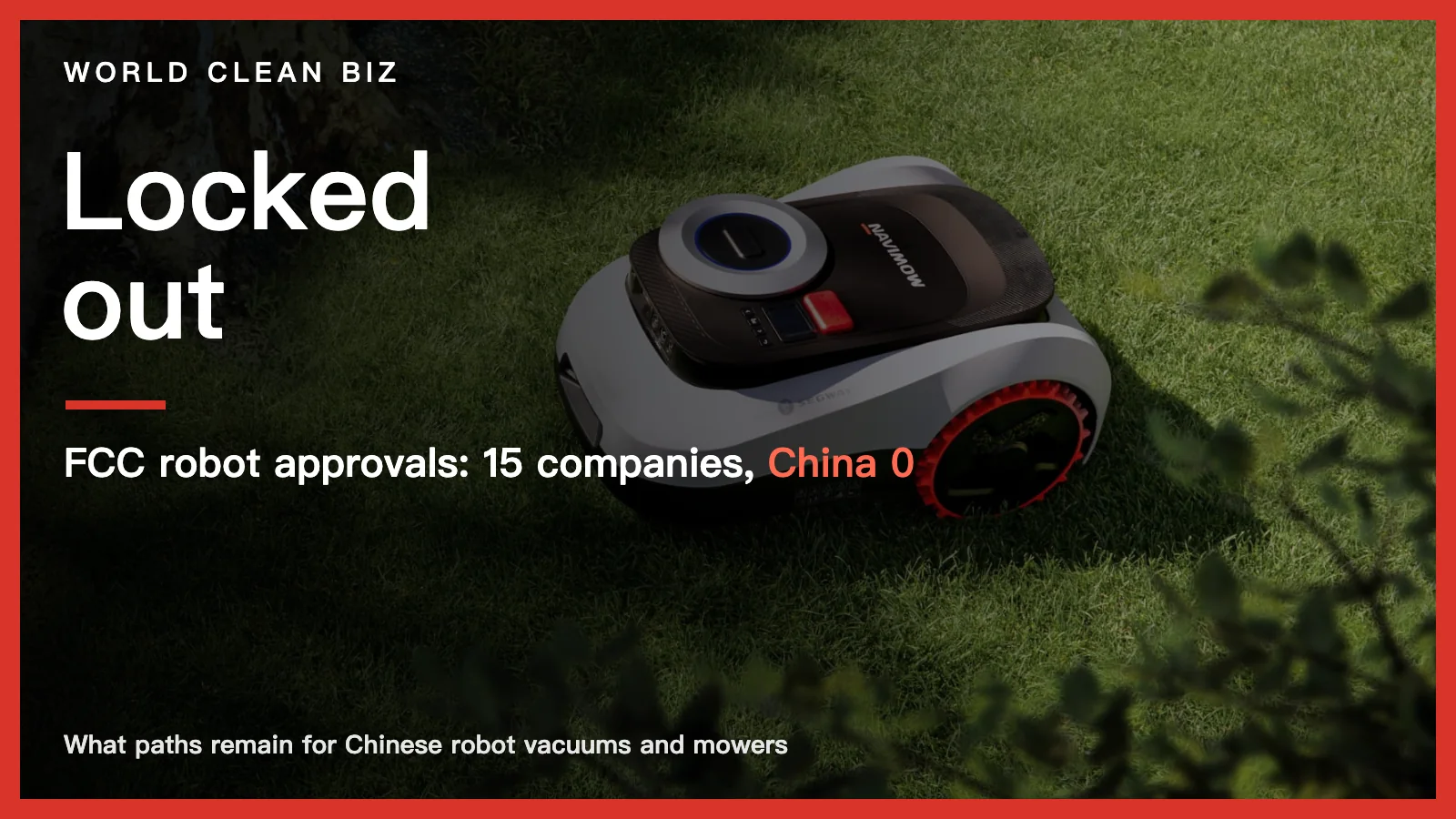
- As of November 6, 2026, 15 companies had FCC conditional approval for foreign-produced robots; none was a Chinese company.
- Approval has not required existing US production. Husqvarna no longer owns a US plant; the author thinks its most likely route is final assembly by Flex in Orangeburg, South Carolina.
- The author expects more Chinese companies to get through in 2027 by moving a core production step to the United States, combined with data and software commitments.
Part of the WCB topic:US Tariffs on Chinese Cleaning Appliances
On November 6, the FCC added two more companies to its list of conditional approvals for foreign-produced robots: the US arm of ABB Robotics and Pantograph Industries, an American firm.
A week earlier, on October 30, it had approved six: OMRON of Japan, ATI Motors and ARAPL of India, Swap Robotics of Canada, and Lightberry and SunScout of the United States.
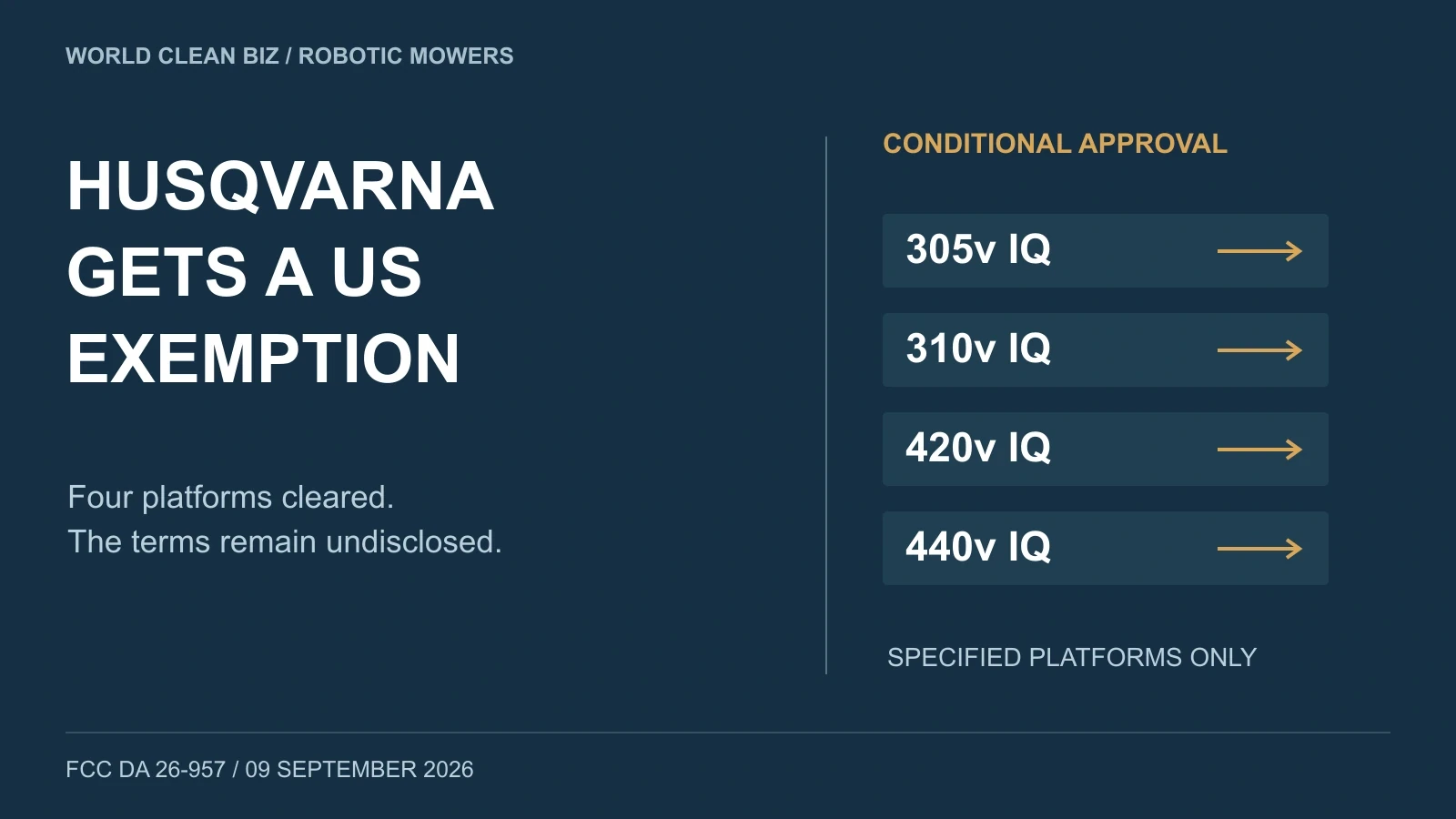
Less than two months after Husqvarna received the first approval on September 9, robots from 15 companies have been cleared. Two of them matter directly to the cleaning industry: four Husqvarna Automower platforms, and a robot vacuum and charging dock from Matic in California. The rest come from Japan, South Korea, India and Canada, with US startups making up the largest group. South Korea's T-Robotics won approval for its entire class of automated guided vehicles, so one application covers multiple future models.
None of the 15 is a Chinese company.
Two other developments arrived at the same time. In October, Intel asked the FCC for a waiver so it could make hardware, software and firmware changes to foreign-produced transport robots it has used in its chip fabs for more than two decades, arguing that the original replacement parts may no longer be available. The request is still pending. On October 29, DJI introduced a "Local Data Mode" for the ROMO 2 that disconnects the app from the internet and keeps data processing on the device. The ROMO 2 has still not entered the US market.
When the restrictions were announced, I wrote two pieces about them. At the end of July, I argued that the measure would probably prove more bark than bite and that exemptions would follow the hard line. After Husqvarna's approval in September, I looked at the routes it might have taken. Exemptions have indeed arrived, faster than I expected, but none has gone to a Chinese company.
I have always thought that putting robot vacuums and robotic mowers on this list served little purpose. The real target appears to be humanoids and embodied AI of the kind Figure builds, the field Washington cares about most and where competition between the US and China is fiercest. Robot vacuums and mowers have almost no US-based manufacturing. iRobot has long relied on contract manufacturers in Asia and is now controlled by its Shenzhen manufacturer, Picea. Shark does not run its own factories. Robotic mowing has no significant American player at all. Banning these categories protects no US company. In my view they were swept in because they fit the definition of a ground-moving, sensor-equipped, connected device. Because the leading companies in both industries are Chinese, the collateral damage falls almost entirely on Chinese firms.
Looking at the 15 approved companies together, a few patterns stand out.
First, approval does not require existing US production. Matic's co-founder has acknowledged to Forbes that although the company assembles in California, its US-sourced content falls short of the 65% threshold. It won approval with an onshoring plan setting out investment, hiring, facilities and milestones, along with full disclosure of its corporate structure, foreign ownership and supply chain. Several of the US startups on the list are small and unlikely to be able to manufacture at scale in the United States, yet they were approved too.
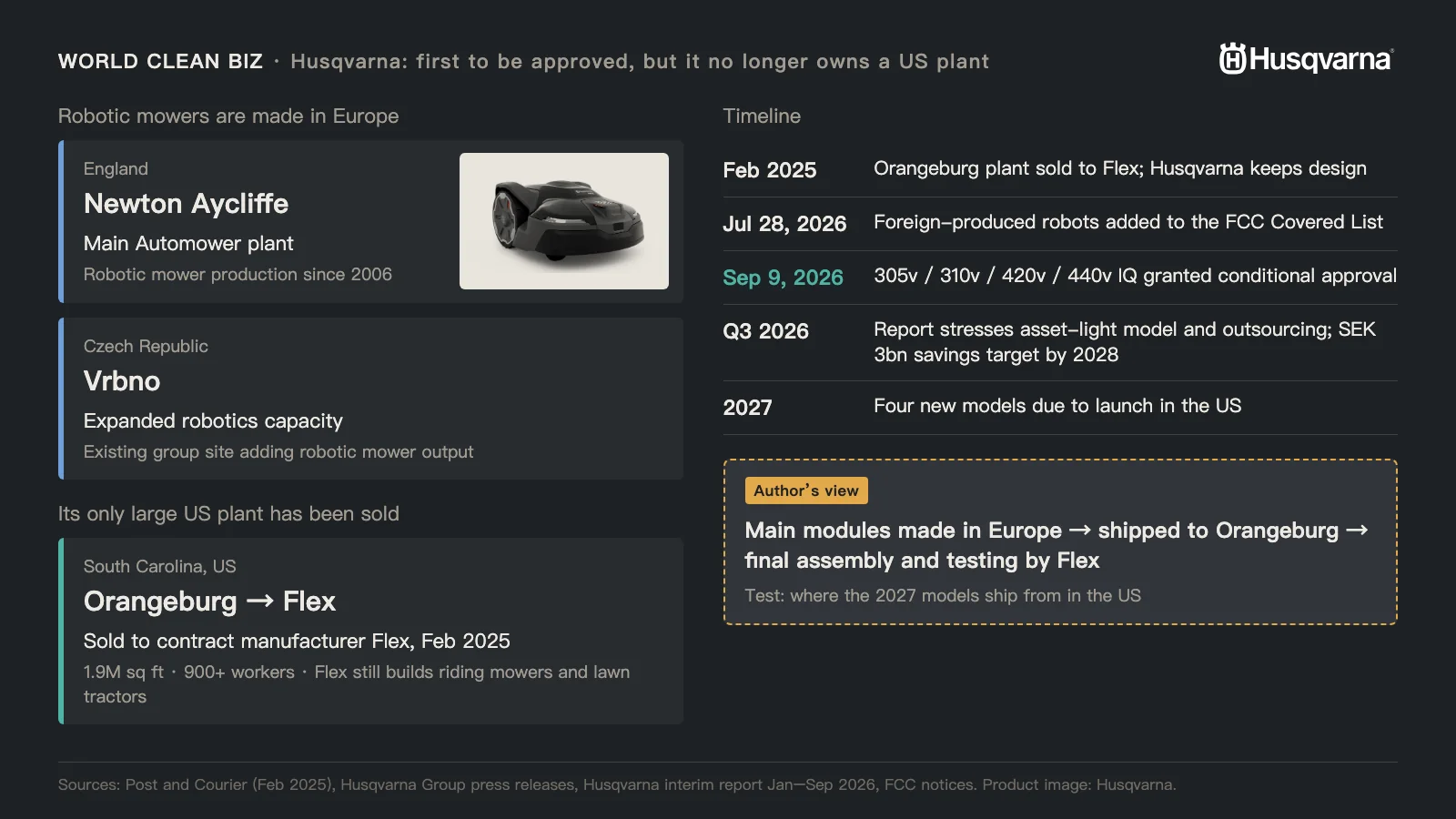
Husqvarna's case is even more telling. It was the first company approved, but it no longer owns a factory in the United States. In February 2025, Husqvarna sold its plant in Orangeburg, South Carolina, to the contract manufacturer Flex. The 1.9-million-square-foot site, with more than 900 workers, made riding mowers and lawn tractors; under a long-term agreement, Flex continues to make those products while Husqvarna keeps the design work. Husqvarna's robotic mowers have always been built in Newton Aycliffe in England and in the Czech Republic, never in the United States. In its third-quarter report, Husqvarna repeatedly stressed an asset-light model and more outsourcing. Its robotics business has fallen short of expectations this year, and the group is pursuing SEK 3 billion in cost savings.
Under those circumstances, it is unlikely that Husqvarna will pay to build its own robotic mower line in the United States. I think the more likely arrangement is for Flex to assemble the mowers in Orangeburg: main modules made in Europe, then shipped to the United States for final assembly and testing. The plant, workforce and supply relationship already exist, so little new investment would be needed. Where the four new models ship from when they launch in the US in 2027 should show whether this is what happened.
If so, today's onshoring plans are more about mapping a route than about building robots at scale in America.
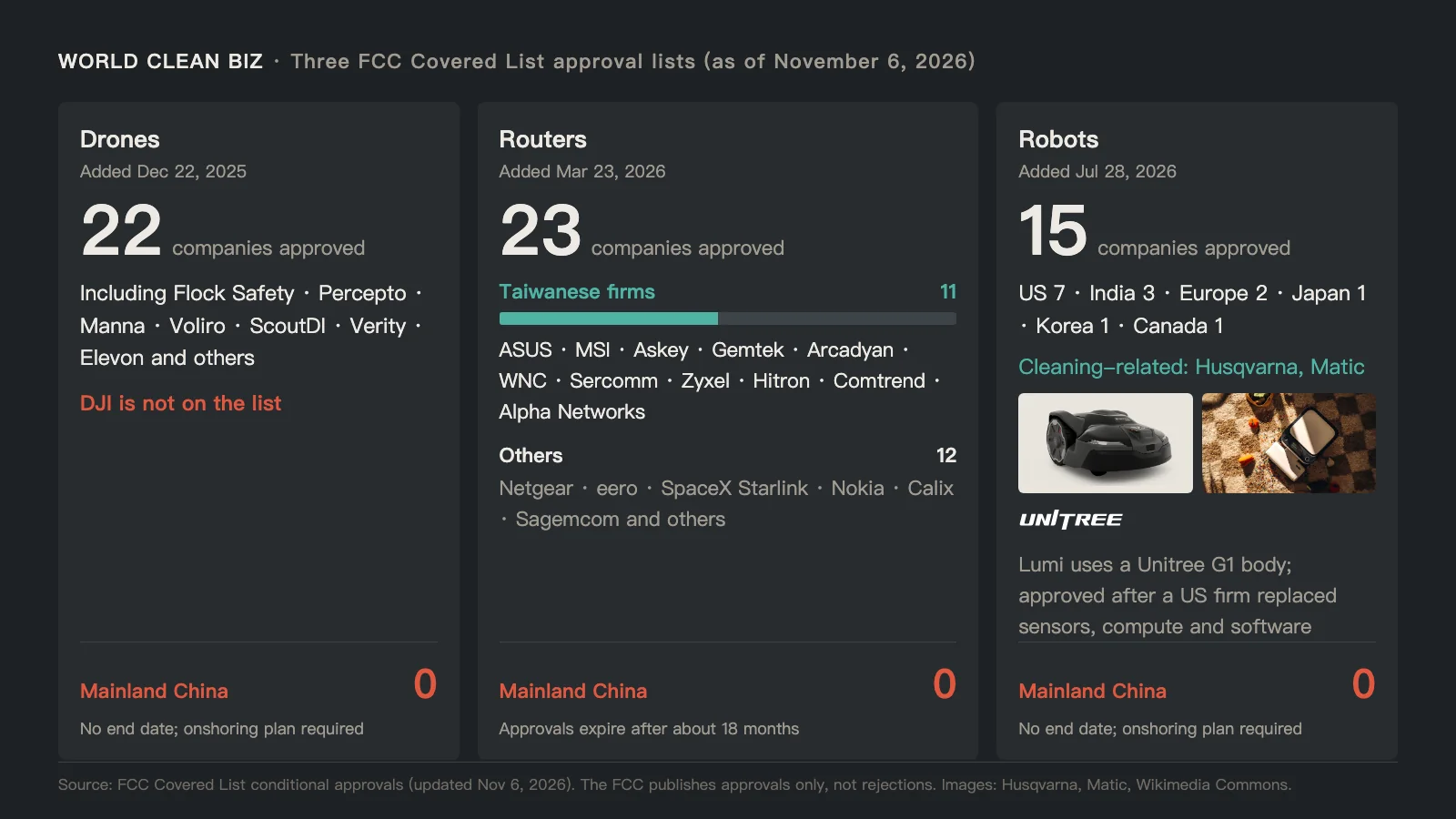
Second, the review appears to focus on who controls a product, not where it is made. Lightberry's humanoid, Lumi, uses the body of Unitree's G1 from Hangzhou. Lightberry replaced the sensors, main computer and software with its own, and the robot was approved. A Chinese-made body, it seems, is acceptable. A product controlled by a Chinese company, for now, is not.
The drone and router lists show a similar pattern. Foreign-produced routers were added to the Covered List in March, and more than 20 companies have since been approved, including a long list of Taiwanese firms: ASUS, MSI, Askey, Gemtek, Arcadyan, WNC, Sercomm and Zyxel. There is not a single company from mainland China, and DJI is absent from the drone list. The FCC publishes only approvals, not rejections, so public information cannot show whether Chinese companies have not applied or have applied without success. But judging from these lists, I believe the restrictions are aimed mainly at China, or more precisely, at Chinese control. The rules also extend to subsidiaries and affiliates, so registering a new US company does not avoid ownership disclosure. iRobot is the example: Roomba is still the robot vacuum Americans know best, but since Picea took control, regulators see it as the brand of a Chinese-owned company.
Third, everyone is still feeling their way. From what I have heard in the supply chain, some contacts, including people at large companies, are already in discussions with the US side, and some routes are reportedly being explored. Nothing has come of it yet, and the industry is waiting. I think that once one Chinese company is approved, others will follow quickly. After the first one gets through, everyone will understand how to prepare the application, what commitments are needed and how far Washington is prepared to go.
How much is at stake for Chinese companies?
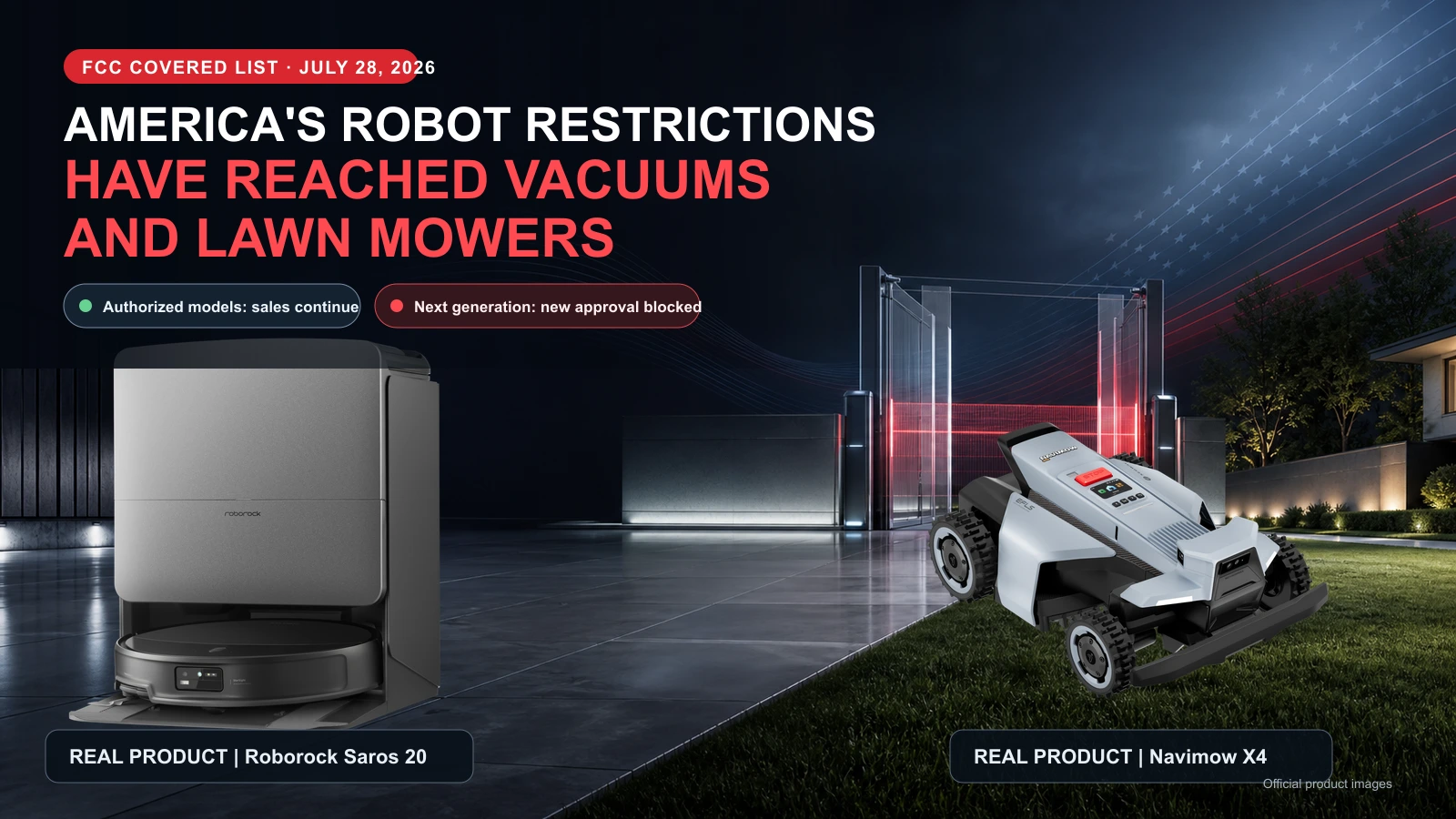
Roborock's overseas revenue reached RMB 10.4 billion in 2025, 56% of its total and up 63% year on year, and the United States is one of its most important markets. Navimow, Segway-Ninebot's robotic mower brand, generated RMB 2 billion in 2025 from 338,900 units. Most of those sales are in Europe, but Segway-Ninebot now ranks North America alongside Europe as a main market. For robot vacuums, the restrictions hit an existing business. For robotic mowers, they hit the next growth market.
In the short term, companies can rely on the FCC authorizations they obtained before the ban. The rule turns on the authorization date, not the launch date, so new products certified before the ban but not yet launched are now the most valuable assets companies hold.
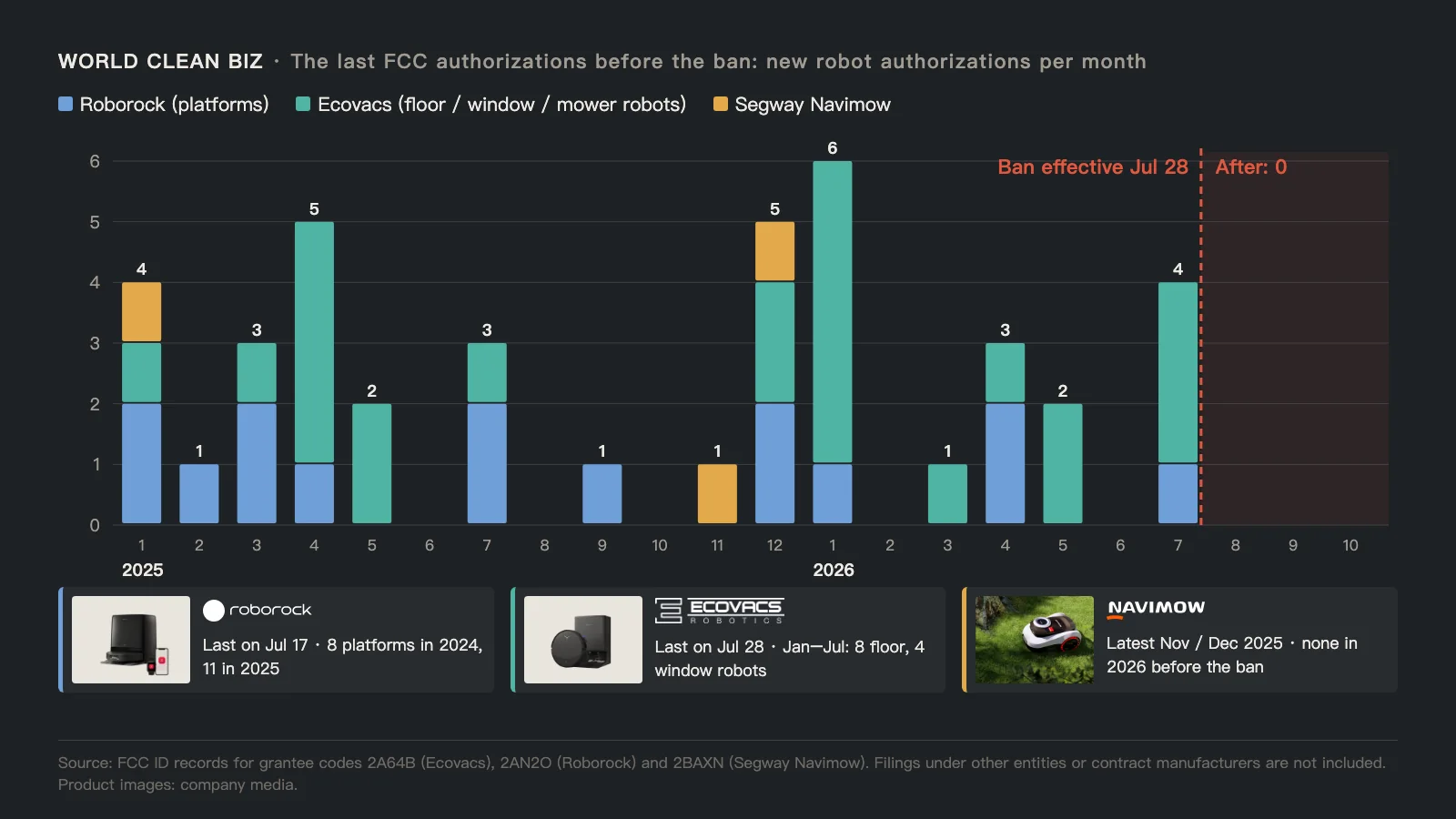
FCC records show that leading companies rushed to certify products before the deadline. Ecovacs received robot vacuum authorizations on July 16 and July 21, and its last came on July 28, the day the ban took effect. Between January and July 2026 it certified eight floor-cleaning robots and four window-cleaning robots. Roborock's last authorization came on July 17, eleven days before the ban. It certified eight new platforms in 2024 and eleven in 2025; since July it has certified none. Segway Navimow's two most recent robotic mower authorizations date from November and December 2025, with nothing new in 2026 before the ban. On August 19, Ecovacs also registered a new applicant entity, Ecovacs Lingding Service Robot (Zhejiang), which has not yet filed any application.
Companies with more unreleased models in their certification pipeline can hold out in the United States for another year or two. Previously authorized models can receive software and firmware updates until at least January 1, 2029, but any hardware change requires a new authorization. A discontinued chip or a replaced module in the supply chain could count as a hardware change. If Intel's request is granted, or if the hardware-change rule the FCC proposed in July is adopted, older models could still receive minor revisions. If neither happens, the number of models companies can sell will keep shrinking.
Taken together, Chinese cleaning companies now have a handful of options.
The most practical is to protect current sales with existing authorizations and software updates. There is some room at the product level too. The FCC has explicitly excluded pool robots that operate only underwater, so Shenzhen brands such as Aiper and Beatbot can offer underwater-only versions in the United States. Cordless vacuums and wet-dry floor cleaners are unaffected: iRobot launched its first non-robotic floor cleaner in May, and Narwal brought a cordless vacuum to the US in early November. Those products at least keep brands, channels and service teams running in America. Whether unconnected robot vacuums or window-cleaning robots fall outside the rules, the FCC has not said, and definitions can change: the definition for power inverters, added to the list on the same day as robots, was rewritten within a month. These are stopgaps.
In the long run, conditional approval is unavoidable, either through a company's own application or through an American partner. Applying directly would mean keeping US user data in the United States under the control of a US entity, ensuring devices work offline, opening firmware and cloud systems to third-party audits, and committing to a timetable that starts with final assembly in the United States. Working through a partner could follow Lumi's model: a Chinese factory provides the chassis, motors, fans, docks and full manufacturing, while a US company supplies the sensors, main controller, navigation software and cloud. Commercial cleaning already divides work this way. Brain Corp in the US does not make floor scrubbers; it supplies the navigation systems for robotic scrubbers from Tennant and others, and Tennant invested $32 million in it in 2024. The most likely US partners are American appliance brands that already rely on Asian contract manufacturing; Shark has publicly said it is confident about launching future models. The price for Chinese companies is giving up navigation algorithms, apps, user data and brands.
Producing complete robots in the United States seems unlikely to me. Reaching more than 65% US content would require motors, sensors and power supplies, the biggest cost items, which are hard to source in America. Even Matic, which assembles in California, falls short, and the threshold rises to 75% in 2029. A more realistic option is to follow Husqvarna and use a US contract manufacturer such as Flex for final assembly as the first step of an onshoring plan. A contract manufacturer solves the production-location problem, but control still has to be addressed separately. Capacity moved to Vietnam or Thailand in recent years to avoid tariffs does not help either: the rule concerns foreign production, not Chinese production.
Commercial cleaning companies should also watch the outcome of Intel's request. Intel argues that its robots work only inside its own plants, that no US alternative exists and that blocking maintenance would itself create supply-chain risk. Commercial cleaning robots also serve large institutional customers such as supermarkets, airports, hospitals and warehouses. If Intel succeeds, those customers could use the same argument to seek maintenance and upgrades for robots already deployed.
Looking further ahead, I think the United States will probably make some compromises.
The United States has no domestic capacity to make robot vacuums or robotic mowers. Even if every Chinese company were shut out, it could not produce competitive products, and American consumers and retailers would bear the cost.
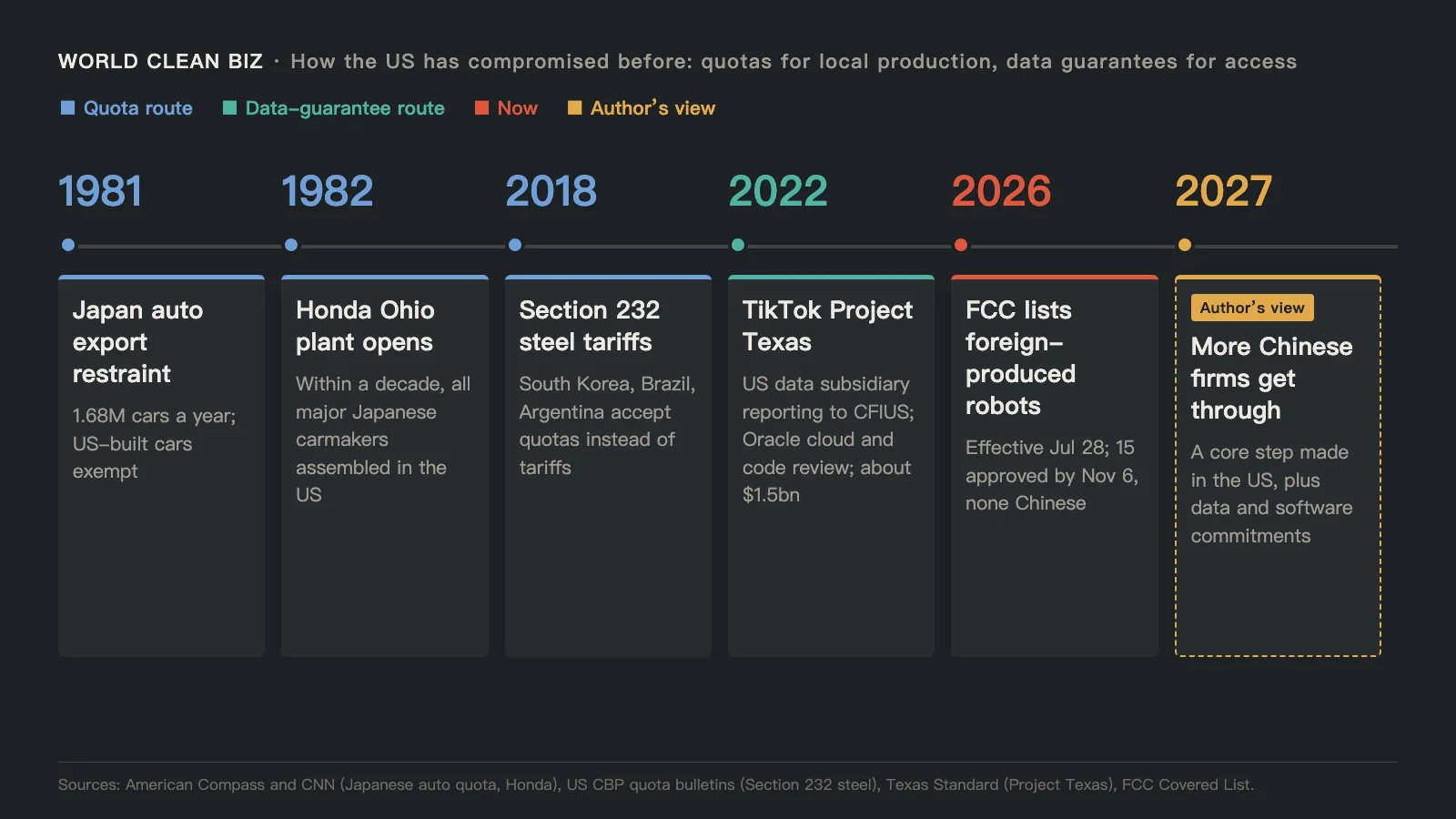
There is precedent. Under TikTok's Project Texas, the company set up a US data security subsidiary whose board reports directly to the Committee on Foreign Investment in the United States, routed US user data through Oracle's cloud and gave Oracle source-code review, at a cost of about $1.5 billion. Cleaning robots handle far less data, and far less sensitive data, than TikTok, so a similar arrangement would cost much less. Cleaning robots could follow that route: companies make commitments on core components and core data, such as storing data in the United States or another designated location and opening firmware and cloud systems to review, in exchange for special approval.
Quotas are another possibility. In 1981, the United States had Japan limit car exports to 1.68 million vehicles a year, with US-built cars exempt. Honda opened its plant in Ohio the following year, and within a decade every major Japanese carmaker was assembling vehicles in America. Under the 2018 Section 232 steel tariffs, South Korea, Brazil and Argentina accepted quotas in exchange for tariff exemptions. If cleaning robots end up under tariff-rate or sales quotas, the result could be similar: sales within the quota proceed normally, and selling more requires some production in the United States.
Several dates matter. Law firms read the rules as closing applications for conditional approval on January 1, 2028. The software-update waiver for older models runs until at least January 1, 2029, and the domestic-content threshold for a "US-made" product rises from 65% to 75% that same year. Robotic mowers face an earlier deadline: spring 2027 is the peak US selling season. Husqvarna's four new models will launch normally, and Chinese brands without approval by then will have to compete with existing models.
My view is that more Chinese companies will probably find a way through in 2027. The most likely approach is to move one core production step to the United States, such as final assembly, main boards or other key components, and combine it with data and software arrangements to secure conditional approval. Husqvarna's arrangement with Flex and the Japanese carmakers' move to American assembly both offer a reference.
Which company, which production step and on what terms remain to be seen.
*This article is policy and industry analysis, not legal advice. FCC authorization dates are taken from FCC ID database records. Judgments about the intent of the restrictions, Husqvarna's onshoring plan and future developments are the author's own estimates.*
Sources: FCC Covered List and conditional approvals · FCC robot and inverter FAQ · Post and Courier on Husqvarna's Orangeburg plant · Husqvarna robotics manufacturing · Husqvarna Q3 2026 report · Humanoids Daily on Lightberry Lumi · DroneXL on Intel's waiver request · Roborock 2025 overseas revenue · FCC ID records for Ecovacs, Roborock and Segway Navimow · Texas Standard on Project Texas · American Compass on the 1981 auto quota · CBP on Section 232 steel quotas
 ECOVACS
 Husqvarna
 Roborock