Previous episode: Episode 03 | The Golden Age Begins.
Next episode: Episode 05 | Hitting Rock Bottom.
Complete series: Building the World’s No.1 Cleaning Show from Scratch.
The golden age of the cleaning industry began in 2020. In 2021, it reached its peak.
The brightest company that year was, without question, Ecovacs Group.
In 2021, Ecovacs Group generated RMB 13.086 billion in revenue, up 80.90%, and more than RMB 2 billion in net profit, up 213.51%. The Ecovacs service-robotics brand contributed RMB 6.710 billion, while Tineco generated RMB 5.137 billion.
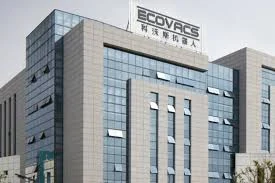
Ecovacs Group headquarters.
Tineco shipped 2.671 million units during the year and captured roughly 69.7% of China’s online floor-washer market. The FLOOR ONE 2.0 series alone generated more than RMB 2 billion in revenue. Competitors were still copying Tineco’s first-generation floor washer while Tineco was already launching several models at different price points, turning one hit product into a complete product line.
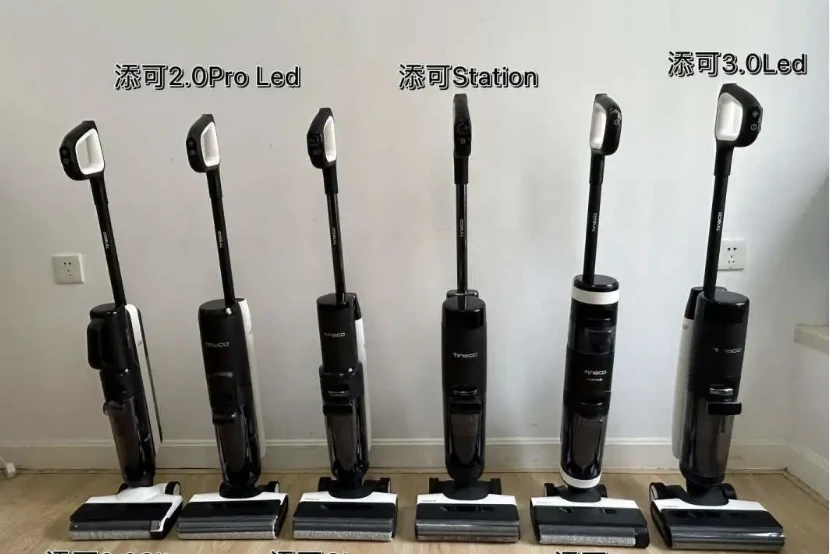
Tineco rapidly built a complete floor-washer product line.
Ecovacs also launched the DEEBOT X1 OMNI, bringing automatic dust collection, mop washing, and water replenishment together in one dock. By the end of 2021, the X1 series had sold more than 200,000 units and generated close to RMB 1 billion in revenue.
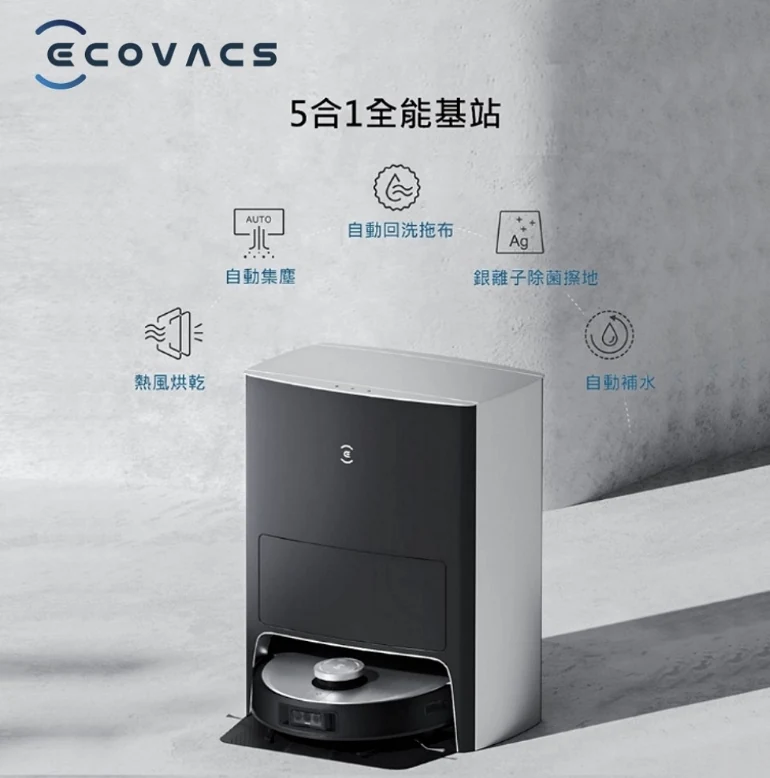
The DEEBOT X1 OMNI brought several automated functions into one all-in-one station.
Narwal had proved that consumers would accept a robot vacuum with a self-cleaning dock. Ecovacs then turned the dock into a more complete cleaning system. From that point on, the robot-vacuum industry entered the era of the robot plus the all-in-one station.
Ecovacs founder Qian Dongqi became a legend within the industry that year. People had once dismissed Ecovacs as a company that only knew how to market. In 2021, it led both the all-in-one robot-vacuum market and the floor-washer market, while turning the previously little-known Tineco into one of the great success stories in China’s appliance industry.
Ecovacs Group’s market capitalization briefly exceeded RMB 150 billion, and its share price rose as much as 27-fold. Many Ecovacs employees achieved financial independence. The wealth extended to its partners: some Tineco distributors made tens of millions of renminbi, while suppliers also earned exceptional profits from the brand’s growth.
After the expansion of 2020, competitors moved into floor washers at full speed. The most aggressive challenger was Dreame.
Dreame had broken through with cordless vacuums in 2019. In 2021, it launched the H11, its first floor washer, and began a direct assault on Tineco.
In October 2021, Dreame completed a RMB 3.6 billion Series C financing round at a valuation of roughly RMB 17 billion. It was one of the largest financing rounds the cleaning industry had seen and immediately electrified both the industrial and investment communities.
I later asked Yu Hao, “Why raise so much money in a single round?”
He told me that the amount of money available in the market was finite. If Dreame did not take it, a competitor would.
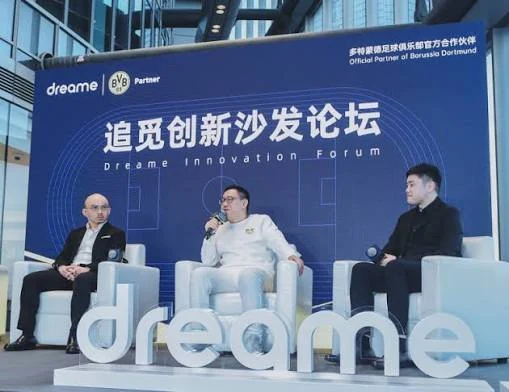
A Dreame Innovation Forum.
That RMB 3.6 billion became critical to Dreame’s next stage. The money was quickly converted into engineers, products, advertising, and channel investment. It also funded the company’s attack on Douyin.
At the time, Tineco’s floor washers dominated online and offline channels. On JD.com, customers sometimes had to wait 30 days for delivery. Breaking through that blockade looked almost impossible.
Dreame chose Douyin. Ecommerce on the platform was still young, and Tineco did not yet control it. Dreame directed most of its marketing budget there, first offering higher commissions to attract Tineco distributors and content creators, then spending heavily to buy traffic.
The industry said that Dreame offered some creators and livestream rooms commissions of 25% to 30%, together with policies such as 30-day returns. Whenever one method worked, the company quickly replicated it across more livestream rooms.
At the time, people in the industry generally believed that a Douyin return on ad spend of around 1:3 was needed to break even. Dreame sometimes continued investing even when it was only 1:0.5. The immediate goal was not profit. It was to become the No.1 floor-washer brand on Douyin.
High commissions, paid traffic, return shipping, and channel costs required enormous capital. The industry once circulated a claim that Dreame spent RMB 1 billion marketing on Douyin. Without the RMB 3.6 billion financing round, that strategy would have been difficult to sustain.
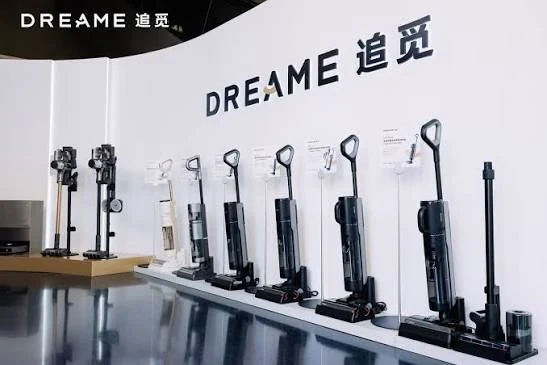
Dreame rapidly expanded its cleaning-product lineup.
Without Dreame’s aggressive attack, Tineco might have enjoyed another two years of rapid growth and high margins.
Roborock reached a peak in the capital markets as well.
In May 2021, Roborock’s share price approached RMB 1,500 and its market capitalization neared RMB 100 billion, earning it the nickname “the Moutai of robot vacuums.” The company generated RMB 5.837 billion in revenue and RMB 1.402 billion in net profit that year. Overseas revenue reached RMB 3.364 billion, or 57.63% of the total, while R&D spending reached RMB 441 million.
Roborock reached the high point of its capital-market story in 2021.
A relatively young robot-vacuum company had reached a valuation of nearly RMB 100 billion. Investors became convinced that the cleaning-robot industry would produce another Roborock.
As Roborock’s market capitalization rose, Narwal became another star pursued by capital. When Narwal’s sales reached more than RMB 1 billion, investors benchmarked it against Roborock, and valuations of around RMB 30 billion circulated in the industry.
I received messages from investor friends asking whether there were any promising projects left in the sector. Some also asked me to connect them with Narwal in the hope of joining a financing round.
Investors saw Narwal’s sales, innovation, and growth. They also began scrutinizing its algorithms, product delivery, team expansion, and next generation of products. Once the Ecovacs X1 appeared, a dock focused only on self-cleaning quickly faced competition from an all-in-one station. Product cycles across the industry accelerated.
Tineco, Dreame, Roborock, and Narwal pushed financing and valuations across the cleaning industry to their high point. Money from far outside the sector began to pour in.
Zheng Quan, formerly a vice president at Lumi United, raised more than RMB 100 million, established Jiakechong Intelligence, and launched the Xiaowu (XWOW) floor-washing robot. Appliance groups including Joyoung, Supor, Midea, and Haier also increased their investment in cleaning appliances.
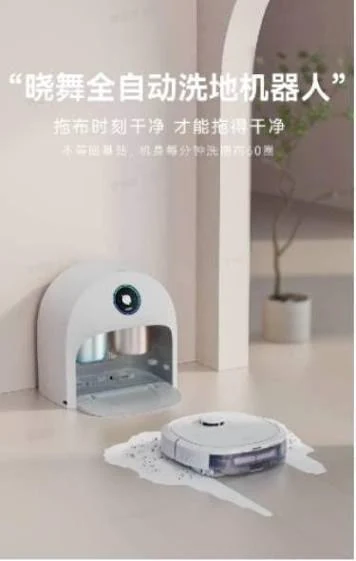
The Xiaowu (XWOW) floor-washing robot from Jiakechong Intelligence.
Haier’s robot-vacuum division expanded aggressively into floor washers and released several models. Its flagship used a dual-roller floor-washer platform developed by Picea. Haier later invested in Picea, and the two companies entered a strategic partnership.
Midea’s cleaning-appliance business was still managed within its microwave and cleaning division. In 2021, Midea began promoting Eureka, the acquired brand, more heavily in China and appointed Jackson Yee as its ambassador while pursuing a target of RMB 10 billion.
UWANT founder Yang Yongbo also left the Bissell distribution system during this period, founded UWANT, and secured investment from Sequoia Capital China. In those years, Sequoia also invested in projects including X-SHINE, Philips Domestic Appliances, and Gree Electric.
UWANT entered upholstery cleaners and mite-removal vacuums. Mite-removal vacuums were already an exhausted category in China, with most products priced between RMB 99 and RMB 199. Yang developed a dual-cup model and sold it for more than RMB 499. UWANT later became a category leader and now sells roughly six million mite-removal vacuums a year.
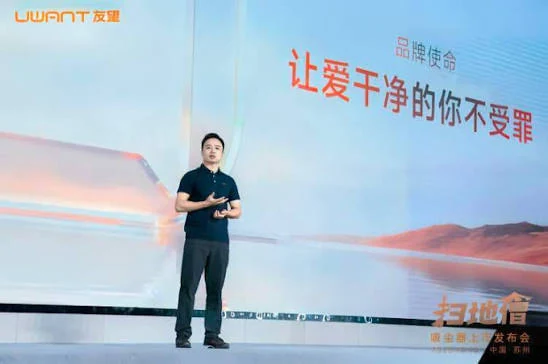
UWANT founder Yang Yongbo at a brand event.
UWANT was built from the ground up. Every major competitor it faced was many times its size. It survived through small but meaningful product innovations and relatively inexpensive, effective marketing, finding new room inside categories that others believed were already mature.
The floor-washer boom also produced competing technology routes.
Hizero used a polymer roller rather than a suction motor, relying on the roller to carry debris into a tray. The architecture offered lower cost and less noise, but it was less effective with certain types of debris.
Part of the Hizero team later left to establish Diisea, promoting a similar water-and-debris cleaning route. As Tineco’s suction-motor-and-brush-roll architecture became the market standard, non-suction systems remained a niche used by only a small number of brands.
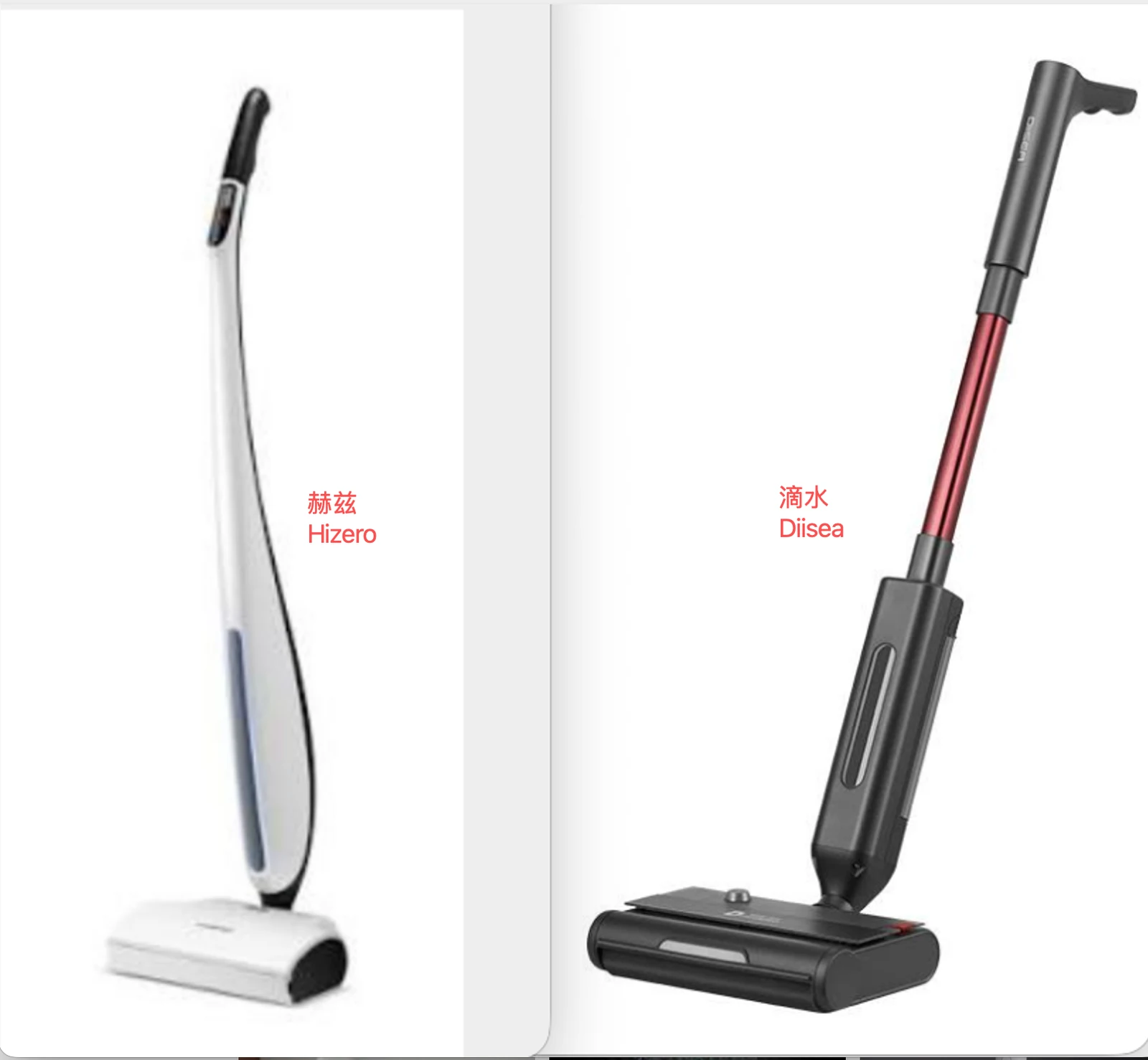
Hizero and Diisea represented an alternative non-suction cleaning architecture.
Brands were fighting for the market. The supply chain was becoming even more frenzied.
Demand for floor washers exploded before factories had mature platforms ready. Dongguan-based Shangsimai was one of the first factories to develop a workable floor washer, and almost every brand entering the category approached it. One story circulated widely in the industry: Mr. Shen of Shangsimai made around RMB 100 million in profit during those two years.
Shangsimai had also been a shareholder in BOBOT, an electric-mop brand that began with dual-disc machines. While competing products sold for RMB 399 or RMB 499, BOBOT could sell an electric mop for more than RMB 2,000. It was also one of the early cleaning brands to capture traffic on Xiaohongshu.

An early BOBOT dual-disc electric mop.
Before the floor-washer market took off, friends from BOBOT approached me and said they wanted to enter the category with an annual target of 40,000 to 50,000 units. I introduced them to a large company to develop the product together.
For several reasons, the BOBOT floor washer was delayed by more than six months. It missed the most profitable stage of the market, although it still caught the later part of the boom. The company also supplied products to Dreame’s Dawei brand and later received investment from listed company Longtech Smart. Afterward, for a variety of reasons, BOBOT gradually disappeared from the industry.
Suzhou vacuum factories were not the only companies rushing into floor washers. Shenzhen companies that had previously made robot vacuums did the same. Picea, Lesheng, Silver Star, and others launched floor washers or their own brands. Two years later, many discovered that crossing into the category had brought neither profit nor growth, only very real losses.
Capital markets were also opening a brief listing window for manufacturers.
On October 21, 2021, Dechang, a major contract manufacturer for TTI, listed on the Shanghai Stock Exchange and raised more than RMB 1.6 billion in its initial public offering. When I joined Chunlan in 2006, Dechang was still one of Chunlan’s suppliers. Fifteen years later, it was a public company.
On November 22, 2021, Fujia, a major Shark contract manufacturer, also entered the public markets.
Dechang and Fujia both entered the capital markets in 2021.
Their listings reignited the industry’s enthusiasm. Companies with similar scale and customer portfolios could suddenly imagine their own path to an IPO. The window lasted only a short time. Roughly six months later, the opportunity began to close.
Dreame’s expansion also triggered a period of inflation across the industry. Monthly salaries for engineers rose from a little over RMB 10,000 to RMB 30,000–50,000. Companies established or expanded R&D teams in Suzhou. Picea, Shunzao, and others added engineers, and Deerma later moved some of its R&D resources there as well.
Suzhou accumulated more and more engineers working on robot vacuums, floor washers, and cordless vacuums. It was a golden age for small-appliance engineers. Jobs were everywhere, and changing employers could bring a pay increase of at least 50%.
Douyin brand livestreaming was just beginning. Livestream commerce still relied mainly on leading personalities such as Luo Yonghao, who could sell several hundred million renminbi of products in a single evening. Most of the commissions went to the top creators. Douyin then began encouraging brands to run their own livestream rooms, allowing the platform to earn both traffic fees and transaction commissions.
While waiting for my own new products to launch, I had some free time and began experimenting with review livestreams.
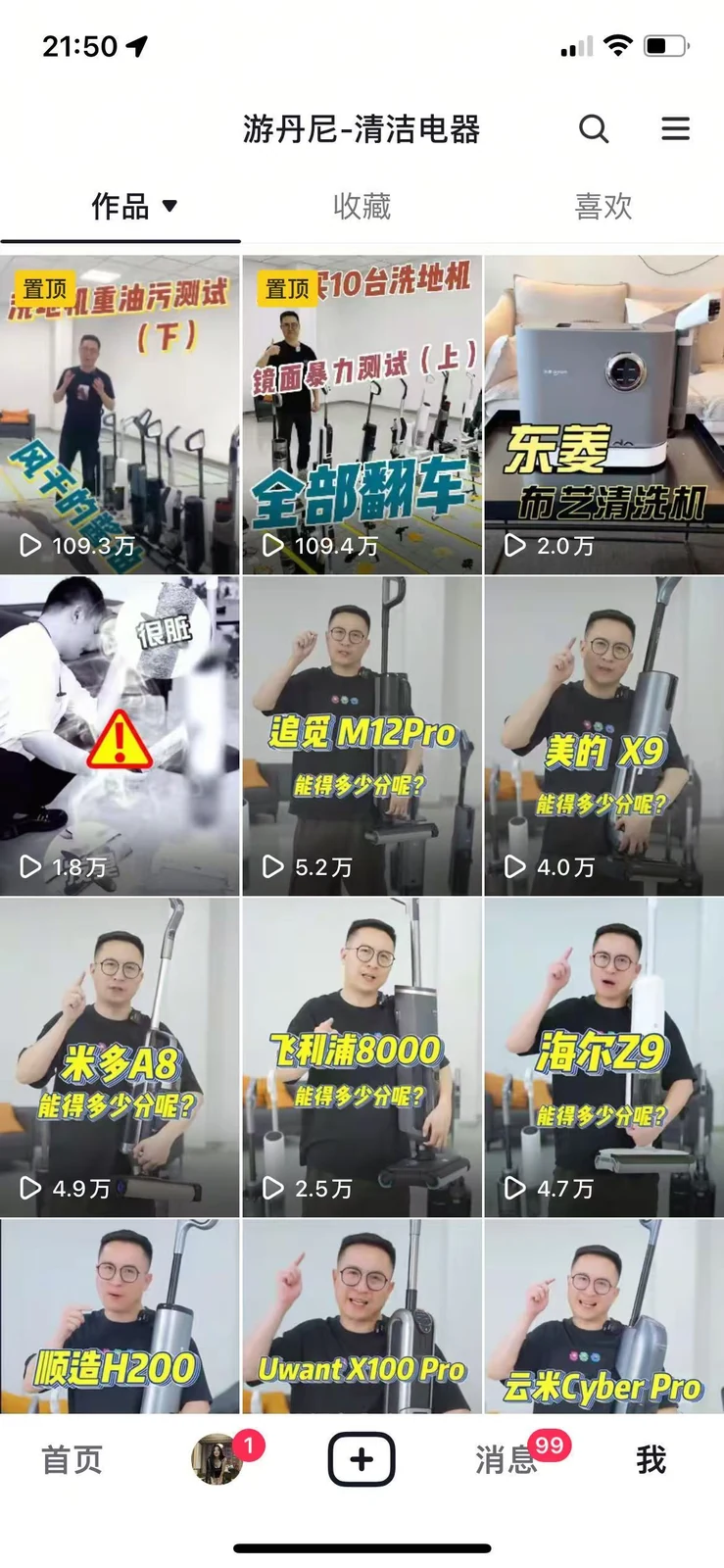
Some of my early floor-washer review videos on Douyin.
We quickly became one of the leading floor-washer review rooms. A two-hour session could sell tens of thousands of renminbi of products. Dreame, Ecovacs, Tineco, Roborock, and other brands sent us samples and asked to participate in reviews and commercial collaborations.
We were among the first people to pour soy sauce across the floor during a livestream. Douyin’s algorithm behaved strangely: the more soy sauce we poured, the more people entered the room.
Watching a floor washer collect soy sauce, eggs, and noodles was far easier for consumers to understand than listening to a list of specifications. One striking cleaning scene could produce a surge of traffic and orders.
Several months later, our own new products came to market. I stopped livestreaming and focused on selling them.
Over the next few years, floor-washer review livestreaming grew into an industry capable of generating tens of millions—and in some cases more than RMB 100 million—in annual profit. The small niche I had unintentionally opened became an important sales channel for floor washers on Douyin.
More independent review rooms appeared. Some leading rooms sold several hundred million renminbi of products a year. Parts of the business moved into a gray zone: a review room could decide what to test, how to test it, and which machine would appear to perform best.
In 2026, CCTV and other media outlets exposed a number of floor-washer review rooms. Reports described reviewers disabling functions on competing products, using different concentrations of soy sauce, and arranging coordinated audience comments.
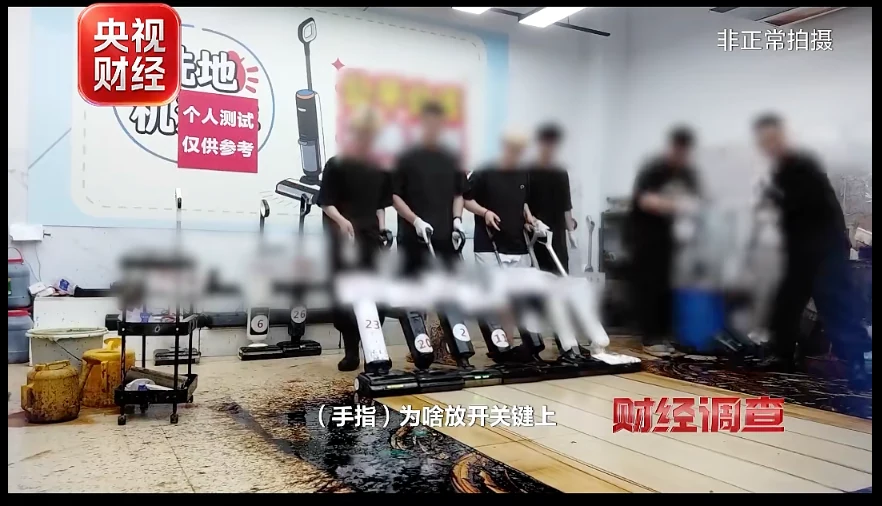
CCTV Finance investigating manipulation in floor-washer review rooms.
During my brief time livestreaming, brands, factories, engineers, distributors, and investors also contacted me through products and projects. I had not yet thought about organizing WCB. I was simply introducing people, connecting resources, and exchanging information across the industry.
On the other side of the market, Amazon’s seller-account suspension wave erupted in 2021.
Amazon began a large-scale crackdown on Chinese cross-border sellers in 2021.
In 2020, cross-border ecommerce had been one of the hottest businesses in China. An Amazon seller could reach several hundred million renminbi in sales within a short period, and a noticeable group of buyers at Shenzhen Bay One came from the industry.
In May 2021, products from Mpow, Aukey, and other brands began disappearing from Amazon. RAVPower, TaoTronics, VAVA, and others were later affected. Amazon eventually said that the enforcement action had closed about 3,000 seller accounts associated with roughly 600 Chinese brands. Accounts, funds, and inventory were frozen.
Youkeshu disclosed that around 340 of its sites had been suspended, freezing approximately RMB 130 million. Cross-border ecommerce had been treated as a wealth-creation miracle only a year earlier. It now faced widespread losses and business failures.
Factories supplying Amazon sellers were left with inventory and large losses. The first wave of leading cross-border brands gradually withdrew from the cleaning-appliance market. Smaller sellers that had struggled in their shadow saw an opening and began moving in.
iRobot and Dyson remained important global cleaning companies in 2021, but the direction of the Chinese market had changed.
iRobot generated US$1.565 billion in revenue, a record high, but operating profit was close to zero and operating cash flow had turned negative. Pandemic restrictions and interrupted international travel left the company slow to recognize the product changes taking place in China and increasingly disconnected from the speed of local iteration. The shift would later become central to the financial crisis at iRobot and Picea’s eventual takeover of the company.
Dyson remained the benchmark in China’s premium cordless-vacuum market, but floor washers were pulling consumer attention and sales toward a new product form. The change that began in the first year of the cleaning industry’s golden age was accelerating.
My first product began generating revenue in 2020 and eventually reached tens of millions of renminbi in sales. In 2021, I invested in several more products. The entire industry was expanding, and I assumed the market would continue to grow. That optimism would cost me heavily over the following years.
By the end of 2021, the industry was filled with confidence. Raising money felt almost as ordinary as drinking water. Brands, factories, and product-development companies all believed that they could become the next public company.
2021 was the peak of this golden age. Immediately beyond the peak was a cliff—and a rapid fall into the valley below.