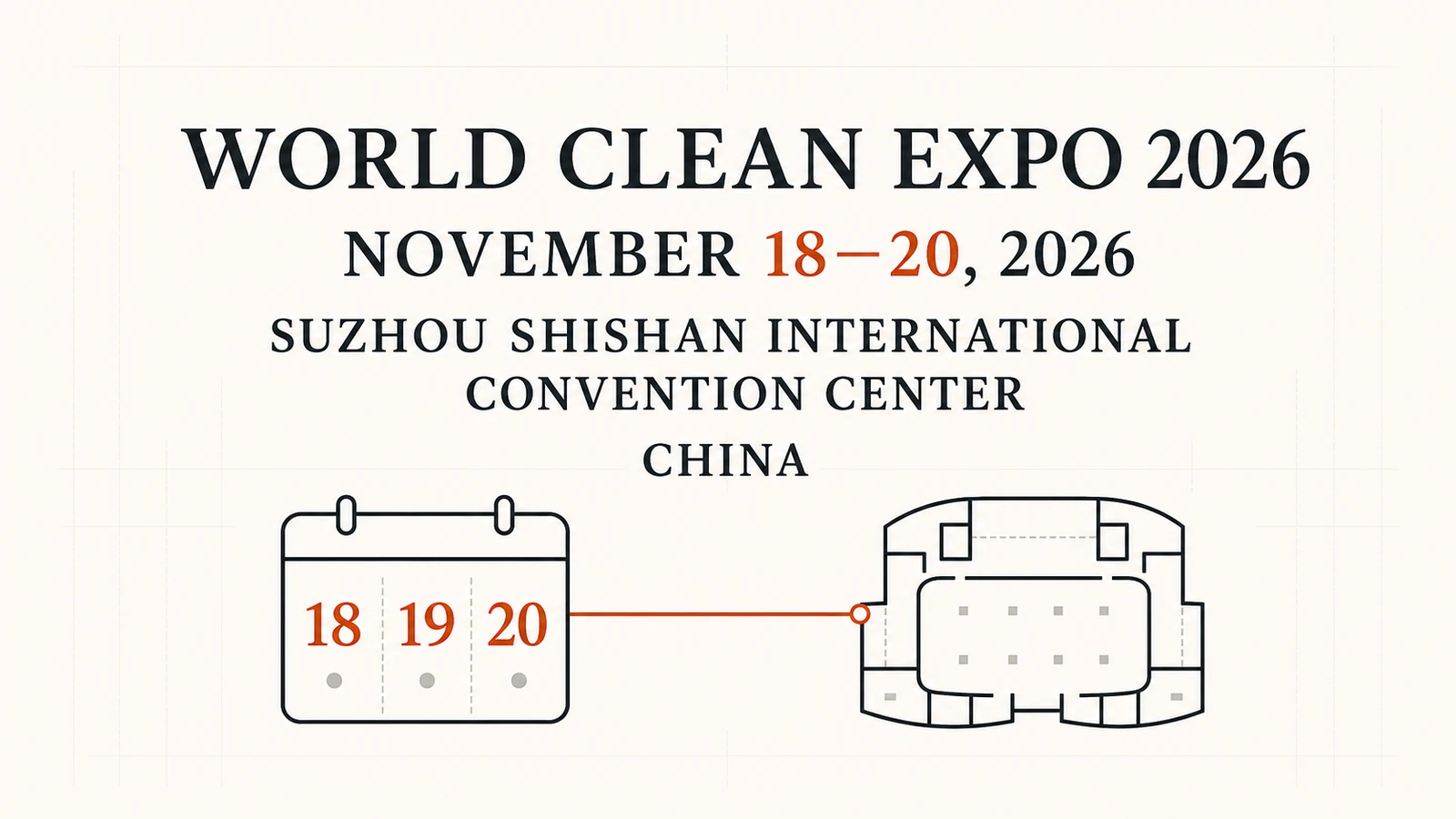
Last week, I announced the official launch of the 2026 World Clean Expo. It will take place on November 18–20, 2026, at the Suzhou Shishan International Convention Center in China.
Over the past few days, I have made a more aggressive decision: from now on, I will document the entire process of building WCB until it becomes the world’s No.1 cleaning show.
“World’s No.1” is a goal for the next three to five years. Today, WCB is only getting started. Every booth still has to be sold. Every exhibitor has to be won over one conversation at a time. Our international buyer program is also starting from zero.
This approach is often called “building in public.” People will see what we get right, but they will also see the mistakes we make. I hope that openness will bring us more honest information and help me correct my judgment along the way.
The series may continue for several years. If I write every week only about booth sales and trade-show operations, readers will probably lose interest quickly. So I will connect the story of WCB with my own entrepreneurial journey, the changes I have witnessed in the cleaning industry, and the stories of the companies and people working in it.
The first episode begins with me.
Many people who have had me on WeChat for years still do not know exactly what I do. When we meet for the first time, I am often asked, “Is You Denny a pen name? What is your real name?”
My family name is You, and my English name is Denny. When I began writing on my WeChat public account in 2017, I combined them in surname-first order and used “You Denny”—written in Chinese as 游丹尼—as my byline.
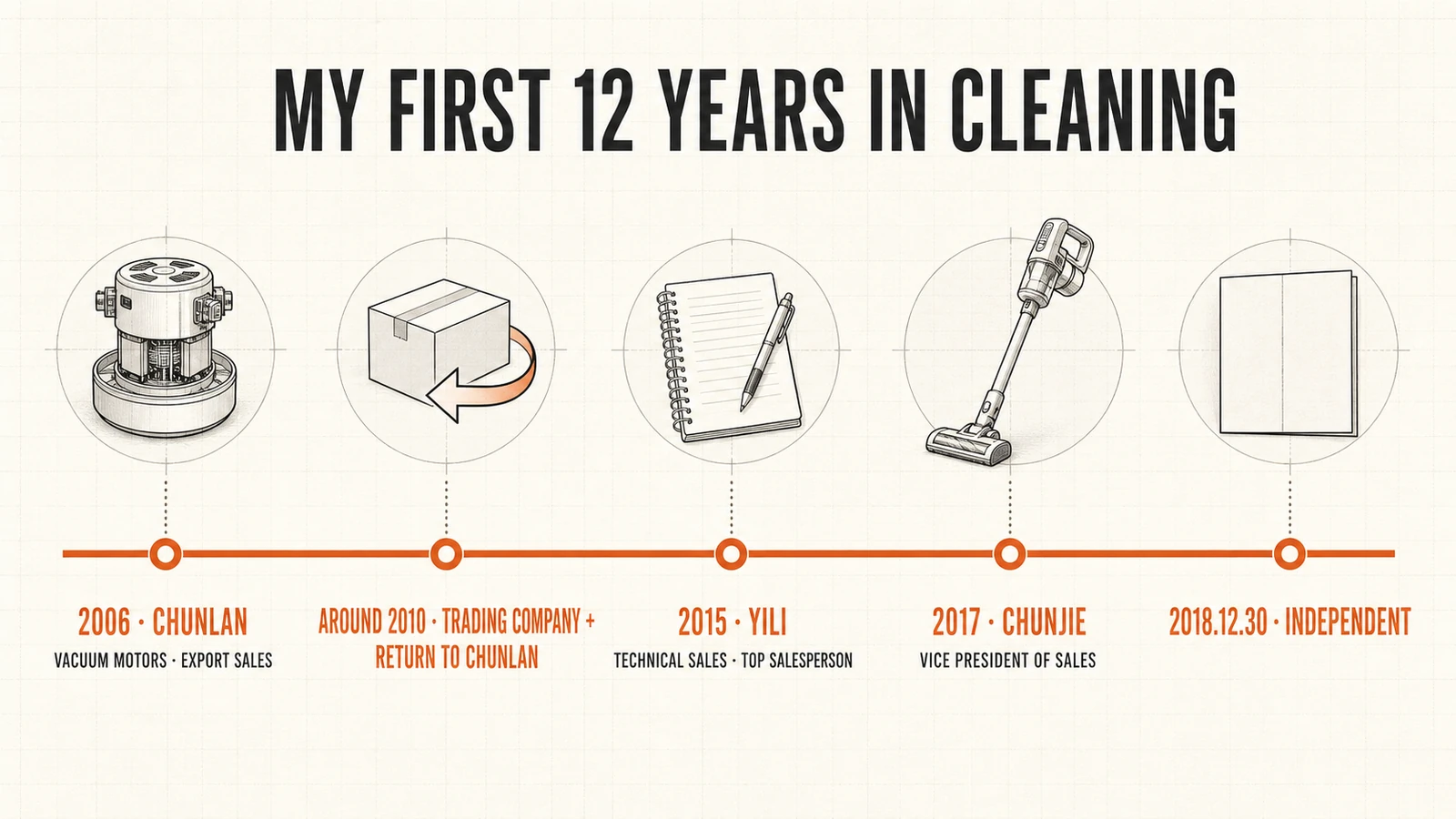
In 2006, I graduated from school with a degree in Business English. My first job was at a vacuum cleaner factory in Linpu, a town in Hangzhou’s Xiaoshan District. The company was Hangzhou Chunlan Electrical Industrial Co., Ltd. It had no connection with the better-known Chunlan air-conditioning business.
Chunlan Industrial began as a manufacturer of vacuum cleaner motors and could produce around three million units a year. At the time, it was a recognized name in China’s vacuum cleaner industry. It had supplied motors to Kingclean Electric, while Dechang—now a listed company—was then one of Chunlan’s suppliers. Chunlan also had motor-related business with companies including TTI and Bissell.
In 2006, Chunlan began preparing to manufacture complete vacuum cleaners. A large appliance company in Guangdong called Longde Electric was producing two to three million finished appliances a year at its peak, including vacuum cleaners. When a group of employees later left Longde, our owner seized the opportunity. He recruited a number of product, engineering, and production specialists, who became the core of Chunlan’s new finished-product team.
When I joined, the products were still under development, and stable orders were a long way off.
The production-line supervisor often asked me, “Denny, do we have any orders coming?”
My answer was always the same: “We’ve sent out a lot of samples. The orders will be here soon.”
I repeated that line for a long time.
The first two years were difficult. Products were developed one by one, samples were shipped one by one, and customers were followed up one by one. Sales only began to rise after the product range became more complete.
Export business was also easier then than it is today. If you brought the right products to a trade show, you could often leave with an order. On several occasions, Middle Eastern customers paid me deposits in US dollars on the show floor. I went from a new graduate who knew almost nothing about foreign trade to one of the company’s leading salespeople.
Around 2010, I became tired of export sales and resigned. The company tried hard to keep me, but I wanted to see what I could do on my own.
I started a small trading company. In the first year, I completed several orders and made around RMB 200,000. The workload was light—sometimes I worked less than an hour a day.
With too much time on my hands, I began running a street stall outside a sports center near my home. Former colleagues saw me there and came over specifically to say, “Denny, if this doesn’t work out, just come back.”
At first, I bought small products from 1688.com, China’s wholesale marketplace. They cost RMB 3–5 each, and I planned to sell them for RMB 10. The sports center had plenty of foot traffic, so I assumed it would be easy to make money.
After half a month of selling—and giving some products away—my total revenue was still below RMB 100.
At the stall next to mine, a young man sold portable radios with memory-card slots for nearly RMB 150 each. Similar devices were available on Taobao for a little over RMB 30. My first reaction was that he was charging uninformed customers an absurd premium.
Then I watched more closely. People really were buying them, and most of the buyers were older.
They wanted to listen to Yue opera, public-square dance music, and old songs. But they did not know where to download the files or how to organize a memory card. Every radio the young man sold already contained carefully arranged folders, together with a printed song list. Customers could select what they wanted by pressing a button.
I bought radios and memory cards and added a customization service. Customers told me what they wanted to hear; I downloaded it, sorted it into categories, and loaded it onto the card.
Every morning shortly after 5 a.m., I set up beside groups doing public-square dancing and got to know the women there. In the evening, I returned to the sports center from 6 p.m. to 9 p.m. Orders gradually came in, and customers began referring their friends.
In a little over a month, I made more than RMB 10,000 in net profit. I later asked the young man next to me about his business. He rotated among five locations every day and made more than RMB 200,000 in annual profit.
After I had been doing this for just over a month, Chunlan asked me to return.
My trading-company customers often placed one or two orders and then bypassed me to work directly with the factory. The business was inconsistent, and I wanted a path that could last. I returned to Chunlan to lead its export department.
Just as I was ready to settle in and focus on the job, the company ran into a cash-flow crisis. Suppliers stopped shipping because they had not been paid. Senior and middle managers began leaving.
At the time, we were still working with Electrolux, whose tooling remained at the factory. When the problems surfaced, its senior management became extremely concerned. I spent time coordinating among the different parties and eventually helped Electrolux transfer the tooling elsewhere.
Once the main unresolved issues for several key customers had been handled, I left as well.
My former manager invited me to join him in Ningbo. But through a series of coincidences, a recruiter contacted me and asked whether I would consider Zhejiang Yili Electric.
Yili had recently moved from Taizhou to Jiashan. A number of people from the original team were preparing to leave, and the company needed replacements. My first interview was with Chairman Huang and Sales Director Ding. They asked many questions, and I felt I answered reasonably well. Director Ding and Chairman Huang then interviewed me twice more.
In 2015, I officially joined Yili. I moved from a village in Hangzhou to another village in Jiashan, where I rented one floor of a rural house in Lianmin New Village for RMB 800 a month.
Every Friday evening, I drove back to Hangzhou. Every Monday morning, I drove from Hangzhou to Jiashan for work. I kept that routine for three years.
At Yili, I quickly developed a group of new customers and became one of the company’s top salespeople. My approach was technical: I studied the product, the market, and the customer’s problems, then helped the customer design a solution.
At the time, however, the vacuum cleaner businesses at both Chunlan and Yili had relatively weak products. Yili later captured the growth opportunity in upholstery cleaners and has developed very well. During my years there, though, without sufficiently competitive products, it was difficult for sales alone to keep winning larger customers.
I was approaching 35 and kept asking myself the same questions. Should I stay in export sales and eventually become an export director? Should I partner with someone to open a small factory? What did I actually want to be doing ten years later?
Because I could not find the answer, I began exploring internet marketing in 2016 and 2017. I joined all kinds of online communities and spent quite a lot of money on them.
I met people working in internet finance, social commerce, traffic acquisition, and community operations. Some operated in legally or ethically gray areas. I also organized what I called “sharing marathons.” Whenever I traveled to a city, I found a temporary venue, invited 30 people, and gave each person 30 minutes to share something.
For a while, I planned to become an Amazon seller. I registered an account and selected the products. Then I switched to another project at the last minute. I made some money from it, but I also missed an early opportunity on Amazon.
As WeChat public accounts became popular, I began writing articles. Almost no one read the early pieces—each attracted only a dozen or so views—but I set myself the goal of publishing three articles a week.
I was doing well in my day job, and my side projects were also bringing in some income. Chairman Huang was very tolerant of his employees. I often joked that, if I wanted to, I could coast at Yili until retirement and he probably still would not fire me.
In 2017, my former employer was placed under the management of a guarantor because of its financial problems. The new management team wanted me to return and help rebuild sales.
I was working in Jiashan and could return to Hangzhou only once a week. My family was unhappy with the arrangement. After weighing everything, I left Yili and returned to Hangzhou to become vice president of sales at Chunjie.
Chairman Huang tried several times to persuade me to stay. In the end, family considerations decided the matter. Chunjie’s general manager and head of R&D were both former colleagues, so the team found its rhythm quickly. I also used the relationships and customer resources I had accumulated over the years to move several new projects forward.
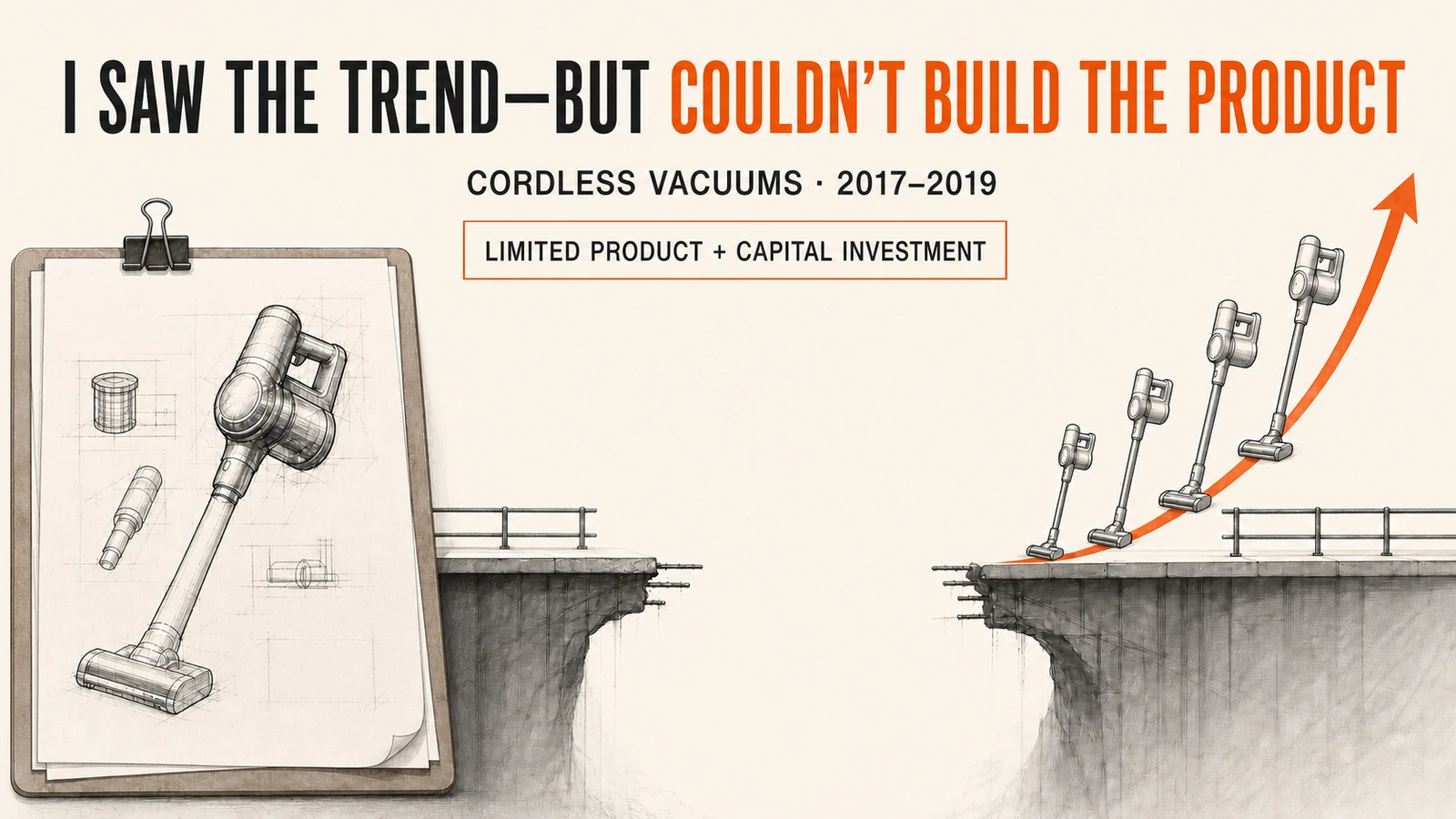
Chunjie still faced the same fundamental problem: too little product investment and not enough funding to develop new products consistently.
Cordless handheld vacuum cleaners began growing rapidly between 2017 and 2019. During that period, I published a large number of articles and gradually became an influential content creator in China’s cleaning appliance industry. I also connected with many people across the sector.
I could see the cordless-vacuum trend very clearly. The irony was that the company I worked for did not have the resources to develop one. We could only watch the opportunity pass in front of us.
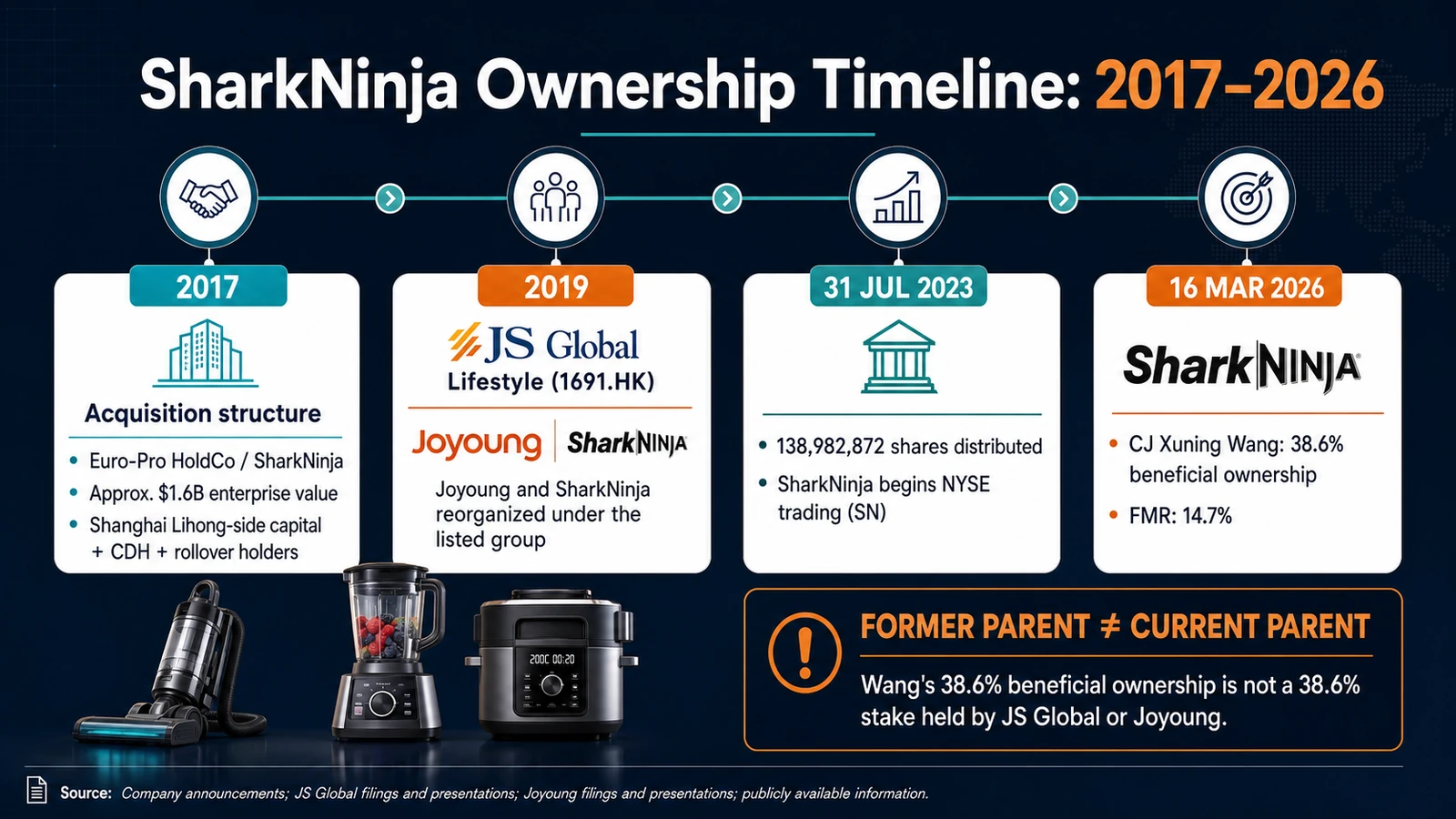
In 2017, Joyoung founder Wang Xuning took part in the acquisition of SharkNinja. In 2018, Joyoung sent Mr. Zhou to integrate SharkNinja’s supply chain in China.
Through contacts at an investment fund, I invited Mr. Zhou to visit Chunjie. I wanted to see whether our cost advantages could help us enter SharkNinja’s supply chain. Chunjie’s product capabilities and financial resources were limited, and the discussions did not lead to a substantive partnership.
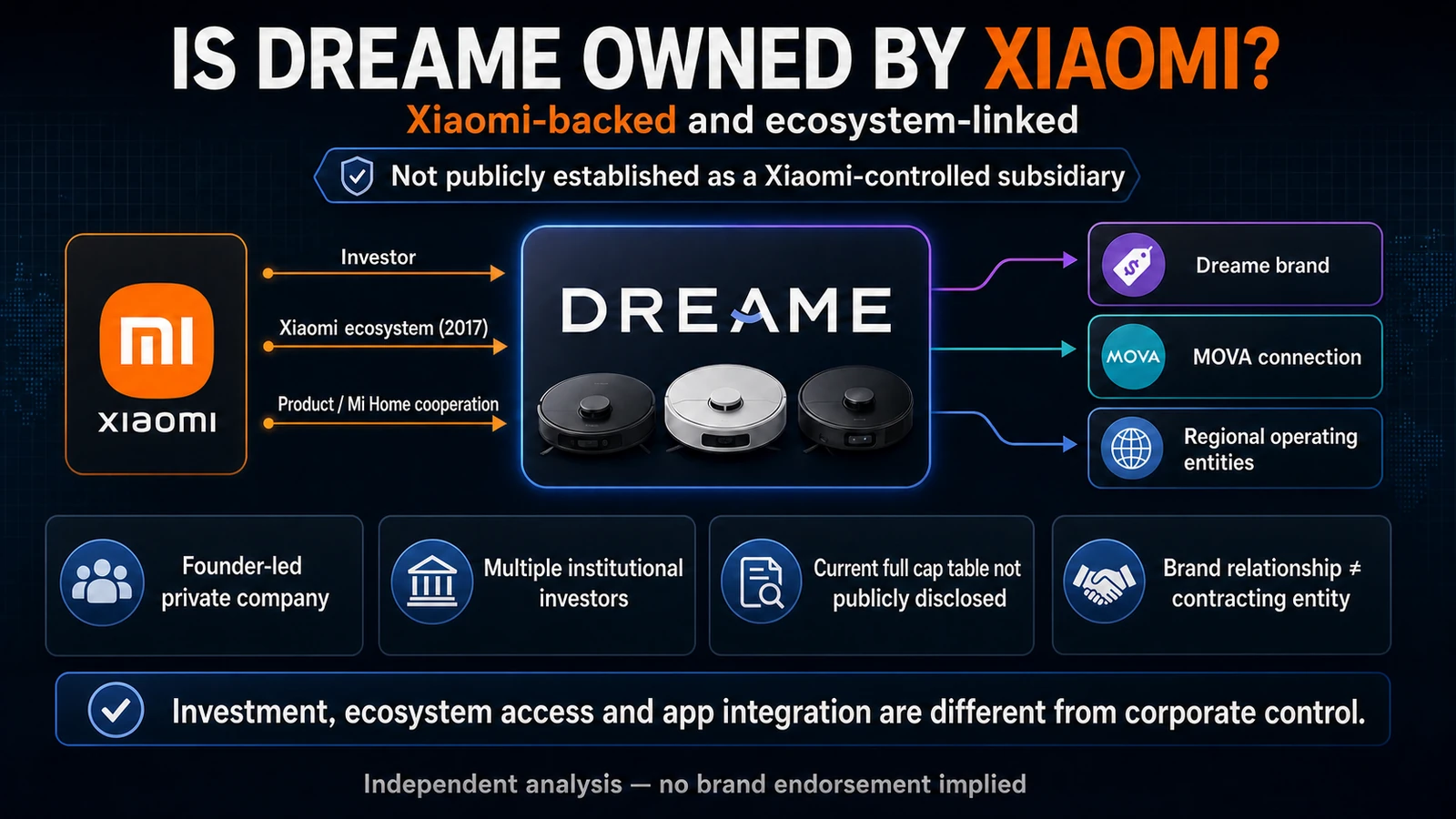
Around the same time, Dreame Technology had just received investment from Xiaomi’s ecosystem fund and was developing products in an office next to Kaili Baomu.
When I visited, Wang Shengle, who was responsible for the relevant business at the time, told me rather mysteriously that they had several products that might become major hits—but I was not allowed to take photos.
I later invited “Dale,” as we called him, to visit Chunjie to explore whether we could manufacture products for the Xiaomi ecosystem. That discussion also went no further.
Wang later left Dreame and founded Beatbot Innovation, entering the robotic pool-cleaner market.
Around 2018, MOOSOO’s Wang Xiaofeng traveled from Shenzhen to Hangzhou to meet me. He said MOOSOO’s power-tool business was doing reasonably well but margins were low, and the company wanted to enter the vacuum cleaner market.
He had found phone numbers for several factories online, but no one he called took the inquiry seriously. He asked whether Chunjie had a suitable vacuum cleaner. We did not, so I gave him the contact details of several vacuum cleaner factories in Suzhou.
One year later, MOOSOO had become a powerful seller in Amazon’s cleaning appliance category. Based on my observation of the rankings at the time, more than half of the products in Amazon’s Top 50 Best Sellers for the cleaning category were, at one point, connected with MOOSOO.
Those were also the years when internet finance and cryptocurrency were taking off. Some of the online communities I had joined began discussing crypto trading.
I experimented with a form of cryptocurrency arbitrage often described in China as “moving bricks”: buying in the Chinese market and selling in South Korea. There was a clear price gap between the two markets, and the paper profit on a single trade could exceed 10%.
After doing it for a while, I had made tens of thousands of renminbi and was preparing to invest more. Then South Korea quickly tightened its policies, and the arbitrage opportunity disappeared just as quickly.
After that, I shut down most of my unrelated projects. I decided to focus on the cleaning industry—the field I understood best. My first goal was to make my cleaning-industry writing one of the leading sources in the sector and to move closer to where information and relationships flowed.
At the end of 2018, Chunjie’s owner concluded that the cleaning business required too much investment for too little return. He no longer planned to invest in it at scale.
He asked several managers whether they would be willing to take over the existing business. They would only need to cover the factory rent and part of the tooling fees.
A colleague asked what I thought. After considering it for a while, I replied, “I’m going to go out and look around for a year first. If any of you need help, I’ll be available.”
On December 30, 2018, I formally ended my career as an employee.
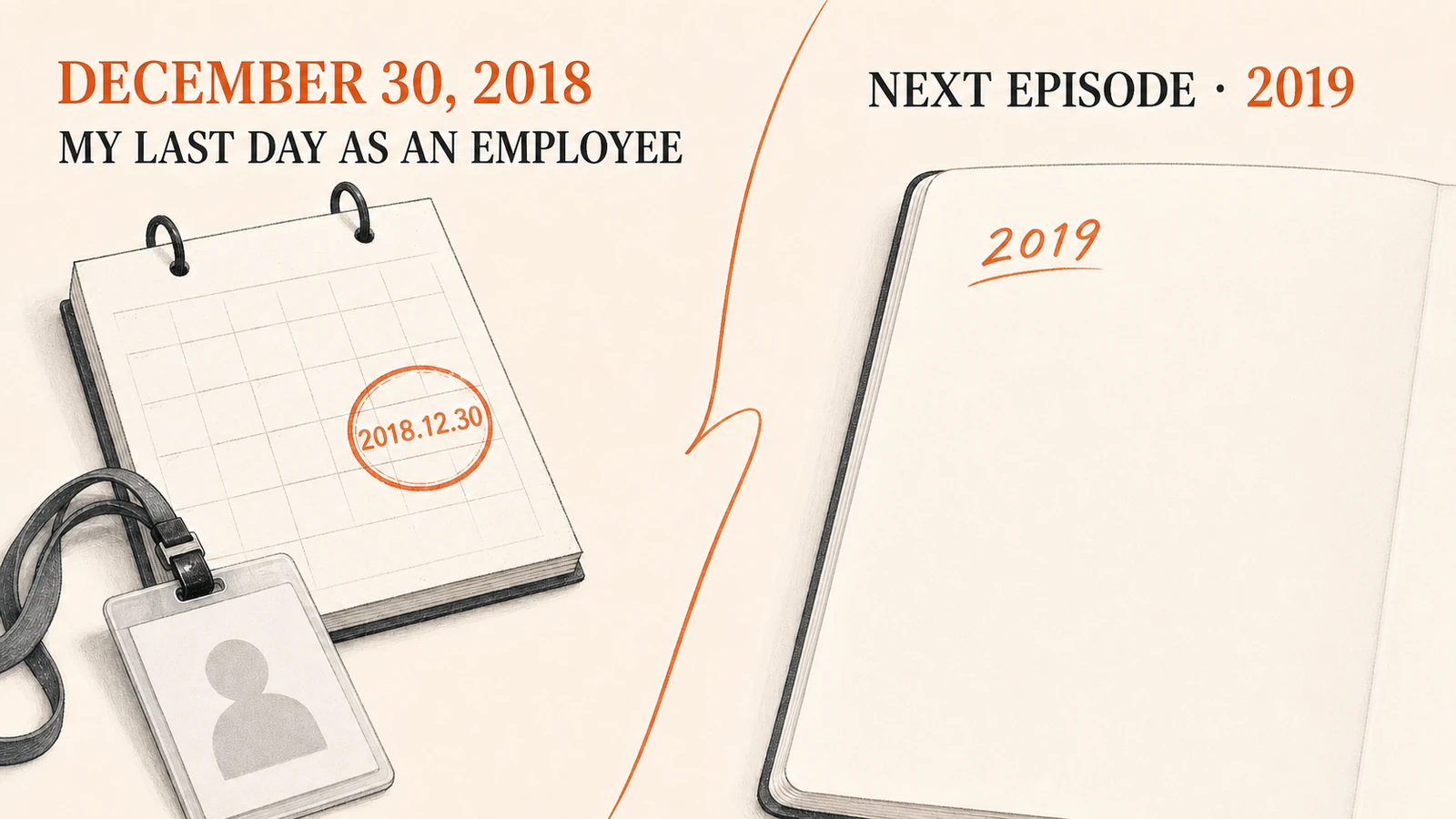
I did not know then that the following seven years would become the fastest-changing period China’s cleaning appliance industry had ever seen.
Cordless vacuums, robotic vacuums, wet-and-dry floor washers, and many other new categories took off one after another. I moved from export salesperson and corporate manager into entrepreneurship. The content, forums, industry connections, and eventually WCB all grew step by step out of those seven years.
WCB today is still a long way from becoming the world’s No.1 cleaning show. The dates and venue have only just been confirmed, and exhibitor recruitment is just beginning.
In the coming episodes, I will document why the first exhibitors decide to join, how we invite international buyers, and the rejections and difficulties we encounter along the way.
If you work in cleaning appliances, core components, brands, distribution, or related services, I would like to hear from you: what is the most important problem a truly global cleaning show should solve for companies?
The next episode begins in 2019.