- A robotic lawn mowing business is a managed service operation, not passive income: the provider still qualifies sites, installs or deploys equipment, monitors work, finishes edges, maintains assets and responds to exceptions.
- Choose the operating model before buying equipment: a dedicated on-site subscription, a mobile crew-assist fleet, or equipment sale or lease plus managed support creates different capacity, cash-flow and risk profiles.
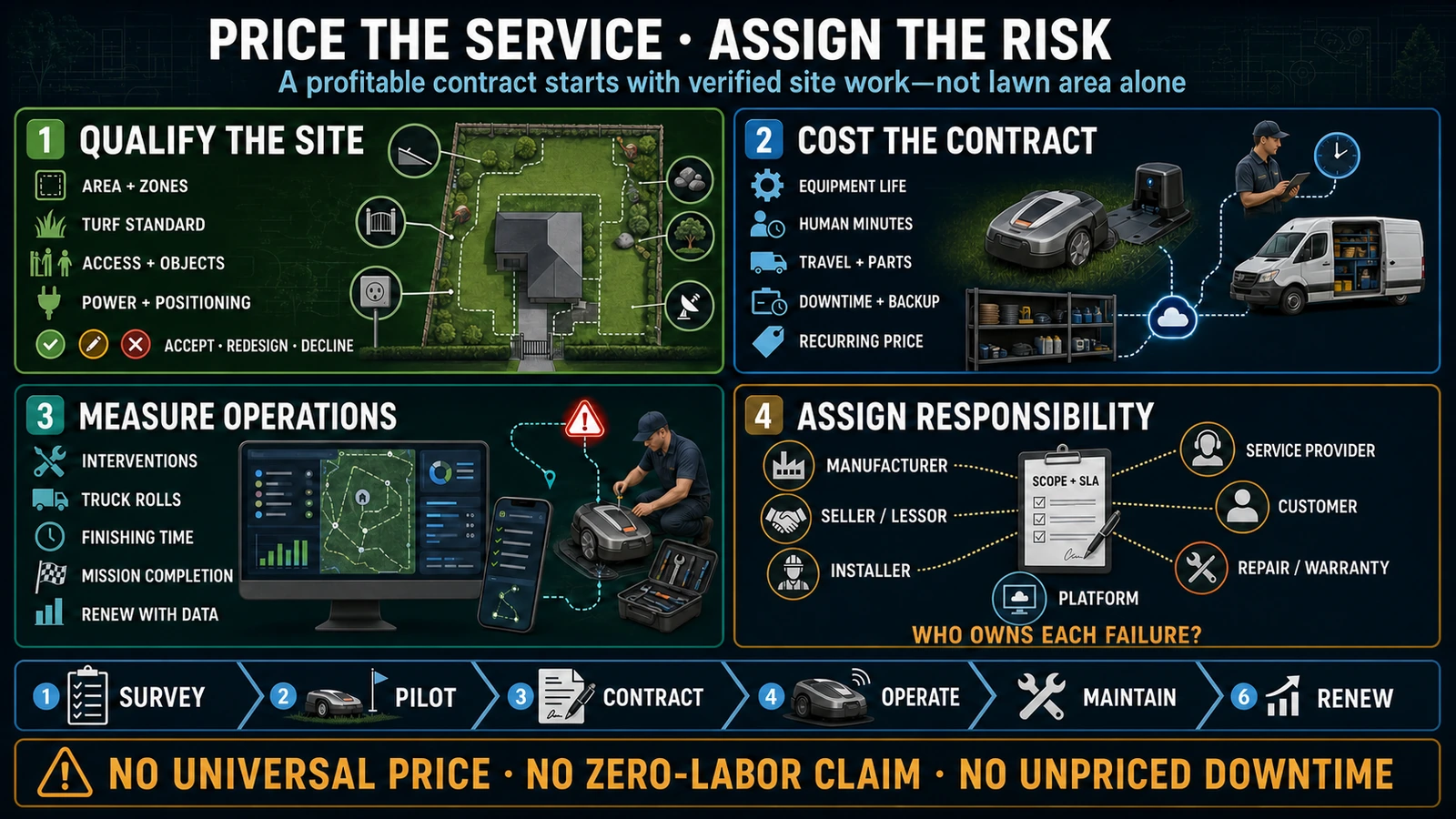
- Price from verified site cost and contract responsibility—not lawn area alone—and assign equipment ownership, connectivity, maintenance, downtime, backup and customer duties in writing.
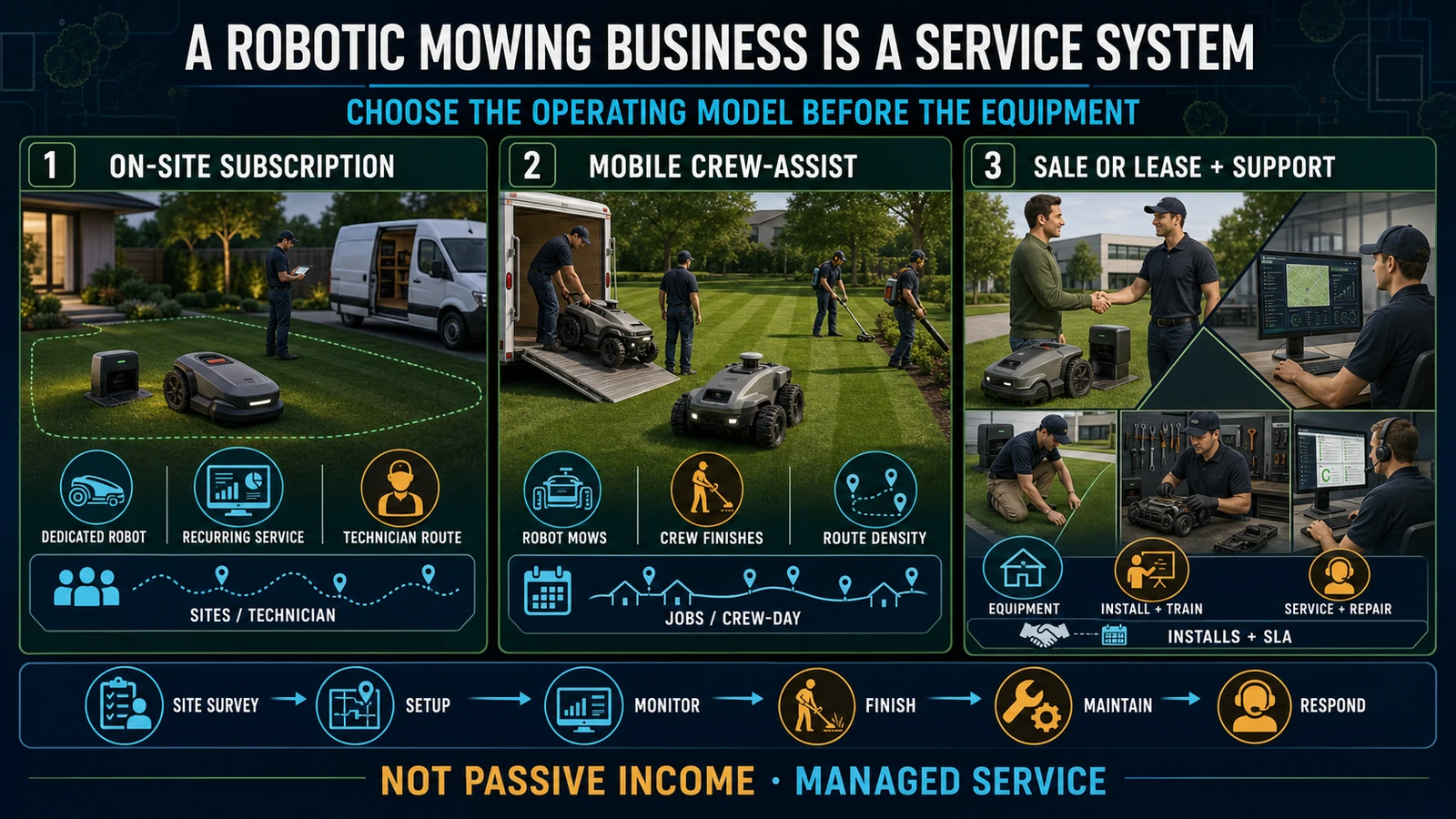
A robotic lawn mowing business is a managed lawn-care service, not passive income from leaving a machine at a property. A viable operator still has to qualify the site, choose and finance the equipment, install or deploy it, monitor exceptions, complete trimming and cleanup, maintain the asset, respond to downtime and manage the customer contract. The robot changes how mowing labor is delivered; it does not remove the service operation.
There are three practical ways to build the business: leave a dedicated robot at each customer site under a recurring service agreement; carry autonomous equipment with a crew and use it during scheduled visits; or sell or lease equipment while charging separately for installation, maintenance and managed support. Each model has different cash-flow, route-density, staffing and liability consequences.
This guide is for lawn-care companies, landscape contractors, robotic-mower dealers, installers, equipment distributors and entrepreneurs evaluating a service operation. It does not promise a universal price, margin or payback period. Those numbers must come from the operator's market, sites, equipment terms and service data.
Robotic Lawn Mowing Business Models at a Glance
| Model | Where the robot stays | Main revenue | Main capacity constraint | Main risk |
|---|---|---|---|---|
| Dedicated on-site subscription | At one customer property | Installation plus recurring managed mowing and add-ons | Active sites per technician and interventions per site | Capital tied to deployments, site access, damage, theft and contract recovery |
| Mobile crew-assist fleet | Travels with a crew | Scheduled landscape or mowing visits | Jobs per crew-day, route density, loading and supervised robot time | Paying for autonomy that does not overlap with other productive work |
| Sale or lease plus managed support | Usually owned or leased by the customer | Equipment margin, installation, maintenance, repair, storage and digital support | Qualified leads, installations and service response capacity | Confusing product warranty with the provider's service obligation |
These models can be combined. A dealer may sell robots, offer installation and run a subscription route. A landscaper may place small robots at residential properties while carrying larger autonomous equipment to commercial jobs. The important decision is not whether to be “robotic.” It is which party owns the asset, where the machine operates, how the human work is scheduled and who pays when the system stops.
Is a Robotic Lawn Mowing Business a Real Service Model?
Yes. Current operators show that several versions already exist.
TurfBot describes a property-specific service that can include robotic mowing, human trimming and edging, installation, programming, cleaning, blade work and off-season storage. Mowze Mowing describes a different workflow: its team schedules visits, deploys robots on site, oversees operation and completes string trimming and edge cleanup. WALLE Corp offers customers a choice between buying a robot and using the company's fleet.
Other providers combine subscription, sales and technical support. Kick Gas Lawn Care says its prepaid service includes installation, normal repairs and maintenance, with recurring inspection and trimming. Mowbot of Iowa currently presents equipment sales, installation, wired and wireless repair, maintenance and subscription service under one operation.
These are company descriptions of their own services, not audited proof that one model is more profitable than another. They do establish an important point: the product sold to the customer is not merely a mower. It is an outcome supported by equipment, installation, people, parts, software and response.
The professional supply side is also still developing. Husqvarna's April 2026 Automower 560 EPOS announcement targets municipalities, schools, universities, office parks and government properties, and connects the mower to fleet-management functions. Greenzie's current autonomous mowing model lets a landscape crew define a work area, allow the machine to mow the middle and use the same labor for edging, weeding or blowing. Greenzie also lists monthly, seasonal, annual and Robotics-as-a-Service payment structures.
This variety is the opportunity—and the reason a business plan must start with the operating model rather than a preferred robot.
Model 1: Dedicated On-Site Robotic Mowing Subscription
In this model, a mower and charging system remain at one property. The service provider may own the equipment, or the customer may own it while buying management and maintenance.
The customer's recurring service can include:
- site survey and mower selection;
- boundary, map, charging and positioning setup;
- mowing schedules and temporary exclusion changes;
- remote monitoring and alert response;
- scheduled inspections, cleaning and blade replacement;
- trimming, edging, blowing and debris checks;
- repairs, pickup, loaner or backup mowing; and
- seasonal shutdown, storage and recommissioning.
The attractive feature is reduced weekly transport of the main mower. The hidden constraint is field service. An operator can deploy many assets only if intervention frequency stays low and a technician can reach faults economically.
Measure this business by active sites per technician, intervention minutes per site-month and truck rolls per site-month. Do not model capacity as “lawns per robot per day”; a dedicated robot normally serves one deployment, while one technician supports a network of deployments.
The contract also needs an asset-recovery plan. If the customer cancels, who removes the charging station, boundary hardware or reference station? Who repairs the property? Who transfers or deletes maps and account access? A low installation price can become a loss if termination work was never costed.
Model 2: Mobile Robotic Mowing With a Crew
In the mobile model, an autonomous mower travels to the job. The crew unloads it, defines or selects the work area and completes other paid tasks while the machine handles repeatable open turf.
This can improve productivity when robot-active time overlaps with trimming, blowing, bed work, litter removal or another mowing zone. Greenzie explicitly presents this “mow the middle, finish the job” workflow. It is not the same as leaving a small residential robot unattended for days.
The operating test is simple:
`Net labor benefit = conventional mowing minutes avoided − robot setup, supervision, recovery, loading and administration minutes added`
Route density still matters. Include vehicle and trailer cost, travel, loading, battery or charging logistics, job setup, mapping reuse, weather and the possibility that one fault delays the rest of the route. A mower can be technically autonomous and still fail to improve the crew-day if the operator must watch it without performing other billable work.
Track completed jobs per crew-day, travel and loading minutes, robot-active overlap with other paid work, interventions per job and unfinished area requiring conventional recovery.
Model 3: Equipment Sale or Lease Plus Managed Support
Some businesses will be stronger as local integrators than as owners of a large deployed fleet. The customer buys or leases the machine; the provider earns from equipment, installation, commissioning, maintenance, repair, consumables, seasonal storage and digital support.
This reduces the service provider's asset capital, but it does not eliminate service expectations. The sales contract, manufacturer warranty and managed-service agreement are separate instruments.
Husqvarna's current U.S. Lease Plus and Service Plus page illustrates the distinction. Lease Plus combines equipment with preventive maintenance and wear-and-tear repair in a monthly payment. Service Plus covers repairs, preventive maintenance and blades for specified professional robotic products for a stated period, with exclusions. A local dealer or service provider still needs to confirm product eligibility, geography, technician route, response and what happens outside the program.
For any brand, never promise “full coverage” based only on a warranty headline. Identify the exact manufacturer, seller, lessor, installer, platform provider, operator and repair provider. One company may fill several roles, but the customer should know which contract answers each failure.
Which Customers and Properties Should You Accept?
A disciplined “no” is part of the business model. The wrong property can consume more interventions, travel and customer support than the contract can recover.
Before quoting, record:
| Site question | Why it changes the business case |
|---|---|
| What is the net mowable area and how many disconnected zones exist? | Determines equipment, docks, transport and mission time |
| What cut height, appearance and peak-season frequency are required? | Defines actual service capacity rather than maximum brochure area |
| Are there slopes, narrow passages, water edges, soft ground, heavy tree cover or moving obstacles? | Changes mower suitability, positioning, rescue and turf-damage risk |
| When are children, pets, wildlife, tenants, vehicles or the public present? | Determines operating windows, controls and supervision |
| Who removes toys, branches, hoses, pet waste and temporary objects? | Repeated preparation can become unpriced labor |
| Are power, charging, connectivity and positioning services reliable? | Creates infrastructure and subscription dependencies |
| Who controls gates, access codes and notices property changes? | Affects every scheduled inspection and emergency visit |
| Are trimming, blowing, leaves, weeds and overgrowth included? | Prevents a mowing subscription from becoming unlimited grounds care |
| What response and backup does the customer expect after a fault? | Drives technician coverage, spares and conventional-mowing reserve |
For the technical site process, use the separate Robot Lawn Mower Installation guide. For steep properties, see Can Robot Lawn Mowers Handle Slopes?.
Run a pilot before a multi-site or high-value contract. Measure completed area, interventions, trimming minutes, charging and docking, turf result, customer access conflicts and recovery after ordinary faults. The pilot is not a sales demonstration; it is the first cost record.
How Should a Robotic Mowing Service Be Priced?
Square footage is a useful intake field, not a complete price.
Build the quotation from seven cost groups:
- Survey and commissioning: site visit, design, installation, mapping, testing and customer handover.
- Recurring mowing service: equipment availability, monitoring, routine visits and the defined turf result.
- Finishing work: trimming, edging, blowing, debris removal and other explicitly included labor.
- Lifecycle maintenance: cleaning, blades, wheels, boundary or positioning hardware, batteries, repairs and seasonal work.
- Digital operation: software, cellular data, correction service, account administration and firmware support where applicable.
- Downtime protection: technician response, pickup, loaner, spare asset or conventional backup mowing.
- Site changes and exceptions: remapping, construction, new landscaping, customer damage, overgrowth or extra visits.
Possible commercial structures include an installation fee plus monthly or seasonal service; one all-inclusive recurring payment; customer-owned equipment plus a management plan; or a base subscription with finishing and repairs priced separately. The right choice depends on whether the operator wants predictable revenue, lower upfront resistance or tighter protection from unusual work.
A planning formula is:
`Annual contract contribution = annual contract revenue − direct site labor − equipment lifecycle cost − service, parts and connectivity − travel − expected downtime and risk cost`
`Required recurring price = (annual direct cost + allocated overhead + target operating margin) ÷ billable contract periods`
This is not an accounting or tax standard. Financing, depreciation, tax, insurance and residual value should follow the operator's local professional advice. Most importantly, do not copy a competitor's price without knowing which equipment, labor, maintenance and risk it excludes.
What Human Work Remains After the Robot Is Deployed?
The robot may remove hours of riding or pushing a mower through the same path. The business still needs people for:
- sales qualification and site surveys;
- installation, mapping and commissioning;
- property preparation and hazard checks;
- trimming, edging, blowing and exception areas;
- cleaning, blades, inspection and preventive maintenance;
- alerts, trapped machines, docking faults and connectivity issues;
- repairs, transport, storage and backup mowing;
- customer communication, billing and schedule changes; and
- account permissions, maps, logs and firmware administration.
Mowze's published workflow and TurfBot's service description both make finishing and maintenance visible. Greenzie positions autonomy as assistance that lets a crew perform other tasks. These examples support a more useful staffing question: not “How many employees does one robot replace?” but “Which recurring minutes move to the robot, which new minutes appear and what higher-value work can the crew complete at the same time?”
Maintenance, Parts and Downtime Can Decide Profitability
Equipment price is only the first cost. Before standardizing a fleet, verify:
- commercial use and warranty eligibility for the exact SKU and market;
- local access to blades, cutting discs, wheels, batteries, charging and positioning parts;
- which repairs are field-serviceable and which require depot shipment;
- dealer diagnosis and warranty approval time;
- software, connectivity and correction-service availability;
- loaner or spare-machine conditions;
- end-of-support and account-transfer policy; and
- realistic off-season storage and recommissioning work.
Greenzie states that warranty and loaner availability are limited by scope, time and geography. Husqvarna's service programs identify eligible product families and exclusions. Those qualifications should become fields in the service provider's own offer.
Set a repair reserve based on actual fleet history. Track blades, parts, batteries, technician time, freight, downtime days and conventional backup visits by asset and site. For lifecycle questions, see How Long Do Robot Lawn Mowers Last?.
What Should the Customer Contract Define?
The service agreement should make the operating system visible.
At minimum, define:
- property, zones, cutting result, frequency and service period;
- equipment ownership and responsibility for installation assets;
- approved operating windows and temporary exclusions;
- customer duties for power, access, connectivity and object removal;
- included trimming, cleanup, leaves, weeds and overgrowth limits;
- maintenance, consumables and repairs;
- alert response, backup mowing and service-credit rules if any;
- theft, vandalism, weather, irrigation, construction and customer damage;
- software accounts, maps, logs, permissions and subscription changes;
- payment, suspension, renewal and price adjustment;
- termination, equipment recovery, property restoration and data transfer; and
- incident notification and escalation contacts.
Do not describe every machine stop as a product defect. A mower can stop because of site conditions, an installation issue, lost correction data, customer changes, wear, software or hardware. The contract should identify who diagnoses first and who pays when the cause falls outside the included service.
Safety, Insurance and Compliance
A robotic mowing company remains responsible for operating its service professionally. Object detection, lift sensors, geofencing and warning lights are controls—not a substitute for property assessment, instructions and operating procedures.
Use the exact manual and market documentation for every model. Define pre-start checks, people and animal controls, public operating windows, water and drop-off boundaries, incident response, restart authority and maintenance records. The Robot Lawn Mower Safety guide explains the product and site layers in more detail.
Insurance and licensing vary by jurisdiction. Ask a qualified local insurance adviser and legal adviser to review the actual operation: general liability, property damage, workers, vehicles and trailers, equipment in transit or left at customer sites, theft, account or data exposure, and contractual service commitments. This article is an operating framework, not legal, insurance, tax or investment advice.
A Practical Launch Sequence
- Choose one operating model and customer segment. Do not buy a mixed fleet before deciding whether the business is residential subscription, mobile commercial work or equipment support.
- Build a site-survey and rejection standard. Record the same technical, access, safety and finishing fields for every lead.
- Secure the service chain. Confirm seller, warranty, parts, repair route, software, connectivity, training, spares and backup.
- Cost one representative pilot. Record all installation, travel, monitoring, finishing, maintenance and exception minutes.
- Write the service scope and customer duties. Price what is included and name what is not.
- Start with a serviceable geographic cluster. A distant customer can destroy an otherwise attractive subscription when one alert requires a truck roll.
- Track asset and contract economics separately. Revenue per deployment is not profit if the same asset creates repeated unpaid work.
- Expand only after renewal and intervention data exist. Brochure capacity cannot replace operating history.
The existing Commercial Robotic Lawn Mowers guide helps evaluate fleet capacity and procurement from the facility side. A service business must add customer acquisition, route design, contract economics and recurring responsibility.
FAQ
Is a robotic lawn mowing business profitable?
It can be, but profitability is site- and model-specific. Calculate contract revenue against equipment lifecycle cost, direct labor, travel, software, parts, downtime, backup and overhead. No universal margin or payback period is credible without those inputs.
Is robotic lawn mowing passive income?
No. Even a robot that remains at the property needs qualification, installation, monitoring, finishing, maintenance, customer support and fault response. A remote alert that requires travel is an operating cost.
Should the service provider or customer own the mower?
Either can work. Provider ownership supports an all-inclusive subscription but ties up capital and creates asset-recovery risk. Customer ownership reduces provider capex but requires a clear separation between product warranty and paid managed service.
How much should a robotic mowing service charge?
There is no responsible universal price. Start with site complexity, required result, equipment and installation, human finishing minutes, maintenance, digital services, travel, downtime protection and target margin. Lawn area alone is insufficient.
Does a robot mower eliminate trimming and edging?
Usually not as a contractual assumption. Boundary design and machine capability vary, and many current services still include human finishing. Survey and price those minutes explicitly.
How many customers can one robot serve?
In a dedicated subscription model, one robot normally serves one deployment while a technician supports many sites. In a mobile model, customer capacity depends on job duration, route density, setup, transport and whether robot time overlaps with other productive work.
What is the biggest operating risk?
The broadest risk is unpriced responsibility: a property that needs frequent rescues, a contract promising rapid backup, a repair route without parts, or a customer expecting full landscaping under a mowing fee. Site screening and written scope control that risk.
The WCB View
Robotic mowing does not turn lawn care into a software business. It turns one repetitive physical task into a connected equipment-and-service system.
The strongest operator will not be the company with the largest number of robots. It will be the company that can reject unsuitable sites, price every human and machine dependency, keep equipment working, assign failures quickly and deliver the promised turf result at renewal—not only during the demonstration.