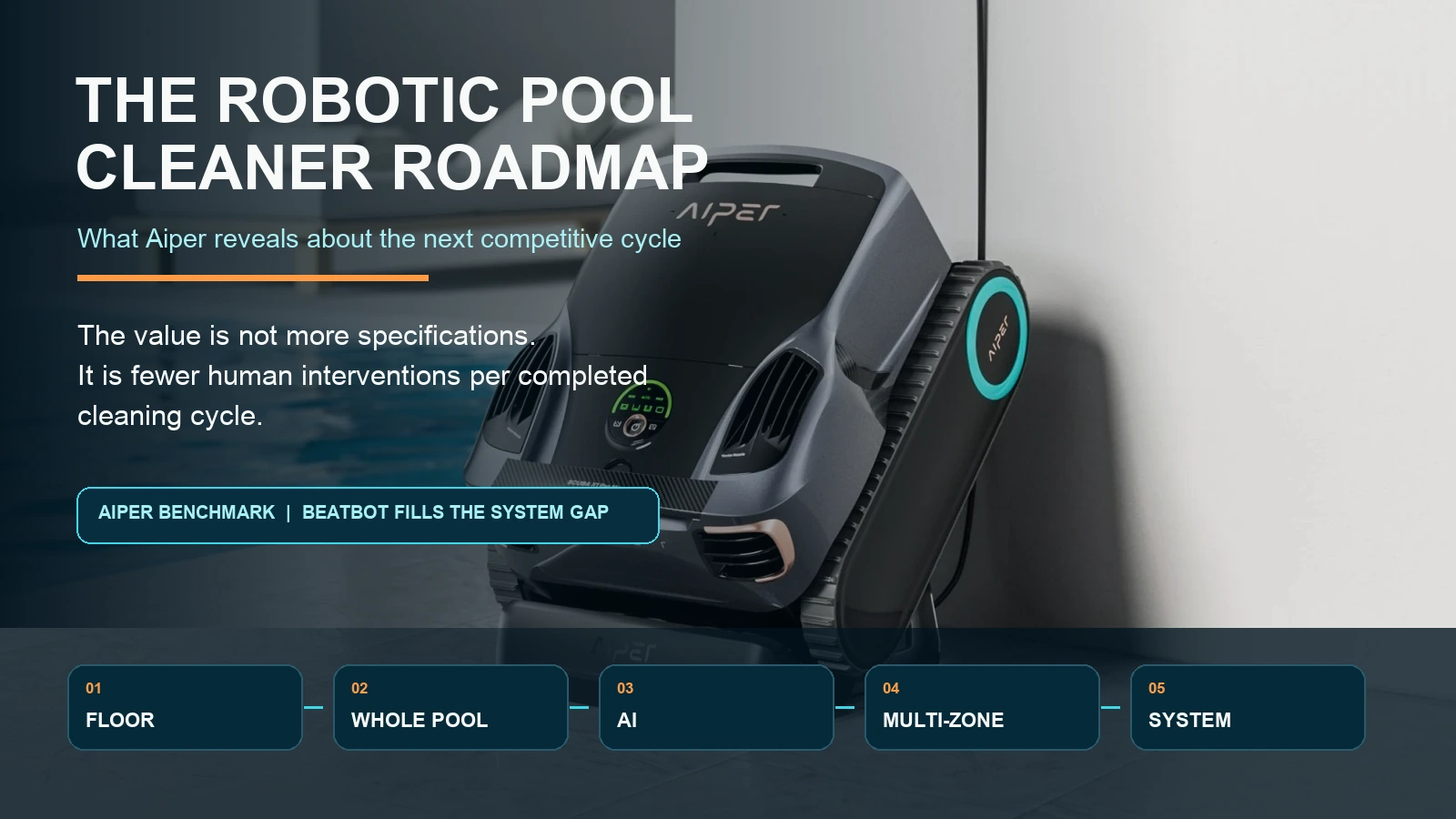
- A commercial robotic pool cleaner should be sized against the complete facility mission, not maximum pool length or a commercial-grade label alone.
- Robot specifications are not comparable until pool geometry, required surfaces, debris load, cleaning window, filter condition and operator work are aligned.
- A pool robot can automate part of mechanical surface cleaning, but it does not replace circulation, filtration, disinfection, water testing or public-pool operating records.
In this article 14 sections
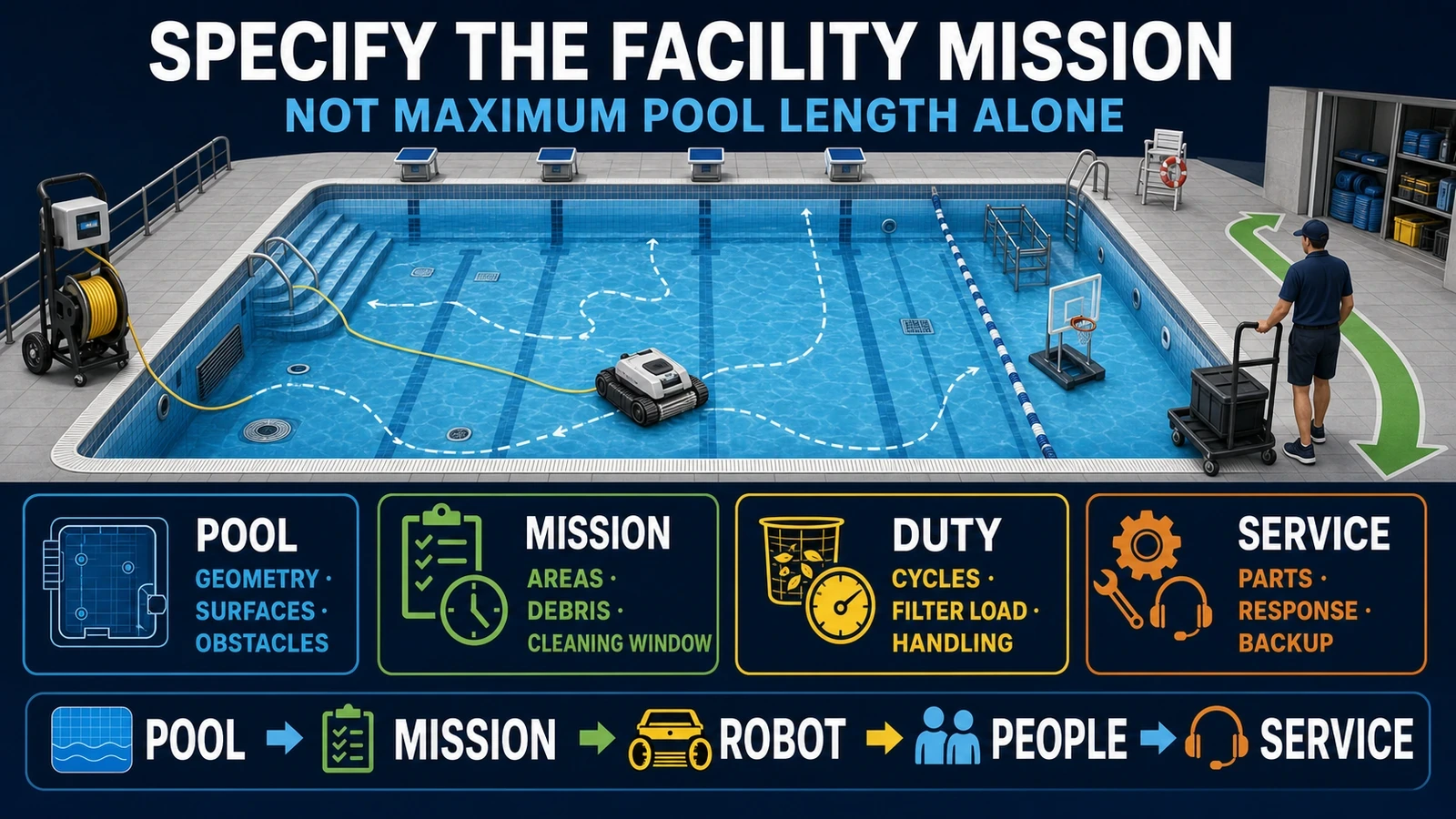
A commercial robotic pool cleaner should be selected against a defined facility cleaning mission—not by maximum pool length or a “commercial-grade” label alone. The buyer must verify pool geometry, required surfaces, debris load, cleaning window, filtration capacity, handling labor, power or charging, service response, parts, backup and written commercial-use terms.
A robot can automate part of the mechanical work on a pool floor, walls or waterline. It cannot take ownership of the aquatic facility. Staff still manage water chemistry, circulation, filtration, disinfection, contamination events, opening and closing procedures, equipment records and the cleaning that remains outside the robot’s approved task.
This guide is for hotels, resorts, schools, universities, fitness centers, public pools, aquatic centers, water parks, property managers, pool service companies, dealers, distributors and sourcing teams. It does not rank models. It explains how to specify, compare, pilot and accept a commercial robotic pool-cleaning system.
If the immediate question is how pumps, brushes, filters and navigation work inside a robot, see How Do Robotic Pool Cleaners Work?. This article begins at the facility level: what must the system deliver during a real operating week, and who responds when it does not?
Commercial Robotic Pool Cleaners at a Glance
| Decision | Weak specification | Facility-grade specification |
|---|---|---|
| Pool | “Up to 25 meters” | Floor area, wall area, waterline, depth profile, shape, surfaces, drains, steps and obstructions |
| Mission | “Full pool cleaning” | Named surfaces, debris types, required finish, frequency and completion window |
| Duty | “Commercial-grade” | Exact cycles, operating hours, rest and maintenance requirements, warranty use and seasonal peak load |
| Filtration | Flow or micron number | Debris mix, usable capacity, loading behavior, clean-down time, media and replacement supply |
| Handling | Robot weight | Route from storage to deck, trolley, cable or battery, launch, retrieval, drainage, lifting and storage |
| Labor | “Automatic” | Minutes for setup, launch, retrieval, filter cleaning, rinsing, cable handling, inspection and records |
| Service | Warranty period | Local diagnosis, parts, response time, loaner or spare plan, exclusions and transport responsibility |
| Acceptance | One demonstration | Representative debris and operating conditions with recorded coverage, intervention, labor and recovery |
What Makes a Robotic Pool Cleaner Commercial?
There is no single feature that converts a residential robot into a commercial system. Commercial suitability is the combination of an authorized use, a defined duty, a pool match and a support chain.
Four current manufacturer ranges illustrate the category:
- Maytronics separates mid-sized commercial pools from extra-large and Olympic-sized facilities in its Dolphin WAVE range.
- BWT lists dedicated commercial lines for small public pools, larger facilities and Olympic-sized pools.
- Zodiac/AstralPool describes ARCO, ARCOMAX and VortraX products for intensive use in public and communal pools.
- Hexagone markets equipment, demonstrations, seasonal hire, service contracts and after-sales support specifically to professional and public-pool operators.
Those ranges are evidence that commercial pool cleaning is a distinct operating problem. They are not a shared standard. A buyer still needs the exact product number, destination market, current data sheet, manual, warranty and quotation.
Commercial suitability has at least six layers
- Authorized application: the manufacturer and contract seller accept the named hotel, school, public, rental or service use.
- Mission capacity: the robot can complete the required surfaces within the available cleaning window.
- Physical handling: staff can safely transport, launch, retrieve, drain, clean and store the complete system.
- Repeatability: the machine, filter and cable or battery can support the planned sequence of cycles and maintenance.
- Serviceability: wear parts, diagnosis, repair and backup are available where the facility operates.
- Operating control: trained people own the schedule, water-safety interface, inspection, records and escalation.
A residential product may be technically capable of cleaning part of a commercial pool. That does not establish approved commercial use, adequate duty cycle, suitable warranty coverage or an acceptable repair route. Obtain those points in writing before treating it as a lower-cost substitute.
Start With the Pool and the Cleaning Mission
Pool length is easy to publish and easy to misunderstand. It is only one dimension of the job.
Build a site record before requesting models or quotations:
| Site field | Why it changes the system |
|---|---|
| Floor area and depth profile | Determines travel, slope transitions and the task that must fit the cleaning window |
| Walls and waterline | A floor-only machine can be appropriate for one facility and incomplete for another |
| Shape and corners | Free-form geometry, tight radii and recessed areas can create missed or repeated zones |
| Steps, ledges and movable floors | Marketing language about wall climbing does not prove access to every structure |
| Main drains, outlets and fittings | These can interrupt movement or create trapping and clearance problems |
| Lane ropes and temporary equipment | The pool may need preparation before each robot cycle |
| Surface material | Tile, stainless steel, membrane, coating and other finishes affect brush and traction selection |
| Debris | Hair, sand, fibers, leaves, fine sediment and surface film impose different filter and brush loads |
| Bather load and events | High-use periods change debris, water conditions, access and the time available for cleaning |
| Deck and storage route | Doorways, stairs, ramps, trolley space, drainage and power location affect daily labor |
Then define the mission in operational language. For example:
Clean the complete pool floor after closing, remove visible sediment and hair before the morning inspection, complete the task within five hours, and require no more than one planned filter clean. Walls and waterline remain a separate weekly task.
That statement can be tested. “Keep the pool clean” cannot.
Why Published Specifications Are Not Directly Comparable
Current commercial product pages demonstrate how different the scopes can be.
| Official example | Published scope | Procurement lesson |
|---|---|---|
| Maytronics Dolphin Wave 80 | Maximum pool length 20 m; floor, walls and waterline; 11.17 kg robot; 24 m cable | A shorter-pool product can include more vertical coverage than a larger floor-only unit |
| Maytronics Dolphin Wave 200 XL | Maximum pool length 33 m; floor cleaning; 26 kg robot; 35 m cable | Larger capacity brings a different handling and coverage problem |
| BWT Aquarius | Small commercial pools up to 15 m; floor and walls; selectable 3, 4 or 5-hour cycles | Cycle duration belongs to a named product and task, not a category benchmark |
| BWT Ultramax | Extra-large and Olympic-sized public pools; selectable 3, 4 or 6-hour cycles | “Olympic” still requires exact geometry, surfaces, cable and acceptance checks |
| Zodiac/AstralPool ARCO | Intensive use in public pools up to 30 × 15 m; floor, walls and waterline | Published dimensions and intensive-use language require confirmation in the current documents and quote |
| Hexagone Spot | Professional/public-pool positioning with specified pool length, handling equipment and service options | Equipment and service configuration may be as important as the machine body |
These are manufacturer specifications, not World Clean Biz performance tests. Products are sold in different regions and configurations, and official pages can change. The purpose of the table is to show why one headline number cannot rank the systems.
Maximum pool length
Maximum length does not disclose total cleanable surface, vertical coverage, debris load, filter loading, overlap or the required finish. Two pools with the same length can impose very different missions.
Cycle time
A shorter cycle is not automatically more productive. It may cover fewer surfaces, use a different path, assume a different pool or deliver a different finish. Compare completed accepted missions per operating window, not hours printed beside unrelated programs.
Flow and filtration ratings
Pump flow, suction descriptions and micron ratings do not share one cross-brand test method. They also do not tell the buyer how the system performs when the filter approaches its practical load, how much debris bypasses the media or how long clean-down takes.
Navigation
Terms such as `smart navigation`, gyroscope, compass, infrared, ultrasonic and mapping describe system components or manufacturer functions. The facility still needs to test repeat coverage, missed areas, obstructions, recovery and the effect of temporary pool equipment.
How Much Labor Does a Commercial Pool Robot Remove?
A robot can reduce repeated manual vacuuming and brushing within its approved mission. Every cycle still creates operator work.
Typical tasks include:
- preparing the pool and removing lane ropes or temporary obstructions when required;
- moving the robot, power supply, controller, cable, charger or trolley from storage;
- inspecting the machine, cable, brushes, filters and power equipment;
- launching and starting the selected program;
- monitoring exceptions or responding to a stop;
- retrieving the unit without using the cable as a lifting device;
- allowing water to drain before handling;
- emptying and washing filters or bags;
- rinsing the robot and checking brushes, tracks, wheels, intakes and impellers;
- managing, untangling and storing the cable or charging a battery system;
- documenting the task, fault or maintenance action; and
- arranging service, parts or backup cleaning.
The Wave 200 XL manual, for example, instructs operators to clean the filter when needed, remove debris from the body, brushes and drive-belt area before each cycle, clean the impeller area weekly and complete prompted preventive maintenance. Those are product-specific instructions, but they illustrate why “automatic” cannot be entered as zero labor.
During a pilot, record human minutes for the complete workflow—not only the time spent pressing start. Separate routine minutes from fault-response minutes. A heavy machine, long cable or distant equipment room can erase labor savings that looked convincing in a product demonstration.
Corded or Cordless for a Commercial Facility?
Energy architecture is one part of the commercial decision.
A corded system may suit repeated scheduled cycles because it is not limited by an onboard battery. It adds a floating cable, poolside power equipment, cable handling, storage and a defined electrical operating procedure.
A cordless system can remove the operating cable from the water. It adds charging time, battery condition, sealed-battery service, retrieval, dry charging location and—in some markets—battery transport requirements. A long advertised runtime does not establish daily commercial duty.
The Cordless vs Corded Robotic Pool Cleaner guide explains those system differences in detail. For a facility procurement, add four questions:
- How many accepted missions must be completed between charging or service windows?
- Who handles the cable or battery after every cycle?
- What happens when the power supply, cable, battery, charger or seal system fails?
- Does the written warranty authorize the planned commercial use and operating frequency?
A Pool Robot Does Not Replace Public-Pool Water Management
The robot’s internal filter collects debris carried through its own water path. It is separate from the facility’s main circulation, filtration and disinfection system.
The US Centers for Disease Control and Prevention tells public-pool operators to maintain disinfectant and pH control, keep recirculation and filtration systems operating, document water testing and maintenance, and follow applicable state or local requirements. Other countries and jurisdictions have their own codes and operator obligations.
A commercial robot may help remove sediment, hair and surface material. It does not:
- maintain the required disinfectant residual;
- correct pH or other water chemistry;
- replace turnover and main filtration;
- respond by itself to a fecal or body-fluid contamination event;
- establish that a pool is safe to open; or
- replace trained operator records and inspections.
Keep robot performance metrics separate from public-health metrics. If a supplier claims reduced chemical, water or energy use, require the exact mechanism, baseline, operating conditions and evidence before including the saving in an ROI model.
How Should Buyers Calculate Total Cost and ROI?
Use the same mechanical-cleaning standard for the current method and the proposed robot system.
Current surface-cleaning baseline
Include:
- manual vacuuming and brushing labor;
- setup, hoses, portable equipment and storage;
- non-public-hours premiums or additional shifts;
- equipment maintenance and replacement;
- travel between pools or facilities; and
- repeat work needed to meet the inspection standard.
Commercial robotic system
Include:
- robot, controller, power supply or charger, cable or battery and trolley;
- installation or electrical work where required;
- spare filters or bags, brushes, tracks or wheels, cables, power supplies and other wear or service parts;
- launch, retrieval, draining, filter cleaning, rinsing, inspection, cable handling, charging and recordkeeping labor;
- preventive maintenance, diagnostics, repair and transport;
- training and operating documentation;
- service contract, software or connectivity where applicable;
- downtime, a spare or loaner and emergency manual cleaning; and
- replacement and disposal at end of service.
A useful planning model is:
`Annual net benefit = verified conventional surface-cleaning cost − verified robotic-system surface-cleaning cost`
`Simple payback period = incremental upfront investment ÷ verified annual net benefit`
This is not an accounting standard. Finance should decide how to treat tax, depreciation, financing and residual value.
Do not count lower disinfectant, water or energy consumption as a benefit unless the facility has a measured baseline and evidence connecting the robot to that change. Do not use a vendor’s cost-per-cycle claim as the complete cost of operation.
Service and Downtime Belong in the Specification
Public and commercial pools operate on schedules. A robot that fails before a school session, event or resort opening creates a cleaning problem even if the warranty eventually covers the repair.
Ask the seller to identify:
- the local diagnostic and repair location;
- which parts are stocked locally;
- normal and peak-season response times;
- whether service is on-site, dealer-based or return-to-depot;
- who pays inbound and outbound transport;
- preventive-maintenance requirements;
- consumables and excluded wear parts;
- any motor-hour, cycle, time or commercial-use warranty limits;
- loaner, spare or exchange options;
- the process for safety notices and serial-number tracking; and
- support after the model leaves sale.
Maytronics provides product manuals, registration and spare-parts routes for current commercial products. Zodiac/AstralPool publishes manuals, product data and warranty-document links for its commercial range. Hexagone advertises demonstrations, seasonal hire, service and contract options. These examples show the questions a commercial buyer can ask; they do not establish that every region receives the same service.
Assign every commercial role
| Party | Record in the contract or handover |
|---|---|
| Brand or product company | Product information, platform and safety communications |
| Legal manufacturer | Compliance identity and technical responsibility |
| Importer | Destination-market placement and regulatory role |
| Contract seller or dealer | Exact configuration, commercial-use promise and warranty channel |
| Trainer or installer | Power location, operating method, training and handover record |
| Facility operator | Pool closure, inspection, water management, cleaning workflow and records |
| Service provider | Diagnosis, parts, response, repair location and escalation |
The same company may perform several roles. Record them separately so a brand logo does not become a substitute for a service commitment.
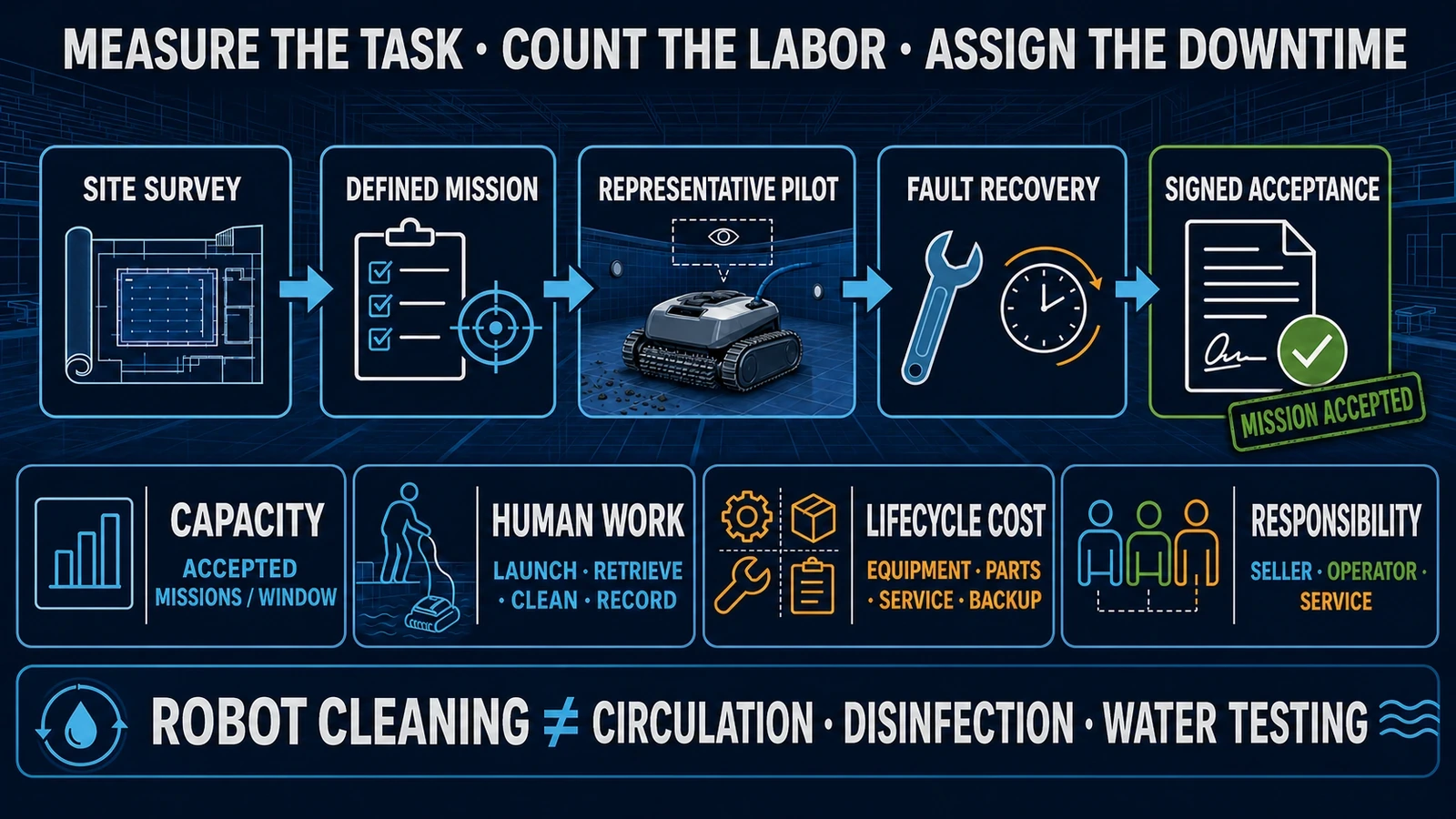
How to Pilot and Accept a Commercial Robotic Pool Cleaner
Run the pilot during representative operating conditions. A freshly cleaned empty pool is useful for setup, not sufficient for acceptance.
Before the pilot
- Record the complete pool geometry, surfaces, equipment and debris profile.
- Define the required floor, wall and waterline result separately.
- Set the allowed cleaning window and maximum planned interventions.
- Confirm the exact model, market version, accessories, filters, brushes, cable or battery and software.
- Agree who prepares the pool, launches the robot, cleans it and records the result.
- Write the failure and backup procedure before the test starts.
During the pilot
Record:
- completion of each required surface;
- visible missed or repeated areas;
- manual touch-up locations and minutes;
- setup, launch, retrieval, drainage, filter clean-down and storage minutes;
- stops, tangles, stuck events and intervention causes;
- behavior around drains, steps, ledges, slopes, corners and temporary equipment;
- filter loading and cleaning result near the end of a representative cycle;
- any marking or damage to the robot, cable, pool surface or fittings; and
- fault acknowledgement, diagnosis and recovery time.
Acceptance
There is no universal pass threshold. A municipal 50-meter pool, a hotel pool and a school training pool have different service standards and operating windows.
The signed acceptance record should state:
- which areas and conditions passed;
- which tasks remain manual;
- the normal operating and maintenance workflow;
- approved users and training completed;
- spare parts and backup held on site;
- service and escalation contacts;
- warranty and commercial-use documents; and
- the baseline that will be used for TCO and ROI review.
Commercial Robotic Pool Cleaner Procurement Checklist
Before issuing a purchase order, confirm:
- [ ] Exact model, product number, market and electrical or battery version
- [ ] Written commercial/public-pool use authorization
- [ ] Pool geometry, surfaces, fittings, obstacles and debris record
- [ ] Required floor, wall and waterline coverage
- [ ] Cleaning window and accepted mission definition
- [ ] Cycle, duty and preventive-maintenance assumptions
- [ ] Filter media, usable capacity, spares and clean-down method
- [ ] Robot, trolley, cable/battery, controller and storage handling plan
- [ ] Operator minutes measured during a representative pilot
- [ ] Applicable manual, safety, electrical, wireless, battery and compliance files
- [ ] Local service, parts, response time and transport responsibility
- [ ] Loaner, spare or manual backup plan
- [ ] Legal manufacturer, importer, seller, trainer, operator and service roles
- [ ] Public-pool circulation, filtration, disinfection and recordkeeping kept outside the robot claim
- [ ] Signed acceptance criteria and TCO baseline
Frequently Asked Questions
What is the best commercial robotic pool cleaner?
There is no facility-independent winner. The appropriate system is the one that completes the defined surfaces and debris task within the operating window, with acceptable operator labor, local service, downtime protection and lifecycle cost. A model list without a site mission cannot answer that question.
Can a residential robotic pool cleaner be used in a hotel or public pool?
Technical ability is only one requirement. Confirm the exact pool size and task, intended-use statement, duty cycle, warranty, local service and written authorization for the planned commercial use. Do not infer approval from appearance, price or a `commercial-grade` motor claim.
Does a commercial pool robot replace the pool filtration system?
No. Its internal filter captures debris passing through the robot. The facility must continue to operate and maintain its required circulation, main filtration, disinfection, water testing and public-health procedures.
How many commercial pool robots does a facility need?
Calculate accepted missions per cleaning window, then include filter cleaning, handling, maintenance and downtime. Multiple pools may require dedicated units because transport and reconfiguration consume labor. A critical facility may justify a spare even when one robot has enough theoretical capacity.
Are commercial robotic pool cleaners always corded?
No. Both corded and battery configurations exist. The facility should compare repeat cycles, charging, cable or battery handling, retrieval, service, transport and written commercial duty for the exact product.
How should a facility calculate payback?
Compare the verified annual cost of the current mechanical-cleaning task with the complete annual robotic-system cost. Include all remaining labor, parts, maintenance and downtime. Divide incremental upfront investment by verified annual net benefit only when that benefit is positive.
Can the robot run while the pool is open to swimmers?
Follow the exact product manual, facility safety procedure and applicable local rules. Commercial planning should normally define a controlled cleaning window, access restriction, electrical procedure and named operator. The separate pool robot swimming-safety guide explains why product architecture and instructions matter.
Final Takeaway
A commercial robotic pool cleaner is one controlled part of facility operations. The buying decision becomes defensible when the pool, mission, duty, operator work, service and water-management boundary are written before the model is selected.
Treat published specifications as screening inputs. Prove the result in the actual pool, record every remaining human task, assign downtime to a named party and sign acceptance against the facility’s own cleaning standard.
Sources
- Maytronics — Commercial Pool Cleaners
- Maytronics — Dolphin Wave 80
- Maytronics — Dolphin Wave 200 XL
- Maytronics — Dolphin Wave 200 XL User Manual
- BWT Robotics — Commercial Pool Cleaners
- Zodiac/AstralPool — ARCO Commercial Robotic Cleaner
- Hexagone — Spot Professional Pool Robot
- CDC — Operating and Managing Public Pools
- CDC — Model Aquatic Health Code