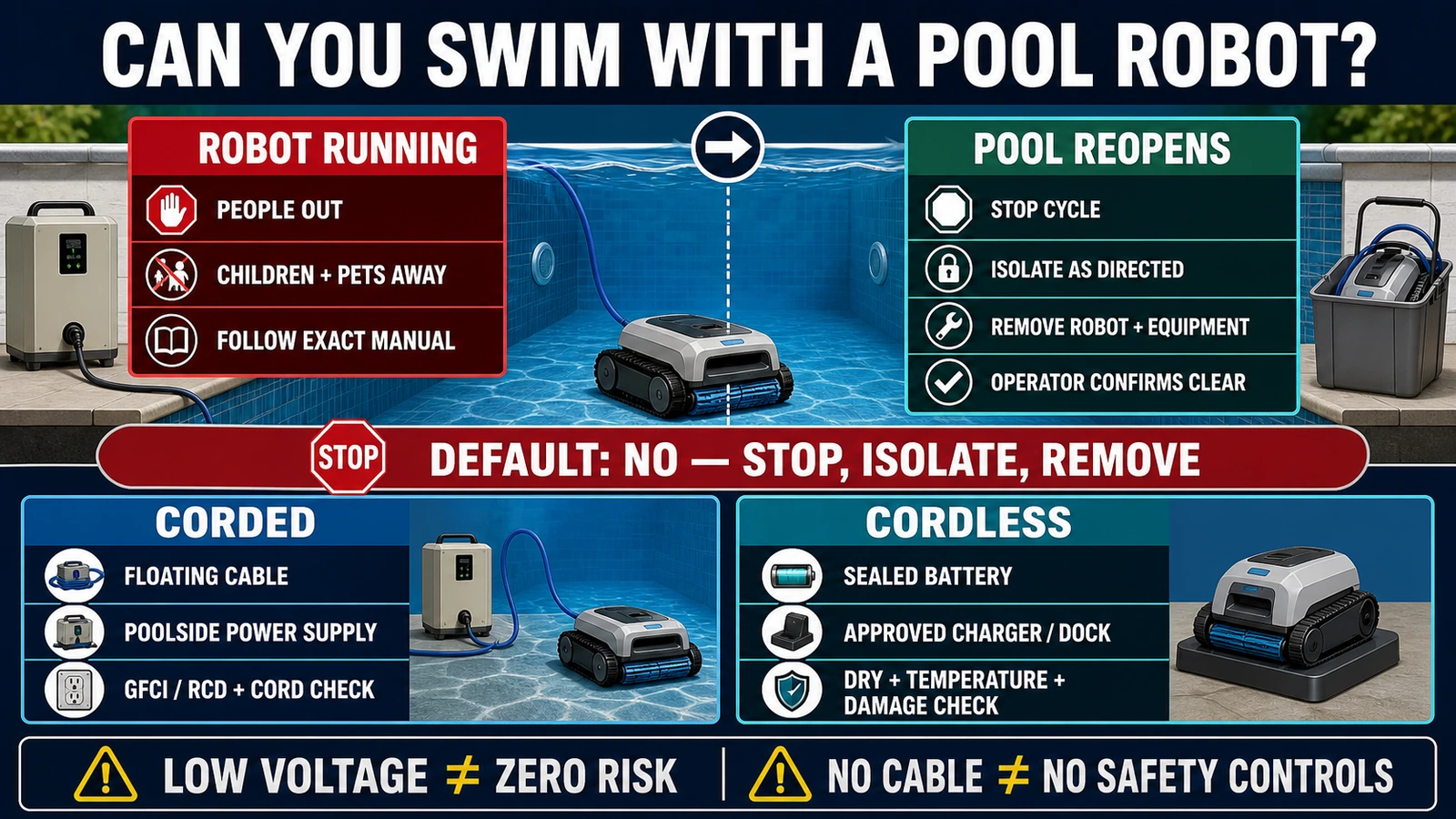
- The safe default is not to enter a pool while a robotic cleaner is operating: stop it, follow the exact isolation instructions and remove it before swimmers enter unless the model manual expressly says otherwise.
- Corded and cordless cleaners have different risk paths. A corded unit adds cable, poolside power and protective-device checks; a cordless unit adds battery sealing, charging, temperature and transport controls.
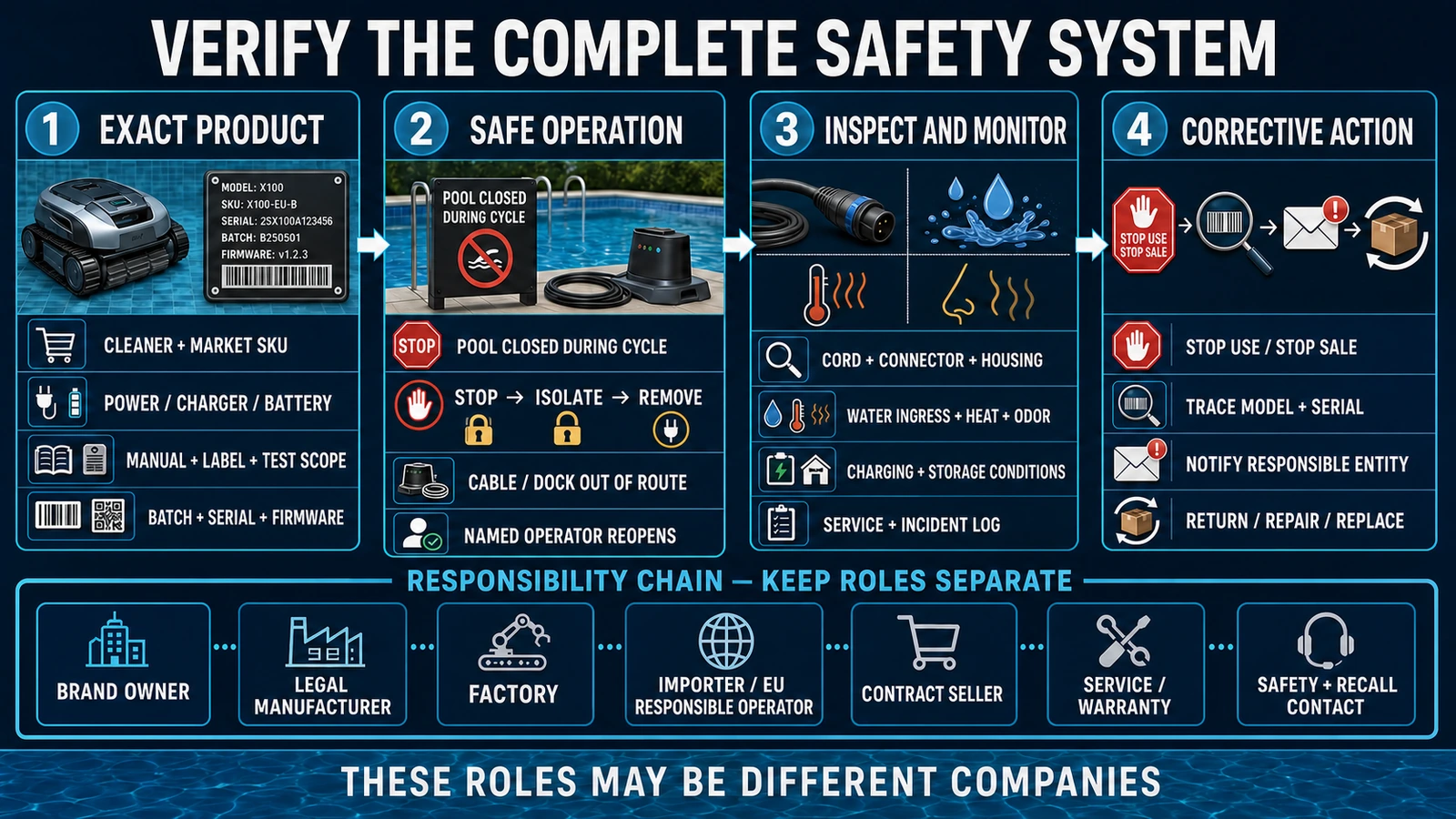
- Professional buyers should verify the complete system and responsibility chain: exact SKU, manual, power or charger, battery, market documents, serial traceability, responsible economic operators and recall process.
In this article 13 sections
No—do not swim while a robotic pool cleaner is operating unless the instructions for that exact model expressly allow it. The safer default is to stop the cleaner, isolate its power as directed and remove it from the water before people enter. A corded cleaner introduces a floating cable and a poolside power system; a cordless cleaner removes that cable but adds a sealed battery and charging system. Neither architecture is risk-free.
This is not just a consumer-use question. Distributors, importers, dealers, hotels, schools, health clubs and public-pool operators need a repeatable rule that works across staff shifts and can be traced to the correct manual.
The key is to treat the cleaner as a system rather than one waterproof machine. The system may include the underwater robot, cable, power supply, plug, charger, dock, battery, software, instructions and several different companies responsible for selling or supporting it.
Robotic Pool Cleaner Safety at a Glance
| Question | Safe operating position | What a professional buyer should verify |
|---|---|---|
| Can people enter while it is running? | Default to no; stop, isolate as instructed and remove the cleaner before swimmers enter | Exact model manual, warning labels and written site procedure |
| Is a corded robot safe because the motor receives low voltage? | Low-voltage output does not eliminate the poolside mains, cable or damaged-equipment risk | Power-supply SKU, plug, GFCI/RCD instructions, cable condition, outlet and placement |
| Is a cordless robot safer because it has no cable? | It removes the floating cable but adds battery, sealing, charger and temperature controls | Battery and BMS, water-ingress controls, approved charger, drying and charging procedure |
| Can one certification logo settle the question? | No. Marks and reports have defined products, configurations, markets and scopes | Exact model coverage, certificate or report number, database record and destination rules |
| Who acts if a defect appears? | The responsible parties depend on the market and transaction | Legal manufacturer, factory, importer, distributor, contract seller, service and recall contacts |
Why Is the Default Answer No?
The clearest reason is that manufacturers themselves tell users not to combine an operating cleaner with swimmers.
Maytronics’ current Dolphin safety FAQ says it does not recommend entering the pool while the robot is working. It advises removing the robot after the cleaning cycle and turning it off first if someone needs to enter before the cycle finishes.
A Maytronics commercial cleaner manual is stricter: it instructs the operator to take the cleaner out before allowing people into the pool. The manual also requires the main supply to be disconnected before examination.
Beatbot’s current AquaSense 2 Ultra manual similarly says not to enter the pool while the robot is working and to keep children and pets at a safe distance during operation.
These examples should not be converted into one universal shutdown sequence. One product may be stopped at a power supply; another may use a physical control or App; a cordless unit may require its own recovery procedure. An App command should not automatically be treated as electrical isolation.
For a multi-user or commercial site, the practical default is:
- stop the cleaning cycle;
- isolate or switch off the system exactly as the manual requires;
- retrieve the cleaner using the approved method;
- move the cable, power unit, charger or dock out of the swimmer route; and
- have a named operator confirm that the pool can reopen.
Are Corded Robotic Pool Cleaners Electrically Safe?
They are designed to operate underwater, but safe use depends on the complete installation.
A corded robotic cleaner normally receives low-voltage DC through a floating cable from a power supply outside the pool. That architecture separates the underwater unit from direct mains voltage, but it does not remove the mains connection, power supply, plug, outlet, protective device or cable from the safety case.
The Maytronics commercial manual cited above requires the named system to use a ground-fault circuit interrupter (GFCI), gives a routine test procedure, prohibits an extension cord, calls for damaged cords to be replaced and specifies where its caddy and power supply should be positioned. Those requirements belong to that product and market configuration; they should not be copied as universal distances or wiring rules.
A buyer should instead obtain the exact manual and verify:
- the power-supply model and output match the cleaner;
- the destination plug and electrical configuration are correct;
- the required GFCI, RCD or other protective arrangement is documented;
- the outlet and power unit can be placed as instructed;
- the floating cable, connector and strain relief are undamaged;
- no prohibited extension, adapter or substitute cable is used; and
- the operator knows how to stop, unplug, retrieve and service the unit.
The cleaner should be lifted by the designated handle, not by using the floating cable as a lifting rope. Wet weight, drainage and a slippery deck also create handling risks even when the electrical system is functioning normally.
Are Cordless Robotic Pool Cleaners Safer?
Not automatically. Cordless architecture removes the floating power cable during cleaning, which can simplify movement around the pool. It also transfers energy storage into the underwater product and creates a separate charging process.
That changes the verification questions:
- Is the battery pack sealed and protected for the intended environment?
- How is water ingress detected or managed?
- Must the charging port and robot be dry before charging?
- Which charger or dock is approved for the exact model?
- What charging and storage temperature limits apply?
- Can the battery be serviced, and by whom?
- How are damaged, returned or recalled batteries transported and quarantined?
Beatbot’s manual, for example, warns against damaged or modified batteries, requires the specified charging dock and says improper charging or charging outside the specified temperature range can increase fire risk. Maytronics’ Niya support guidance likewise treats charger location, approved equipment and post-use care as part of the operating system.
“Cordless” therefore answers a cable-management question. It does not by itself answer the battery, sealing, charging or recall question.
What Do Recent Pool-Robot Recalls Show?
Recent official recalls show several different failure paths. They do not prove that every product from the named brands—or cordless pool robots as a category—is unsafe.
| Official action | Product-specific issue | B2B lesson |
|---|---|---|
| Aiper Seagull Pro ZT6001, CPSC, 2025 | The adapter could overheat; the notice covered about 32,660 US units and recorded 19 reports of melting, smoking or fire | Treat the charger and adapter as controlled SKUs; trace models, serials, channels and end users |
| Zodiac Freerider RF 5200 iQ, UK OPSS, 2025 | Specified batches had a manufacturing-related battery-enclosure watertightness problem that could lead to short circuit and fire | Validate sealing through production control and batch traceability, not a marketing claim alone |
| WYBOT Osprey 700 Max and S1, CPSC, 2026 | Batteries in specified models and serial ranges could overheat; CPSC recorded ten reports and nine property-damage incidents | Keep serial-level customer records and a defined stop-use, return and replacement route |
The notices also reveal why corporate roles matter. One recall may identify a manufacturer and distributor; another may name a manufacturer and destination-market importer. The brand visible on the robot is not enough to determine who signed the supply contract, placed the product on the market, holds the technical file, provides warranty service or must execute a corrective action.
Is Waterproofing Enough to Make a Pool Robot Safe?
No. A waterproof or ingress-protection claim applies to a defined enclosure and test scope. It does not automatically cover the charger, external power supply, damaged connector, manufacturing variation, aged seals or every condition of use.
Professional buyers should ask for more than an `IP68` line in a product listing:
- the exact product and component to which the rating applies;
- the test standard, laboratory and report identifier;
- sample configuration and production date;
- limits for depth, duration and water conditions;
- sealing controls used in production;
- post-assembly leak or pressure testing, where applicable;
- inspection criteria after impact, service or battery replacement; and
- the response required after suspected water ingress.
An ingress rating is one input to a safety case. It is not a warranty that the entire commercial system can be charged wet, left indefinitely in chemicals or used outside the manual.
What About Children, Pets, Cables and Moving Parts?
Electrical and battery risks are only part of the question.
An operating robot moves, pumps water, rotates brushes or tracks and may have intake or drive openings. A floating cable can also cross the swimmer route or become damaged through poor handling. The exact mechanical hazards and protective design vary by product, so the manual—not a generic online article—must set the rule.
Children should not play with the robot, power supply, charger or cable. Pets should be kept away during operation and charging. Before swimmers enter, staff should remove the cleaner and prevent the cable or charging equipment from becoming a deck trip hazard.
Maintenance introduces a separate state. Turn the product off and disconnect or isolate it as instructed before opening filters, clearing an impeller, examining a cable or working near moving parts. A stop command in software does not necessarily make every service operation safe.
Can You Leave a Robotic Pool Cleaner in the Pool?
Only for the period and operating mode allowed by the exact instructions.
Some products support scheduled operation or a limited period in the water. That does not mean every cleaner should remain submerged between cycles. Pool chemicals, salt, heat, sunlight and uncleaned filters can increase wear, while a cordless product still needs an approved retrieval and charging routine.
The lifecycle question is covered in detail in How Long Do Robotic Pool Cleaners Last?. For swim safety, the simpler rule is that a cleaner left in the water should still be removed before the pool reopens when the model instructions require it.
How Should Hotels and Public Pools Manage Pool Robots?
A residential habit is not enough for a site with staff shifts, guests or public access.
A hotel, school, health club or aquatic facility should convert the manufacturer instructions into a written operating procedure. At minimum, the procedure should define:
- permitted cleaning windows when the pool is closed;
- who can start, stop and retrieve each cleaner;
- how the pool is physically or operationally kept closed during the cycle;
- how power supplies, cables, chargers and wet robots are positioned;
- who confirms that the robot and equipment have been removed before reopening;
- what happens after cable damage, water ingress, abnormal heat, odor, smoke or charging behavior;
- where serial numbers, firmware and service history are recorded; and
- who monitors safety notices and can stop all affected units.
Commercial duty must also be confirmed in writing. A product sold for a residential pool may have different permitted use, warranty, cycle capacity and service support from a commercial model.
What Safety and Compliance Documents Should Buyers Verify?
Do not begin with a logo. Begin with the exact SKU, market and responsible companies.
Product and test identity
- Complete cleaner, power supply or charger, battery, dock and accessory model numbers
- Product, packaging and manual labels for the destination market
- Applicable declarations, reports and certificate or listing numbers
- Exact model and component scope of each document
- Instructions and safety information in required languages
- Batch, serial and production-date traceability
UL’s pool and spa equipment marking guide lists different standards and product categories for pumps, controls and other pool equipment. It is a useful warning against guessing the applicable certification from the product’s marketing name. Verify the exact category and database record for the actual configuration.
Market and responsibility identity
For the United States, the CPSC’s business guidance explains reporting duties that can apply to manufacturers, importers, distributors and retailers when they obtain reportable safety information.
In Great Britain, current OPSS guidance emphasizes pre-market safety evidence, instructions, traceability and post-market monitoring for manufacturers and importers.
In the European Union, current GPSR guidance distinguishes manufacturers, authorised representatives, importers, distributors and other economic operators. The GPSR is not the only potentially applicable framework; electrical, wireless, battery, environmental and other requirements still depend on the product and market.
The procurement record should therefore name, separately:
- brand owner;
- legal manufacturer;
- factory or factories;
- importer or EU responsible economic operator where applicable;
- distributor and contract seller;
- warranty and repair provider; and
- safety-reporting and recall contact.
B2B Procurement and Commissioning Checklist
Before purchase
- Obtain the exact manual before approving the SKU.
- Confirm whether swimmers, children and pets are prohibited during operation.
- Match the power supply, charger, battery and plug to the destination market.
- Verify document scope against every configured component.
- Record the legal manufacturer, importer, seller and after-sales entities separately.
At acceptance
- Inspect labels, cable, connector, power unit, charger, dock and housing.
- Test required protective devices and shutdown steps only as the manual permits.
- Confirm retrieval, drainage, drying and charging procedures.
- Record model, batch, serial, firmware and installation location.
- Train operators and document who can reopen the pool.
During operation
- Keep people and pets out during the cleaning cycle.
- Stop and remove the robot before swimmers enter when required.
- Quarantine equipment after damage, water ingress, abnormal heat, odor or smoke.
- Monitor official recall sources and supplier safety notices.
- Preserve complaints, incident evidence and customer traceability.
For the underlying architecture, see How Do Robotic Pool Cleaners Work?. Buyers evaluating suppliers can use Robotic Pool Cleaner Manufacturers in China, while the company structures behind major platforms are covered in World Clean Biz’s guides to Dolphin and Maytronics, Aiper and Fluidra and WYBOTICS.
Frequently Asked Questions
Can you swim with a robotic pool cleaner running?
The safe default is no. Follow the exact manual, stop and isolate the cleaner as instructed, and remove it before swimmers enter unless that manual expressly provides another procedure.
Are robotic pool cleaners safe?
They can be used safely when the exact product, installation, operating procedure and maintenance controls are suitable. They are not risk-free, and safety claims should be verified at model and market level.
Can you swim with a cordless pool robot?
Do not assume so. Cordless removes the floating power cable but the robot still moves in the pool and contains an onboard battery. Current manufacturer manuals may still prohibit people from entering while it operates.
Is a corded robotic pool cleaner dangerous because it uses electricity?
It is designed for underwater operation, usually with low-voltage power to the robot, but the complete system still includes a poolside mains connection, power supply, cable and required protective measures. Use only the exact approved configuration and follow the manual.
Is turning the robot off in the App enough before swimming?
Not as a universal rule. App behavior and isolation requirements vary. Use the shutdown, disconnection and retrieval sequence specified for the exact model.
Can I use an extension cord with a robotic pool cleaner?
Only if the exact manual and applicable installation rules expressly permit it. Some manufacturer instructions prohibit extension cords and require a properly located outlet.
Should a pool robot be removed after every cycle?
Follow the model instructions. Regular removal allows filter cleaning, inspection and correct storage, while some products support defined scheduled modes in the pool. Long-term exposure and lifecycle effects are separate from permission to swim while the machine is present.
What should a distributor do after a pool-robot safety complaint?
Identify the exact model and serial, preserve the evidence, stop further use or sale when appropriate, notify the responsible manufacturer or importer, check official reporting duties and maintain a documented corrective-action route.
Final Takeaway
The answer to “Can you swim with a robotic pool cleaner?” should be operational, not promotional: keep people out while the cleaner runs, then stop, isolate and remove it according to the exact manual before the pool reopens.
For buyers and operators, the more important lesson is that safety extends beyond the underwater robot. The cable or battery, power supply or charger, sealing process, instructions, staff procedure, serial records and responsible market entities all determine whether the product remains controllable after the sale.