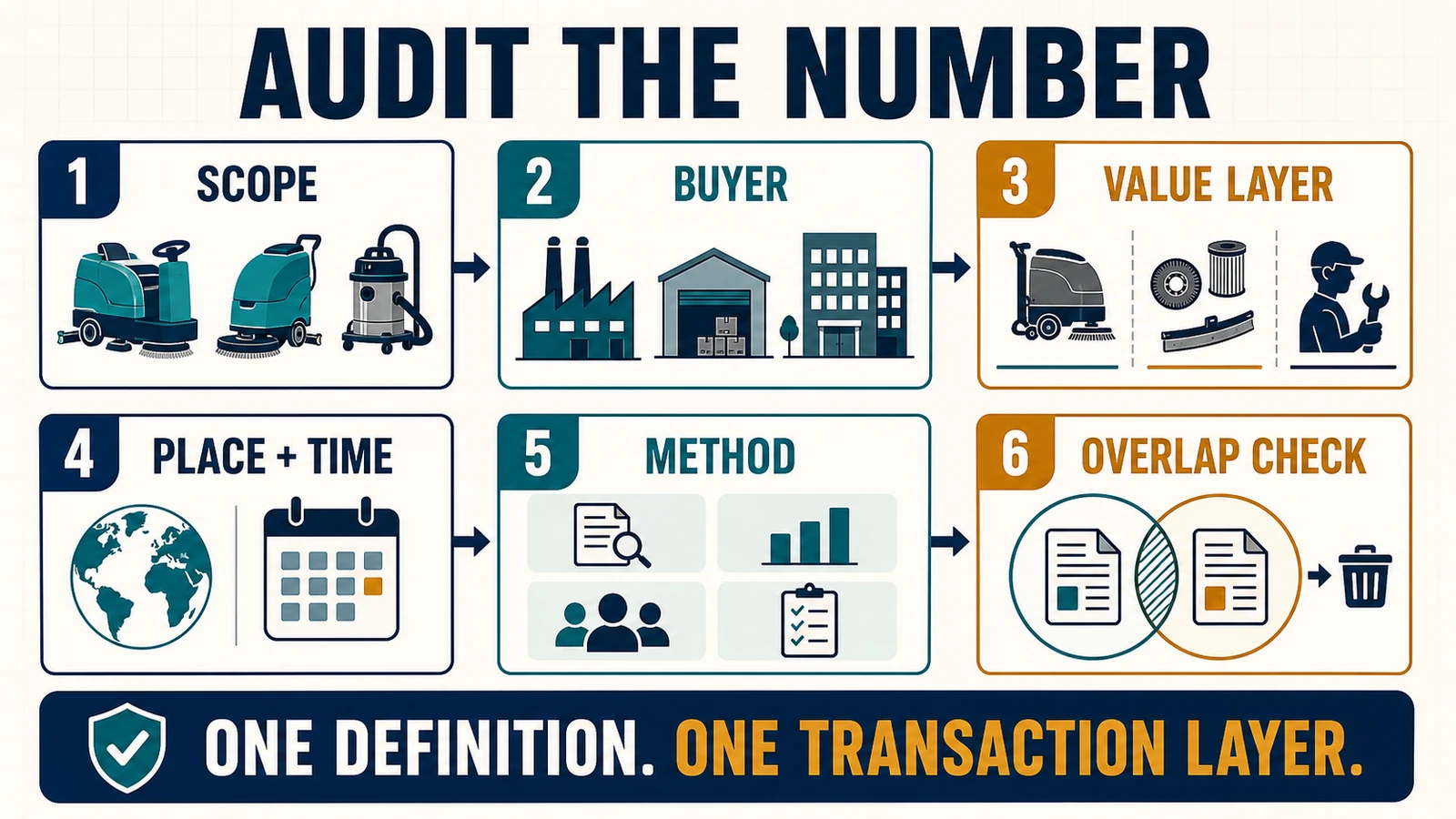
- There is no interchangeable global market-size figure until equipment scope, buyer scope, transaction layer, geography and time are aligned.
- Equipment revenue is only one layer: parts, consumables, service, rental, financing and software can materially change the measured revenue pool.
- A defensible estimate triangulates supplier revenue, installed-base demand, trade data and channel evidence without double counting.
In this article 13 sections
There is no single interchangeable industrial cleaning equipment market-size figure. A defensible estimate must first define the machines, buyers, revenue layer, geography and time period being measured. Public reports can all use the same market label while one counts floor sweepers, pressure washers and vacuums, another adds steam or ultrasonic systems, and a third includes service or chemicals.
For manufacturers, distributors and investors, the important question is not which published number is largest. It is whether the denominator matches the commercial decision.
Industrial Cleaning Equipment Market at a Glance
Two public estimates illustrate the problem:
| Public source | Base-year value | Public equipment scope | Main limitation |
|---|---|---|---|
| Allied Market Research report listed by Research and Markets | US$9.1189 billion in 2021 | Floor sweepers, pressure washers, vacuum cleaners and other equipment; manual and automatic | A 2021 base-year estimate published in 2022; the public page does not provide a complete auditable model |
| Straits Research | US$11.1 billion in 2025 | Headline segmentation lists pressure washers, floor sweepers, vacuum cleaners and other equipment; the description also names steam and ultrasonic machines | A wider descriptive scope than the headline segmentation; methods and transaction layer are not fully visible on the public page |
The Allied report listing forecasts US$14.1409 billion for 2031. The Straits Research page forecasts US$16.37 billion for 2034. These are estimates from two specific models, not observed global sales ledgers.
The values should not be averaged. They should not be used to calculate a new growth rate across different base years. Before either figure enters a strategy deck, the user needs the full scope, method and value layer behind it.
What Counts as Industrial Cleaning Equipment?
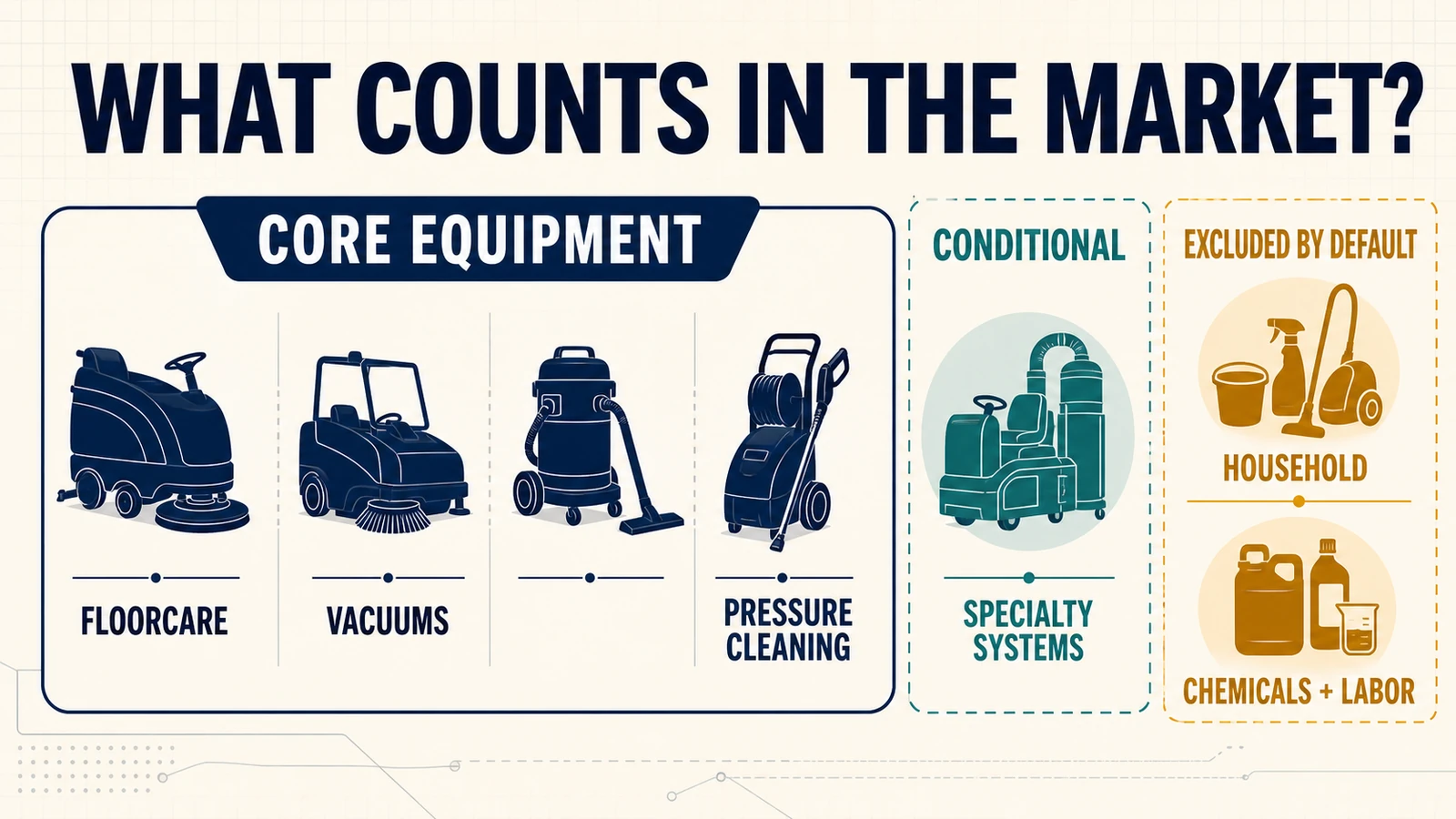
For this World Clean Biz framework, the core market covers powered machines used to perform professional cleaning tasks in industrial or commercial facilities.
| Core equipment group | Typical machines | Main job |
|---|---|---|
| Mechanized floorcare | Scrubber dryers, sweepers, combination machines, burnishers | Remove dry soil, wash hard floors and restore finishes |
| Professional and industrial vacuum | Dry, wet-and-dry, hazardous-dust, stationary and central systems | Capture dust, debris, liquids or process material |
| High-pressure cleaning | Hot- and cold-water mobile or stationary washers | Remove attached soil from equipment, vehicles and surfaces |
| Carpet and textile extraction | Portable, self-contained and larger extractors | Apply and recover cleaning solution from soft surfaces |
| Autonomous versions | Robotic scrubbers and other autonomous machines within an included product class | Automate part of an existing professional cleaning task |
The VDMA Cleaning Systems association uses a narrower industry boundary: manufacturers of floor-cleaning and high-pressure cleaning machines for commercial cleaning technology. Nilfisk’s professional product taxonomy adds floor scrubbers, sweepers, robotic floor cleaning, combination machines, commercial and industrial vacuums, pressure washers and carpet extractors.
Both are useful. Neither automatically defines the universe used by every market report.
Which Categories Need an Explicit Inclusion Rule?
Some machines sit at the boundary of the market.
Municipal sweepers can be treated as outdoor cleaning equipment or as municipal vehicles. Parts washers and ultrasonic systems may belong to industrial cleaning, production equipment or precision-processing machinery. Vehicle-wash systems can be counted as cleaning equipment or as a separate car-wash market. Steam, dry-ice and very-high-pressure systems can be included in a broad industrial definition but disappear from a floorcare-focused report.
These categories should be marked included, excluded or reported separately before any market value is calculated.
The same applies to autonomous equipment. A robotic scrubber belongs inside the floorcare category when it replaces or extends a floor-cleaning task. It should not also be added as a second standalone robotics market unless the analyst removes the overlap.
The commercial cleaning robot market guide measures annual robot sales, active fleets, utilization and TCO. Those metrics answer an automation question. They do not replace a market model for the much larger installed base of manual and operator-driven equipment.
What Is Usually Outside the Equipment Market?
A clean denominator normally excludes:
- household vacuums, pressure washers and floor cleaners;
- general detergents and janitorial chemicals;
- mops, carts and other manual tools;
- contract cleaning labor;
- hygiene, pest-control and facility-management services;
- unrelated water-treatment equipment;
- production-process cleaning systems not covered by the chosen equipment taxonomy.
Exclusion does not mean these activities are commercially unimportant. It means they belong in another revenue pool.
Kärcher shows why the boundary matters. Its 2025 company figures report €3.483 billion in group sales. Its professional portfolio spans pressure cleaning, vacuums, robots, scrubbers, sweepers, municipal equipment, vehicle washing, dry-ice cleaning, water treatment, manual equipment and cleaning agents. The group also operates a Home & Garden business. Total group sales therefore cannot be treated as a pure industrial cleaning-equipment value.
Industrial and Commercial Buyers Overlap
The word `industrial` is used in two different ways.
One definition describes the duty level and machine design: robust equipment built for long operating hours, larger debris loads or specialist hazards. Another describes the customer site: manufacturing, food processing, pharmaceuticals, automotive plants and warehouses.
Commercial cleaning equipment serves offices, retail, hospitality, schools, healthcare, arenas and public buildings. The machines can be identical to those used in lighter industrial environments.
Tennant’s 2025 Form 10-K explicitly combines industrial and commercial use. Its listed environments include factories, warehouses and distribution centers alongside retail, offices, schools, hospitals and public venues.
| Buyer-scope choice | Included examples | Best use |
|---|---|---|
| Industrial sites only | Manufacturing, logistics, food, pharma, automotive | Factory and industrial-channel demand |
| Professional equipment | Industrial sites plus commercial and institutional facilities | Manufacturer and distributor opportunity |
| All cleaning equipment | Professional plus household products | Broad appliance-and-equipment research |
A report called `industrial cleaning equipment` can use any of these universes. The title alone does not reveal which one.
Equipment Revenue Is Not the Whole Revenue Pool
The market can be measured at several layers:
- New equipment sold by manufacturers.
- Distributor or dealer sell-in.
- End-user equipment spend.
- Parts, accessories and consumables.
- Maintenance and repair.
- Rental, leasing and financing.
- Connected services and fleet software.
Adding multiple transaction layers double counts the same machine. Excluding every aftermarket layer can understate the commercial value of an installed base.
Tennant provides a useful audited example. Its 2025 net sales were US$1.2035 billion, split into US$714.7 million of equipment, US$275.6 million of parts and consumables, and US$213.2 million of service and other revenue. Equipment represented one component of company sales, not the complete total.
This does not establish Tennant’s global market share. It establishes why a company’s reported revenue and an equipment-only market denominator are different measurements.
Why Manufacturer Revenue Cannot Simply Be Added
Three current company disclosures show the comparability problem:
| Company disclosure | 2025 revenue signal | Scope issue |
|---|---|---|
| Tennant | US$1.2035 billion net sales | Includes equipment, parts/consumables, service and other |
| Nilfisk | €996.3 million revenue | More than 90% of sales are to professionals, but the company still has consumer products |
| Kärcher | €3.483 billion group sales | Includes Home & Garden and a professional portfolio wider than most industrial-equipment definitions |
Nilfisk’s investor page identifies its 2025 annual report, while its official company information describes floorcare, vacuums, high-pressure washers and aftermarket as main product lines. The professional share makes Nilfisk relevant to the market, but it does not make every euro equivalent to a new industrial machine.
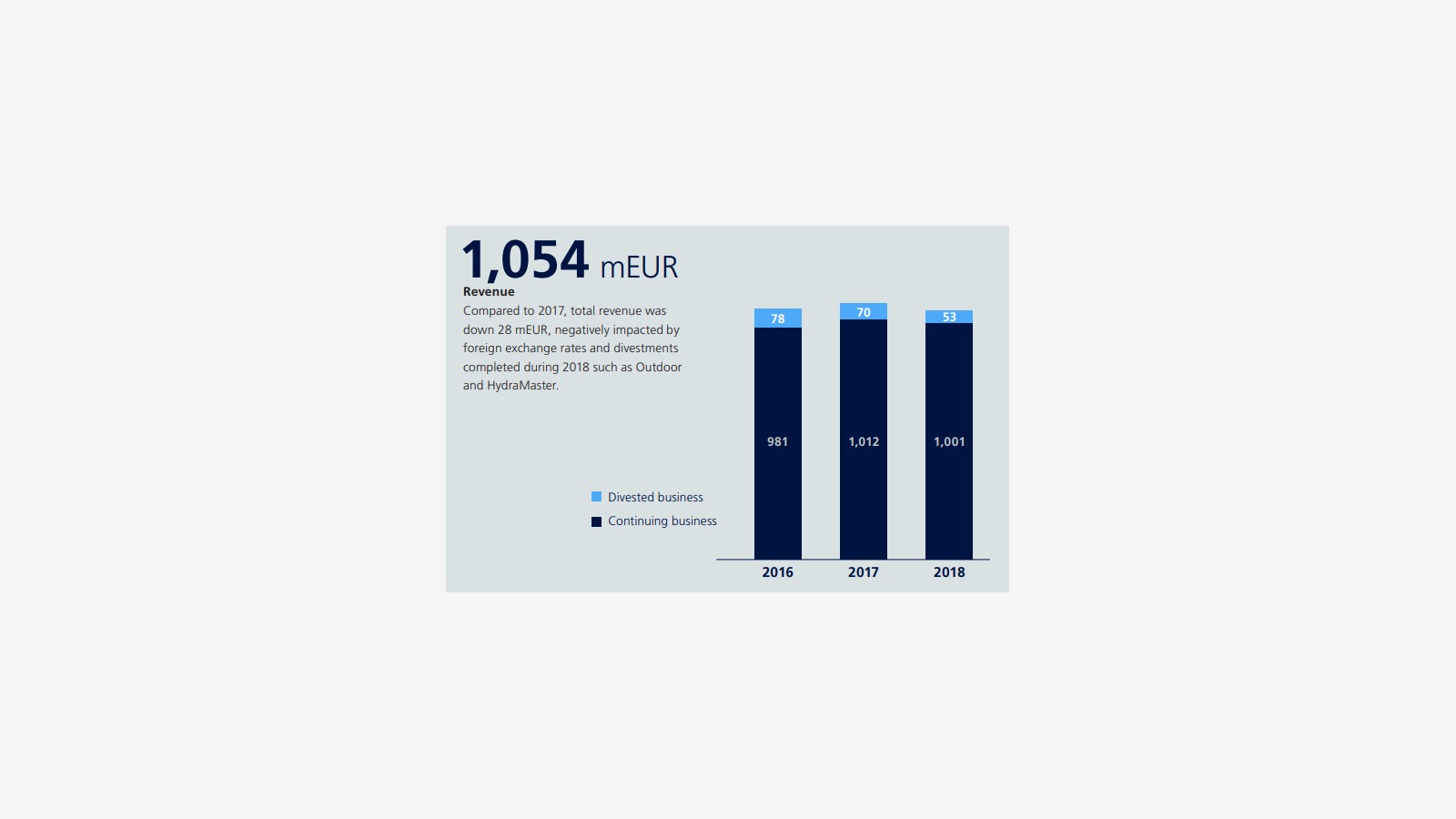
Currency is another problem. Converting one year’s revenue at a spot exchange rate does not produce a comparable historical market series. Acquisitions, divestments, intercompany eliminations and geographic reporting also need consistent treatment.
A credible supply-side model begins with related revenue, then applies documented adjustments. It does not add every cleaning company’s total turnover.
Four Ways to Measure the Market
1. Supplier-revenue model
Start with manufacturers whose product scope fits the definition. Separate equipment from aftermarket and service where disclosures allow it. Remove consumer products, unrelated machinery and intra-group sales.
This method works best for a concentrated category with several reporting companies. It weakens when private manufacturers, regional brands and dealer private labels represent a large share.
2. Installed-base and replacement model
Estimate active machines by product class and buyer segment. Then model annual demand:
`Annual equipment demand = replacement units + first-time or new-site units + net fleet expansion`
Replacement assumptions should reflect actual duty cycle, repair economics and asset age. A nominal design life is not the same as the observed replacement interval.
Multiply units by a realized value at one transaction layer:
`Equipment market value = units × realized manufacturer, distributor or end-user value`
The selected price layer must remain consistent across countries and product classes.
3. Trade-data model
Customs data can identify cross-border flows, production hubs and changes in declared value. It rarely maps perfectly to the market.
One customs code can combine household and professional vacuums. A finished scrubber and a component shipment can sit in different classifications. Transfer values between related companies can differ from distributor or end-user prices. Local production never crossing a border is absent.
Trade data is evidence, not an automatic global total.
4. Channel model
Distributor sell-in, dealer sell-through, rental fleets and service records can show regional demand. The risk is overlap.
A machine sold by an OEM to a distributor and then rented by a dealer remains one machine. The equipment sale, rental revenue and service parts can all be valid commercial measures, but they need separate columns.
What Market Signals Matter Beyond a CAGR?
For a manufacturer, distributor or component supplier, four signals are more actionable than one headline forecast.
Installed base and replacement
A large active fleet creates recurring parts, consumables and service demand. Replacement demand is more stable than first-time adoption, but it can shift when repair costs, battery platforms or safety requirements change.
Product mix
Walk-behind and ride-on machines, compact and industrial systems, and manual and autonomous operation have different selling values and channel requirements. Unit growth can coexist with flat revenue when mix moves downward.
The floor sweeper versus floor scrubber guide explains why dry soil and wet cleaning are separate jobs. A market model that merges both classes still needs a product-mix bridge.
Aftermarket capture
Parts and service depend on fleet age, machine intensity, local technician coverage and whether customers buy original or third-party consumables. High installed units do not guarantee that the original manufacturer captures lifecycle revenue.
Automation conversion
Autonomous machines can raise equipment and software value, but announced pilots are not the same as active scaled fleets. The autonomous floor scrubber guide covers site fit and pilot evidence; the market model should count a robot only in the stage that the data actually proves.
How Buyers and Distributors Should Use Market Data
A facility buyer does not need a global market value to choose one machine. The buyer needs site conditions, accepted cleaning output, service coverage and total cost.
The commercial floor scrubber buying guide converts deck, tank, battery and productivity claims into an operating decision. The rent, lease or buy guide separates ownership, utilization and service risk.
Distributors use market data differently. They need a serviceable installed base, replacement timing, parts demand, technician capacity and territory economics. A fast-growing equipment category with weak parts availability can create revenue without creating a durable channel.
Manufacturers should test whether reported regional growth represents new units, price, product mix, currency or channel inventory. Those drivers require different production and sales decisions.
Industrial Cleaning Equipment Market Audit Checklist
Before using a market-size or market-share claim, record:
- original publisher and release date;
- observed base year and forecast period;
- exact product taxonomy;
- industrial, commercial, institutional and household buyer treatment;
- equipment-only or lifecycle revenue;
- manufacturer, distributor, dealer or end-user value layer;
- units, revenue, installed base or contract value;
- new equipment versus used equipment;
- rental and leasing treatment;
- parts, consumables, service and software treatment;
- geography and currency conversion method;
- supplier sample and private-company estimation method;
- customs codes and local-production adjustment;
- overlap between OEM, distributor and rental-fleet data;
- acquisition, divestment and restatement treatment.
If these fields are unavailable, keep the published number attributed to its source. Do not present it as an audited industry total.
FAQ
How large is the industrial cleaning equipment market?
There is no single interchangeable figure. Public pages currently show different base-year estimates, including US$9.1189 billion for 2021 in an Allied Market Research report listing and US$11.1 billion for 2025 from Straits Research. The values use different years and public scope descriptions, so they should not be averaged or treated as one audited series.
What products are included in industrial cleaning equipment?
Most definitions include some combination of floor sweepers, scrubber dryers, professional or industrial vacuums and pressure washers. Steam, ultrasonic, municipal, vehicle-wash, carpet and autonomous equipment require an explicit inclusion rule.
Is commercial cleaning equipment part of the industrial market?
Sometimes. Major suppliers sell similar machines into factories, warehouses, retail, healthcare, schools and offices. A market study must state whether `industrial` describes only industrial end users or the broader professional equipment class.
Are cleaning chemicals included?
Not by default in an equipment-only market. Chemicals and detergents can be measured as a separate consumables pool. If a report includes them, its value is not directly comparable with a machinery-only estimate.
Does manufacturer revenue equal market size?
No. Manufacturer revenue can include consumer products, parts, service, rental, software and unrelated equipment. It can also exclude private companies and downstream channel margins. Use relevant company revenue as one input after documented scope adjustments.
How should autonomous floor scrubbers be counted?
Count them once inside the relevant floorcare class when measuring the full equipment market. Separate them as an automation subsegment only when the denominator removes the overlap.
Bottom Line
The industrial cleaning equipment market is not difficult to discuss because the machines are mysterious. It is difficult because familiar machines are placed inside different commercial boundaries.
A useful estimate defines the equipment, buyer and revenue layer first. It then triangulates supplier revenue, installed-base demand, trade flows and channel evidence. The result may be less dramatic than a single global headline, but it is far more useful for production, distribution and procurement decisions.