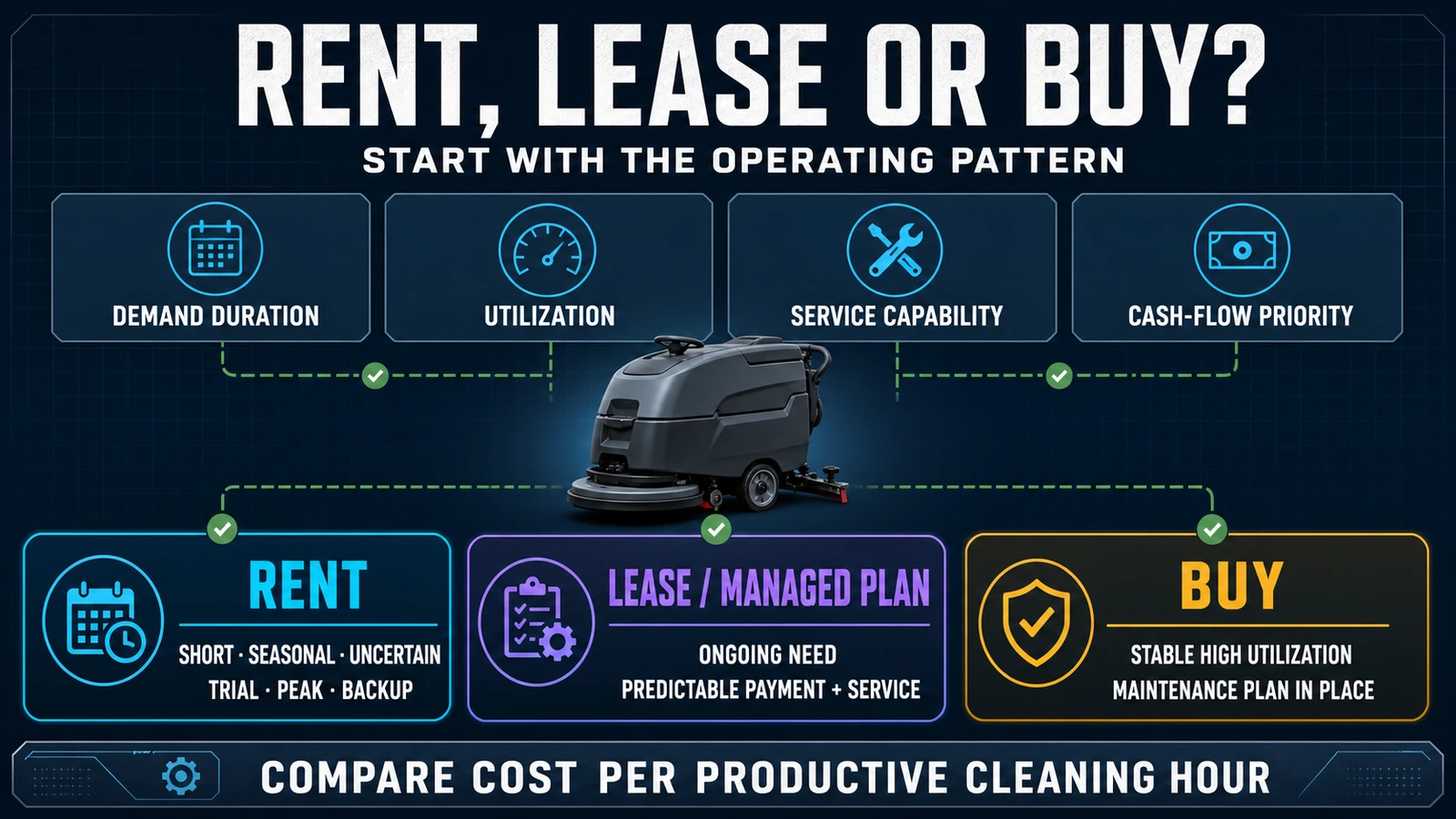
- Rent for short, seasonal or uncertain demand; lease for ongoing access with predictable monthly service; buy for stable, high-utilization work supported by a maintenance plan.
- Compare cost per productive cleaning hour, not a rental rate against a purchase price.
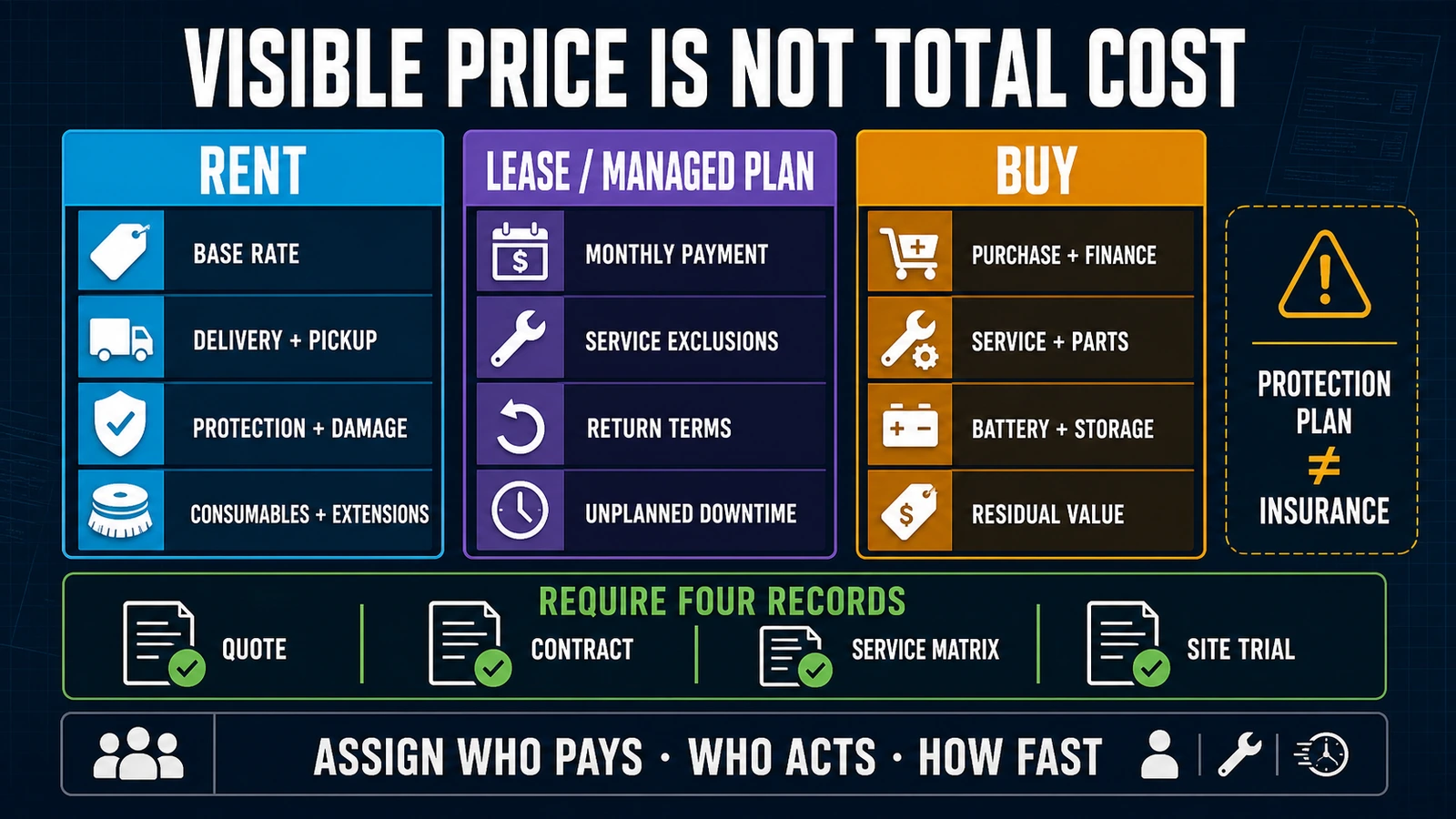
- The contract must assign delivery, daily care, repairs, replacement equipment, damage, consumables and end-of-term responsibility.
In this article 13 sections
Rent a floor scrubber when the requirement is short, seasonal, uncertain or part of a machine trial. Lease—or use a managed monthly program—when the need is ongoing but predictable payments and bundled service matter more than owning the asset. Buy when demand is stable, utilization is high and your operation can support maintenance and downtime.
The wrong comparison is rental rate versus purchase price. A useful floor scrubber rental vs buy decision compares the same machine, the same cleaning output and the full responsibility attached to each option.
That means calculating cost per productive cleaning hour, then checking who pays when the machine must be delivered, trained, maintained, repaired or replaced.
Floor Scrubber Rental vs Buy at a Glance
| Operating condition | Best starting option | Why |
|---|---|---|
| One project or shutdown cleanup | Rent | Access the machine only for the required period |
| Seasonal peak or temporary contract | Rent | Capacity can expand without a permanent fleet commitment |
| Machine trial before specification approval | Rent | Real floors and operators expose fit problems before purchase |
| Continuing need with limited capital budget | Lease or managed monthly program | Spreads payments and can bundle service |
| Continuing need with uncertain service capability | Managed monthly program | Service responsibility can be defined in one contract |
| Stable weekly or daily cleaning | Buy | High utilization can lower long-run cost per productive hour |
| Mission-critical operation with in-house maintenance | Buy, plus a backup plan | Ownership gives scheduling control while the backup protects uptime |
| Several sites with different demand patterns | Mixed model | Own the base fleet and rent peak or specialist capacity |
These are starting positions, not automatic answers. A poor machine rented cheaply still wastes labor. A well-priced purchase still fails if the site cannot maintain it.
First Define Rent, Lease and Buy
Commercial equipment suppliers do not always use these terms in the same way.
Short-term rental normally covers a defined project, week or month. The rental company owns the equipment and may include scheduled maintenance, but the customer remains responsible for operation and the obligations written into the agreement.
Long-term rental, lease or managed monthly program provides access over a longer term. The contract may combine the machine, planned maintenance, repairs, training and support in one payment. The exact bundle matters more than the label.
Tennant, for example, describes its Flex Clean and Clean 360 programs as monthly packages combining equipment, service and technical support. Its published service matrix shows that coverage differs by plan, including planned maintenance, emergency repairs and training.
Buying transfers the asset to the customer. The buyer controls deployment and keeps any resale value, but also carries the equipment’s operating-life costs unless a separate service agreement transfers part of that responsibility.
Before comparing quotations, ask each supplier to mark the offer as:
- rental with a fixed return date;
- long-term rental;
- lease with an end-of-term return;
- lease with a purchase option;
- financed purchase; or
- equipment plus managed service.
Two offers with the same monthly payment can create very different rights, costs and return obligations.
Match the Machine Before Comparing Payment Methods
The finance decision comes after the application decision.
A compact walk-behind scrubber and a mid-size rider do not deliver the same coverage, require the same transport or fit the same building. A lower rate is irrelevant if the operator needs twice as long to finish the work.
Define:
| Requirement | What to verify |
|---|---|
| Floor and soil | Surface type, loose debris, dust, oil, grease and required chemistry |
| Layout | Open floor, narrow aisles, doors, elevators, slopes and obstacles |
| Cleaning output | Area that must be completed inside the available shift |
| Machine format | Walk-behind, stand-on, ride-on or sweeper-scrubber |
| Water system | Solution and recovery capacity, refill and dump locations |
| Power | Battery runtime, charging window, charger and available electrical supply |
| Tooling | Brush or pad type, squeegee material and consumable availability |
| Access | Delivery route, loading dock, transport vehicle and storage |
| People | Operator count, training, daily care and maintenance capability |
If the main problem is dry litter or packaging debris rather than wet soil, first read Floor Sweeper vs Floor Scrubber. If the machine type is already clear but the size is not, use the walk-behind vs ride-on floor scrubber guide.
When Renting a Floor Scrubber Is the Better Choice
Rental is strongest when flexibility has measurable value.
The need is short or irregular
Post-construction cleaning, shutdown work, seasonal deep cleaning and one-time floor recovery do not always justify a permanent asset. Rental aligns access with a limited job.
Demand is not yet proven
A contractor may win a new account without knowing whether the workload will continue. A facility may also be testing a revised cleaning standard. Renting limits the commitment while the team measures actual hours, water cycles and operator productivity.
You need to test the specification
A live trial can reveal that a rider cannot pass through a door, a walk-behind is too slow, the selected pad is wrong or the battery cannot cover the shift. The trial should use the real floor, soil, operator and cleaning window.
Your owned machine is down
Rental can protect the cleaning schedule while an owned unit is repaired. That backup should be arranged before an emergency if equipment availability is critical.
You need temporary peak capacity
A contractor may own the base fleet and rent extra machines for a large project. This avoids buying for a peak that will not continue.
Rental still requires a landed-cost calculation. Kärcher’s current U.S. rental service page, accessed July 24, 2026, illustrates why. It lists a one-week minimum, a 60-mile delivery area and a $300 pickup-and-delivery fee. It also shows separate weekly and monthly rates for a walk-behind and a ride-on scrubber.
Those figures are not market averages. They are a dated quotation example showing that machine rate, minimum period and logistics must be compared together.
When Leasing or a Managed Monthly Program Fits
Leasing sits between short rental and outright ownership, but its value does not come only from spreading the purchase price.
It can fit when:
- the cleaning requirement is continuing;
- the buyer prefers a predictable operating payment;
- capital approval is difficult;
- the fleet needs a defined refresh cycle;
- local maintenance capability is limited; or
- management wants equipment and service under one accountable supplier.
The main question is what the payment includes.
One program may include planned maintenance but exclude wear parts. Another may include emergency labor but not replacement equipment. A third may require the machine to be returned at a defined condition and charge for excess wear.
Request a service matrix with five columns:
| Event | Included? | Response time | Customer cost | Evidence |
|---|---|---|---|---|
| Planned maintenance | Contract section | |||
| Breakdown labor | Contract section | |||
| Travel and call-out | Contract section | |||
| Wear parts | Parts schedule | |||
| Replacement machine | Uptime or service clause | |||
| Operator training | Training scope | |||
| Battery failure | Battery terms | |||
| End-of-term condition | Return standard |
Do not treat “full service” as a substitute for this table. The commercial name of the plan is not the responsibility boundary.
When Buying a Floor Scrubber Is the Better Choice
Buying becomes stronger when the machine is used consistently and the organization can manage the asset.
Utilization is stable
Daily or recurring weekly work spreads the acquisition cost over more productive hours. The buyer is not repeatedly paying rental mobilization and availability premiums.
Immediate availability matters
An owned machine can be deployed when needed without waiting for rental inventory or delivery. This matters in healthcare, food operations, manufacturing and high-traffic facilities where cleaning cannot be postponed.
Operators benefit from one familiar machine
Consistent controls, tooling and daily-care routines reduce relearning. The benefit depends on training and supervision, not ownership alone.
The service route is credible
Ownership works better when the buyer has trained internal technicians or a dealer service agreement. Kärcher’s equipment service page shows the kinds of support that can sit beside ownership: planned maintenance, on-site repair, parts, service agreements, trade-in programs and temporary replacement equipment. Each item still needs a quoted scope and response time.
The machine has useful remaining value
An owned scrubber can be retained, traded or sold. Residual value should be treated conservatively and supported by a real buyback or used-equipment quotation.
Buying is not automatically cheaper because the purchase order has been paid. Poor water recovery, battery neglect and delayed wear-part replacement can increase labor and downtime. For the operating consequences of recovery-system faults, see Floor Scrubber Not Picking Up Water.
Calculate the Full Cost of Each Option
Use the same time horizon and the same cleaning output.
Rental cost
`Annual rental cost = base rental + delivery/pickup + protection or insurance + accessories and consumables + extensions + operator cost + uncovered downtime`
Rental quotations should state whether taxes, transport, fuel or logistics surcharges are included. Cat Rentals, for example, states that displayed rental rates and estimated totals exclude several charges, including taxes, freight and delivery. The final contract and dealer quotation control the actual price.
Lease or managed-program cost
`Annual program cost = monthly payments + upfront fees + excluded service and parts + consumables + return charges + insurance + operator cost + uncovered downtime`
Include the full contractual term. A lower monthly amount can become more expensive if the agreement is long, difficult to exit or expensive to return.
Ownership cost
`Equivalent annual ownership cost = (purchase + finance + setup + lifetime service and parts + battery system + storage − realizable resale value) ÷ planned service years + annual consumables + operator cost + downtime contingency`
Use the actual configuration. A machine price without batteries, charger, brushes, pads or delivery is not the installed cost.
Do not insert an optimistic life or resale value to make ownership win. Obtain a service history assumption, a battery-replacement plan and a trade-in indication from the supplier.
Use productive hours as the denominator
`Cost per productive cleaning hour = total annual cost ÷ productive scrubber hours`
Productive hours are the time when the machine is delivering acceptable cleaning. They exclude delivery, charging delays, refilling, operator waiting, breakdowns and rework.
A second useful measure is:
`Cost per accepted square foot or square meter = total annual cost ÷ accepted cleaned area`
“Accepted” matters. Fast passes that leave water or soil behind are not useful output.
Rental Contract Costs That Are Easy to Miss
The headline rate is only one line in the agreement.
Check:
- exact model, configuration, accessories and charger;
- minimum billing period and when the rental clock starts;
- delivery, pickup, loading and distance charges;
- extension, late-return and automatic-renewal rules;
- deposit, tax, payment and credit terms;
- damage, theft, transit and insurance responsibility;
- daily cleaning, charging and return-condition duties;
- brushes, pads, squeegees, detergent and other consumables;
- breakdown reporting and repair response;
- replacement-equipment availability;
- training and permitted operators; and
- cleaning, contamination or missing-accessory fees.
Protection plans need their own review. Sunbelt’s U.S. Rental Protection Plan terms provide a clear example: the plan is not insurance, carries a fee equal to 15% of gross rental charges and contains conditions and exclusions.
That does not establish the terms of a floor scrubber quotation from another supplier. It demonstrates why “damage waiver included” is not enough information.
Build a Break-Even Worksheet from Quotations
There is no responsible universal answer such as “buy after three months.” Machine size, local rates, service coverage and duty cycle can move the result substantially.
Use a worksheet with one column for each option:
| Input | Rent | Lease / managed program | Buy |
|---|---|---|---|
| Required months or years | |||
| Required productive hours | |||
| Base payment | |||
| Delivery and setup | |||
| Training | |||
| Planned maintenance | |||
| Breakdown labor and travel | |||
| Batteries and charger | |||
| Brushes, pads and squeegees | |||
| Protection or insurance | |||
| Storage and internal handling | |||
| Expected downtime cost | |||
| End-of-term or disposal cost | |||
| Less realizable residual value | |||
| Total cost | |||
| Cost per productive hour |
Then test three demand cases:
- base case: expected weekly use;
- low case: contract loss, seasonality or reduced traffic; and
- high case: extra shifts, new sites or peak demand.
Rental often performs better in the low case because capacity can be returned. Ownership can perform better in the high case because more output is spread across the asset. Leasing can reduce payment volatility, but only if the service package and term match the operation.
A Mixed Fleet Is Often the Practical Answer
The decision does not have to be all rent or all buy.
A multi-site operator can own frequently used walk-behind scrubbers and rent riders for periodic large-area work. A cleaning contractor can own the machine required for core accounts, then rent identical units for mobilization peaks. A facility can buy its main scrubber and pre-arrange emergency rental coverage.
The same logic applies to autonomous equipment. A robotic scrubber should normally be tested on the real route, with the real intervention workload, before a larger commitment. The autonomous floor scrubber guide explains why a pilot must measure delivered productivity and support rather than navigation claims alone.
B2B Decision Checklist
Before approving rent, lease or buy, confirm:
- the application and required cleaning result;
- the exact machine and tooling;
- measured productive hours from a site trial;
- total landed and operating cost;
- who performs daily care;
- who pays for wear parts and batteries;
- repair response time;
- replacement-machine availability;
- damage and insurance terms;
- end-of-term return or residual value; and
- a named owner for uptime and service escalation.
If one of those lines is blank, the proposal is not yet comparable.
Frequently Asked Questions
Is it cheaper to rent or buy a floor scrubber?
Renting is commonly cheaper for short, seasonal or uncertain demand. Buying can produce a lower cost per productive hour when use is stable and high, but only after maintenance, batteries, wear parts, downtime and residual value are included.
When should a business buy instead of rent?
Buy when the required machine is proven, weekly demand is stable, availability matters and the organization has a workable service plan. Do not use a generic month threshold without comparing actual quotations.
Is leasing the same as renting?
Not always. Short rental usually covers a project or limited period. A lease or managed monthly program normally creates a longer commitment and can include service or an end-of-term option. Read the contract rather than relying on the label.
Does a rental company pay for all maintenance?
Only if the agreement says so. Planned maintenance may be included while daily care, consumables, damage, misuse or cleaning on return remain the customer’s responsibility.
Should I rent a walk-behind or ride-on floor scrubber?
Choose the machine from the floor area, layout, cleaning window and labor plan. Walk-behind units fit tighter spaces; riders can reduce operator walking and cover larger open areas. Test delivered productivity rather than comparing cleaning-path width alone.
Can rental be used before buying?
Yes. A controlled rental trial can validate machine size, tooling, battery runtime, water recovery, operator acceptance and service response before purchase.
Final Answer
The best floor scrubber payment method follows the operating pattern:
- Rent for temporary, seasonal, uncertain or trial demand.
- Lease or use a managed program for continuing access with predictable payments and clearly defined service.
- Buy for stable, high-utilization work backed by maintenance and downtime planning.
Compare the same output over the same time horizon. The winning option is not the one with the lowest visible payment. It is the one that delivers the required clean floor at the lowest credible cost per productive hour—with responsibility clear before the machine arrives.