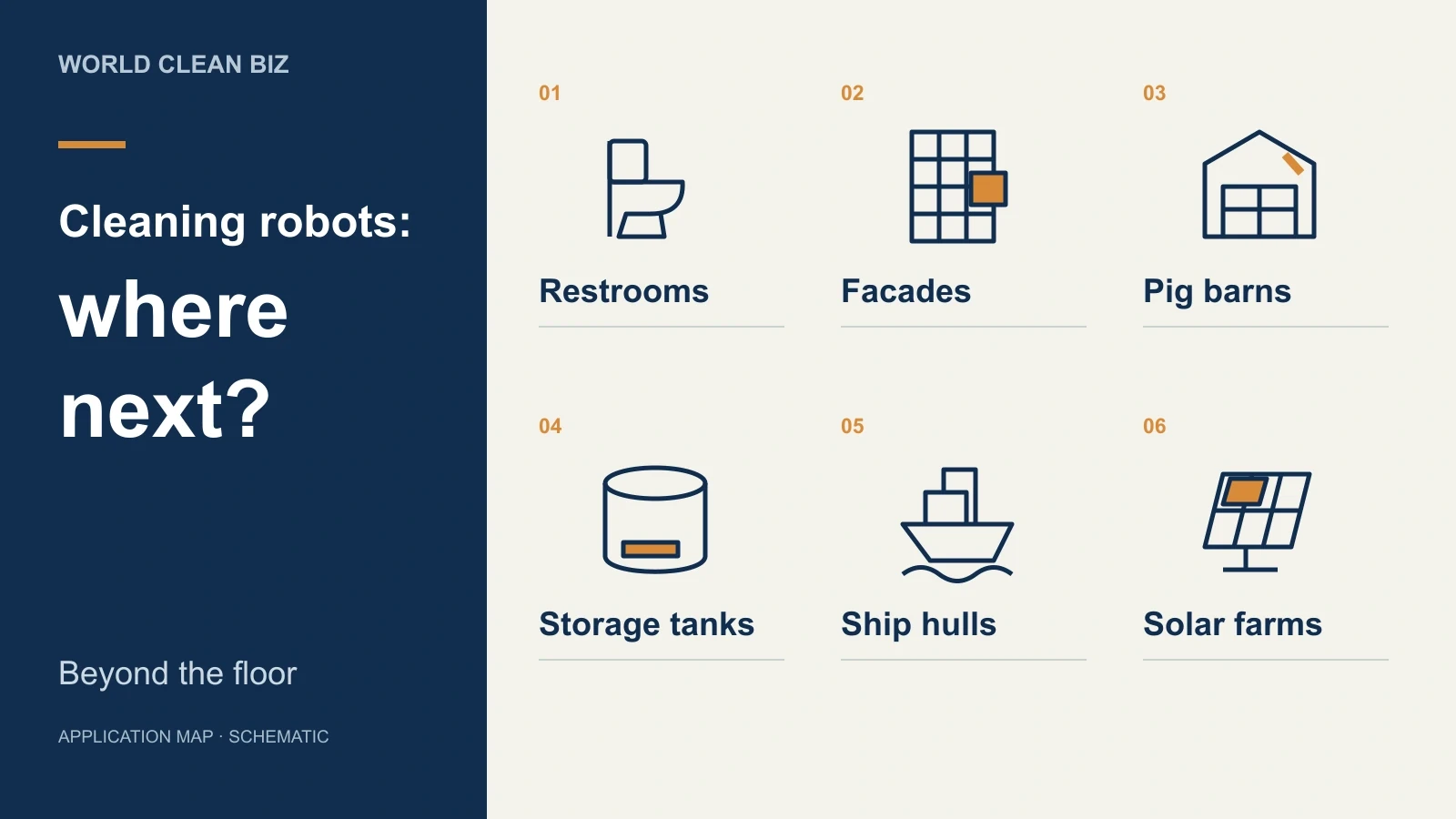
- Cleaning robots are expanding beyond floors, but each application has different operating demands and reasons to buy.
- A product's ability to serve multiple customers without extensive redevelopment determines how far the business can scale.
- Existing specialist cleaning contractors can provide a practical route into professional markets.
A company developing robots to clean toilets has raised $6 million.
On September 4, the National University of Singapore announced that alumni-founded Hivebotics had completed a Series A round to bring its Abluo restroom-cleaning robot into volume production and expand internationally. The idea grew out of a cleaning contractor's staffing difficulties during the pandemic. The two founders spent days cleaning toilets and mixing cleaning solutions themselves before working out a product approach. National University of Singapore
Robots can already clean large stretches of shopping-mall floors. Inside a restroom, the space narrows, toilets and basins come in different shapes and positions, and floor-cleaning equipment cannot reach them. A machine that can drive through the door is still a long way from doing a cleaner's job.
Yet restrooms need cleaning repeatedly throughout the day. The work is demanding, and recruiting people to do it is difficult. If a robot can reliably take on part of the workload, some customers will be willing to try it. Hivebotics now has to show how much time remains saved after staff have prepared the machine, dealt with problems during its run and cleaned it up afterward.
Much of commercial cleaning robot development in recent years has focused on floors. Relatively flat working environments gave manufacturers a place to get navigation and cleaning right. Expanding beyond them sometimes requires a new cleaning mechanism. In other cases, the first problem is getting the machine to its next work area.
On September 8, Schindler published a case study from a school in Austria. A Gausium robot connected to the elevators through Schindler CoLab can call a lift, select a floor and carry on cleaning within a six-story building. Local importer Denzel Robotics and a sales partner handled on-site integration. The robot cleans common areas; staff still clean beneath classroom furniture and wash large glass surfaces. Schindler case study
If someone has to move the robot to the next floor every time it finishes, staff cannot leave it entirely on its own. Elevator access allows it to change floors independently and makes continuous overnight work easier to schedule. But a local team must coordinate with the building's systems. Installation and ongoing support already extend beyond selling a machine.
High-rise facade cleaning depends even more on conditions at the site. Skyline Robotics' Ozmo uses robotic arms to clean glass facades, with sensors determining its position and controlling the cleaning action. It serves the professional facade-cleaning market, a very different business from selling window-cleaning robots to households. Ozmo product information
Whether a building can use the equipment, and how it can be deployed, depends on the building's existing provisions for work at height. Facade-cleaning contractors that know the sites and already serve building owners could become a manufacturer's most important partners. They can also help developers identify which features will actually be useful on the job.
On farms, cleaning robots have been at work for years.
Sweden's Envirologic makes the EVO Cleaner for pressure-washing pig barns. An operator uses a joystick to teach it the washing routine, which the machine stores and repeats. It can send a text message when the job is finished. Routines can be adapted to individual barn layouts, avoiding obstacles such as feeding equipment. Envirologic product information
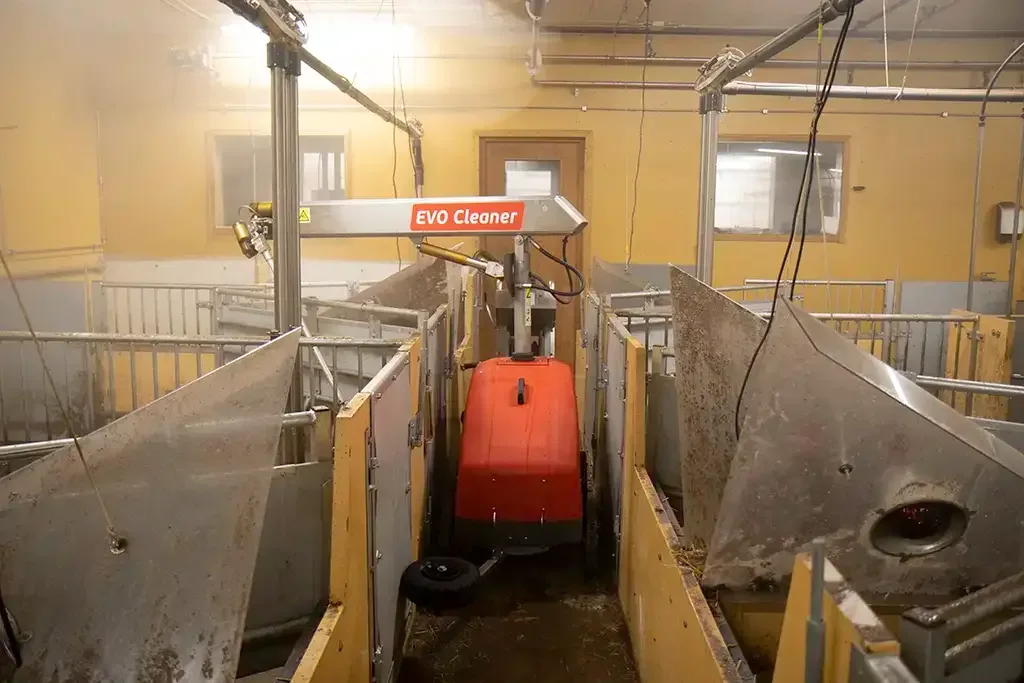
*EVO Cleaner in a pig barn. Photo: Envirologic.*
Barn layouts are relatively fixed, and washing involves repeated movements. Developers do not have to wait for a machine that can understand every unfamiliar environment on its own. Teaching it how to wash this particular barn is enough to put it to work.
For the farmer, cleaning performance and ease of operation matter more than the algorithm. A machine that handles dirt every day needs cleaning and maintenance itself. If staff have to spend a long time taking it apart and washing it afterward, the labor savings shrink.
Finding a difficult manual task is not enough for a manufacturer. Whether the same machine can be sold to the next customer determines how large the business can become. If each new site requires redevelopment, engineering and delivery costs rise along with orders. Products such as pig-barn washing robots, which can accommodate different layouts through on-site teaching, offer one approach: retain the equipment and handle the differences in its operating program.
In some specialist applications, there is a strong reason to buy even when the robot still needs a human operator at the controls.
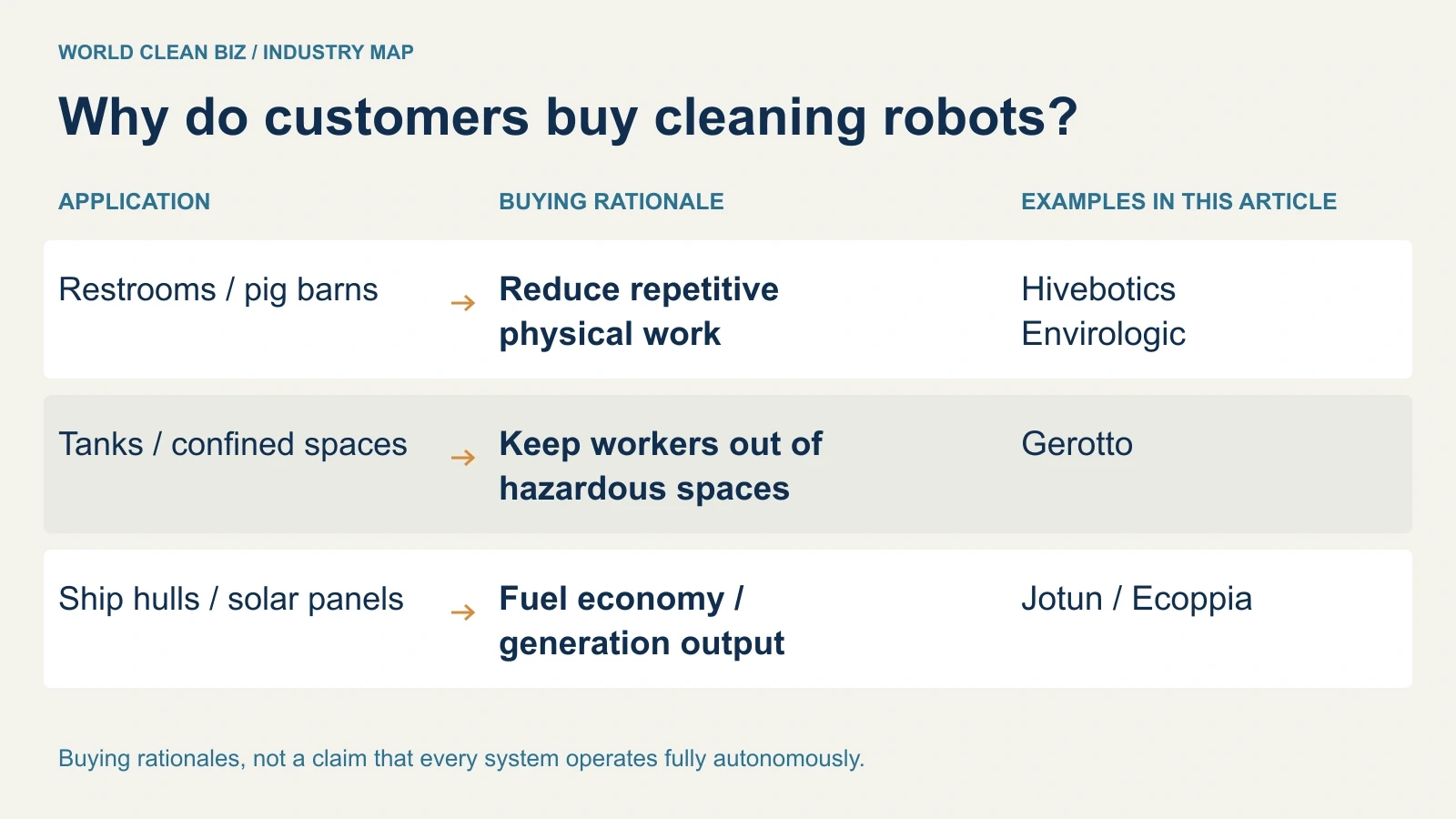
Italy's Gerotto supplies robots for cleaning storage tanks and confined spaces, allowing operators to stay outside. It also offers configurations for specific explosive atmospheres. Reducing the need to send workers into hazardous spaces has value of its own; hours of labor saved cannot be the only measure. Gerotto product information
These products face higher industry-specific requirements. Manufacturers must select equipment configurations for the actual working environment. They cannot simply modify an ordinary cleaning robot and send it in. An order may be valuable, but the range of customers the product can serve—and what it costs to deliver—need to be understood in advance.
For ships and solar farms, cleaning can be tied directly to operating returns. Jotun's HullSkater cleans ship hulls underwater, and the company has disclosed a collaboration with Carnival Cruise Line. Ecoppia supplies automated cleaning systems for utility-scale solar sites, including water-free cleaning and remote management. Jotun, Ecoppia
Hull fouling increases drag; dust on solar panels reduces generation. If fuel savings or additional electricity revenue cover the cleaning expense, customers have a reason to keep buying. These applications extend beyond ordinary commercial housekeeping and already have purpose-built products. New entrants will need better operating results or economics to win a place.
I expect more companies specializing in narrow cleaning applications to emerge. They may not all reach enormous sales figures. But once a supplier has built a substantial customer base in an industry, rivals will find it difficult to win those orders on price alone. Field experience helps reduce problems during deployment, and existing customers' results influence the next buyer's decision.
For companies entering these fields, established cleaning contractors may offer the most direct route to market.
On September 9, specialist cleaning services company Promera announced the acquisitions of Formula Facilities Services and Critical Area Cleaning, expanding its data-center contamination-control business in the UK and Ireland. Their work covers operational maintenance and construction-stage cleaning, respectively. Promera announcement
The acquisition of service businesses does not establish that robots are already being widely deployed in data centers. But if suitable cleaning equipment becomes available, these contractors could be buyers. They understand customer requirements, can organize its use on site and can introduce it into existing projects. Working through such partners will often be more practical for a manufacturer than finding end customers from scratch.
Chinese companies have built considerable capabilities in cleaning-product development and manufacturing. As they enter these markets, they also need to decide which orders are worth pursuing. Some projects have substantial contract values but require a great deal of engineering work for every machine delivered. Some apparently modest applications allow the same equipment to be sold to many similar customers. The two businesses call for different teams and funding arrangements.
I favor applications with relatively fixed sites and repeated work, where one product can serve multiple customers. Pig-barn cleaning attracts less excitement than humanoid robots, but it may produce repeat orders sooner.
For a Chinese manufacturer, the next product opportunity may be found in a cleaning contractor's daily work. Start by seeing where the most labor goes, then decide whether a machine can take on that job.