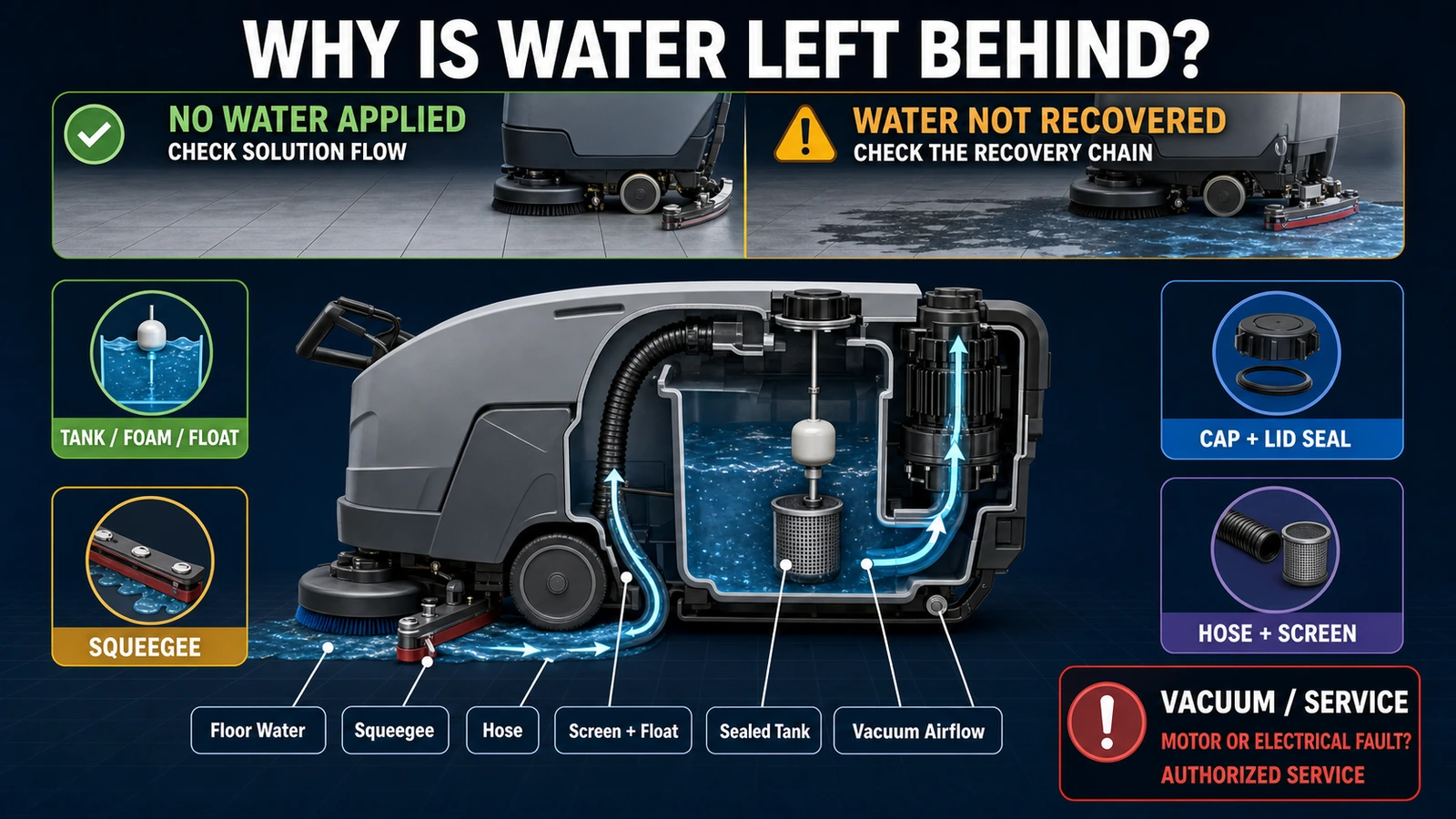
- First separate a solution-flow problem from a recovery problem: a dry floor suggests no water is being dispensed, while a wet trail means water is not being recovered.
- For poor pickup, check the recovery tank and foam, drain cap and tank lid, squeegee, visible hose path, screens and debris traps allowed by the exact operator manual.
- Escalate motor, electrical, control, internal leak and recurring faults to trained service personnel, then complete and record a controlled return-to-service test.
In this article 14 sections
If a floor scrubber leaves water behind, first stop and protect the wet area. Then determine whether the machine failed to dispense solution or failed to recover it. A dry, unwashed path points to the solution side; a wet trail usually points to the recovery tank, foam or float shutoff, an open drain cap, a leaking tank lid, dirty or worn squeegee blades, a blocked or leaking hose, or a vacuum-system fault.
The exact checks and adjustments vary by model. Use the operator manual for the complete model and configuration, isolate the machine as instructed, and keep internal electrical, motor and control-system work within trained or authorized service.
Floor Scrubber Water Pickup Problems at a Glance
| Symptom | Likely area to investigate | First safe action |
|---|---|---|
| Floor stays dry and is not washed | Solution tank, flow setting, filter, supply line, valve or pump | Confirm that the solution tank and model-specific controls are set correctly |
| Broad wet trail behind the machine | Full recovery tank, excessive foam, float shutoff, drain cap, lid seal, hose or squeegee | Stop the route, protect the area and inspect the operator-level recovery checks |
| One narrow streak | Debris, a nick or a contact gap at one point on the squeegee blade | Clean and visually inspect the blade according to the manual |
| Water mainly at turns or one end | Speed, turning technique, squeegee installation, level or deflection | Repeat a controlled test and use only the model's adjustment procedure |
| Suction can be heard but pickup is weak | Air leak, obstruction, dirty screen, lid seal or squeegee contact | Check the visible, manual-approved recovery path |
| No suction sound or a recurring fault code | Mode, power, motor, wiring, controller or safety device | Stop troubleshooting at the operator boundary and contact trained service |
| Floor looks smeared but has little standing water | Chemistry, soil, brush or pad, speed or residue | Diagnose cleaning performance separately from water recovery |
First Separate No Solution Flow from No Water Recovery
A scrubber dryer uses two related systems. The solution system places water or cleaning solution on the floor. The recovery system channels dirty water through the squeegee and suction path into the recovery tank. A complaint that the machine is “not picking up water” can be misdiagnosed if no water reached the floor in the first place.
If the floor remains dry, inspect the solution side using the exact manual: correct tank, fill level, flow setting, filter and supply line. Nilfisk's official troubleshooting guidance separates an empty or incorrectly filled solution tank and restricted hose, valve or filter from recovery failures. The Tennant T500 operator manual similarly lists an empty solution tank, low flow setting, clogged filter and plugged supply line under little or no solution flow, while pump and control faults move to service.
If the machine applies solution but leaves a wet lane, investigate the recovery chain. Do not compensate by repeatedly driving over an uncontrolled wet area. Protect people and materials from the wet floor, move the machine to an approved service location and follow its shutdown procedure.
How the Water-Recovery Chain Works
The rear squeegee gathers liquid into its suction opening. Airflow carries the liquid through a hose and protective screens or traps into a sealed recovery tank. A float or other full-tank protection limits pickup before liquid reaches the vacuum system.
Every stage depends on the next one:
- The blade must contact the floor evenly enough to channel water.
- The suction opening and hose must pass air and liquid without a damaging obstruction or leak.
- The recovery tank, drain hose and lid must form the seal required by the design.
- Screens, traps and the float system must be clean and correctly positioned.
- The vacuum system must run in the correct operating mode.
Kärcher's maintenance guidance explains that dirt on the recovery-tank lid seal can prevent the negative pressure needed for extraction. Its B 50 W manual lists the drain cap, tank-cover seals, turbine screen, suction lips, hose, suction-bar adjustment and internal seals as distinct checks for low suction performance. That list is useful as a system map; its controls and access steps apply to the B 50 W, not automatically to another machine.
Stop and Isolate the Machine Before Inspection
The first response is site control, not disassembly.
- Stop applying more water and secure the affected area under the site's wet-floor procedure.
- Park on a suitable level surface and isolate the machine exactly as its manual requires.
- Keep hands away from moving brushes, pads and linkages.
- Do not open electrical panels, test live circuits or bypass a float, interlock, fuse or safety switch.
- Do not pick up flammable material or reactive metal with a general-purpose scrubber.
- Use the specified drain point and local wastewater process.
For example, Tennant's T500 manual tells personnel to stop on a level surface, switch off, remove the key and set the parking brake if fitted before leaving or servicing that model. Other machines can have different energy-isolation steps. A site checklist should therefore reference the exact manual rather than copy one manufacturer's sequence into a universal rule.
Check the Recovery Tank, Foam and Float Shutoff
A full recovery tank is one of the most common official-manual causes of poor pickup. Excessive foam can create a similar symptom by activating a float or interfering with airflow before the tank appears full.
At operator level, and only as the manual permits:
- check the recovery-tank level and drain it at the designated location;
- look for abnormal foam and verify the approved detergent and dosing process;
- inspect and clean the float screen, cage or related filter named in the daily-care instructions;
- empty any coarse-debris tray or trap included on the exact configuration;
- confirm that nothing prevents the lid from closing fully.
Do not defeat the float to gain more tank capacity. It protects the downstream vacuum system. If foaming returns, investigate chemistry, water conditions, cross-contamination in the tank and operator dosing rather than treating the float as the fault.
Check the Drain Cap, Tank Lid and Seals
The recovery system needs an airtight path. A loose drain-hose cap, an open flow-control valve, a lid that is not seated or a damaged gasket can reduce suction even when the motor is running.
The Advance Micromatic 17B manual lists a full tank or closed float, a blocked vacuum path, disconnected or damaged hoses, worn blades, an unseated cover and a damaged cover gasket as causes of poor water pickup. The Tennant T500 manual adds a loose drain cap or open drain valve, an obstructed lid and defective lid seals. These independent manuals support the same diagnostic principle: test the complete air path, not the motor alone.
Clean only the sealing surfaces and components identified for routine care. Replace damaged caps, gaskets or hoses with parts verified for the exact model. An apparently similar seal can have the wrong profile, material or chemical resistance.
Inspect the Squeegee Before Adjusting It
The squeegee is the floor-level control point. A small piece of debris under the rear blade can leave a narrow line of water. A torn, hardened or worn blade can leave a wider trail. Incorrect installation, uneven contact or the wrong blade can produce water at one end, on turns or across the full width.
Use a simple inspection order:
- Confirm that the squeegee is lowered and installed as the manual shows.
- Remove trapped debris using the approved cleaning method.
- Inspect the wiping edge for nicks, tears, waves, hardening and uneven wear.
- Check that retainers, wheels and hose connections are present and seated.
- Adjust level or blade deflection only with the model-specific procedure and measurement.
Some blades can be rotated to another wiping edge; others cannot. The Tennant T500 manual describes four usable wiping edges for its blades, while Kärcher's general maintenance page says a lip can commonly be turned once. Neither statement creates a rule for every scrubber. Confirm the blade design, part number and approved orientation before rotation or replacement.
Avoid arbitrary “more pressure is better” adjustments. Excessive or uneven deflection can increase drag, wear and streaking without fixing a blocked or leaking recovery path.
Inspect the Visible Hose, Screens and Traps
A restriction reduces airflow; a leak admits air and weakens water transport. Both can sound like a working vacuum motor.
With the machine isolated and the operator manual open, check visible hose connections, kinks, damage and the accessible screens, filters, drip traps or suction openings assigned to routine maintenance. Pre-sweep loose debris before scrubbing so that packaging fragments, grit, hair and similar material do not reach the recovery system. World Clean Biz's floor sweeper vs floor scrubber guide explains where a sweep-then-scrub workflow is useful.
Do not force rods, compressed air, chemicals or high-pressure water into a hose unless the manufacturer explicitly authorizes that method for the exact component. A tool can puncture a hose, drive debris into an inaccessible section or send liquid toward electrical equipment. An inaccessible or recurring blockage belongs with maintenance or service personnel.
Read the Water Pattern, Not Just the Complaint
The trail can narrow the investigation before parts are replaced.
| Pattern | Diagnostic meaning | What it does not prove |
|---|---|---|
| Narrow continuous line | Local debris, nick or contact gap at the blade | That the vacuum motor has failed |
| Broad sheet across most of the path | Recovery capacity, airflow, seal or overall blade contact problem | That a new blade alone will solve it |
| Water at one end | Installation, level, caster/wheel or localized blade condition | A universal adjustment value |
| Water after sharp turns | Technique, speed, geometry or adjustment may be involved | That straight-line pickup is acceptable everywhere |
| Pickup stops as the tank fills | Full tank, foam or float/screen behavior | That the float should be bypassed |
| Film or haze without standing water | Chemistry, soil removal, pad/brush or dosing issue | A recovery-system failure by itself |
The Advance manual explicitly connects narrow streaks to a dirty or damaged squeegee. Kärcher's B 80 training material treats poor pickup, squeegee adjustment, streaking, detergent overdose and no suction as separate training topics. That separation is valuable: a single symptom label should not collapse mechanical pickup, cleaning chemistry and operator technique into one repair.
When to Escalate to Trained Service
End operator troubleshooting when the fault moves beyond routine care or the manual's authorized checks. Service escalation is appropriate when:
- the vacuum motor does not run, repeatedly stops or produces an abnormal sound or smell;
- an electrical warning, breaker, fuse or controller fault returns;
- wiring, connectors, batteries or internal electronics appear damaged or wet;
- a pump, valve, solenoid, motor or control board is suspected;
- an internal hose, duct, seal or blockage is not safely accessible;
- a float, interlock or other protective device does not operate correctly;
- water has reached the vacuum turbine or an electrical compartment;
- the same problem returns after documented cleaning, adjustment or part replacement;
- the correct procedure or responsibility is uncertain.
Do not use a bypass as a production workaround. It can move dirty water into the vacuum system, expose personnel to moving or energized parts, damage the machine and affect warranty or liability.
Test the Machine Before Returning It to Service
A machine that “looks better” in the workshop still needs an operating test. Use a controlled lane on a compatible floor and follow the site's safety and wastewater procedures.
- Record the exact model, configuration, meter hours and original symptom.
- Use approved water, chemistry, brush or pad and settings.
- Run the same defined lane at a controlled speed, including a representative turn if turns were part of the complaint.
- Observe the center, both ends and the turn for streaks or standing water.
- Confirm that recovered liquid reaches the recovery tank without abnormal foam or external leakage.
- Record the action, part number, test result and person releasing the machine.
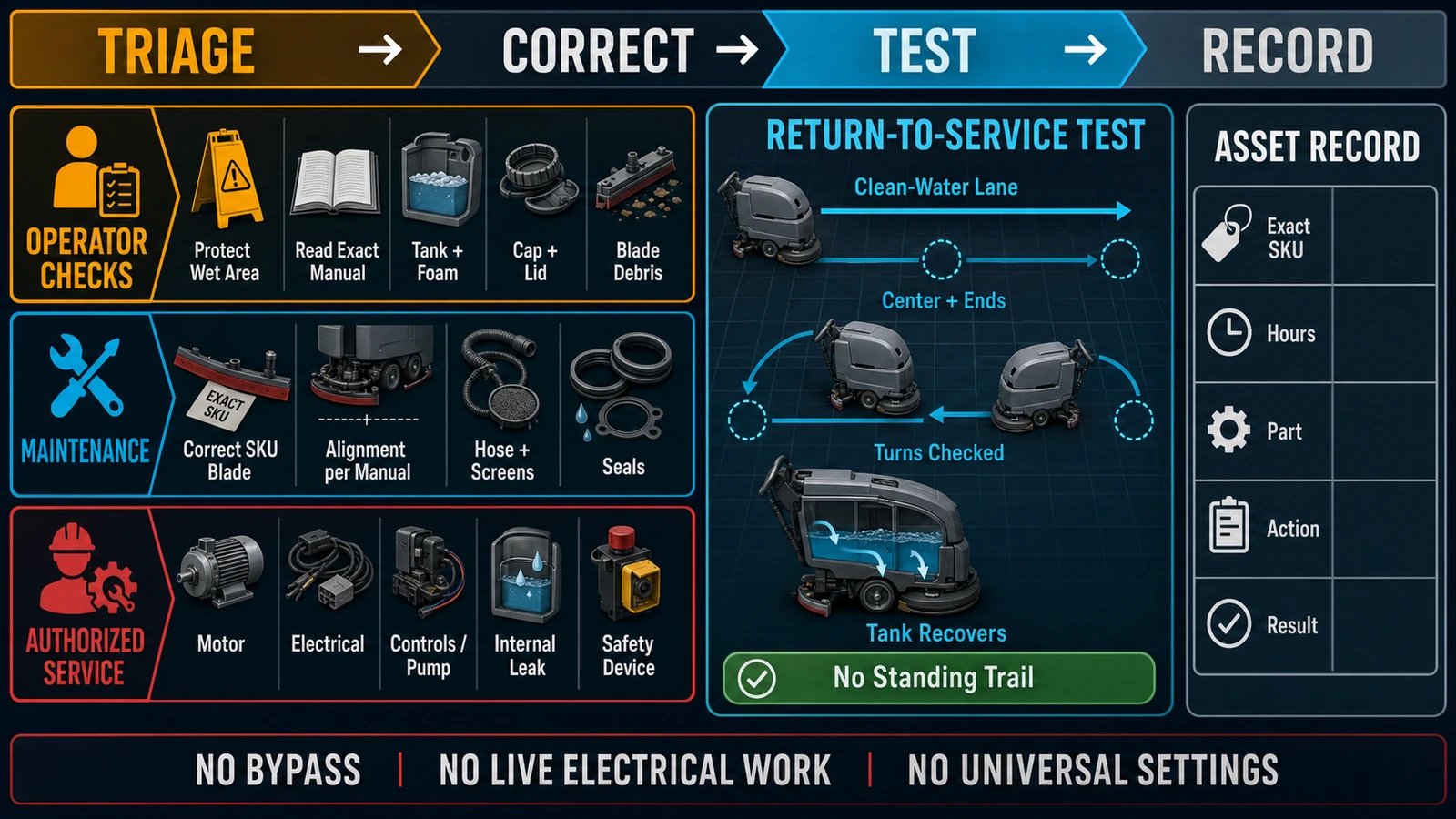
The pass criterion should be set by the facility: no uncontrolled standing trail, acceptable edge and turn pickup, no abnormal warning, and no manual mopping needed to conceal a machine fault. If the machine cannot meet that criterion consistently, keep it out of production and use the site's backup plan.
Turn Repeated Pickup Problems into a Maintenance Program
Repeated water-recovery failures reveal an operating-system problem, not a single repair event. A commercial owner or contract cleaner should define:
- pre-use and post-use checks by exact machine and shift;
- who empties and cleans the tank, squeegee, screens and debris tray;
- blade inspection limits and the approved replacement part number;
- preventive-maintenance intervals based on the manual, hours and site conditions;
- detergent and foam-control rules;
- spare blades, caps, seals and hoses held on site;
- service territory, response time, loan-machine or backup arrangements;
- failure codes, meter hours, parts and test results retained in the asset record.
For robotic equipment, route automation does not remove these duties. The buyer still needs water-recovery acceptance, operator escalation and local service responsibility. See World Clean Biz's autonomous floor scrubber guide for the wider pilot, software and support questions.
Procurement should also identify the exact seller, importer or distributor responsible for warranty and parts in the destination market. A brand name alone does not establish who stocks the correct blade, approves a repair or supplies a replacement machine during downtime.
FAQ
Why is my floor scrubber leaving water behind?
Common causes include a full recovery tank, excessive foam, a triggered or dirty float system, an open drain cap, a poorly sealed tank lid, dirty or worn squeegee blades, a blocked or leaking hose, dirty screens or a vacuum fault. Use the exact model's manual to identify which checks are operator-authorized.
Why does my floor scrubber leave one streak?
A narrow streak often points to debris under the blade, a nick or tear, or a local contact gap. Clean and inspect the blade before adjusting the full squeegee assembly.
Can I flip a floor scrubber squeegee blade?
Only if the exact blade and manual allow it. Some designs have multiple usable wiping edges; others have a fixed orientation. Verify the part number and installation instructions.
Why is the vacuum running but the scrubber is not picking up water?
The system may have an air leak, blocked hose or screen, open drain cap, poor tank-lid seal, full tank, excessive foam or inadequate squeegee contact. Motor noise confirms only that something is running; it does not prove that the recovery path is sealed and clear.
Can too much detergent stop water pickup?
Excessive foam can activate a float system or interfere with airflow, and too much chemical can also leave residue that looks like poor cleaning. Follow the approved detergent and dosing instructions and investigate recurring foam.
When should I call a floor scrubber technician?
Call trained service for motor, electrical, controller, pump, internal leak, inaccessible blockage, safety-device or recurring faults, or whenever the operator manual does not authorize the work.
Final Answer
When a commercial floor scrubber does not pick up water, diagnose the complete recovery chain: tank and foam, float protection, drain cap, lid seal, squeegee, hose, screens and vacuum operation. Use the water pattern to avoid replacing parts blindly, and keep model-specific adjustment and internal repairs within the manual's responsibility boundary.
After any correction, prove the result on a controlled test lane and record the exact machine, part, action and acceptance outcome before returning it to service.