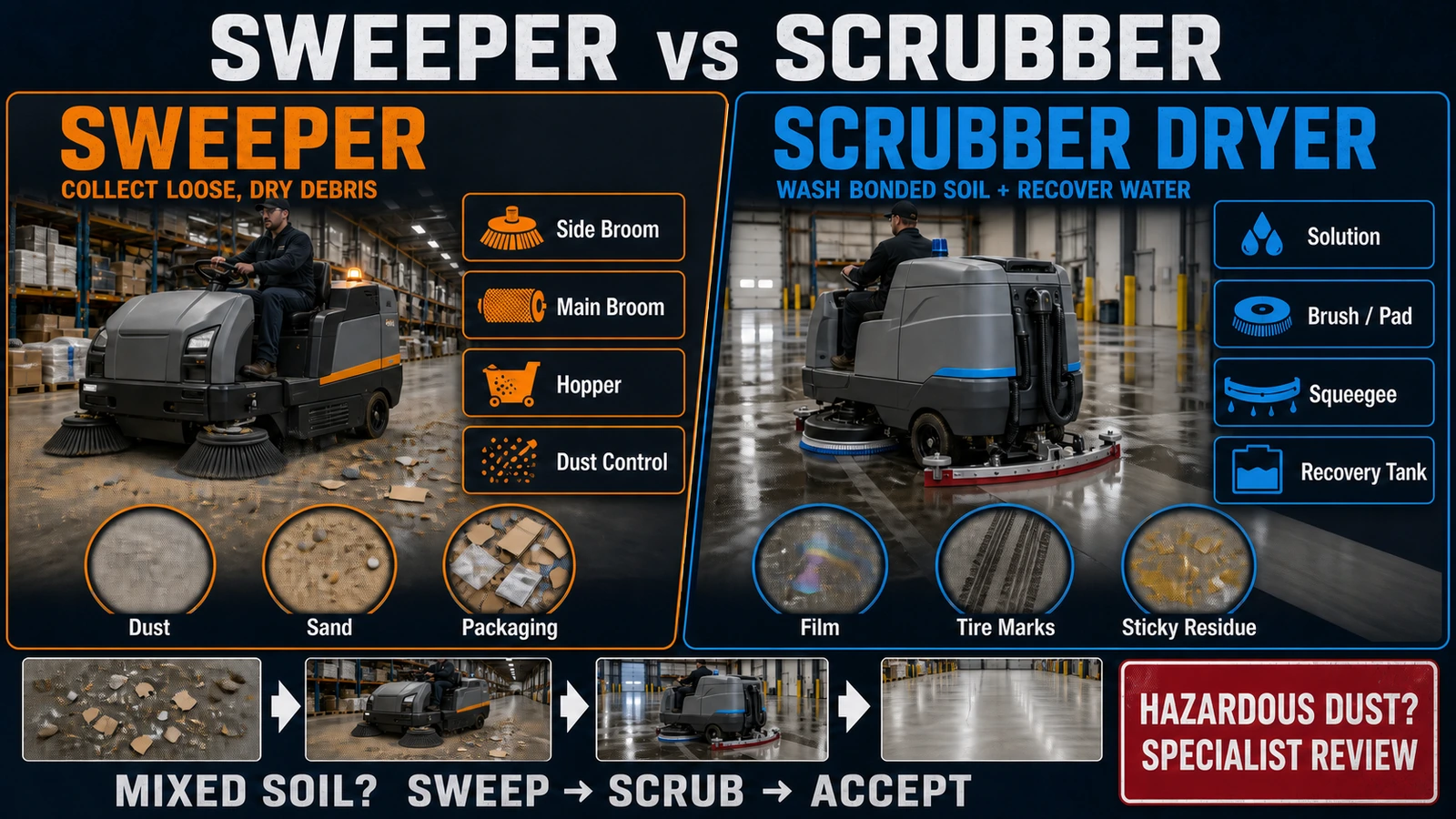
- A floor sweeper collects loose, mainly dry debris into a hopper; a scrubber dryer applies solution, agitates bonded soil and recovers dirty water.
- Facilities with both bulk debris and adhered contamination may need a sweep-then-scrub workflow or a combination machine, but the choice must be proven on the real floor.
- Compare accepted clean area, dust escape, residual water, manual finishing, replenishment, maintenance and downtime—not theoretical productivity alone.
In this article 13 sections
A floor sweeper collects loose, mainly dry debris such as dust, sand and packaging fragments. A floor scrubber applies water or cleaning solution, agitates soil attached to a hard floor and—when it is a scrubber dryer or automatic scrubber—recovers the dirty water. Choose by the material on the floor and the required result, not by machine size or brochure productivity alone.
A warehouse may need a sweeper for dust and pallet debris, a scrubber dryer for tire marks and oily film, or both in sequence. A supermarket with relatively clean aisles but frequent marks and spills may rely more heavily on scrubbing. A manufacturing site with metal swarf, combustible dust or hazardous material needs a formal hazard assessment before any general-purpose cleaning machine is selected.
The practical decision is therefore wider than “sweeper or scrubber.” Buyers must decide what to collect, what to wash, whether pre-sweeping is required, how the waste will be handled and which result the supplier must prove during a site trial.
Floor Sweeper vs Floor Scrubber at a Glance
| Decision point | Floor sweeper | Floor scrubber dryer |
|---|---|---|
| Primary job | Collect loose debris and control dust | Wash bonded soil and recover dirty water |
| Typical material | Dust, sand, grit, leaves, packaging scraps and other dry loose debris | Grease, film, spills, tire marks, sticky residue and embedded soil |
| Main system | Side broom, main broom, hopper and often a vacuum/filter system | Solution tank, brush or pad deck, squeegee, vacuum and recovery tank |
| Waste stream | Dry or mainly dry material in a hopper | Contaminated liquid in a recovery tank |
| Floor condition after one pass | Debris removed; surface is not washed | Surface washed and normally left with most solution recovered |
| Common limitation | Does not remove bonded film simply by making more passes | Large loose debris can clog, scratch, overload recovery or degrade the result |
| Typical consumables | Main and side brooms, filters, skirts and seals | Brushes or pads, squeegee blades, detergent and water-system parts |
| Best comparison metric | Accepted debris pickup with controlled dust | Accepted soil removal with controlled residual water |
How Does a Commercial Floor Sweeper Work?
A powered sweeper normally uses side brooms to move material into the path of a main broom. The main broom transfers it into a hopper. Many machines add airflow and filtration to retain fine dust rather than releasing it back into the work area.
Nilfisk's professional product FAQ describes sweepers as machines that collect dust, dirt and larger particles with rotating brushes, while many models use a vacuum or filter system for dust control. Kärcher explains that vacuum sweepers disturb dirt with a roller brush, draw dust through a fan and retain it in a filter system. Its product range also illustrates two mechanical approaches: direct pickup using a dustpan principle and rearward pickup using a throwing principle.
Those differences affect debris capacity, brush wear, dust behavior and the types of material a machine can collect. They also show why the word “sweeper” is not a complete specification. Buyers still need to examine the main-broom design, side-broom reach, filter area and cleaning method, seals, hopper capacity, dumping arrangement and suitability for the actual material.
A sweeper can leave a floor visibly free of loose dirt while an oily film or tire mark remains. That is not a failed sweeper if washing was outside its intended task. It is a mismatch between the cleaning process and the acceptance standard.
How Does a Floor Scrubber Dryer Work?
A scrubber dryer meters water or cleaning solution onto the floor. Disc brushes, cylindrical rollers, orbital pads or another scrubbing system apply mechanical action. A rear squeegee then channels the dirty liquid into a vacuum recovery path and a separate tank.
Nilfisk defines a scrubber dryer as a machine that scrubs and dries hard floors in one pass. Kärcher's scrubber dryer guide similarly separates the cleaning solution and brush action from the turbine, squeegee and dirty-water recovery system.
Terminology varies by market. “Floor scrubber,” “automatic scrubber,” “scrubber dryer” and “scrubber-drier” may be used for overlapping products. Some simple scrubbers agitate soil without recovering the liquid. Procurement documents should specify the physical functions required rather than relying on the category name.
A scrubber dryer is also not automatically a disinfecting machine. Cleaning, sanitizing and disinfection are different outcomes. Chemistry, concentration, contact time, surface compatibility, local rules and the machine manufacturer's instructions still apply.
Choose the Machine by Soil Before Choosing It by Area
Machine width and tank size matter only after the cleaning task is defined. Start with what arrives on the floor, what adheres to it and what must be removed.
| Floor condition | Likely starting point | Questions for the site survey |
|---|---|---|
| Fine dust and dry loose dirt | Sweeper with suitable dust control | What is the particle size, exposure risk and required filtration? |
| Sand, grit, leaves or packaging debris | Sweeper | Can the broom and hopper accept the size, density and volume without excessive wrapping or dust? |
| Tire marks, grease or bonded film | Scrubber dryer | Which brush or pad, pressure, chemistry and dwell time are compatible with the floor? |
| Food, beverage or sticky residue | Scrubber dryer within the site's hygiene process | How will chemistry, cross-contamination, wastewater and post-cleaning inspection be controlled? |
| Bulk debris plus bonded contamination | Two-step process or combination machine | Can one pass meet the standard, or are separate dry and wet stages more reliable? |
| Hazardous, combustible or hot material | Specialist assessment and equipment | What is the material classification, zone, exposure route and exact certification requirement? |
Floor construction can change the answer. Smooth sealed concrete, textured coatings, tile joints, damaged surfaces and drainage all affect brush choice, water recovery and residual moisture. A sweeper that works well on an open warehouse floor may not control dust in a sensitive production area. A scrubber that performs on smooth epoxy may leave water in joints or low spots elsewhere.
Do You Need to Sweep Before Using a Floor Scrubber?
Pre-sweeping is usually sensible when the floor carries enough loose debris to interfere with scrubbing or water recovery. Grit can become trapped under a pad and scratch a finish. Packaging fragments, straps or string can wrap around brushes. Solids can occupy recovery capacity, obstruct hoses or leave trails behind the squeegee.
Nilfisk's official guidance recommends using a sweeper first for loose debris and then a scrubber dryer for deep cleaning. Kärcher's production-facility guidance describes industrial workflows that alternate sweeping and scrub vacuuming according to the dirt generated by the site.
Pre-sweeping is not a universal extra step. Some cylindrical scrubber dryers include a coarse-debris tray, and some combination machines integrate a true hopper and sweeping system. The supplier should demonstrate the exact machine against the buyer's normal debris load. A brochure statement such as “sweeps and scrubs” does not reveal the maximum particle size, fine-dust behavior, hopper capacity or result at edges.
When Does a Combination Sweeper-Scrubber Make Sense?
A combination machine integrates dry pickup and wet scrubbing into one chassis. The Tennant M20, for example, lists a main sweeping brush, sweeping and scrubbing side-brush options, a debris hopper, solution and recovery tanks, and separate sweeping and scrubbing airflow specifications. It is an example of a genuine integrated architecture, not a benchmark for every facility.
Combination equipment can reduce passes and the space required to store two machines. It may fit large industrial floors where loose debris and bonded soil repeatedly occur together.
The trade-offs need equal attention:
- a larger chassis may not fit narrow aisles, doors, ramps or congested zones;
- one machine carries more systems, wear points and operator training requirements;
- emptying dry debris and managing clean and dirty water remain separate tasks;
- a breakdown can remove both sweeping and scrubbing capacity at once;
- the purchase price may be lower or higher than two appropriately sized machines depending on configuration, market and service;
- a single pass has value only if it meets the debris, dust, soil and residual-water acceptance criteria.
Separate machines can be scheduled independently, sized for different zones and maintained without stopping the entire floor-care process. The correct architecture depends on utilization and operating resilience, not the appeal of a two-in-one label.
Walk-Behind vs Ride-On Is a Separate Decision
“Sweeper versus scrubber” describes the cleaning process. “Walk-behind versus ride-on” describes operator position, capacity and maneuverability. A facility can buy a walk-behind sweeper, ride-on sweeper, walk-behind scrubber dryer, ride-on scrubber dryer or ride-on combination machine.
Walk-behind equipment often suits smaller or congested areas, but total square footage alone is an unreliable cutoff. Net cleanable area, aisle width, turning space, door clearance, elevator capacity, transport distance and the length of the cleaning shift all matter. Ride-on equipment can reduce operator fatigue and increase capacity in open areas, yet lose time where repeated dismounting or manual detail work is required.
Ask the supplier to map the machine footprint and turning envelope onto the real route. A wide theoretical cleaning path has little value if the machine cannot enter important zones.
Why Brochure Productivity Does Not Settle the Comparison
Manufacturers may publish cleaning paths, travel speeds, estimated coverage, tank capacities and runtime. IEC 62885-9:2019 lists characteristic performance parameters and measurement methods for commercial walk-behind and ride-on sweepers, scrubbers and other floor-treatment machines. A standardized parameter still does not predict every customer's delivered result.
Theoretical area calculations can exclude turns, overlap, obstacle avoidance, transportation, pre-sweeping, refilling, draining, dumping, filter cleaning, pad changes, battery charging, inspection and manual finishing. The buyer needs an operating metric:
accepted clean area ÷ total paid time and downtime required to deliver it
For a sweeper, acceptance may include debris pickup, visible dust escape, edge performance and hopper interruptions. For a scrubber dryer, it may include removal of a defined soil, streaking, residual water, slip-control procedure and recovery-tank interruptions. A combination machine must pass both sets of criteria.
How Facility Type Changes the Answer
Warehouses and distribution centers
Pallet fragments, stretch wrap, dust and grit may favor sweeping, while tire marks and traffic film require periodic scrubbing. Inspect string and film wrapping, fine-dust containment, dock transitions and the effect of forklifts moving during the test.
Manufacturing plants
The production process determines the equipment. Swarf, oil, coolant, powders and hot material create different mechanical and safety problems. A general floor machine should never be treated as a substitute for material-specific extraction or hazardous-dust controls.
Retail and public buildings
Loose dirt may be limited while marks, spills and presentation standards make scrubber dryers more prominent. Noise, public traffic, residual moisture, cordons and access to back-of-house water and drainage can dominate the operating plan.
Food and beverage sites
Dry ingredients, packaging and wet organic residue can coexist. Equipment selection must sit inside the site's hygiene, allergen, chemical, wastewater and cross-contamination program. A visually clean floor is not, by itself, proof of a validated hygiene outcome.
Parking areas and outdoor zones
Litter, leaves, sand and higher debris loads often support a sweeper. Oil film or tire residue may add a wet-cleaning stage where runoff, drainage and environmental rules permit it. Confirm that the exact machine, power source and tires are approved for the surface and environment.
Run a Site Trial Before Comparing Total Cost
A useful trial reproduces a normal shift rather than clearing the route for a demonstration.
Record a baseline for:
- net cleanable area and required cleaning frequency;
- debris and soil types, volume and peak events;
- current labor minutes, equipment time and manual finishing;
- water, detergent, disposal, electricity or fuel;
- consumables, planned maintenance, failures and substitute equipment;
- access restrictions, noise limits and operating windows.
Then measure each candidate against the same zones and acceptance criteria:
- How much area passed inspection?
- What debris, dust, film, streaks or water remained?
- How many repeat passes and manual interventions were required?
- How long did filling, draining, dumping, filter care and end-of-shift cleaning take?
- Did the machine fit the complete route and operate safely around normal traffic?
- Which consumables wore, clogged or required adjustment?
- What happened when the machine stopped, and who restored service?
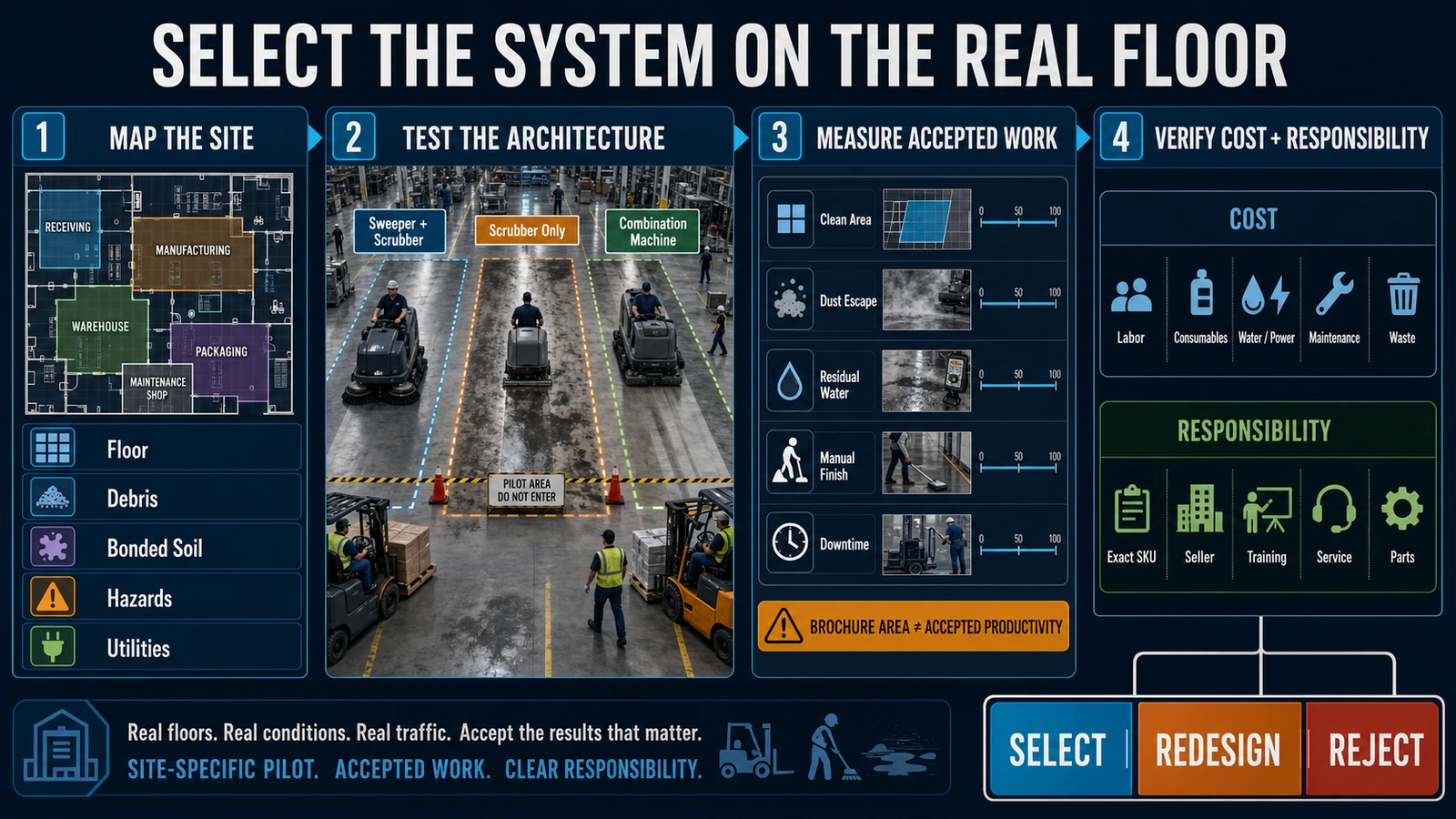
Total cost should include the machine or lease, financing, battery or fuel, water, chemistry, brooms, filters, pads or brushes, squeegees, labor, training, planned maintenance, repair, downtime, backup capacity, storage and waste handling. A combination machine may save labor on the route but concentrate downtime risk. Two machines may cost more to own while offering scheduling flexibility and resilience.
Verify the Exact Machine and Supplier Responsibility
A category comparison cannot approve a specific purchase. Before ordering, obtain:
- the exact model, SKU, power source and included configuration;
- legal manufacturer, importer, contract seller and invoice entity;
- floor, debris, chemical and environmental limitations from the manual;
- battery, charger, ventilation, water, drainage, storage and transport requirements;
- the included brooms, filters, pads, brushes, squeegees and optional kits;
- training, daily-care and preventive-maintenance responsibilities;
- parts availability, service territory, response time and backup-machine terms;
- warranty exclusions and the process for technical or safety notices;
- certificates and declarations tied to the exact model and destination market.
IEC 60335-2-72:2021 covers powered ride-on and walk-behind commercial floor-treatment machines used for sweeping, scrubbing and other tasks. Its scope expressly excludes machines designed for explosive or corrosive environments and machines intended to collect hazardous dust, flammable substances or glowing particles. The standard helps define a safety category; it does not prove that a product is certified or suitable for a buyer's hazard.
Autonomy adds another layer of site, software and service verification. Buyers considering self-driving equipment can use World Clean Biz's guide to autonomous floor scrubbers. For manufacturer and regional-service context, see who owns Kärcher.
FAQ
Is a floor sweeper the same as a floor scrubber?
No. A sweeper collects loose debris into a hopper. A scrubber uses water or solution and mechanical action to remove soil attached to a hard surface. A scrubber dryer also recovers the dirty water.
Should you sweep before using a floor scrubber?
Often yes, when loose debris could scratch the floor, wrap around brushes, clog the recovery path or reduce the cleaning result. Some cylindrical scrubbers and combination machines can collect limited or substantial debris, but the exact capability must be demonstrated.
Can a floor scrubber pick up dust and debris?
It may collect some small material with the dirty water, and certain models include a coarse-debris tray or pre-sweep function. That does not make every scrubber a substitute for a sweeper, particularly where debris volume or dust control is important.
Is a combination sweeper-scrubber always cheaper than two machines?
No. It may reduce passes, labor and storage, but it can cost more to buy and maintain and can concentrate downtime risk. Compare the complete operating program after a representative trial.
Which machine is better for a warehouse?
The warehouse's soil profile decides. Dry dust, grit and packaging debris point toward sweeping. Tire marks, oily film and sticky residue point toward scrubbing. Many warehouses require both processes at different frequencies.
Can a standard sweeper collect combustible or hazardous dust?
Do not assume so. Material hazards, area classification, exposure controls and the exact machine certification must be assessed by qualified personnel. General commercial floor-machine standards exclude several hazardous and explosive applications.
Final Answer
Choose a floor sweeper when the main task is collecting loose, mainly dry debris. Choose a scrubber dryer when the floor needs washing and dirty-water recovery. Where debris and bonded soil coexist, test a sweep-then-scrub process and a suitable combination machine against the same acceptance standard.
The best purchase is the system that produces an accepted floor with controlled dust and water, manageable waste, supportable maintenance and a defensible total cost in the buyer's real facility.