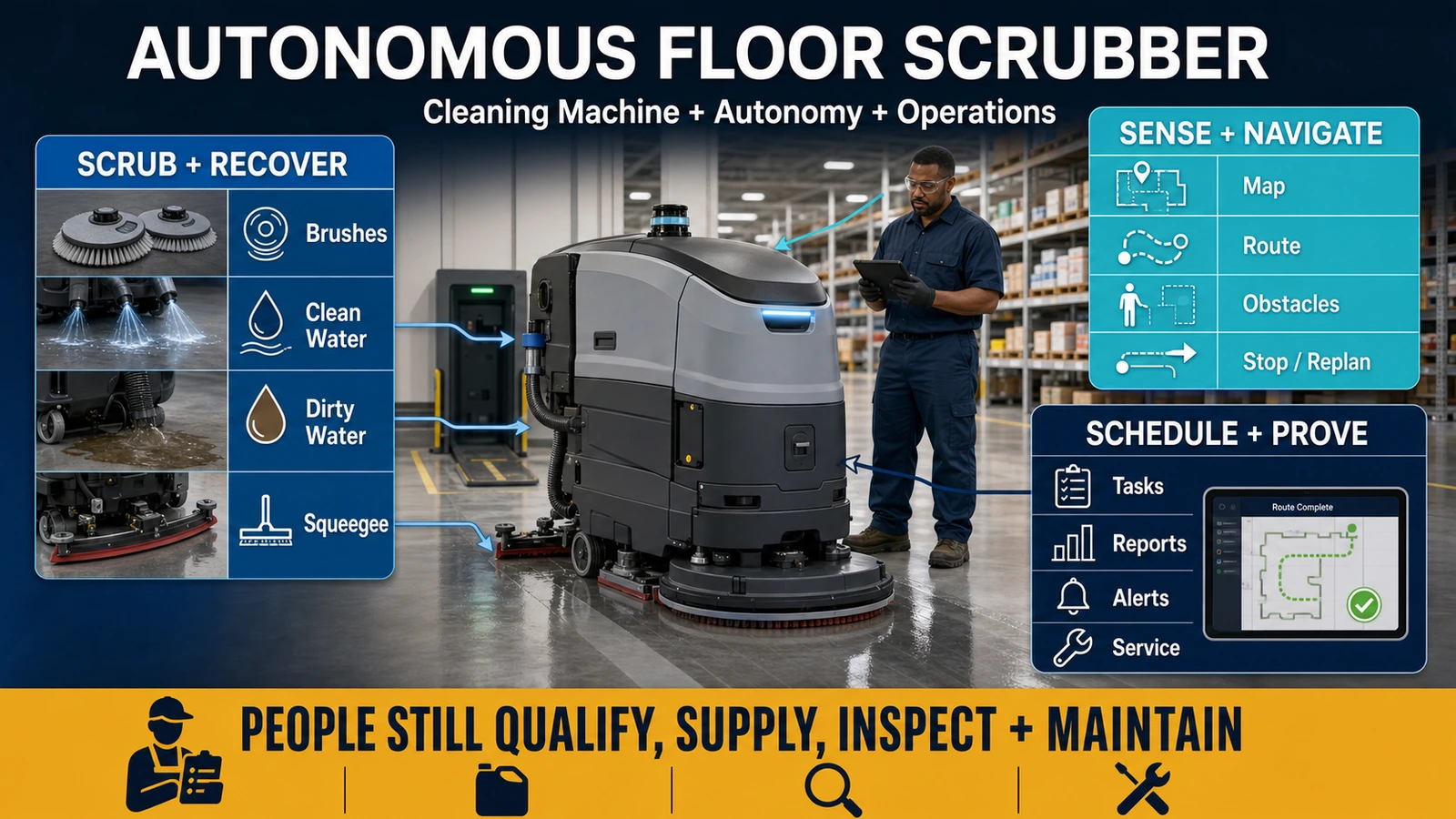
- An autonomous floor scrubber combines a commercial scrubbing and water-recovery system with sensors, localization, route execution and operational software; it still requires site preparation, replenishment, maintenance, exception handling and quality control.
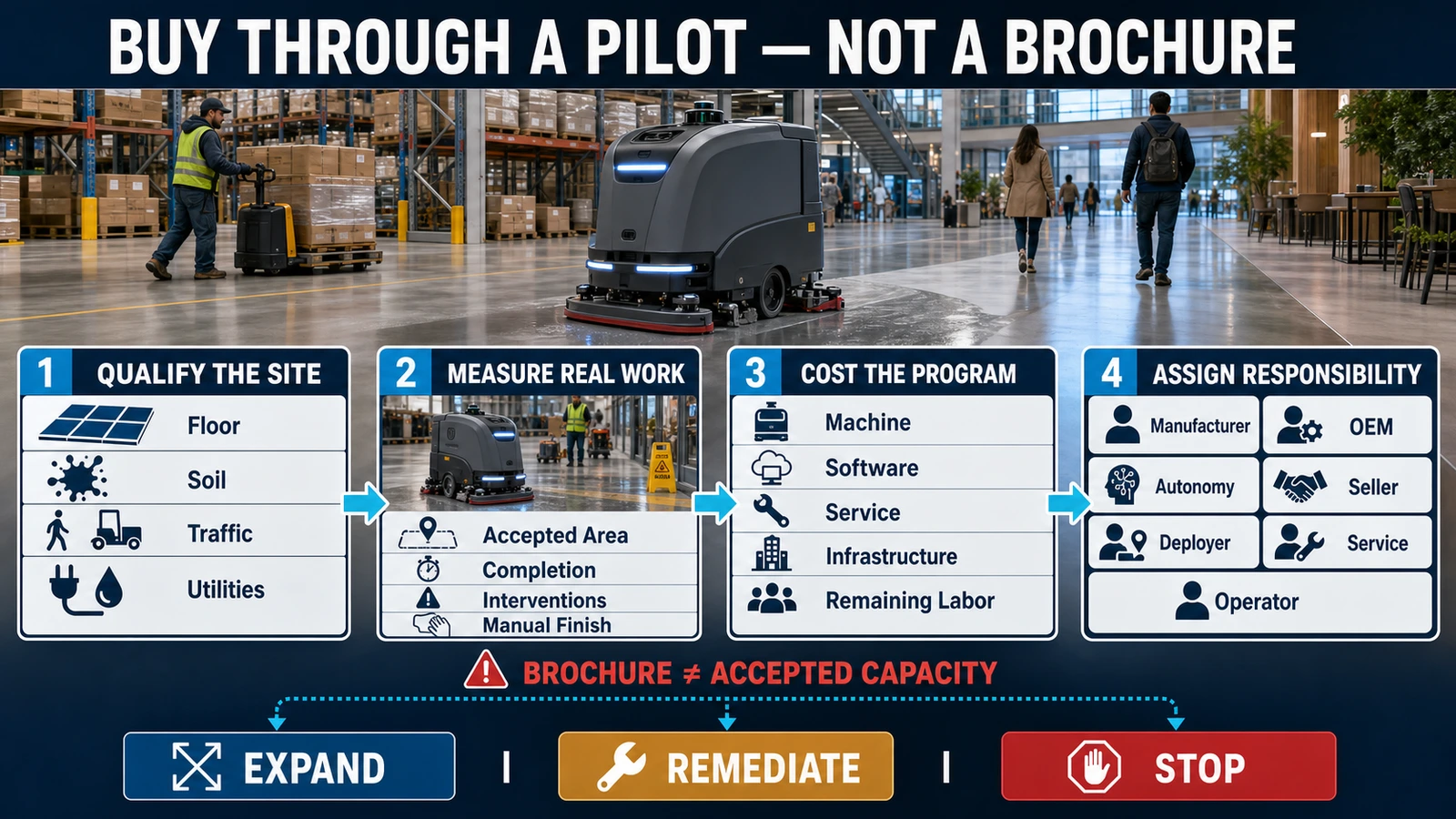
- Brochure productivity, runtime and coverage reports are not delivered cleaning capacity: buyers should measure accepted clean area, task completion, intervention time, manual finishing and downtime in a representative pilot.
- A purchase can involve a legal manufacturer, machine OEM, autonomy platform, seller, deployment partner, cloud provider and service organization, so compliance, data, warranty and SLA responsibilities must be assigned by exact SKU and market.
In this article 12 sections
An autonomous floor scrubber is a commercial floor-cleaning machine that scrubs hard floors, recovers dirty water and navigates a defined work area without an operator continuously steering it. Sensors, localization, route software and obstacle responses automate movement, while the cleaning deck, solution system, brushes and squeegee still do the physical cleaning.
The machine does not make the operation labor-free. Someone still has to qualify the site, prepare or map the route, manage water and waste, inspect results, maintain brushes and squeegees, respond to exceptions and coordinate service. A docking station can automate charging, filling or draining on some systems, but it adds infrastructure and does not remove these responsibilities.
For facility managers, building service contractors, distributors and procurement teams, the useful question is not whether the robot is “fully autonomous.” It is whether an exact machine, software configuration and service arrangement can deliver an accepted cleaning result in the buyer's real environment at a defensible total cost.
Autonomous Floor Scrubbers at a Glance
| Layer | What it does | What buyers must verify |
|---|---|---|
| Cleaning machine | Applies solution, agitates soil and recovers dirty water | Floor and soil fit, brush system, water recovery, consumables, battery and maintenance |
| Autonomy system | Localizes, follows or plans routes, detects obstacles and controls motion | Mapping method, route behavior, minimum clearances, dynamic traffic, safety response and degraded operation |
| Operations system | Schedules work, manages users, records missions and connects support | Reports, data rights, connectivity, software support, alerts, service levels and account exit |
| Human workflow | Prepares the site, supplies resources, finishes missed work and handles exceptions | Labor minutes, training, inspection, escalation, daily care and responsibility |
What Does an Autonomous Floor Scrubber Actually Do?
A conventional automatic scrubber already combines several processes. It meters water or cleaning solution onto the floor, uses disc, cylindrical or other brush action to loosen soil, and collects the resulting liquid through a squeegee and vacuum system. “Automatic” in this older equipment category does not necessarily mean self-driving.
An autonomous model adds machine perception and motion control. Depending on the product, an operator may teach a route, mark an area for the system to fill, or commission a map from which the robot plans work. LiDAR, cameras, depth sensors, ultrasonic sensors and other devices can support localization, obstacle detection and route decisions. The exact sensor set and behavior vary by model.
The international standard IEC 63327:2021 covers particular safety requirements for powered automatic floor-treatment machines intended for indoor commercial use. Its scope includes sweeping, scrubbing and wet or dry pickup, and it recognizes machines that operate in automatic or manual modes. That scope is useful for defining the category; it is not evidence that every machine on the market is certified.
The Market Includes Several Different Machine Architectures
“Robotic floor scrubber” now describes products that do not share one architecture.
| Architecture | Typical strength | Main procurement question |
|---|---|---|
| Existing scrubber platform with autonomy | Proven cleaning hardware and possible manual operation | How well is autonomy integrated, and who supports the machine versus the navigation platform? |
| Purpose-built autonomous scrubber | Compact packaging, sensing and maneuverability designed around robotic operation | Can it match the site's soil load, water recovery and service requirements? |
| Compact multifunction robot | Sweeping, vacuuming, mopping or scrubbing in one smaller platform | Which functions and accessories are included, and what performance is accepted for each mode? |
| Dock-assisted system | Less manual charging, filling or draining | What water, drain, power, network and maintenance infrastructure does the dock require? |
Tennant describes the X4 ROVR as a purpose-built autonomous scrubber powered by Brain Corp's BrainOS platform. Its official specifications list Teach & Repeat and Area Fill operation, a 500 mm cleaning path, a 38-liter solution tank and up to 2.5 hours of autonomous scrubbing battery time. Those figures describe one configuration; they do not establish a cross-brand productivity benchmark.
Kärcher's KIRA B 50 combines pre-sweeping and scrubbing and can operate with or without an optional docking station. The dock can charge the battery, refill fresh water, drain dirty water and rinse the tank. Kärcher also states that the device requires instruction—a useful reminder that autonomy still needs an operating process.
At the compact multifunction end, the PUDU CC1 offers sweeping, scrubbing, vacuuming and mopping modes, visual and laser SLAM, task resumption and cleaning reports. Its carpet assembly and workstation options illustrate a common purchasing trap: a feature shown within a product ecosystem is not always part of the base machine or every regional offer.
Which Facilities Are a Good Fit?
Large area alone does not establish suitability. Repetition and controllability matter just as much.
Good candidates often have substantial hard-floor zones, repeatable routes, stable layouts and a predictable cleaning window. Retail stores, schools, hospitals, transport facilities, warehouses and manufacturing sites appear repeatedly in current manufacturer applications. Each of those labels still contains very different traffic, soil and risk conditions.
Before requesting a quotation, measure:
- net cleanable area rather than total building area;
- floor materials, joints, transitions, gradients and drainage;
- dry debris, grease, food residue, tire marks and other soil types;
- aisle widths, turns, doors, elevators, glass and low or overhanging obstacles;
- people, forklifts, carts, pallets, beds and other moving traffic;
- noise, lighting, public-access and cleaning-time restrictions;
- locations for charging, water, wastewater, detergent, waste and daily maintenance;
- network availability and rules governing maps, images and telemetry.
A busy facility is not automatically unsuitable. It does, however, need a pilot that reflects the real traffic pattern. A demonstration on a cleared route cannot prove performance during a normal shift.
Why Brochure Productivity Is Not Delivered Cleaning Capacity
Machine specifications can include theoretical square meters per hour, estimated coverage per tank and maximum runtime. These numbers answer different questions.
Theoretical productivity commonly derives from cleaning width and travel speed. It may not include turns, overlaps, obstacles, refilling, draining, transport between zones, setup, recovery from stops or inspection. Runtime says how long a battery may support operation under stated conditions; it does not say how much floor will pass the customer's cleaning standard.
Coverage reporting needs the same discipline. Nilfisk describes usage, coverage and efficiency reporting as a way to provide proof of clean. A mission record can show where the machine traveled and how it operated. The buyer must separately verify soil removal, water pickup, streaks, edges, missed zones and the condition left for building users.
Useful operating measures include:
- accepted clean area per scheduled hour;
- autonomous mission completion rate;
- intervention minutes and interventions per mission;
- blocked, skipped and repeated area;
- manual pre-sweeping, edge work and spot-cleaning minutes;
- refill, drain and consumable events;
- downtime and time to acknowledge and restore service;
- post-clean inspection acceptance rate.
These measurements also prevent a common ROI error: counting every autonomous runtime hour as one labor hour eliminated.
How Should a Buyer Run a Pilot?
A credible pilot begins with the existing operation, not the robot.
- Record the baseline. Document net area, cleaning frequency, labor minutes, equipment, soil, consumables, quality failures and current service cost.
- Choose representative zones. Include normal turns, traffic, obstacles and contamination. Do not restrict the test to the easiest open floor.
- Freeze the configuration. Record the exact SKU, brush or pad, squeegee, chemical, battery, firmware, map method, connectivity and dock configuration.
- Run normal operating cycles. Test the machine during the conditions in which it would actually work, not only during a supervised sales demonstration.
- Count the remaining work. Measure clearing, setup, refilling, draining, edge work, spot cleaning, daily care and exception response.
- Inspect the result. Use an agreed cleaning standard and safety process in addition to the supplier's dashboard.
- Define expansion and exit conditions. State what performance unlocks more sites, what requires remediation and what allows rejection or return.
The pilot should also test support. A robot that completes routes but remains out of service for days after a minor fault can fail the business case.
How Do You Calculate Cost and ROI?
There is no responsible universal price or payback period for an autonomous floor scrubber. Equipment may be purchased, leased or supplied through a service arrangement; software, deployment and maintenance can be bundled or separate.
A full annual cost model should include:
`equipment depreciation or lease + autonomy and cloud fees + deployment and training + site work + charging, water and drainage + consumables and chemicals + preventive maintenance + repairs and batteries + IT and connectivity + downtime or backup + remaining labor`
Compare that total with verified changes in overtime, contractor cost, vacancies, rework and cleaning frequency. Labor reassigned to other tasks remains employed labor; it may create operational value, but it is not the same as cash removed from the budget.
Benefits can also include greater route consistency, more frequent cleaning and auditable mission records. Put each benefit in its own line rather than forcing every improvement into a single labor-savings percentage.
Who Is Responsible for the Machine, Software and Service?
The name on the machine may not identify every party behind the system.
Tennant's X4 ROVR announcement identifies Tennant as the machine company and Brain Corp as the BrainOS platform provider. Nilfisk also markets BrainOS-powered Liberty machines. Other suppliers use their own autonomy stack or a different technology relationship.
The contract should identify:
| Role | Questions to resolve |
|---|---|
| Legal manufacturer | Which entity appears on the nameplate, declaration, certification and recall process? |
| Machine OEM | Who built the chassis, cleaning system and battery configuration? |
| Autonomy provider | Who controls navigation software, updates, maps and platform support? |
| Importer and seller | Which local entity invoices the buyer and carries mandatory market responsibilities? |
| Deployment partner | Who surveys, maps, configures, trains and signs the acceptance record? |
| Service provider | Who supplies parts, preventive maintenance, field response and backup capacity? |
| Facility operator | Who prepares routes, performs daily checks, handles exceptions and controls access? |
World Clean Biz has separately examined Kärcher's family ownership and professional cleaning network. Ownership can help explain a supplier, but the local contract and product documents determine who owes the buyer performance, warranty and service.
Safety Certification and Data Need Exact-SKU Verification
Procurement teams should request the applicable declaration, certificate and test scope for the exact model, battery, charger, dock, firmware range and destination market. A supplier statement that one product complies with IEC 63327 or CSA/ANSI 336 cannot be expanded to every machine sold under the same brand.
Certification also does not replace the site's risk assessment. Routes, public access, traffic rules, warning indicators, emergency stops, training, maintenance and incident procedures remain deployment controls.
Connected machines create a second diligence track. Maps, images, diagnostics, cleaning schedules, account records and telemetry may move between the robot, mobile applications and cloud services. Brain Corp's security information discusses encryption, access control, image handling and robot-data retention for BrainOS. A buyer still needs contract-specific answers on data categories, storage regions, administrator access, remote assistance, exports, deletion, offline behavior and what happens when a subscription ends.
Autonomous Floor Scrubber Procurement Checklist
Before signing, obtain:
- the exact SKU, market version, included accessories and optional equipment;
- manufacturer, importer, seller, autonomy platform and service-provider identities;
- applicable declarations, certificates, manuals and battery/charger documents;
- a site survey showing cleanable area, exclusions, traffic, utilities and network needs;
- a pilot protocol with baseline, accepted-clean metrics and failure conditions;
- full pricing for hardware, software, deployment, training, consumables and service;
- warranty exclusions, preventive-maintenance terms, parts availability and battery policy;
- response, repair, remote-support and backup-machine commitments;
- data, cybersecurity, account, update, export and end-of-contract terms;
- a signed responsibility matrix and acceptance record.
Frequently Asked Questions
Does an autonomous floor scrubber replace a cleaner?
It automates a repeatable floor-cleaning task. Staff may spend less time steering a scrubber, but site preparation, supplies, inspection, edge and spot work, daily care and exceptions remain. Measure the labor that actually changes during the pilot.
What is the difference between an autonomous scrubber and a robot vacuum?
An autonomous scrubber applies liquid, agitates the floor and recovers dirty water. A commercial robot vacuum primarily removes dry material. Some compact products offer several modes, but each cleaning process and accessory must be evaluated separately.
Can it work around customers, patients or warehouse traffic?
Some products are designed and certified for operation near people, but suitability depends on the exact machine and the site's hazards. Test normal traffic, low and transparent obstacles, route conflicts and stopping behavior under an approved risk process.
Does a docking station make the operation unattended?
A dock may automate charging, water filling, wastewater discharge or tank rinsing. Brushes, squeegees, filters, debris, chemicals, exceptions, inspections and infrastructure still require management.
How much does an autonomous floor scrubber cost?
Public prices rarely define the full program. Request hardware or lease cost together with software, deployment, infrastructure, maintenance, batteries, consumables, connectivity, service and backup terms.
Which autonomous floor scrubber is best?
There is no universal winner. The defensible choice is the exact system that passes a representative site pilot, meets the cleaning standard and comes with acceptable safety, data, service and contract responsibility.
The Buying Decision Is an Operating-System Decision
An autonomous floor scrubber brings together cleaning hardware, robotics software and a long-term service process. Buyers who compare only tank size, runtime or an hourly area figure leave the largest risks outside the quotation.
Start with the floor and the cleaning standard. Test the remaining human work, not just the autonomous route. Then contract the machine, software, data and service responsibilities as one operating system with clearly identified parties.