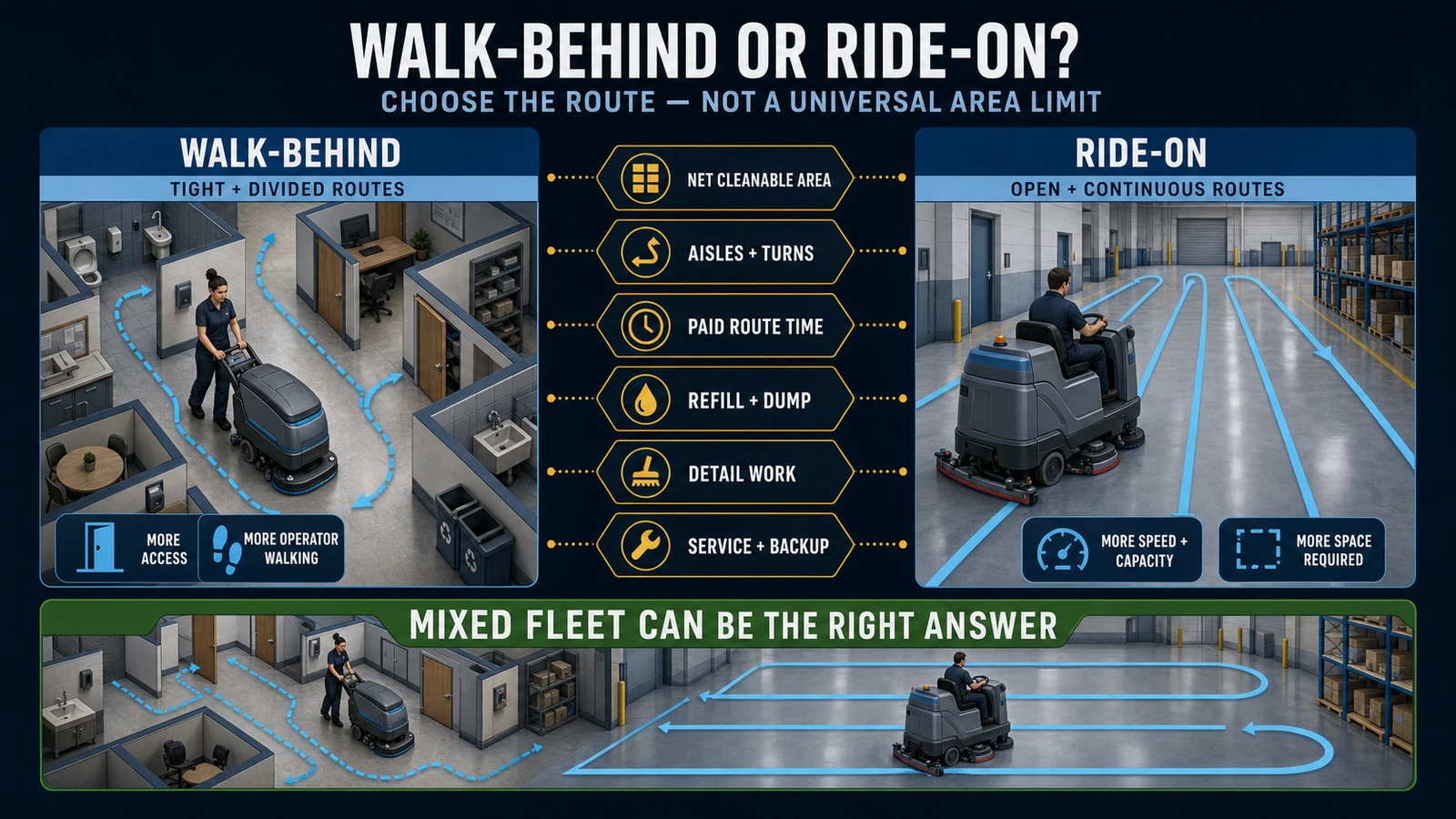
- Choose the operator format around net cleanable area, route geometry and paid work-cycle time—not one universal square-foot threshold.
- Ride-on machines can increase speed, capacity and operator comfort, but a compact walk-behind may deliver more accepted work where access and repeated turning dominate.
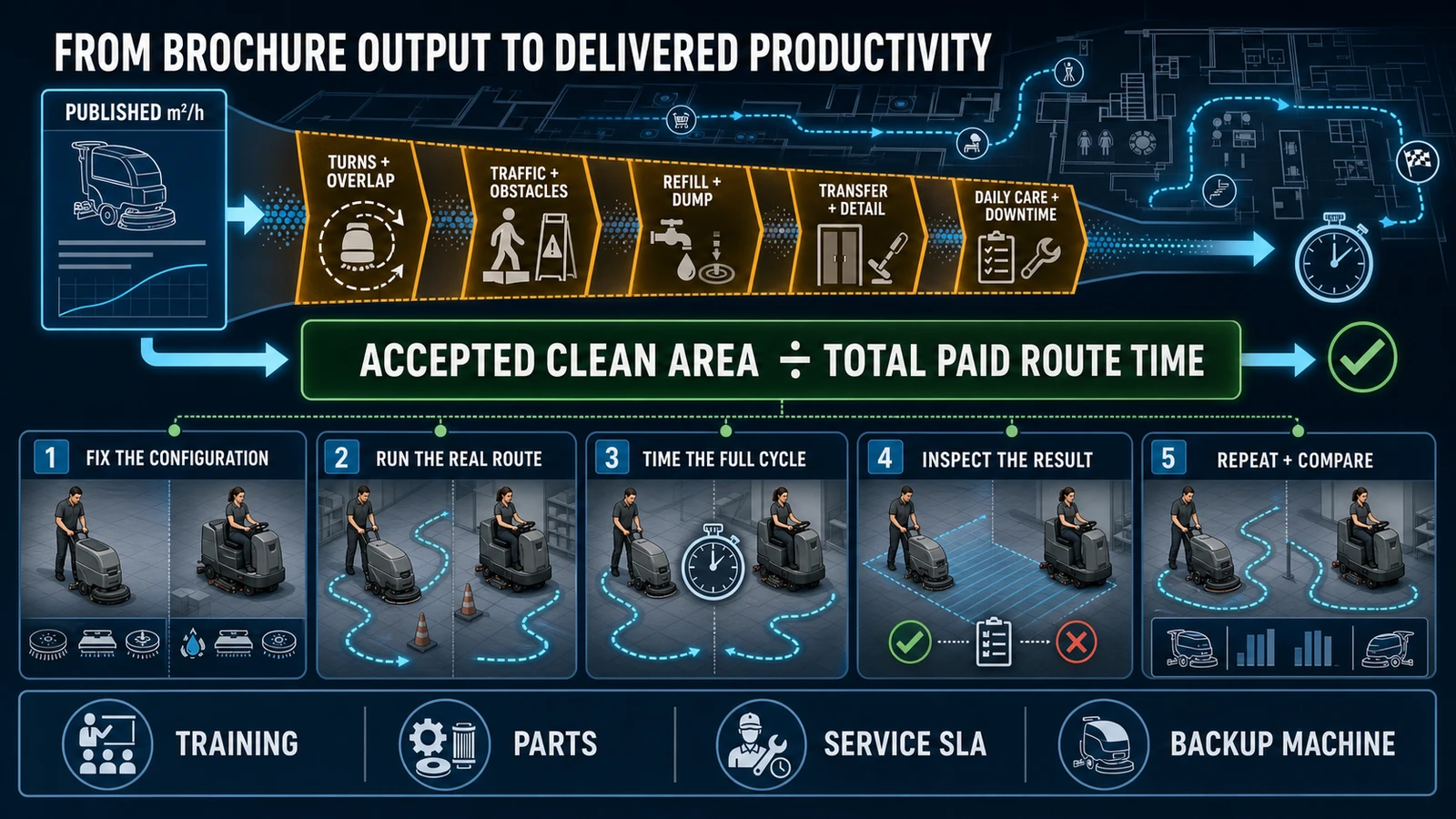
- Compare accepted clean area per paid hour, then verify exact configuration, training, parts, service and downtime responsibility in an on-site trial.
In this article 14 sections
Choose a walk-behind floor scrubber when the route is compact, divided or obstacle-heavy and access matters more than continuous travel speed. Choose a ride-on when the facility has long, open and frequently cleaned routes where higher speed, larger tanks and reduced operator walking can lower paid cleaning time. Do not use one universal square-foot threshold: measure the net cleanable area, route geometry, refill and dump cycle, operator work and accepted result.
Both formats apply solution, scrub the floor and recover dirty water. The purchasing difference is not the cleaning principle. It is the operating system around the machine: where the operator works, how fast the unit travels, how long it runs before an interruption, which spaces it can enter and how much supporting labor remains.
For facility managers, contractors, distributors and equipment buyers, the useful comparison is:
accepted clean area ÷ total paid route time
That is more informative than a brochure’s maximum square metres or square feet per hour.
Walk-Behind vs Ride-On Floor Scrubbers at a Glance
| Decision area | Walk-behind scrubber | Ride-on scrubber |
|---|---|---|
| Operator position | Walks behind and guides or drives through handle controls | Sits on the machine and drives |
| Typical route strength | Rooms, narrow aisles, congested zones and frequent turns | Long runs, open floors and repeated large-area work |
| Main productivity advantage | Access and control where a larger chassis loses time | Travel speed, capacity and less operator walking |
| Common constraint | Fatigue and paid walking time on long routes | Turning space, doors, elevators, storage and detail access |
| Tanks and runtime | Often smaller, but vary widely by model | Often larger, reducing refill and dump events |
| Upfront investment | Usually lower within a comparable product class | Usually higher, but must be compared with labor and route output |
| Supporting equipment | May cover more detail zones itself | May still require a compact scrubber or manual detailing |
| Best buying metric | Accepted area per paid hour on the real route | Accepted area per paid hour on the real route |
This table describes common category tendencies, not guarantees. Compact riders and stand-on machines blur the boundary. A large walk-behind can share a cleaning width with a small ride-on, while two machines in the same operator category can differ substantially in tank capacity, weight and application.
What Does the Operator Format Actually Change?
A walk-behind scrubber places the operator on foot behind the machine. Some units are push-operated, but many commercial models have powered traction. Buyers should not assume that every walk-behind requires the operator to push the full machine weight.
A ride-on scrubber carries a seated operator. This can raise travel speed and reduce the physical burden of walking a long route. The chassis can also support larger tanks, batteries and cleaning systems. Those advantages matter when the machine can keep moving through a continuous area.
The market also includes stand-on and micro-rider machines. These models aim to combine a compact footprint with a powered operator platform. They are evidence that “walk-behind or ride-on” is a spectrum, not two fixed size classes.
Nilfisk provides a useful example. Its SC500 walk-behind and SC2000 micro ride-on both use a 530 mm scrubbing width in the cited configurations. The SC500 page lists 45 L solution and recovery tanks. The SC2000 page lists 70/70 L tanks and travel speed up to 6 km/h, compared with the manufacturer’s average 4 km/h walk-behind reference.
The rider’s difference is therefore not simply a wider brush. Operator position, speed, capacity and route continuity change together.
Why Facility Size Alone Is an Unreliable Cutoff
Many buying guides recommend a walk-behind below one area threshold and a ride-on above it. That is convenient, but two facilities with the same floor area can require different machines.
Consider 4,000 m² of net floor:
- one site is an open distribution area with long parallel runs;
- the other is divided among classrooms, corridors, doors and elevators.
The open site can convert ride-on speed into productive travel. The divided site may spend more time entering rooms, turning, waiting for access and completing edges. A smaller machine can finish more of the actual route without requiring a second operator or detail machine.
Start with net cleanable area, not gross building area. Remove offices, racks, fixed equipment, permanently blocked zones and surfaces outside the machine’s task. Then map:
- the longest continuous runs;
- the narrowest point on the required route;
- doors and turning spaces;
- elevator dimensions and rated load;
- ramps, thresholds and floor transitions;
- water, drainage, charging and storage locations;
- zones that still require another machine or manual work.
Square footage becomes useful only after the route is defined.
Theoretical Productivity Is Not Delivered Productivity
IEC 62885-9:2019 covers characteristic performance parameters and measurement methods for commercial walk-behind and ride-on floor treatment machines. Standardized parameters improve product descriptions, but they do not recreate every customer’s operating route.
Theoretical area performance is commonly based on cleaning width and travel speed. It can exclude:
- turns and overlap;
- obstacle avoidance and traffic;
- transport from the equipment room;
- pre-sweeping and moving objects;
- refilling solution and emptying recovery tanks;
- pad, brush and squeegee work;
- edge cleaning and spot work;
- inspection and rework;
- charging, faults and service delays.
Kärcher’s current product pages demonstrate the gap. The B 50 W Bp Pack 115Ah+R55 walk-behind lists theoretical area performance up to 3,600 m²/h and practical performance of 2,160 m²/h. The cited configuration has a 550 mm brush width and 50/50 L tanks.
The B 110 R ride-on configuration lists theoretical performance up to 5,100 m²/h and practical performance of 3,600 m²/h, with a 750 mm main brush width, an additional side deck and 110/110 L tanks.
These are valuable model-level reference points. They are not a universal 60% or 71% efficiency factor. A buyer must establish the delivered ratio for the proposed configuration and site.
How to Calculate Real Route Productivity
Use one clock for the entire work cycle:
- prepare and inspect the machine;
- travel from storage to the route;
- clean the defined area;
- refill, dump or change consumables;
- complete required edges and missed zones;
- inspect the result;
- rinse, charge and return the machine.
Then calculate:
Delivered productivity = accepted clean area ÷ total paid route time
“Accepted” matters. An operator can travel quickly while leaving soil, streaks or uncontrolled residual water. The route is not complete until it meets the facility’s defined cleaning and safety criteria.
A second useful measure is:
Route realization = accepted clean area ÷ (published productivity × scheduled operating time)
Use this only to compare trials performed under the same site method. Do not export the ratio to another building.
When a Walk-Behind Scrubber Is Usually the Better Fit
A walk-behind often wins when the machine must:
- enter multiple small rooms;
- turn repeatedly in narrow aisles;
- pass through standard doors or crowded service areas;
- use an elevator with limited space or load;
- work around displays, furniture or fixed equipment;
- move between separated zones;
- perform short cleaning tasks throughout the day;
- fit a limited storage or transport footprint.
It can also be the more resilient choice for a contractor serving multiple sites. A compact unit may be easier to load, unload and support than a large rider. Transport equipment, ramps, vehicle payload and tie-down procedures still need verification.
The trade-off appears on long routes. The operator walks the full distance, and smaller tanks can create more interruptions. A machine that is easy to maneuver can still be undersized if it consumes excessive paid labor every shift.
When a Ride-On Scrubber Is Usually the Better Fit
A ride-on is strongest where the route provides:
- long, open cleaning lanes;
- sufficient aisle and turning space;
- frequent or multi-shift cleaning;
- long travel distances between route sections;
- accessible water, drainage and charging;
- enough storage and service space;
- trained operators and controlled mixed traffic.
Tennant’s product range illustrates why buyers should compare configurations, not labels. The T500 walk-behind offers 650, 700 and 800 mm cleaning paths. The T7 ride-on offers 650 and 800 mm paths. Their widths overlap, but the cited T7 has 110/110 L tanks compared with the T500’s 85 L solution and 102 L recovery capacity.
A ride-on can therefore improve the work cycle through speed, operator comfort and fewer tank events even when the cleaning path is similar. It loses that advantage if the route repeatedly forces the operator to stop, reverse, dismount or leave areas unfinished.
One Machine or a Mixed Fleet?
The answer is not always one walk-behind or one ride-on.
A large warehouse may use a rider for open traffic lanes and a compact walk-behind for offices, loading areas and tight zones. This can produce better total coverage than forcing one machine into every task.
The mixed-fleet decision introduces other costs:
- two sets of operator training;
- additional storage and charging;
- more batteries and wear parts;
- more planned maintenance;
- possible duplication of pads, brushes and squeegee blades.
Standardization has value when platforms share consumables, controls or service support. However, shared branding does not prove shared parts. Confirm part numbers and configuration compatibility.
A mixed fleet also improves resilience. If one large rider is the only machine for the whole site, a breakdown can remove most planned capacity. Two appropriately sized machines may protect the route, even if their combined headline productivity is lower.
Labor Cost: Count the Work That Remains
Ride-on savings are often presented as fewer cleaning hours. That claim should be tested, not assumed.
Build the labor comparison from:
- operator time on the machine;
- pre-sweeping and clearing obstacles;
- refill and dump time;
- manual edge and detail work;
- machine transport and setup;
- post-clean inspection;
- daily maintenance and charging;
- training and supervision;
- downtime and replacement-machine coordination.
For a walk-behind, long walking distance and fatigue can reduce sustained output. For a rider, remaining detail work and repeated mounting or dismounting can reduce the expected advantage.
Do not convert “hours of machine operation” directly into labor savings. A faster machine saves money only where paid work is actually removed, avoided or reassigned to another defined task.
Compare Total Cost, Not Purchase Price
An annual cost comparison should include:
depreciation or rental + financing + operator labor + training + water and chemicals + electricity + consumables + preventive maintenance + repairs + batteries + downtime and backup + storage and transport
The contract matters as much as the chassis. Ask:
- Which legal entity sells the machine?
- Who is the manufacturer and local importer?
- Which configuration is included in the quotation?
- Are batteries, charger, brushes, pads and squeegee blades included?
- Who performs commissioning and operator training?
- What preventive maintenance is required?
- Which parts are stocked locally?
- What are service response and restoration targets?
- Is a loan machine available?
- Who approves warranty work?
A lower purchase price can be expensive if the machine waits for parts. A higher-capacity rider can also be wasteful if it cannot access enough of the route.
How to Run an On-Site Comparison
Require the supplier to test the proposed walk-behind and ride-on—or the closest available configurations—on a representative route.
Fix the test conditions
Record the exact SKU, battery, brush or pad, squeegee, chemical, water setting and operator training. Do not compare one machine with a specialist brush and the other with a general-purpose pad.
Use a real route
Include normal turns, doors, traffic, obstacles and floor transitions. Do not accept a demonstration limited to the easiest open rectangle.
Time the complete cycle
Start at the equipment room and finish after dumping, inspection and required daily care. Record every interruption and the reason.
Inspect the result
Check soil removal, streaking, edge coverage, residual water, missed zones and floor compatibility. Define the pass/fail criteria before the trial.
Repeat
One demonstration is vulnerable to unusually light soil, an expert demonstrator or temporarily cleared traffic. Repeat the route under normal operating conditions and, where possible, with the buyer’s trained operator.
B2B Buying Checklist
Site and route
- Net cleanable area and cleaning frequency
- Longest continuous route and number of separated zones
- Minimum aisle, door, elevator and turning dimensions
- Ramps, thresholds, floor loading and transitions
- Traffic, obstacles and public operating conditions
- Storage, charging, water and drainage
Exact machine
- Walk-behind, stand-on, micro-rider or ride-on
- Cleaning and squeegee widths
- Overall dimensions, operating weight and turning envelope
- Solution and recovery tank capacities
- Battery type, charger, approved charging method and warranty
- Brush or pad system, pressure and floor compatibility
- Noise, slope and indoor/outdoor limitations
Delivered operation
- Accepted clean area per paid hour
- Refill and dump events
- Edge and manual rework
- Operator walking, mounting and dismounting
- Daily maintenance time
- Training and supervision
- Downtime, parts and backup coverage
Supplier responsibility
- Manufacturer, importer, seller and warranty entity
- Commissioning and site survey scope
- Training records and operator authorization
- Preventive-maintenance plan
- Parts list, local stock and lead times
- Service hours, response targets and loan-machine terms
Frequently Asked Questions
Is a ride-on floor scrubber always faster?
Its travel speed and capacity can be higher, but delivered productivity depends on the route. Tight turns, doors, traffic, dismounting and unfinished detail areas can remove the advantage.
What facility size requires a ride-on scrubber?
There is no reliable universal threshold. Use net cleanable area, route continuity, cleaning frequency, access dimensions and paid work-cycle time. A smaller open floor can justify a rider, while a larger divided site may still favor walk-behind equipment or a mixed fleet.
Does a ride-on scrubber always have a wider cleaning path?
No. Some walk-behind and compact ride-on models share the same or overlapping cleaning widths. Speed, tanks, chassis, turning space and operator position remain different.
Is a walk-behind scrubber manually pushed?
Not necessarily. Commercial walk-behind machines may use a traction motor. Confirm whether the exact model is push-operated, brush-assisted or traction-driven.
Should a buyer compare battery runtime?
Yes, but runtime is not delivered cleaning time. Also measure charging, tank events, route access, maintenance and the accepted area completed during the available shift.
Can one facility need both formats?
Yes. A ride-on can handle open main floors while a walk-behind covers tight or divided zones. Compare the mixed fleet’s complete cost and operational resilience with a single-machine plan.
Final Takeaway
Walk-behind versus ride-on is not a contest between a small machine and a large one. It is a route-design and labor decision.
Map the real floor, time the complete work cycle and accept only clean area that meets the site’s result. Then compare acquisition, remaining labor, maintenance and service responsibility. The best floor scrubber is the format that completes the required route at the lowest controlled cost—not the one with the highest brochure number.
For adjacent decisions, see Floor Sweeper vs Floor Scrubber, What Is an Autonomous Floor Scrubber? and Floor Scrubber Not Picking Up Water.