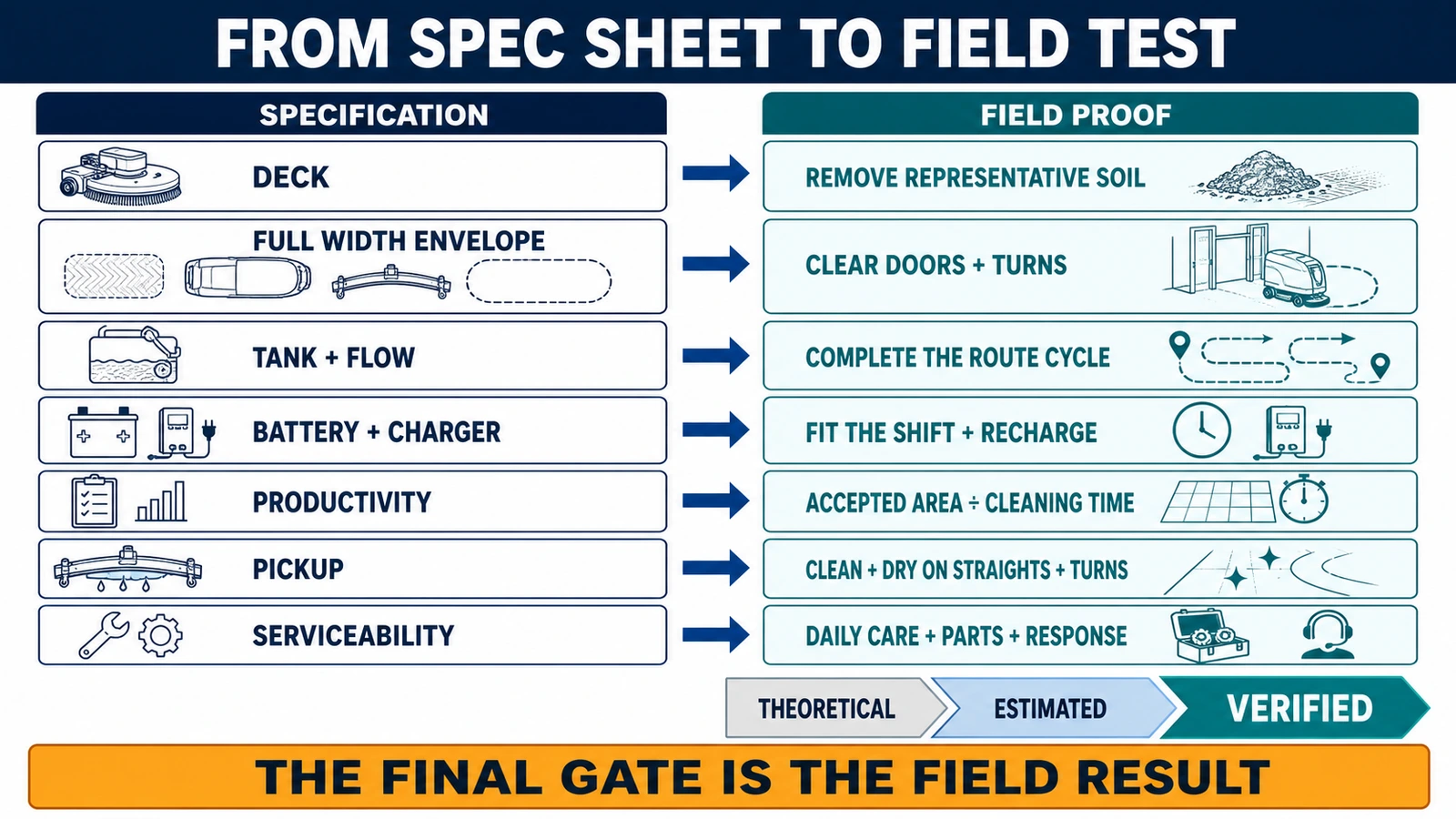
- Define the cleanable route and cleaning window before comparing floor scrubber specifications.
- Compare estimated or field-verified productivity with theoretical maximums, and test the full tank and battery cycle.
- Approve the purchase only after an on-site trial proves route completion, accepted cleaning results, maintainability and TCO.
In this article 15 sections
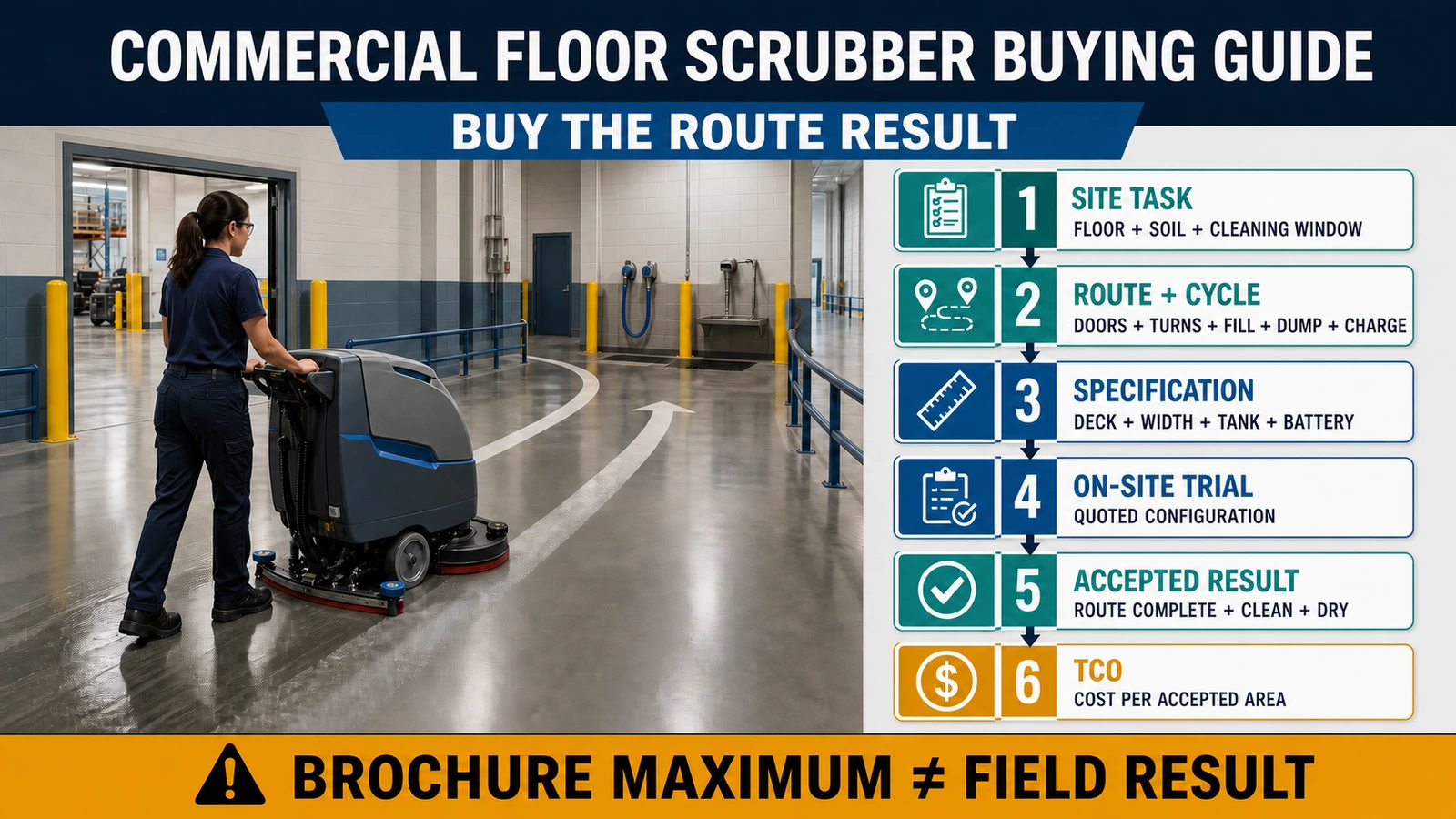
The right commercial floor scrubber completes the required route inside the cleaning window, leaves an accepted dry result and can be maintained by the available team. Start with cleanable area, floor condition, soil, doors, elevators, slopes and fill–dump access. Then compare deck, working and squeegee width, tank cycle, verified battery runtime and estimated—not merely theoretical—productivity. Make the final decision with an on-site trial, service plan and total cost of ownership.
A specification sheet describes a machine under defined conditions. Your facility supplies the route, interruptions, soil and acceptance standard. A productive purchase connects the two.
This guide covers conventional commercial scrubber dryers. If the first decision is whether to use a sweeper or scrubber, start with our floor sweeper vs floor scrubber guide. For operator format, see walk-behind vs ride-on floor scrubbers. Financing and contract structure belong in the rental vs buy comparison.
Commercial Floor Scrubber Buying Decision
| Decision | Site input | Specification to compare | Proof before purchase |
|---|---|---|---|
| Cleaning task | Floor, soil, frequency and required result | Deck, brush or pad, pressure and solution control | Representative soil is removed without floor damage |
| Route | Doors, elevators, aisles, turns, slopes and transfers | Machine, working, squeegee and turnaround dimensions | The machine completes the full route |
| Operating cycle | Cleaning window, fill–dump points and charging access | Tanks, solution flow, battery and charger | One measured cycle fits the shift plan |
| Dry result | Reopening time, turns, joints and floor condition | Squeegee, vacuum system and recovery design | Residual water meets the site standard |
| Ownership | Operators, consumables, maintenance, parts and backup | Service access, warranty and support | Comparable TCO and documented response plan |
Define the Site Task Before Comparing Machines
Begin with cleanable route area, not gross building area. Remove offices, storage, fixtures and zones that the machine will not scrub. Split the remaining floor by cleaning frequency and soil level. A warehouse travel lane cleaned nightly is a different task from a weekly deep scrub around production equipment.
Record the floor material and finish. Confirm the flooring manufacturer’s care instructions, especially before aggressive pads, brushes or coating-removal work. The same machine can produce different results when the brush, pad, down pressure, chemistry or solution flow changes.
Map the actual route. Measure the narrowest door and elevator entrance, elevator capacity, aisle width, rack ends, turning points and storage space. Note thresholds, drains, ramps and cross-slopes. Locate clean-water supply and an approved wastewater disposal point. A large machine can perform well in an open demonstration and lose its advantage through repeated maneuvering or a distant dump point.
The cleaning window needs its own definition. Separate productive scrubbing from inspection, filling, dumping, travel, charging and operator handover. If a two-hour window contains 30 minutes of unavoidable non-scrubbing work, the machine has 1.5 productive hours—not two.
Calculate the Required Effective Productivity
Use the route and available productive time to set the requirement:
`Required effective productivity = cleanable route area ÷ available productive cleaning hours`
Suppose the route contains 6,000 m² and the team has three productive hours. The required effective productivity is 2,000 m²/h. That figure is a procurement threshold, not a promise that every 2,000 m²/h brochure rating will pass.
Cleaning time can be calculated in the other direction:
`Task time = cleanable route area ÷ verified effective productivity`
ISSA’s public cleaning-time guidance uses the same area-divided-by-production-rate logic. The quality of the answer depends on the production rate entered. Use a relevant standard rate for early planning and replace it with measured site performance before approval.
Keep two productivity figures in the comparison:
- brochure estimate under stated assumptions;
- verified effective productivity on the buyer’s route.
If a supplier provides only a theoretical maximum, ask for the assumptions and test the machine.
Choose the Scrubbing Deck for the Floor and Soil
Disc, cylindrical and orbital decks perform different mechanical tasks. None is a universal upgrade.
| Deck | Typical fit | Buying questions |
|---|---|---|
| Disc | Routine cleaning on smoother hard floors; broad brush and pad availability | Which brush or pad is approved for the floor? Does the result require one or two passes? |
| Cylindrical | Textured or grouted floors and routes with manageable light debris | What debris can the hopper recover? What still requires pre-sweeping? |
| Orbital or rectangular | Deep cleaning, close edge work and selected finish-removal tasks | Which pad system and chemistry are required? Is the method approved for the floor finish? |
Nilfisk’s scrubber selection guidance describes disc scrubbers as a common choice for smooth daily cleaning, cylindrical systems as suitable for debris and textured or grouted floors, and orbital systems as an option for deep cleaning and finish removal. Treat those descriptions as a test plan, not a substitute for one.
Do not compare deck types by rpm or down pressure alone. Contact pattern, brush or pad, floor profile, solution, speed and dwell time all affect the result. More pressure can also increase energy use and wear. The correct setting is the lowest practical combination that repeatedly achieves the agreed result without harming the floor.
Cylindrical machines are often promoted for sweep-and-scrub operation. Define the debris limit. Packaging bands, metal fragments, large objects and excessive dry soil can still require removal before wet scrubbing. The trial should use the debris the site actually encounters.
Check Every Width and the Maneuvering Envelope
“Cleaning width” is only one dimension.
- Working width controls the nominal scrub path.
- Machine width determines whether the body clears doors and obstacles.
- Squeegee width can be wider than both and controls the rear pickup envelope.
- Turnaround width affects aisle ends, corners and small rooms.
- Length, height and operating weight affect elevators, storage and transport.
The differences can be substantial. In Tennant’s official T500e brochure, the 650 mm dual-disc version is about 700 mm wide, uses a 973 mm squeegee and lists a 1,499 mm aisle turnaround width. A buyer who checks only the 650 mm cleaning path can miss the actual clearance requirement.
Measure the full machine in operating configuration. Include side brushes, guards, hoses or tools that remain attached. During the trial, watch the operator approach doors, turn at rack ends and align the squeegee without clipping fixtures.
A wider deck reduces the number of straight passes on an open floor. It can lose time in fragmented spaces. Route completion time decides whether the extra width produces value.
Size the Tank Cycle Around the Route
Tank capacity affects how long the machine can scrub between service stops, but it does not determine the cycle by itself.
`Estimated solution runtime = usable solution volume ÷ observed solution flow`
Use usable volume and the setting that achieved the test result. A lower flow can extend the cycle, but it must still wet the floor appropriately. Heavy soil or porous surfaces can require more solution. Recovery capacity, foam and shutoff design can end the cycle before the clean-water tank is empty.
The T500e example lists an 85 L solution tank and a 102 L recovery tank. Its operator documentation shows that solution flow varies by setting and configuration. The useful question is how many accepted square metres the machine completes before the actual fill–dump stop.
Record the entire interruption:
- travel to the service point;
- drain and rinse;
- refill and dose;
- inspect filters, hoses and squeegee;
- return to the route.
A large tank positioned far from a suitable drain can still produce a poor operating cycle. A smaller machine with a nearby service point can be faster on a divided route.
The wastewater plan belongs in procurement. Confirm where the operator may discharge recovered solution and how local rules, site policy and chemical labels apply. Do not design the route around an unapproved floor drain.
Match the Battery and Charger to the Shift
Battery selection combines runtime, charging time, maintenance, infrastructure and replacement cost.
Ask the supplier to identify the exact battery chemistry, capacity, charger and warranty included in the quote. The word “battery-powered” is not a complete configuration. Wet lead-acid, AGM, TPPL and lithium-ion options have different maintenance and charging requirements, and availability varies by model and market.
Read runtime footnotes. Tennant’s T500e brochure lists up-to runtimes across several deck configurations, but the footnote defines continuous scrubbing with 260 Ah wet batteries, low down pressure and ec-H2O switched off. A real route with higher brush pressure, stops, slopes or an aging battery can produce a different result.
During the trial, record:
| Battery field | Trial record |
|---|---|
| Starting state | Indicated charge, battery age and configuration |
| Work performed | Deck, pressure, solution setting, route and soil |
| Productive runtime | Scrubbing time separate from travel and stops |
| End state | Remaining indicated charge and any power reduction |
| Recharge | Charger used, connection time and time to ready |
| Shift fit | Whether the planned next use remains protected |
Verify the charging location before choosing the battery. Power supply, ventilation, temperature, fire controls and battery handling rules can affect the installation. In the United States, OSHA 1926.441 includes ventilation and designated-area provisions for covered battery charging conditions. The applicable requirements depend on jurisdiction and workplace. Obtain a local safety and electrical review instead of applying one generic charging-room rule worldwide.
Read Productivity Claims Correctly
Theoretical productivity is usually based on working width multiplied by travel speed. It is an upper boundary for continuous straight movement. Real cleaning includes overlap, turns, obstacles, slower soil treatment, filling, dumping and travel.
The T500e brochure makes the distinction visible:
| T500e configuration | Theoretical maximum | Conventional estimated coverage |
|---|---|---|
| 650 mm dual disc | 2,657 m²/h | 1,911 m²/h |
| 700 mm dual disc | 2,861 m²/h | 2,070 m²/h |
| 800 mm dual disc | 3,270 m²/h | 2,389 m²/h |
| 700 mm cylindrical | 2,861 m²/h | 2,070 m²/h |
| 710 mm orbital | 2,601 m²/h | 1,882 m²/h |
Tennant states that its estimated coverage uses practical speed and empty/fill time standards from the 2004 ISSA Cleaning Times handbook. Those estimates are more useful than the theoretical maximum, but they still do not include every buyer’s layout and workflow.
Do not convert the example into a universal efficiency factor. Measure:
`Verified effective productivity = accepted cleaned area ÷ productive cleaning time`
Also report elapsed route time. Productive cleaning time helps compare machine performance; elapsed time confirms whether the work fits the real window.
Verify Pickup, Noise, Slope and Safety
A scrubber dryer must recover the applied solution. Vacuum specifications describe one part of the system. Squeegee condition and adjustment, hoses, seals, recovery-tank airflow, foam and floor profile influence the result.
Test pickup in straight lines, turns, joints and changes in floor level. Define what “dry” means for the site: no visible trail, no pooled water and an acceptable reopening time. If the machine leaves water, investigate the configuration or select another option. Our floor scrubber water-pickup troubleshooting guide covers the separate diagnostic process.
Noise needs a time and location. A published operator-ear value does not predict sound inside every hospital corridor, school or occupied retail space. Run the machine during the intended operating period and ask the responsible site team to accept or reject the result.
Use the target model’s operating manual for slope limits. Test the planned ramps under the supplier’s approved procedure and site safety rules. Do not infer gradeability from motor power or from a different model.
Check operator view, braking, emergency controls, key or access management, transport speed and chemical handling. If the machine shares space with pedestrians or vehicles, include that traffic in the route risk assessment.
Audit Maintenance Access, Consumables, Parts and Service
Daily maintenance is part of the labor model. The Tennant T500 operator manual assigns recurring work to tanks, filters, squeegee components, brushes and batteries. The exact schedule varies by machine, so review the manual for every finalist.
Ask the operator—not only the salesperson—to demonstrate:
- draining, rinsing and leaving tanks ready to dry;
- removing and cleaning the squeegee;
- checking or changing brushes and pads;
- accessing filters and recovery shutoff components;
- connecting the charger and performing battery care;
- identifying items that require authorized service.
Nilfisk’s SC550 product page highlights onboard maintenance guidance, color-coded touchpoints and squeegee removal. Those features illustrate what buyers should inspect: can a new operator complete the required care correctly and consistently?
Price the wear items before approval. Obtain part numbers, expected use conditions, unit prices and lead times for brushes, pads, squeegee blades, filters and relevant battery components. A low acquisition price can be offset by frequent wear, long parts delays or service travel.
Define the service model in writing:
| Service field | Required answer |
|---|---|
| Preventive maintenance | Tasks, interval, labor and included parts |
| Breakdown response | Response target and geographic coverage |
| Common parts | Local stock, ordering route and lead time |
| Major repair | Authorization process and estimated turnaround |
| Backup | Loaner, rental or manual contingency |
| Training | Initial and replacement-operator coverage |
| Warranty | Battery, charger, machine and wear-item exclusions |
Calculate TCO and Cost per Accepted Area
Compare complete configurations over the same evaluation period and workload.
`TCO = acquisition or contract + financing + labor + battery and charging + water and chemistry + pads/brushes/squeegees + planned maintenance + repairs/parts + downtime/backup + training + end-of-life`
Labor includes productive operation, filling, dumping, daily care and supervision. Downtime includes the cost of delayed work or a replacement method. Do not count only the repair invoice.
Use accepted output as the denominator:
`Cost per accepted area = TCO ÷ accepted cleaned area`
“Accepted” matters. A machine can travel quickly and still require rework. Rejected or repeated areas should not receive full productivity credit.
The purchase price remains important, but it needs context. A 2026 Tennant TCO article asks buyers to consider energy, uptime, labor deployment and the service model after purchase. Treat supplier TCO claims as questions to verify with the buyer’s labor rates, route data, consumable quotes and service terms.
Run an On-Site Trial and Acceptance Test
Use the finalist configuration: machine, deck, brush or pad, battery, charger, squeegee and chemical system. A demonstration with a different battery or deck cannot validate the quoted machine.
The trial should include representative heavy and routine soil, the full route, planned service points and the intended operator. Record the conditions before the run so competing machines receive a comparable test.
| Acceptance field | Record |
|---|---|
| Route completion | Complete, incomplete or interrupted; reason |
| Elapsed and productive time | Start/finish plus scrub time |
| Accepted area | Area passing the agreed result |
| Cleaning result | Soil removed, floor unaffected, edge result |
| Pickup | Residual water on straights, turns and joints |
| Tank cycle | Fill/dump count and total service time |
| Battery cycle | Start/end charge, runtime and recharge |
| Maneuverability | Doors, elevator, aisles and turns |
| Operator use | Training, control, visibility and fatigue |
| Maintenance | End-of-shift tasks and minutes required |
| Service readiness | Parts, response, warranty and backup confirmed |
Set acceptance criteria before the demonstration. Avoid changing the standard after seeing one machine. If no finalist completes the route and meets the result, revise the process or specification rather than approving the least unsuccessful option.
Commercial Floor Scrubber Procurement Checklist
Before issuing the order, confirm:
- [ ] cleanable route area and cleaning frequency;
- [ ] floor and finish compatibility;
- [ ] representative soil and required outcome;
- [ ] productive cleaning window;
- [ ] doors, elevator, aisle, turn and storage dimensions;
- [ ] working, machine, squeegee and turnaround widths;
- [ ] approved slope and transport conditions;
- [ ] deck, brush or pad and chemical configuration;
- [ ] tank cycle and approved fill–dump points;
- [ ] exact battery, charger, runtime test and charging location;
- [ ] estimated and field-verified productivity;
- [ ] dry-result, noise and operator acceptance;
- [ ] daily maintenance time and responsibility;
- [ ] consumable part numbers, prices and lead times;
- [ ] preventive maintenance, warranty, response and backup;
- [ ] comparable TCO and cost per accepted area;
- [ ] signed trial record for the quoted configuration.
Frequently Asked Questions
How do I choose the right size commercial floor scrubber?
Use cleanable route area, productive cleaning time and the narrowest route constraints. Required effective productivity is area divided by productive hours. Then test whether the complete machine—including its squeegee and turning envelope—finishes the route.
Is a wider floor scrubber always more productive?
No. Greater width reduces straight passes on open floors, but doors, obstacles, turns and transfers can remove the advantage. Compare elapsed full-route time and accepted area.
Which scrubber deck is best?
Disc is a versatile choice for many smooth-floor routines. Cylindrical systems can suit textured floors and manageable light debris. Orbital systems can fit deep-cleaning and selected finish-removal work. The floor, soil, pad or brush and required result decide the final choice.
How large should the solution and recovery tanks be?
Large enough for an efficient route cycle under the tested solution flow, with practical fill and dump access. Compare accepted area per tank and the total interruption time, not litres alone.
How much battery runtime do I need?
Enough verified runtime to complete the planned work with a safe operating reserve and a charging plan for the next use. Test the exact battery and charger under the intended deck, pressure, floor and route.
What is the difference between theoretical and effective productivity?
Theoretical productivity is an ideal width-and-speed calculation. Effective productivity includes real operating speed and route losses. Field-verified productivity should use accepted cleaned area divided by productive cleaning time.
What should be included in floor scrubber TCO?
Include acquisition or contract cost, labor, battery and charging, utilities and chemistry, wear items, maintenance, repairs, downtime, backup, training, financing and end-of-life. Compare cost per accepted area over the same period.
Should I buy, rent or lease the machine?
That is a separate ownership decision. Stable, heavily used routes can support purchase, while uncertain, seasonal or short-term work can favor rental or a service contract. See our floor scrubber rental vs buy guide.
Final Takeaway
Buy the route result, not the brochure maximum. Define the task, calculate the required effective output, verify the deck and full operating envelope, and measure a complete tank and battery cycle. The purchase is ready only when the quoted machine finishes the real route, passes the cleaning and dry-result standard, fits the team’s maintenance capability and produces an acceptable cost per accepted area.