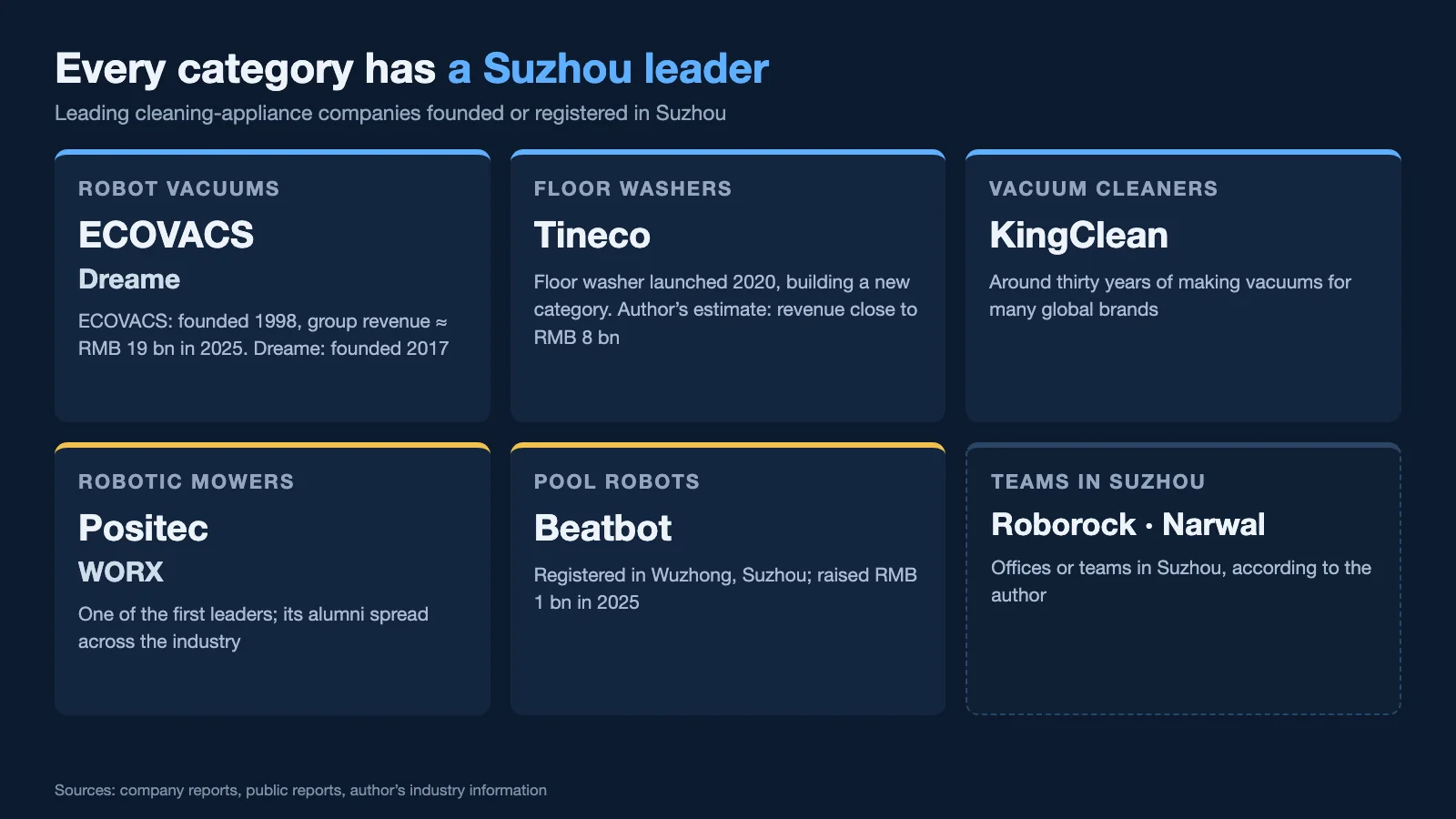
- Leading companies in robot vacuums, floor washers, vacuum cleaners, robotic mowers and pool robots, including ECOVACS, Tineco, Dreame, KingClean, Positec and Beatbot, were founded or registered in Suzhou.
- Decades of these companies have built a deep pool of engineers, product managers and sales people, which pulls in new companies and keeps talent in the city.
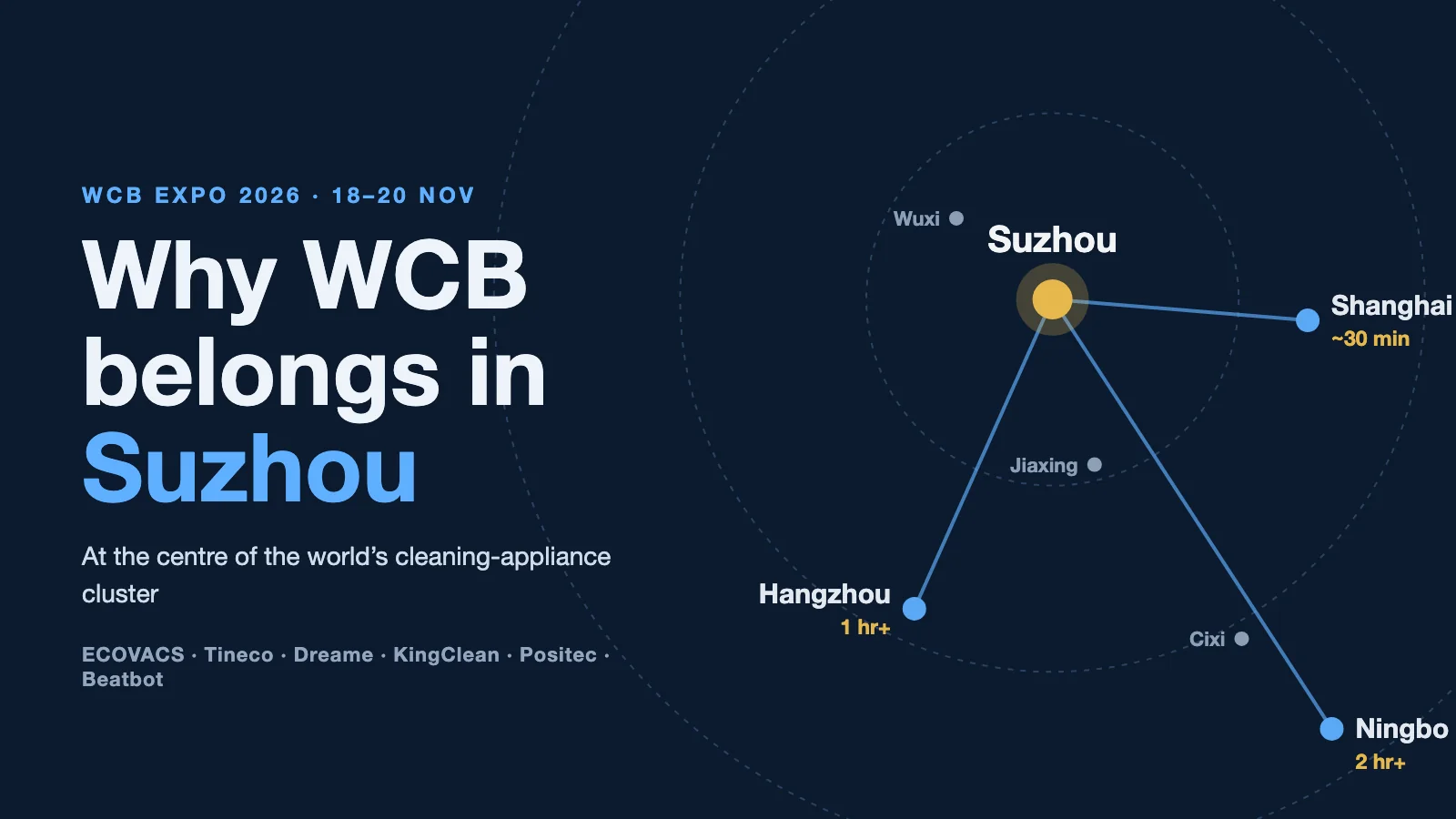
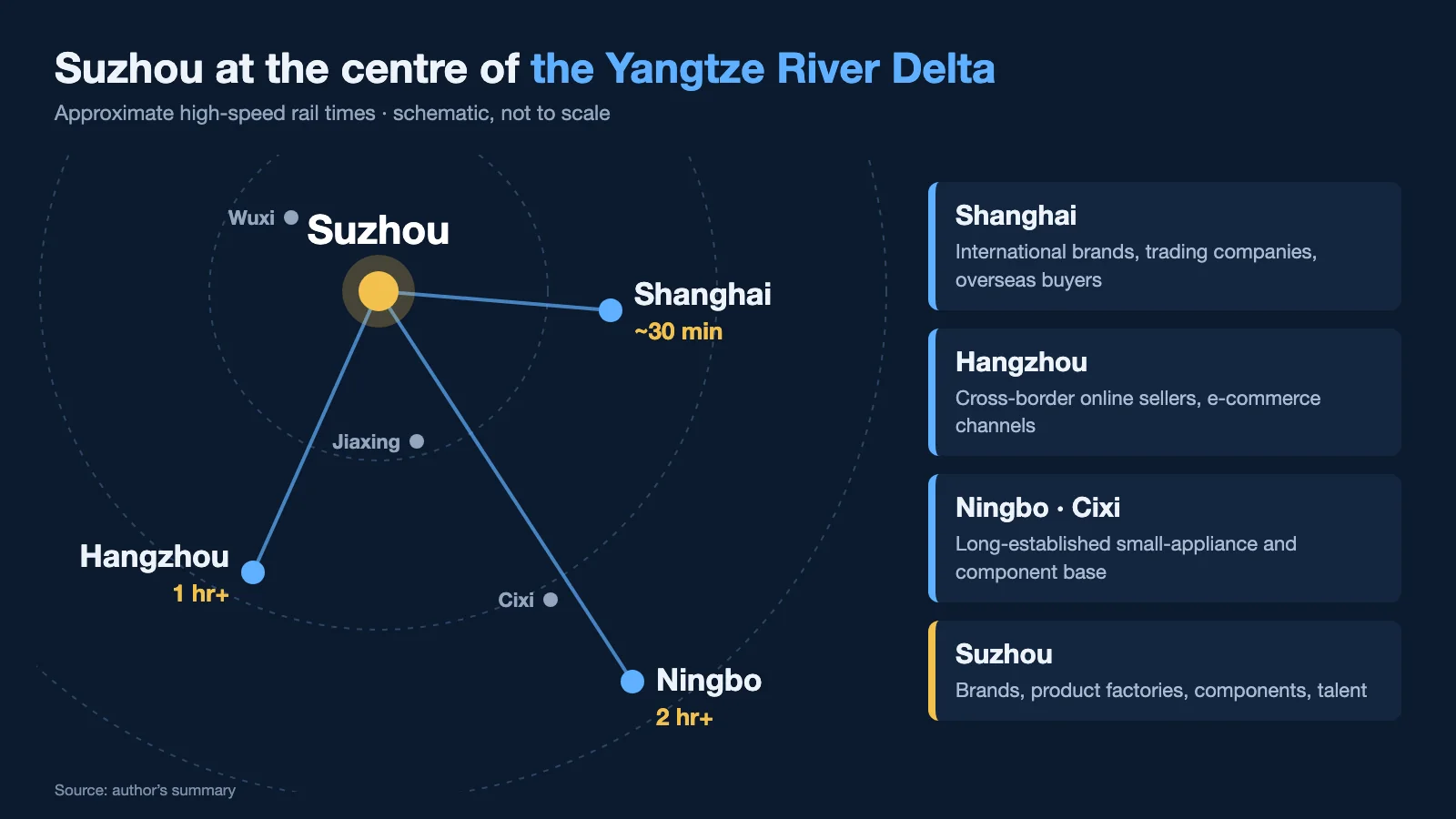
- Suzhou sits at the centre of the Yangtze River Delta, close to Shanghai’s brands and buyers, Hangzhou’s online sellers and the Ningbo–Cixi component base.
- A trade show’s life depends on its industry cluster, so I expect WCB to become more closely tied to Suzhou in the years ahead.
In this article 5 sections
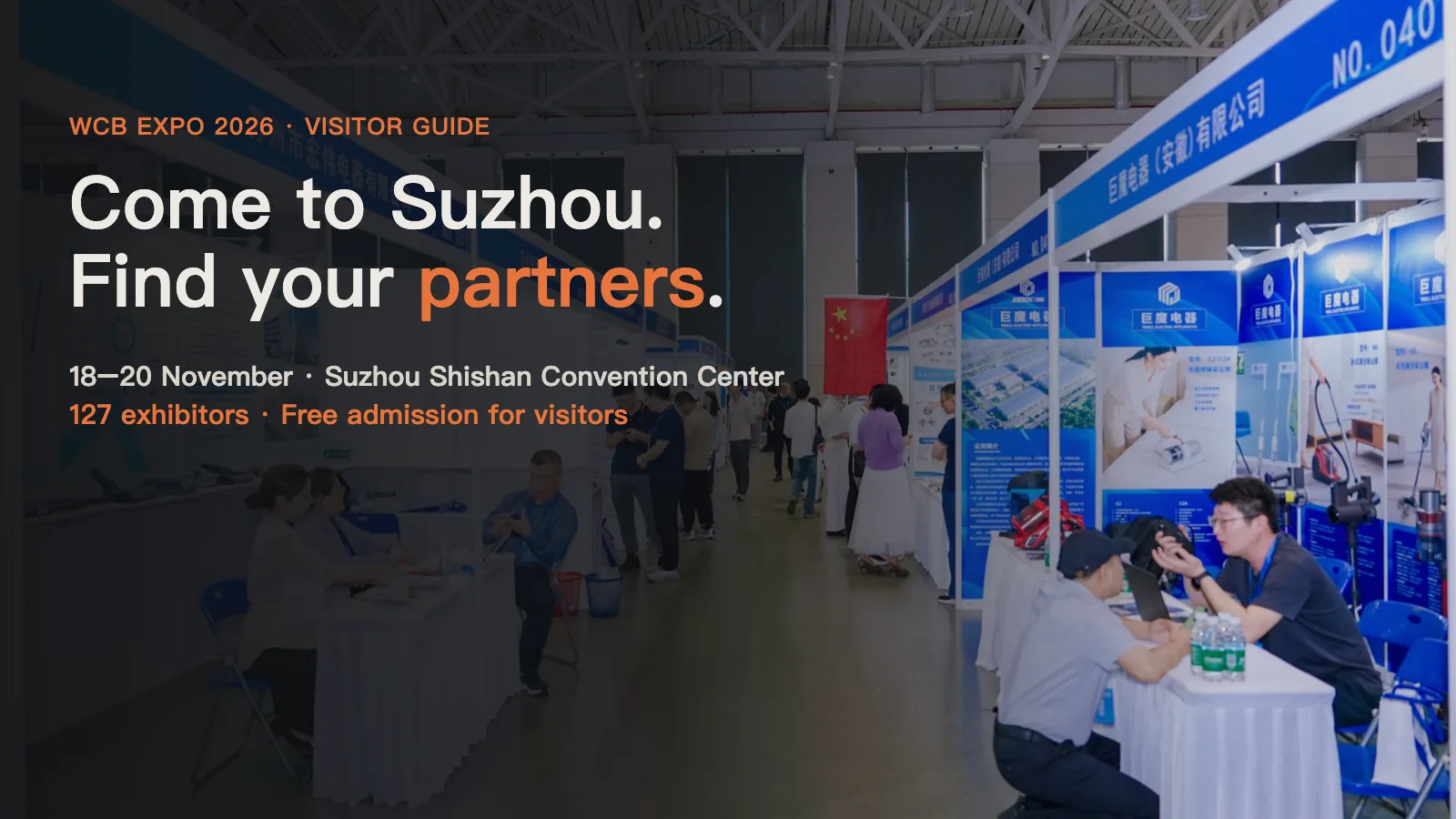
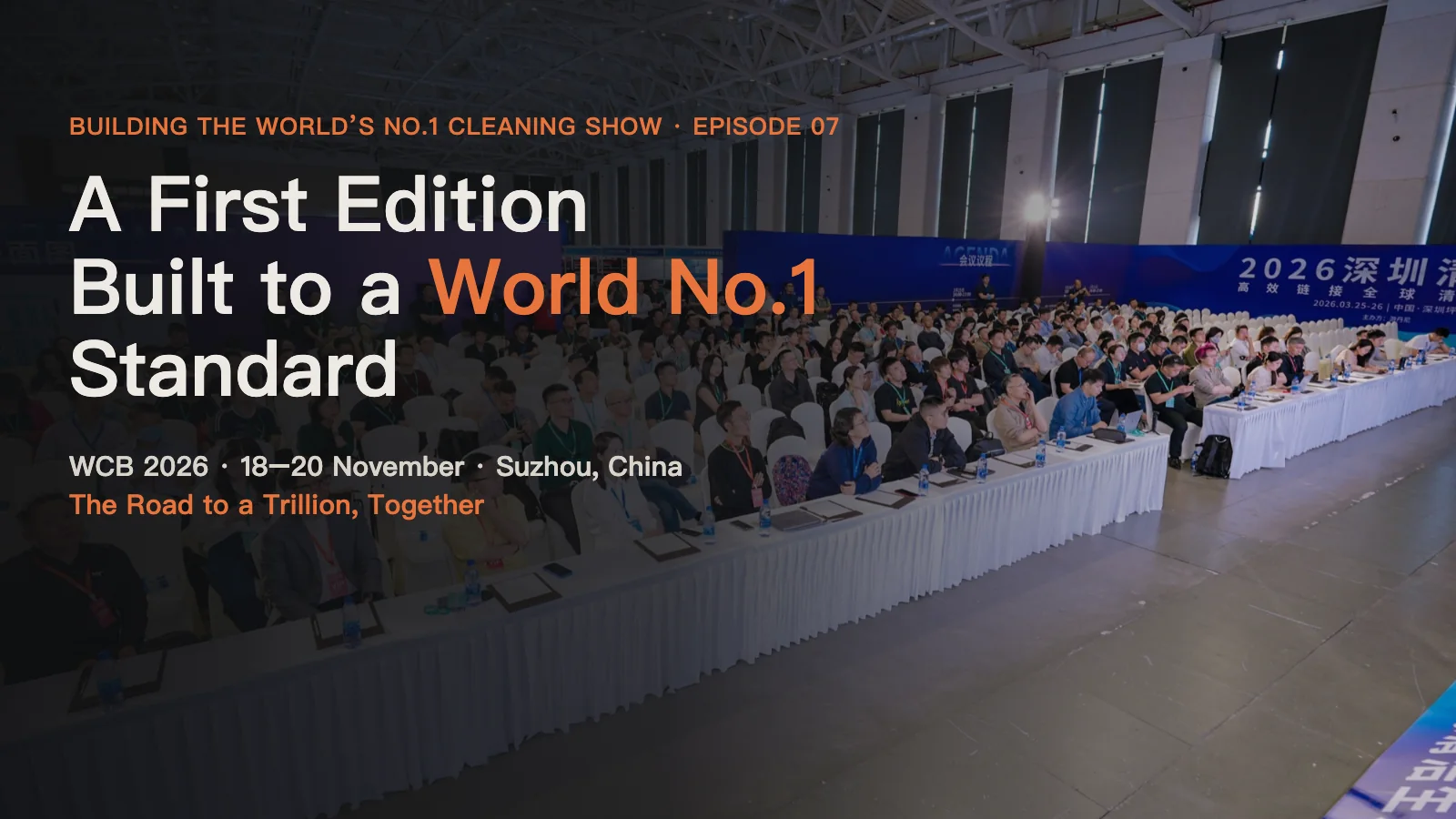
On 18 November, the 2026 WCB International Cleaning Appliance Expo opens at the Suzhou Shishan Convention Center. Lately, friends keep asking me the same question: why Suzhou, and not Shenzhen or Shanghai?
My answer is simple. Suzhou is the centre of the global cleaning-appliance industry. Whether a trade show can last depends on how close it is to its industry. Holding WCB in Suzhou puts it on the industry’s doorstep.
The brands grew up here
Start with the brands. Several of today’s leading cleaning-appliance companies started in Suzhou. ECOVACS was founded in Suzhou in 1998 and began as a contract manufacturer. By 2025, the group’s revenue had reached about RMB 19 billion. ECOVACS is not just Suzhou’s leader; it has led the global robot-vacuum industry, and it was the first to push the all-in-one docking station that defined the latest product cycle. KingClean is Suzhou’s veteran vacuum maker, with around thirty years of making vacuums for many of the world’s big brands. Dreame was founded in Suzhou in 2017, grew into a company of RMB 10 billion-plus scale within a few years, and is now one of the most watched companies in cleaning appliances.
The floor-washer category was also built in Suzhou. ECOVACS’s sister brand Tineco brought its floor washer to market in 2020 and, starting almost from zero, turned a new product into one of the biggest categories in cleaning appliances. Tineco grew with it. Based on ECOVACS’s 2025 annual report, I estimate Tineco’s revenue at close to RMB 8 billion a year. Tineco has been the biggest winner of the floor-washer boom, but not the only one. A large group of smaller brands and supporting factories grew alongside it, many of them in and around Suzhou.
Brands that did not start here are moving here too. From what I hear, Roborock, Narwal and others have offices or teams in Suzhou. The reason is practical: the people are here, and so is the supply chain.
The factories are here
Then look at the factories. Suzhou is home to a large number of contract manufacturers and component suppliers: motors, batteries, pumps, plastic parts, moulds and PCBAs. Almost everything a product needs can be found within an hour or two by car. There is a long-standing saying in the industry that about 70% of the world’s cleaning-appliance production capacity is tied to Suzhou and the surrounding region. I cannot verify that figure precisely, but after many years in this industry, from factories to brands, my view is that calling Suzhou the world’s largest cleaning-appliance cluster is no exaggeration.
Robotic mowers follow the same logic. Positec, the Suzhou company behind WORX, was one of the first leaders in garden tools and robotic mowers worldwide. Over the years, many of the engineers, product managers and sales people Positec trained have gone on to start companies or join new ones, taking their experience across the robotic-mower industry. Positec is an important reason the robotic-mower scene in Suzhou is so lively today.
Pool robots are no different. Beatbot’s operating company is registered in Wuzhong, Suzhou. It raised RMB 1 billion in 2025, is one of the leading pool-robot brands, and is now moving into robotic mowers as well.
Robot vacuums, floor washers, vacuum cleaners, robotic mowers and pool robots: every major cleaning category has a leading company in Suzhou. These companies have grown here over two or three decades and trained generation after generation of engineers, product managers, supply-chain and sales people. More talent attracts more new companies, and more new companies make talent more willing to stay. That is a virtuous circle.
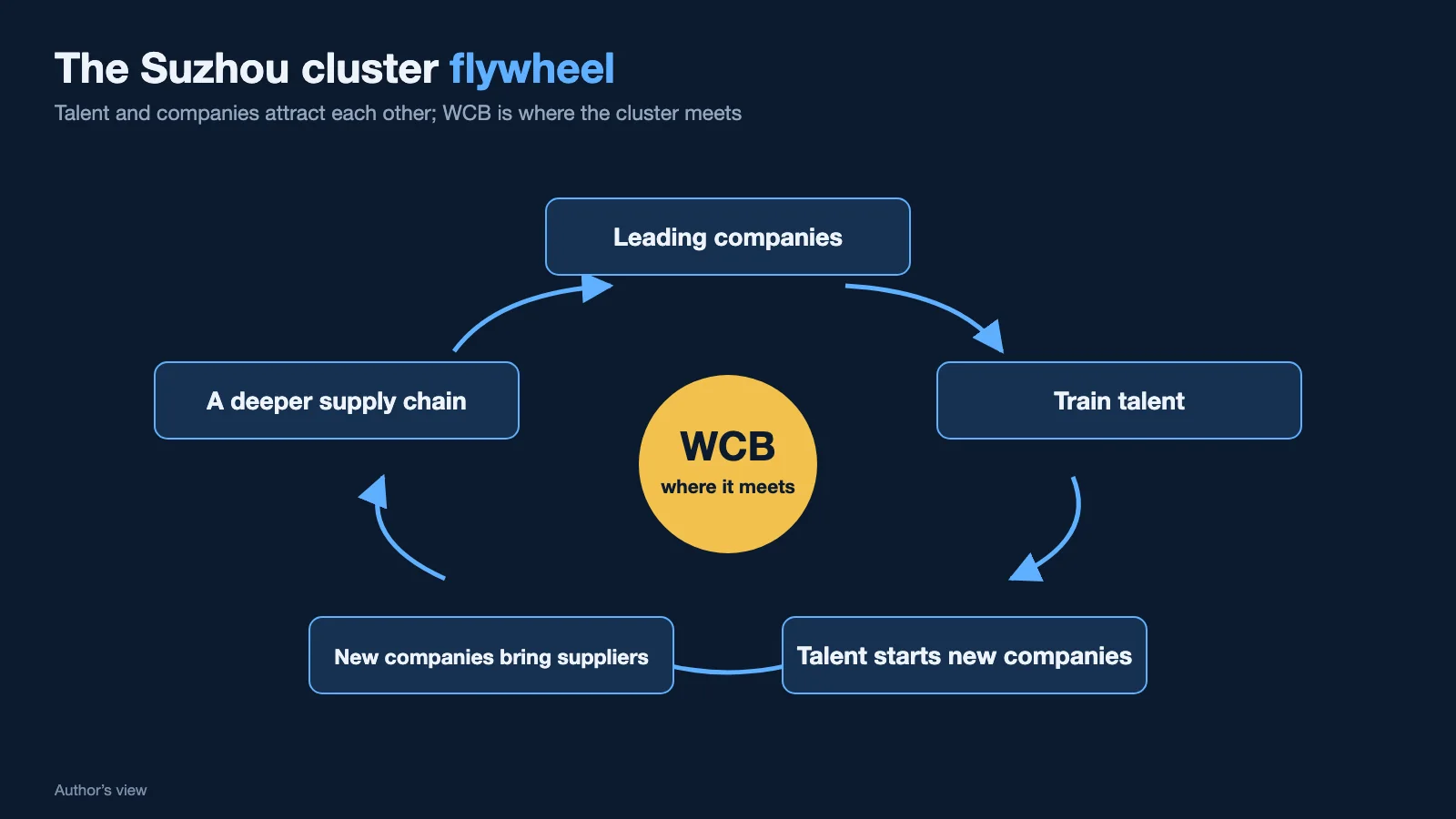
That is why I often say that if a company wants to grow big in cleaning appliances, it will struggle to hire enough good people without an office in Suzhou.
The whole Yangtze River Delta within reach
Suzhou’s advantage goes beyond Suzhou itself. The city sits in the middle of the Yangtze River Delta. By high-speed rail, Shanghai is about half an hour away, Hangzhou a little over an hour and Ningbo a little over two hours. Shanghai has a large base of international brands, trading companies and overseas buyers. Hangzhou has many cross-border online sellers and e-commerce channels. Ningbo and Cixi are a long-established base for small appliances and components, with a great many motor, plastic-part and mould makers. Together they form a large network, and Suzhou sits at its centre.
So when we call Suzhou a cluster, we really mean the whole Yangtze River Delta with Suzhou at its centre. Whether you are looking for suppliers, customers or brands, you can reach Zhejiang and Shanghai quickly from Suzhou. For visitors from other parts of China and from overseas, one trip to Suzhou is enough to see factories and partners across the delta.
A government that understands industry
Besides companies, talent and location, Suzhou has one more advantage: its government.
When I talk with friends who run companies here, they speak highly of the Suzhou government. It works efficiently: when a company runs into a problem and contacts the relevant department, someone usually picks it up and follows through quickly. The government also understands industry well and takes the time to learn what companies actually need. In attracting talent, building industrial parks and helping companies set up, it has done a great deal of practical work. One important reason many companies choose to stay and expand in Suzhou is that doing business here is straightforward.
A city with leading companies, a complete supply chain and deep talent, plus a government that understands industry and is willing to serve it, will see its cluster keep getting stronger.
Why this matters for WCB
Back to the show itself. I have always believed that a trade show’s life is tied to its industry cluster. The exhibitors are here, the visitors are here, the buyers are here and the R&D teams are here. When a show is held inside its cluster, exhibitors do not need to travel far, visitors from Shanghai, Hangzhou and Ningbo can come and go in a day, and the day after the show you can visit a factory to see samples. Few other cities can match that.
This year’s WCB brings together more than 120 exhibitors, from brands to finished-product factories to component suppliers, and a large share of them come from Suzhou and the surrounding region. Read the WCB Expo 2026 visitor guide for who is exhibiting and how to get there.
So WCB’s future is closely tied to Suzhou. The further Suzhou’s cleaning-appliance industry goes, the stronger WCB becomes; and the better WCB does, the more it can help Suzhou take this cluster to the world. I expect WCB to become even more closely tied to Suzhou over the next few years.
From 18 to 20 November, come to Suzhou and see WCB for yourself.