- TTI's complaint avoids suing on Galli's expired non-solicit, pairs federal and Illinois trade-secret claims, and pleads several counts that do not depend on proving a trade secret.
- Comparable cases range from HP v. Hurd, settled in under two weeks, to Motorola v. Hytera, where about $400 million in trade-secret damages was upheld on appeal.
- A negotiated settlement looks most likely; a limited injunction or a narrowed case are possible; a jury verdict is least likely but carries the highest risk for Chervon.
In this article 4 sections
Part of the WCB topic:The Robot Vacuum Wars Have Moved to CourtTTI vs Chervon: The Lawsuit, the Rivalry and the Numbers
First, a short recap.
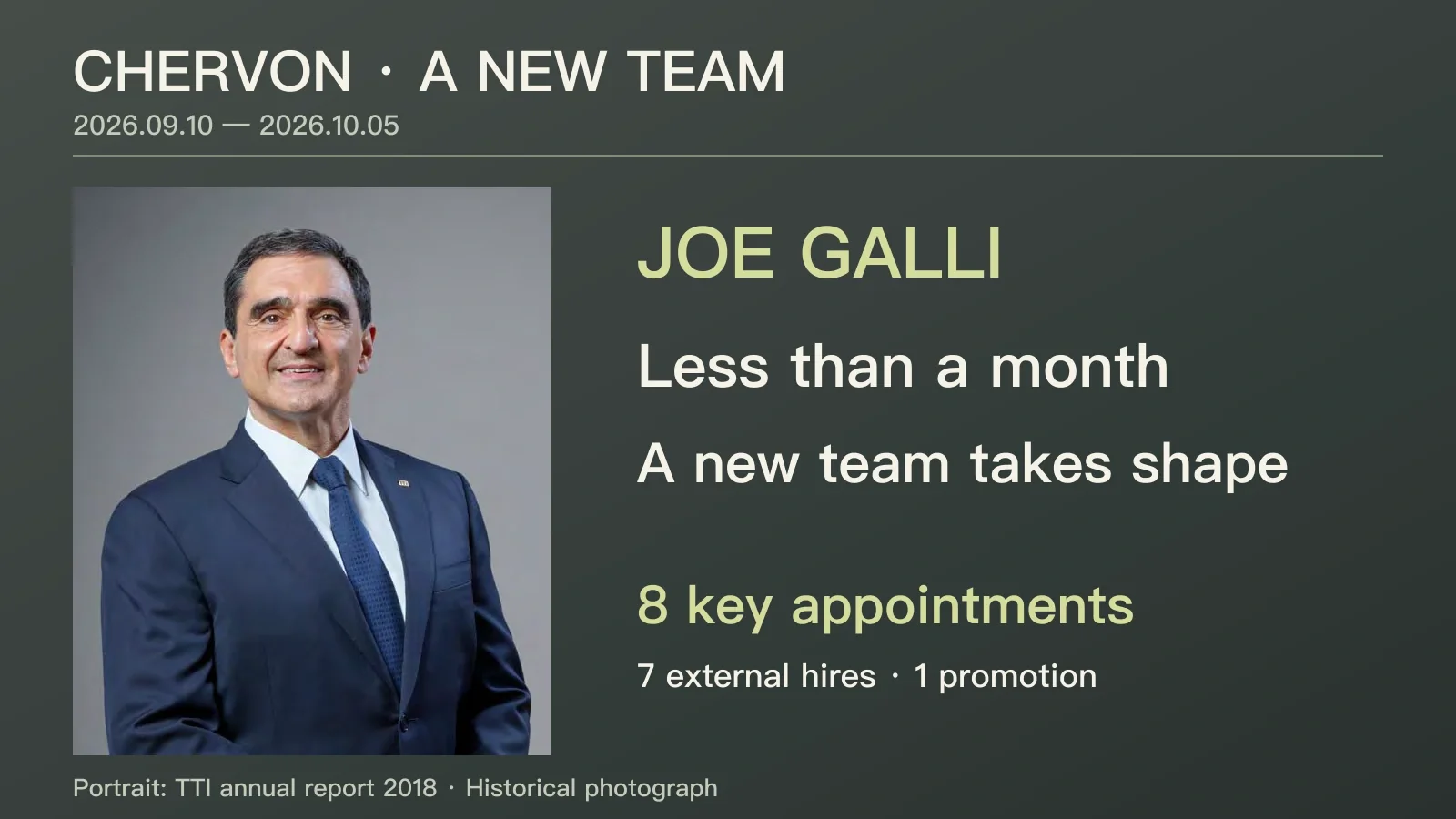
Joseph Galli was TTI's chief executive from 2008 to May 2024, a period in which Milwaukee grew into one of the leading professional power tool brands. On September 10, 2026, Chervon named him group CEO. Within two months Chervon announced a series of senior hires from TTI and Milwaukee across sales, recruiting, training, end-user research, supply chain and Canada, and its shares hit their highest intraday level since April 2023.
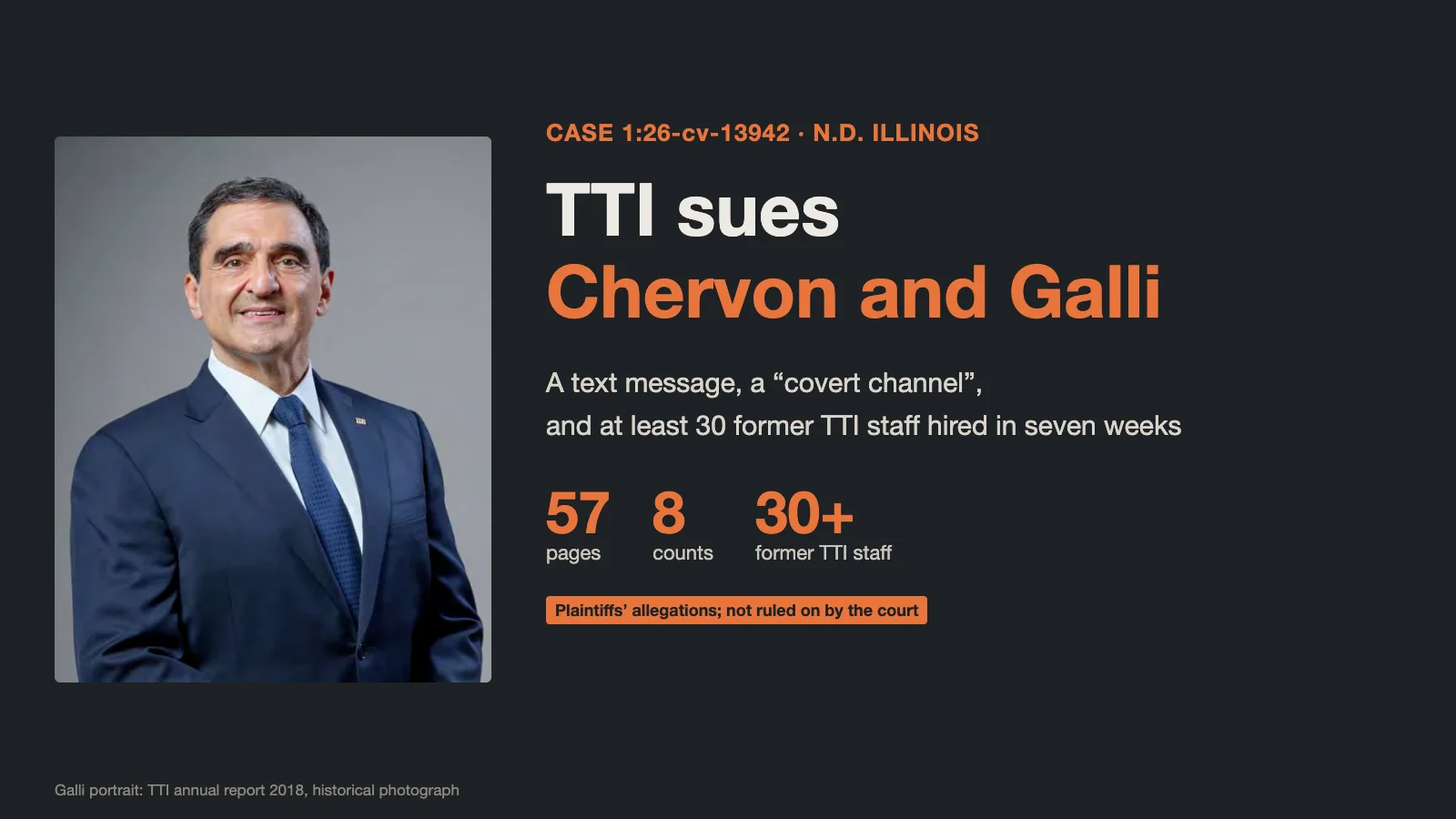
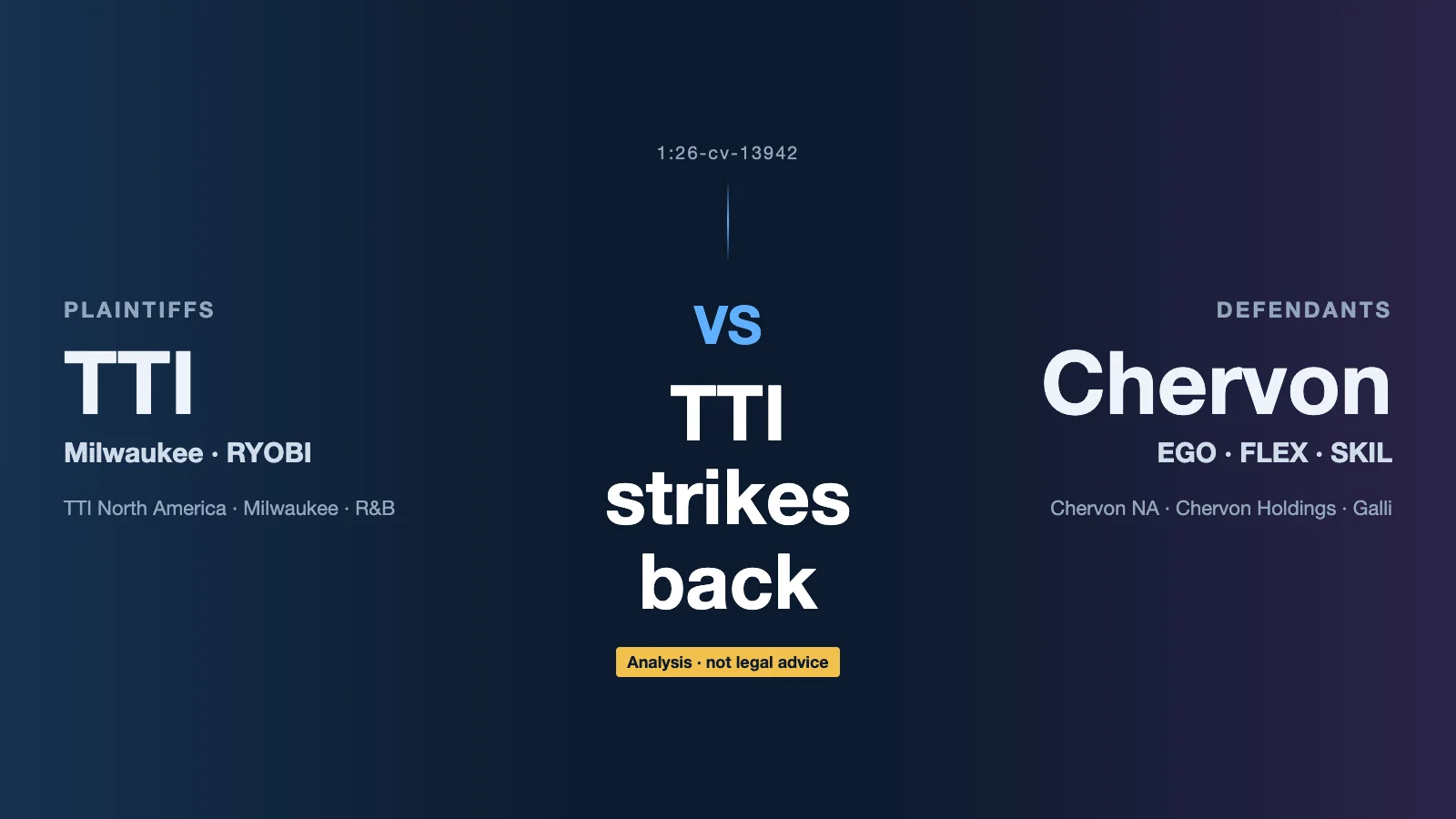
On November 9, TTI North America, Milwaukee and R&B Sales & Marketing sued Chervon North America, Chervon Holdings and Galli himself in the Northern District of Illinois. The 57-page complaint alleges that after retiring, Galli kept a "covert channel" through Daniel Abbott, then TTI's senior vice president of sales for the western division, receiving store information, sales reports, customer meeting notes and Milwaukee CFO slides from June 2025; that the channel was exposed by a text message from Galli in February 2026, after which Abbott was fired; and that after Galli joined Chervon, the company hired at least 30 former TTI employees in roughly seven weeks into near-identical roles. TTI brings eight counts and seeks damages, disgorgement and injunctions.
On November 12, Chervon's shares fell more than 9% intraday. My previous article retold the complaint in order. This one asks three questions: where the case is likely to go, what cards Chervon holds, and how it could end.
As of November 15, the docket still shows only the four filings from November 9. There is no injunction motion and no public response from Chervon or Galli. Everything in the complaint is an allegation the court has not ruled on. The legal discussion draws on US law-firm analysis, legal commentary and public case law, and is not legal advice.
Where the case is likely to go
The way TTI wrote the complaint says a lot about its plan.
First, TTI is not suing Galli under his own contracts. His service agreement contained a two-year non-solicitation clause that ran out around May 2026. The complaint says it is not bringing claims for breach of the service agreement or the retirement agreement, and uses them only to show that Galli understood how sensitive the information was. That sidesteps the most obvious defense: the non-solicit had already expired.
Second, TTI pairs federal and Illinois law. Count I is under the federal Defend Trade Secrets Act; Count II is under the Illinois Trade Secrets Act.
The difference matters. The federal statute says an injunction may not prevent a person from entering into an employment relationship, and any conditions on employment must be based on evidence of threatened misappropriation, not merely on the information the person knows. Many lawyers read this as rejecting the "inevitable disclosure" theory at the federal level: you cannot assume someone will use a former employer's secrets simply because they know them.
Illinois is different. In PepsiCo v. Redmond (discussed below), the Seventh Circuit upheld an injunction under the Illinois Trade Secrets Act, and the case became the most cited authority for inevitable disclosure. The Northern District of Illinois sits within the Seventh Circuit.
Chervon North America is headquartered in Naperville, Illinois, so suing there is natural. My view is that adding the state-law count gives TTI a second route: if federal law leaves too little room for an injunction, Illinois law and Seventh Circuit precedent may support wider limits on Chervon's hiring and use of information.
Third, one sentence recurs throughout the complaint: "This Count does not depend on whether the information at issue qualifies as a trade secret." It appears under the counts for tortious interference, unfair competition, aiding and abetting breach of fiduciary duty and unjust enrichment. As I read it, this stops Chervon from sinking the whole case by arguing that the information was not a trade secret. Even if some material is not protected, inducing employees to break their contracts, or working for a rival while still employed, can stand on its own.
Fourth, TTI runs its claims against individuals on a separate track. The complaint says contract claims against departing employees are being pursued in the forums their agreements require. In March, R&B sued Abbott in California, and the parties stipulated to injunctive relief. This case targets only Chervon and Galli.
Fifth, TTI has to connect Galli's conduct before his appointment to Chervon as a company. The complaint argues that Galli, Matthew DeFeo and Thomas Kentouris took senior roles at Chervon and led its recruiting, so their knowledge is imputed to Chervon, and that Chervon hired employees it knew were bound by confidentiality and restrictive covenants into the same roles. Whether that link holds will be one of the central disputes.
The evidence falls into two groups. The first is specific conduct. The complaint says Abbott, while still employed, sent out store information, the Milwaukee CFO's confidential financial slides, sales report screenshots and customer meeting notes, and had remotely wiped his company phone by the time he was fired; it also says David Reguidel copied a large number of files to an external drive three days before leaving, and alleges on information and belief that he has started working for Chervon. These allegations come with dates, quoted messages and forensic findings.
The second is the hiring pattern. The complaint says that in roughly seven weeks from September 10 to November 3, Chervon hired at least 30 former TTI employees, that 18 of the 19 external hires Chervon announced came from TTI, that the roles map one to one, and that many people started within days of leaving, some on the same day.
The comparable cases below suggest the first group carries far more weight.
Data from Lex Machina points the same way. Of trade secret cases resolved between 2016 and 2020, about 67% settled and 16% ended on procedural grounds; very few reached a trial judgment. Among DTSA cases that ended in 2023, only about 3% were resolved at trial. Its latest report says these cases are settling less often and taking longer.
TTI has not yet moved for a preliminary injunction. If it does, I expect that to be the most important near-term step. I think it is unlikely the case ends in a jury verdict.
How comparable cases ended
US companies have often sued rivals for hiring away executives and teams. Here are five cases that resemble this one, each with a different ending.
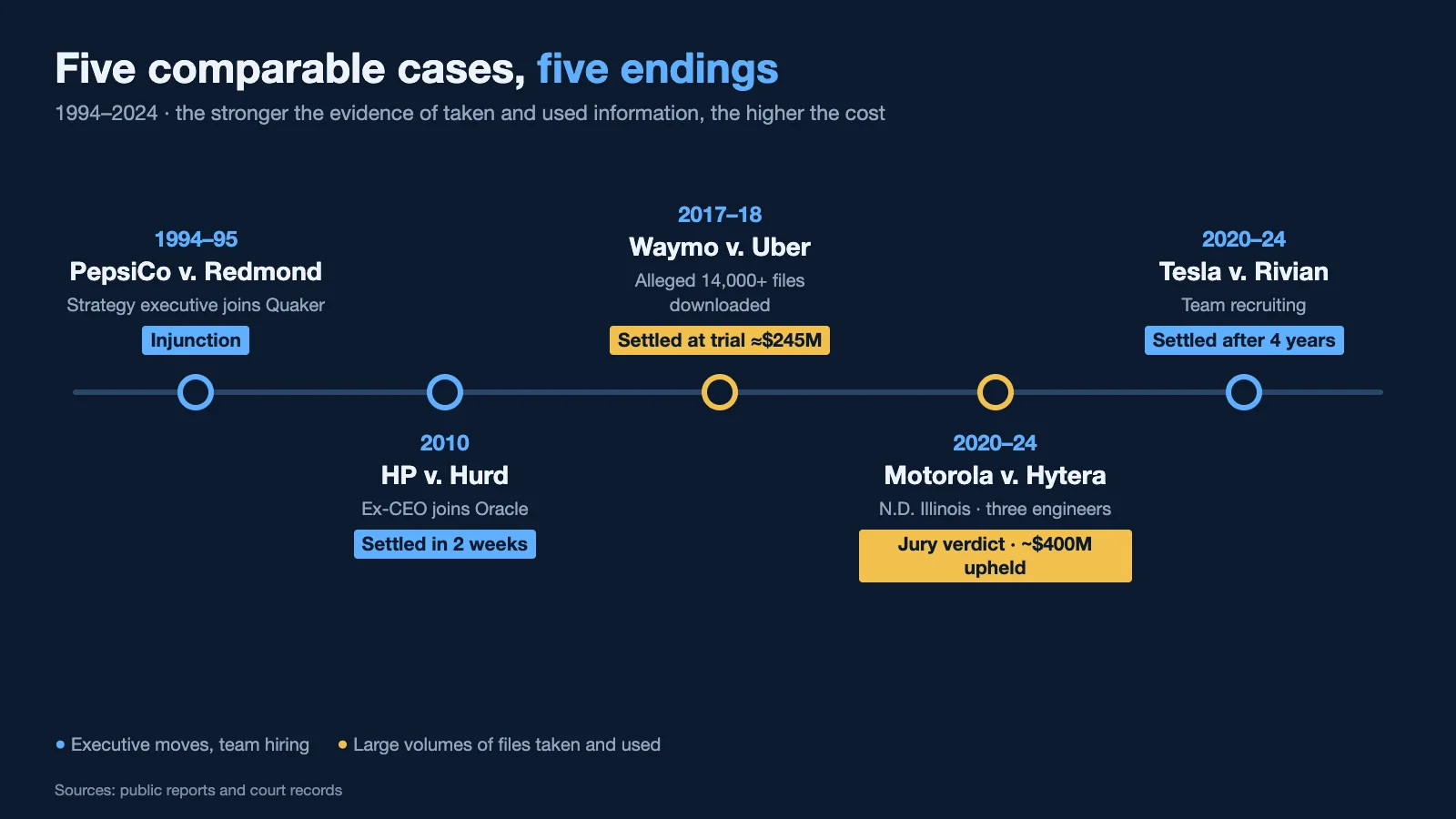
HP v. Hurd, a CEO move. In 2010, former HP chief executive Mark Hurd joined Oracle as co-president, and HP sued, arguing that the nature of his new job meant he would inevitably use HP's trade secrets. The parties settled in under two weeks. Hurd agreed to keep protecting HP's confidential information and gave up about 346,000 HP restricted stock units, which the Associated Press valued at nearly $14 million. The case rested on what he might use, with no specific evidence of information taken, and it ended fastest.
PepsiCo v. Redmond, an injunction. In 1994, a PepsiCo executive with knowledge of its North American strategy and pricing plans left for rival Quaker Oats to work on Gatorade and other drinks. The court issued a preliminary injunction under the Illinois Trade Secrets Act, temporarily barring him from the new job and from using or disclosing PepsiCo's secrets, and the Seventh Circuit affirmed in 1995. There was no evidence he took documents; the case rested on inevitable disclosure. Some lawyers see the decision as still influential in Illinois, but many read the 2016 federal statute as rejecting that theory.
Waymo v. Uber, settled during trial. In 2017, Alphabet's Waymo sued Uber, alleging that former engineer Anthony Levandowski downloaded more than 14,000 confidential design files before leaving to found a start-up that Uber then acquired. The case went to a jury trial in February 2018 and settled a few days in: Uber gave Waymo about 0.34% of its equity, reported at about $245 million, and agreed not to use Waymo's hardware or software. Waymo had sought $1.86 billion.
Motorola v. Hytera, a jury verdict in the same court. Motorola alleged that Hytera hired three of its engineers who, before leaving, downloaded thousands of files and source code later used in Hytera's radios. In 2020 a jury awarded $764.6 million; the court reduced the total to about $544 million; and in 2024 the Seventh Circuit upheld the trade-secret portion of roughly $400 million.
Tesla v. Rivian, settled after four years. In 2020, Tesla sued Rivian, alleging that it systematically recruited Tesla employees and encouraged them to take confidential information. Rivian denied it and said Tesla was trying to suppress competition. The court denied Rivian's motion to dismiss, trial was set for March 2025, and the companies reached a conditional settlement in November 2024 on undisclosed terms.
Taken together, I see a rough pattern. Cases about a move and what someone might use, like Hurd, tend to settle quickly. Where a person holds core strategy and a court is willing to apply state law, as with PepsiCo, an injunction is possible. Where large volumes of files were taken and used in products, as with Waymo and Hytera, the cost is highest: an expensive settlement or a heavy verdict. Team hiring with disputed core evidence, as in Tesla v. Rivian, tends to drag on for years.
TTI's case has both kinds of evidence: specific allegations about Abbott passing on information while employed and Reguidel copying files before leaving, and a hiring pattern of 30 people in seven weeks. What the complaint does not yet allege is that this information was used in Chervon's products or business. That will depend on discovery.
Chervon's options
Chervon has at least four cards.
Procedure. Chervon Holdings is registered in Hong Kong with headquarters in Nanjing, and Galli lives in Florida; TTI spends several paragraphs arguing that an Illinois court has jurisdiction over them. Chervon can move to dismiss on jurisdiction and on the merits of some counts, which could remove part of the case or at least slow it. The Illinois Trade Secrets Act displaces other state-law claims for misappropriation of trade secrets, which I take to be why TTI keeps saying its other counts do not depend on a trade secret. Expect a lot of back and forth on this.
Factual defenses. Hiring a competitor's employees is generally lawful in the US, and people change jobs all the time; Galli can say these people followed him personally. His non-solicit has expired. DeFeo left TTI in April 2025 and Kentouris in August 2025, more than a year before they joined Chervon, so any similar 12-month restriction has probably run out. If Abbott worked mainly in California, the state generally does not enforce employee non-competes, although confidentiality and trade-secret obligations still apply. Most importantly, most of the alleged messages and disclosures happened before Galli joined Chervon; TTI will need discovery to show whether Chervon as a company received or used any of the information.
Remediation. I expect Chervon to check new hires with TTI backgrounds for company material and obtain written certifications, set up information walls, and widen its hiring sources. That cannot change the past, but it weakens any argument that the threat is continuing. The complaint says Chervon set up no screen at all, which is the easiest gap for Chervon to close.
Shared history. The complaint itself notes earlier adverse patent and trademark litigation between Chervon and Milwaukee. In 2005 the two companies litigated a patent dispute in the same court, which ruled on a preliminary injunction. Bloomberg Law reported that a Delaware jury found certain TTI lawnmowers infringed five Chervon patents, awarding about $3.99 million. Chervon and other companies also challenged Milwaukee battery patents; Milwaukee's counsel says the Federal Circuit upheld their validity. Chervon may not tie any of this to the present case, but both sides will likely weigh what each holds if they negotiate.
Chervon is also listed in Hong Kong, so a lawsuit with a material effect could require a disclosure. I have not found one yet.
How it could end
TTI asks for compensatory damages and lost profits, disgorgement of profits Chervon earned, punitive damages, and preliminary and permanent injunctions, without stating an amount. I see four broad possibilities.
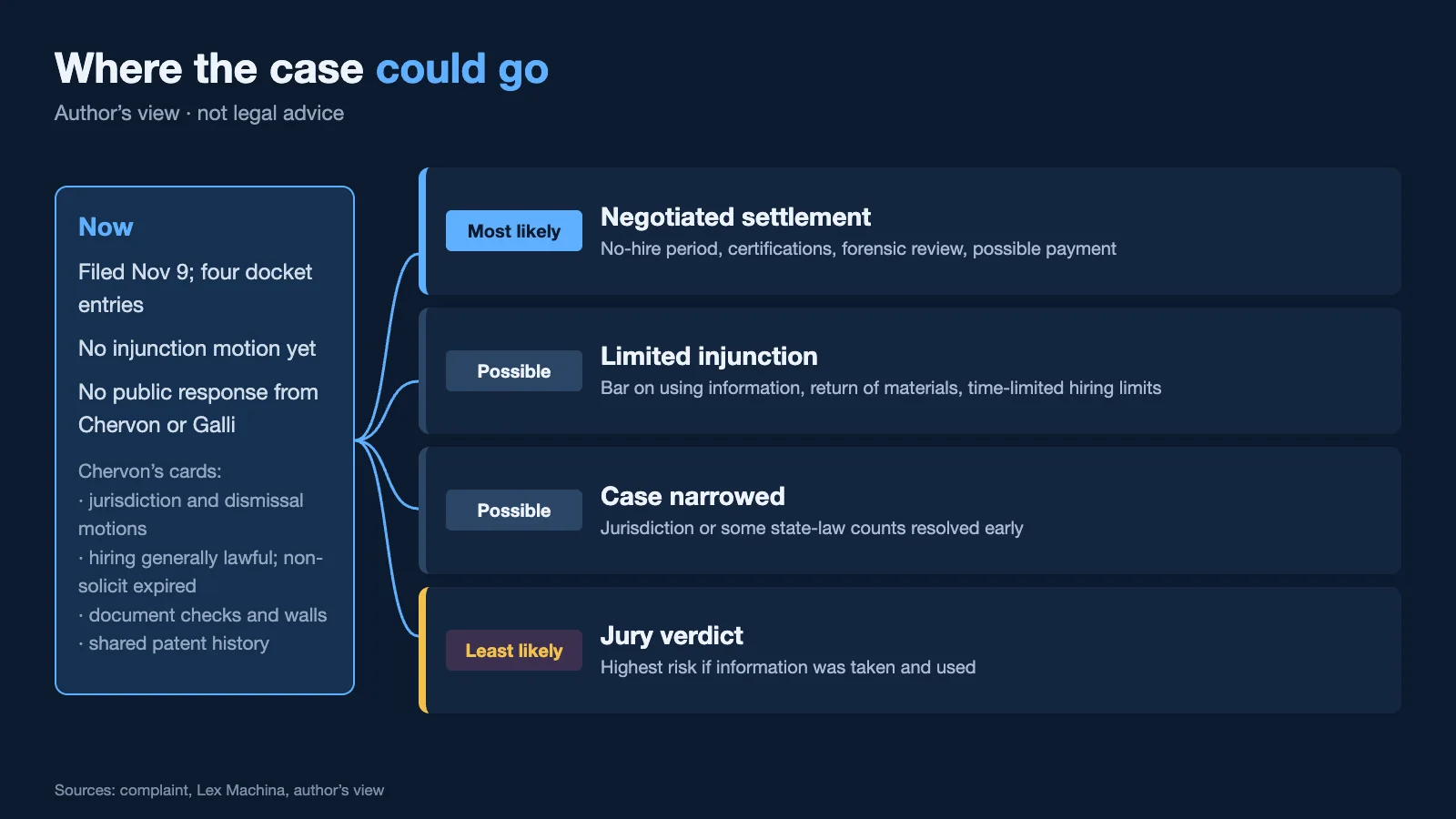
A negotiated settlement, which I think is most likely. Terms could include a period in which Chervon does not hire from TTI, certifications that new hires took no material, cooperation with forensic review, limits on some employees' duties, and possibly a payment. It could take weeks, as with HP and Hurd, or years, as with Tesla and Rivian.
A limited injunction at an early stage. Given the federal statute, a court is unlikely to bar these people from working at Chervon the way the PepsiCo court did. It is more likely to bar Chervon from using or disclosing TTI's confidential information, require the return of materials, or restrict Chervon, for a period, from soliciting or hiring TTI employees whose covenants have not expired. Abbott's case was handled through a stipulated injunction.
A narrowed case. Jurisdiction over Chervon Holdings or Galli, or some state-law counts, could be resolved early. That would not mean Chervon had won, but it would shift the balance in negotiations.
A jury verdict. This is uncommon. But if discovery showed that information reached Chervon and was used in its business, then with disgorgement and punitive damages on the table the cost could be large, as Waymo and Hytera show. It is the least likely outcome and the riskiest.
Whatever happens, hiring directly from TTI will be much harder for Chervon in the near term. But by the complaint's own count it has already hired at least 30 people, launched its global end-user research group and campus recruiting program, and its most senior hires left TTI more than a year ago. I expect Chervon to keep building FLEX into a professional tool brand, only more slowly.
For TTI, the goal is probably not just damages but to make this stop, and to send a message to its thousands of salespeople: you can leave, but taking material, or doing the same job for a rival while your restrictions still apply, will be pursued.
Three things to watch next: whether TTI moves for a preliminary injunction, how Chervon responds and whether it challenges jurisdiction, and whether more employees are added as defendants.
For the full story of the complaint, see One Text Message and a 'Covert Channel': Inside TTI's Lawsuit Against Chervon and Joe Galli.
Sources: the complaint in Techtronic Industries North America, Inc. et al. v. Chervon North America, Inc. et al., No. 1:26-cv-13942 (N.D. Ill.); 18 U.S.C. § 1836(b)(3)(A)(i); PepsiCo, Inc. v. Redmond, 54 F.3d 1262 (7th Cir. 1995); Motorola Solutions v. Hytera (7th Cir. 2024); public reporting on HP v. Hurd, Waymo v. Uber and Tesla v. Rivian; Lex Machina trade secret litigation reports. Not legal advice.