- Choose between current regional models, not brand names alone: Tineco and Dreame both sell multiple floor-washer architectures with different heat, lay-flat and maintenance systems.
- Compare recovered water, roller condition and edge residue on the same floor rather than treating suction or temperature claims as a complete cleaning result.
- Retailers should evaluate consumables, spare rollers, cleaning solution, local warranty handling and failure diagnosis alongside headline specifications.
In this article 16 sections
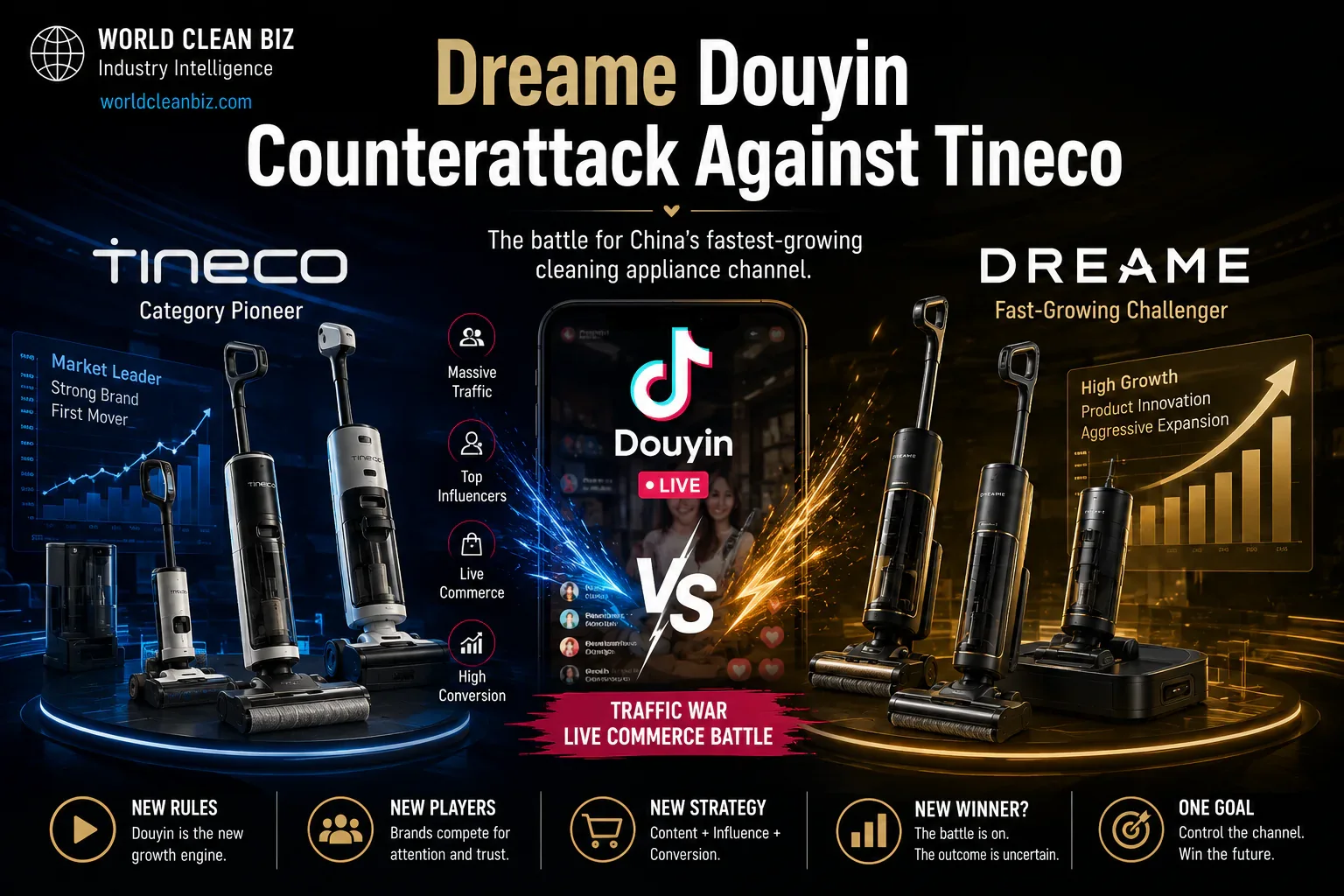
Do not choose between Tineco and Dreame by brand name alone. First match two current models sold in your country at a similar price, then compare the roller and water path, edge reach, lay-flat behavior, self-cleaning process, consumables and local support. Both brands offer strong floor-washer systems, but the best fit depends on which cleaning and maintenance problem matters most.
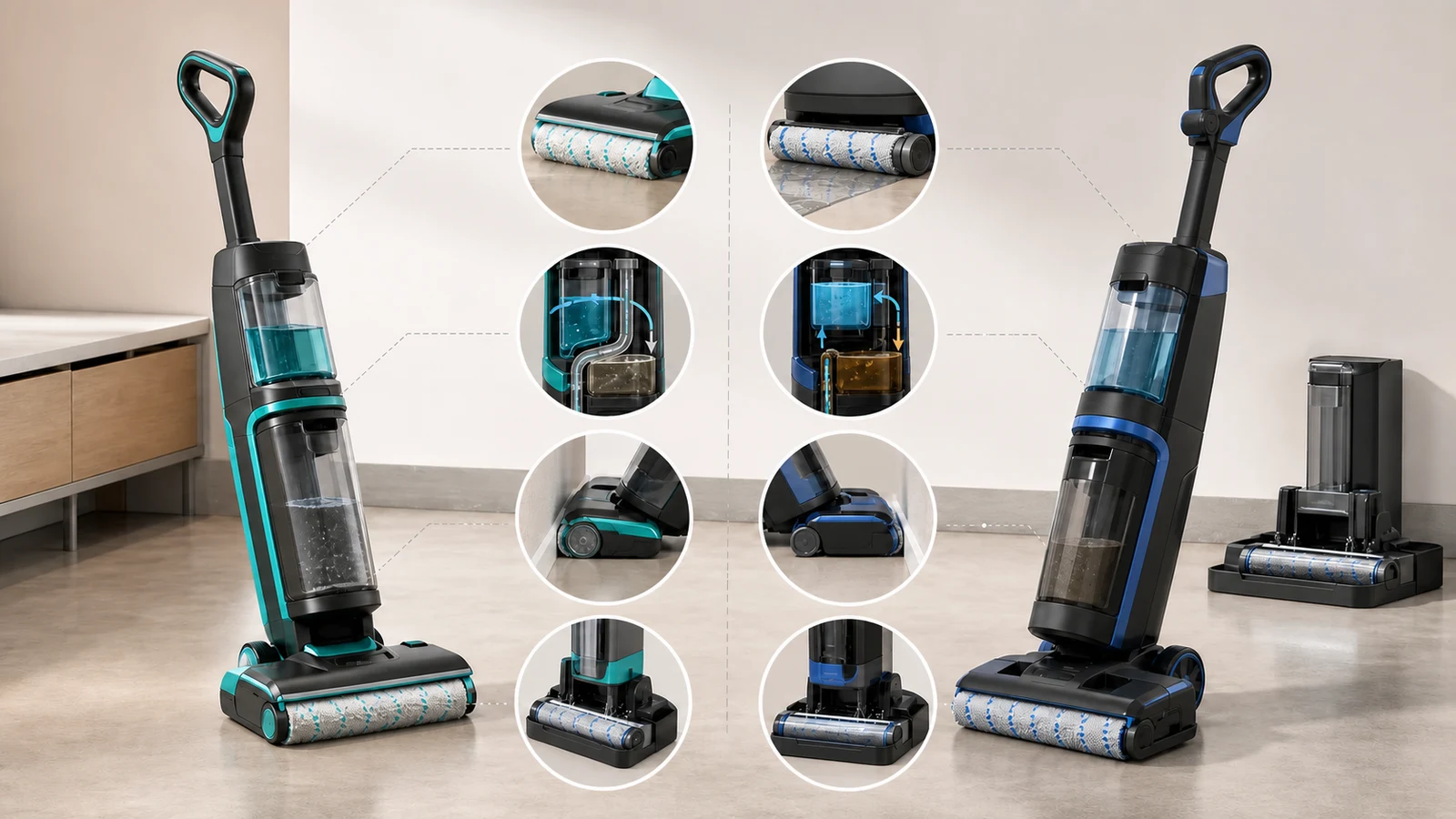
A floor washer is a system, not a suction number. It must apply clean water, agitate the floor, scrape the roller, recover dirty liquid and keep the wet path serviceable after the cleaning session.
Tineco vs Dreame at a Glance
| Decision area | What to examine in Tineco | What to examine in Dreame |
|---|---|---|
| Product range | FLOOR ONE series and exact regional suffix | H-series generation and exact regional suffix |
| Main architecture | Roller washing, scraper contact and MHCBS implementation | Roller rotation, scraper and water-recovery implementation |
| Lay-flat cleaning | Body height and dirty-water separation when reclined | Head height and reduced recovery-tank capacity when reclined |
| Edge reach | Single, dual or triple-sided claim on the exact model | Dual or triple-edge design and any moving edge mechanism |
| Heat | Floor steam, hot wash or base cleaning must be separated | Hot-water floor mode, hot self-wash and drying must be separated |
| Self-cleaning | Roller wash, debris removal and drying cycle | Roller wash, base cleaning and drying cycle |
| Ownership | Roller, filter, solution, battery and service availability | Roller, filter, solution, battery and service availability |
This is a comparison framework, not a declaration that every Tineco or every Dreame follows one design.
Start With the Exact Country and SKU
Product names change by market. A familiar family name can contain:
- a standard washer;
- a lay-flat model;
- a steam model;
- a combination vacuum;
- a premium model with a more complex dock;
- a retailer-specific bundle.
Tineco’s current U.S. support page lists separate S9, S7, S6, S5, S3, i and iFloor families. Dreame also maintains several H-series generations. A comparison that combines specifications from different regions or suffixes can produce a machine that does not actually exist.
Record:
- full model number;
- country and retailer;
- listed accessories;
- warranty owner;
- current price and date;
- replacement roller and filter part numbers.
Use those records before comparing features.
Roller and Water-Path Design Matter More Than One Power Claim
The roller must remain evenly wet without carrying too much dirty water forward. The scraper must remove soil and liquid from the roller without creating excessive drag or hair buildup.
Tineco describes its MHCBS system as continuously washing the roller with fresh water while a scraper removes dirty water. On the FLOOR ONE S7 Stretch, the company also describes a three-chamber dirty-water separation system intended to maintain performance while the body is flat.
Dreame’s H15 Pro describes a dual-rotation self-cleaning action and a heat-resistant brush and scraper. These are architecture claims. They do not replace a floor test.
Run the same test on both machines:
- spread a measured wet soil over a fixed hard-floor area;
- make one forward and one backward pass at normal speed;
- weigh or photograph the remaining residue;
- inspect water left at the turn point;
- inspect the roller ends and scraper;
- measure dirty-water recovery;
- repeat after the filter and roller have been used for several sessions.
The machine that looks stronger in a launch video can lose its advantage when the roller is loaded or the recovery path is partially fouled.
Do Not Compare Suction Numbers as a Complete Result
Tineco lists 22 kPa for the current U.S. FLOOR ONE S7 Stretch Steam. Dreame lists 22,000 Pa for the global H15 Pro Heat.
Those numbers look directly comparable, but floor-washing performance also depends on:
- nozzle sealing;
- roller pressure;
- scraper geometry;
- airflow under liquid load;
- pump delivery;
- travel speed;
- control logic;
- filter condition.
Ask for debris and liquid-recovery results on the same surface. A matched practical test is more useful than two equal-looking peak values.
Edge Cleaning
Edge claims require geometry.
Check the distance from the roller to:
- the left side of the head;
- the right side;
- the front edge;
- the baseboard when the handle is angled;
- an inward corner.
Tineco’s current S7 family includes models advertised with dual- or triple-sided edge cleaning. Dreame’s H15 Pro Heat lists triple-edge cleaning. The terms do not guarantee the same residual strip.
Use flour, fine dust or colored test material along:
- a straight baseboard;
- a cabinet toe-kick;
- an inward corner;
- a table leg;
- a wall approached from both directions.
Photograph the residual width. Also note whether the edge mechanism increases hair entry or makes the head harder to clean.
Lay-Flat Cleaning
Both brands sell machines designed to recline for low furniture. The important measurement is not “180 degrees” by itself.
Measure:
- head height;
- body height at its highest point;
- clearance needed to steer;
- whether dirty water reaches the motor area;
- usable recovery-tank volume when flat;
- cleaning power during a long under-bed pass.
Tineco says the S7 Stretch compresses to 5.1 inches and uses separated dirty-water chambers. Dreame specifies a 400 ml used-water capacity for the H15 Pro Heat when flat, compared with 650 ml when standing. That reduced capacity changes the practical cleaning window.
Test under the actual furniture. A low head is of little value if the tank body or handle joint stops halfway.
Heat and Steam: Separate Four Different Temperatures
Marketing pages can mention high temperatures that refer to different locations:
- heating-module outlet;
- water reaching the roller;
- steam or water reaching the floor;
- base-station self-cleaning or drying.
Tineco’s S7 Stretch Steam is a steam-equipped floor washer. Dreame’s H15 Pro Heat has a hot-water floor mode and hot self-cleaning. These are not identical processes.
Dreame states that the H15 Pro Heat’s heating-module outlet can reach 85°C while the roller can reach up to 55°C under its laboratory conditions. That distinction is essential. A temperature measured inside the machine is not automatically the temperature on the floor.
Before using heat:
- check the flooring manufacturer’s instructions;
- avoid unsealed or heat-sensitive materials unless approved;
- use the specified solution;
- test a hidden area;
- observe joint swelling, haze or finish change.
Heat can improve grease handling, but it also adds energy, seals, controls and failure modes.
Runtime and Tank Capacity
Official maximums are mode-specific.
| Illustrative current model | Maximum runtime claim | Clean tank | Used-water tank | Listed weight |
|---|---|---|---|---|
| Tineco FLOOR ONE S7 Stretch Steam | Up to 80 min normal / 30 min steam | 0.88 L | 0.7 L | 7.8 kg |
| Dreame H15 Pro Heat | Up to 72 min quiet / 20 min hot-water mode | 0.8 L | 0.65 L standing / 0.4 L flat | 6.2 kg |
Sources: Tineco S7 Stretch Steam specifications and Dreame H15 Pro Heat specifications, checked July 27, 2026. These are not necessarily matched-price products in every country.
Runtime is useful only if the tanks and roller remain usable for the same period. During a home trial, record:
- square meters cleaned;
- refills;
- dirty-tank emptying;
- time in high or hot mode;
- battery remaining;
- cleaning interruptions.
Self-Cleaning Does Not Eliminate Manual Cleaning
A dock can wash and dry the roller, but it cannot make all soil disappear.
Inspect after the automated cycle:
- scraper edge;
- roller ends;
- suction inlet;
- hair comb;
- dirty-water lid and float;
- filter;
- dock tray;
- seals and corners.
Run the cycle after a protein spill, hair, fine mud and greasy kitchen soil. Then open the removable parts.
The right question is not whether the machine has self-cleaning. It is how much manual work remains and whether the components are easy to reach.
Maintenance time per week = post-use handling + manual roller and tray cleaning + filter care + periodic descaling or odor treatment
Record this for four weeks. A faster floor pass can be offset by a difficult wet-path cleanup.
Hair Management
Anti-tangle systems usually combine a comb, scraper, roller geometry and airflow. Performance changes with:
- wet versus dry hair;
- strand length;
- pet undercoat;
- thread and fibers;
- roller wear;
- detergent residue.
Test a known mass and length of hair. Count material wrapped on the roller and lodged at each bearing after the full cleaning and self-cleaning cycle.
Do not accept a test that shows only the visible roller surface. Hair often accumulates at the ends.
Weight, Steering and User Effort
Listed weight does not predict pushing force.
Powered wheels can make a heavy washer feel light when moving straight, yet the same machine may be difficult to:
- pull out of a dock;
- turn in a narrow kitchen;
- lift over a threshold;
- carry between floors;
- control when the drive changes direction.
Test with a full clean-water tank and some recovered water. Include the shortest and least-strong intended user.
Consumables and Support
Before choosing either brand, price a two-year service basket:
- rollers;
- filters;
- cleaning solution;
- small cleaning tools;
- dock tray or seals if sold;
- battery service;
- shipping for warranty service.
Tineco and Dreame both provide official support and manuals, but availability differs by country and model generation. A retailer should verify local stock rather than assume that global website coverage equals local parts support.
Ask the seller:
- Who receives the warranty claim?
- Is the machine repaired, replaced or shipped to a central center?
- Which consumables are stocked locally?
- How long will rollers and filters remain available?
- Is the battery replaceable by service?
- Does changing the cleaning solution affect coverage?
Which Brand Should You Choose?
Choose the exact Tineco model when its regional package gives you the better combination of floor-safe cleaning modes, low-furniture access, roller maintenance and local Tineco consumables.
Choose the exact Dreame model when its matched product gives you the better recovery result, useful heat implementation, handling and local Dreame support.
Do not use that rule without a matched SKU test. Product generations move quickly.
For ordinary hard-floor maintenance
Prioritize predictable water recovery, simple cleaning and available rollers over the highest temperature.
For greasy kitchen soil
Test the exact heated or steam mode on the floor finish. Measure residue and drying rather than assuming heat solves every stain.
For hair and pets
Inspect roller ends, scraper and dirty-water separation after wet and dry hair.
For low furniture
Measure the entire body and usable dirty-water volume while flat.
For retailers and distributors
Prioritize failure diagnosis, parts availability, return reasons and training. A feature-rich model with weak local support can create more channel cost than a simpler washer.
Retail and Dealer Evaluation Scorecard
| Area | Weight | Evidence |
|---|---|---|
| Cleaning and recovery | 25% | Matched soil and water-recovery test |
| Roller and hair control | 15% | Roller-end inspection after repeat cycles |
| Edge and low access | 15% | Measured residual and clearance |
| Maintenance | 15% | Four-week handling-time record |
| Reliability | 15% | Leak, clog, sensor and dock-cycle validation |
| Parts and warranty | 15% | Written local service and stock plan |
Adjust the weights to the customer, but require evidence for every score.
Frequently Asked Questions
Is Tineco better than Dreame for floor washing?
Not at brand level. Compare current regional models at a similar price and test cleaning, recovery, maintenance and support.
Which has better edge cleaning?
Both brands offer models with multi-sided edge claims. Measure the residual strip on the exact head because the labels are not a standardized result.
Is hotter cleaning always better?
No. Temperature location, contact time, floor compatibility and recovery matter. Confirm whether a number refers to the module, roller, floor or self-cleaning dock.
Does self-cleaning prevent odor?
It reduces handling when the cycle works well, but the dirty tank, filter, roller ends, scraper and tray still need inspection and drying.
Which is better for retailers?
The model with repeatable performance, lower return risk, available consumables and a clear local warranty process—not necessarily the model with the longest feature list.
Bottom Line
Tineco and Dreame both compete with advanced roller washing, lay-flat bodies, edge systems and automated maintenance. The reliable decision comes from locking the country and SKU, testing the whole wet path and pricing the support system. Compare the work the owner must do after the floor looks clean; that is where many real differences appear.
For broader sourcing context, see the floor washer OEM and ODM guide, the Dyson WashG1 vs Tineco FLOOR ONE comparison, and the Tineco vs BISSELL CrossWave guide.
Explore 2026 new models
From brand to model
Specifications, versions & buying considerations
Floor washersRoborock F25 Ultra Steam Gen 2 ↗Specifications, versions & buying considerations
Floor washersDreame T16 Pro Heat ↗Specifications, versions & buying considerations
Floor washersDreame T16 Pro Steam ↗Specifications, versions & buying considerations
Floor washersRoborock F25 Pro Turbo ↗Specifications, versions & buying considerations
Floor washersTineco FLOOR ONE STATION S9 Scientist Pro ↗Specifications, versions & buying considerations
Floor washersTineco FLOOR ONE i7 Fold ↗Specifications, versions & buying considerations
Floor washersTineco FLOOR ONE S9 Master ↗Specifications, versions & buying considerations