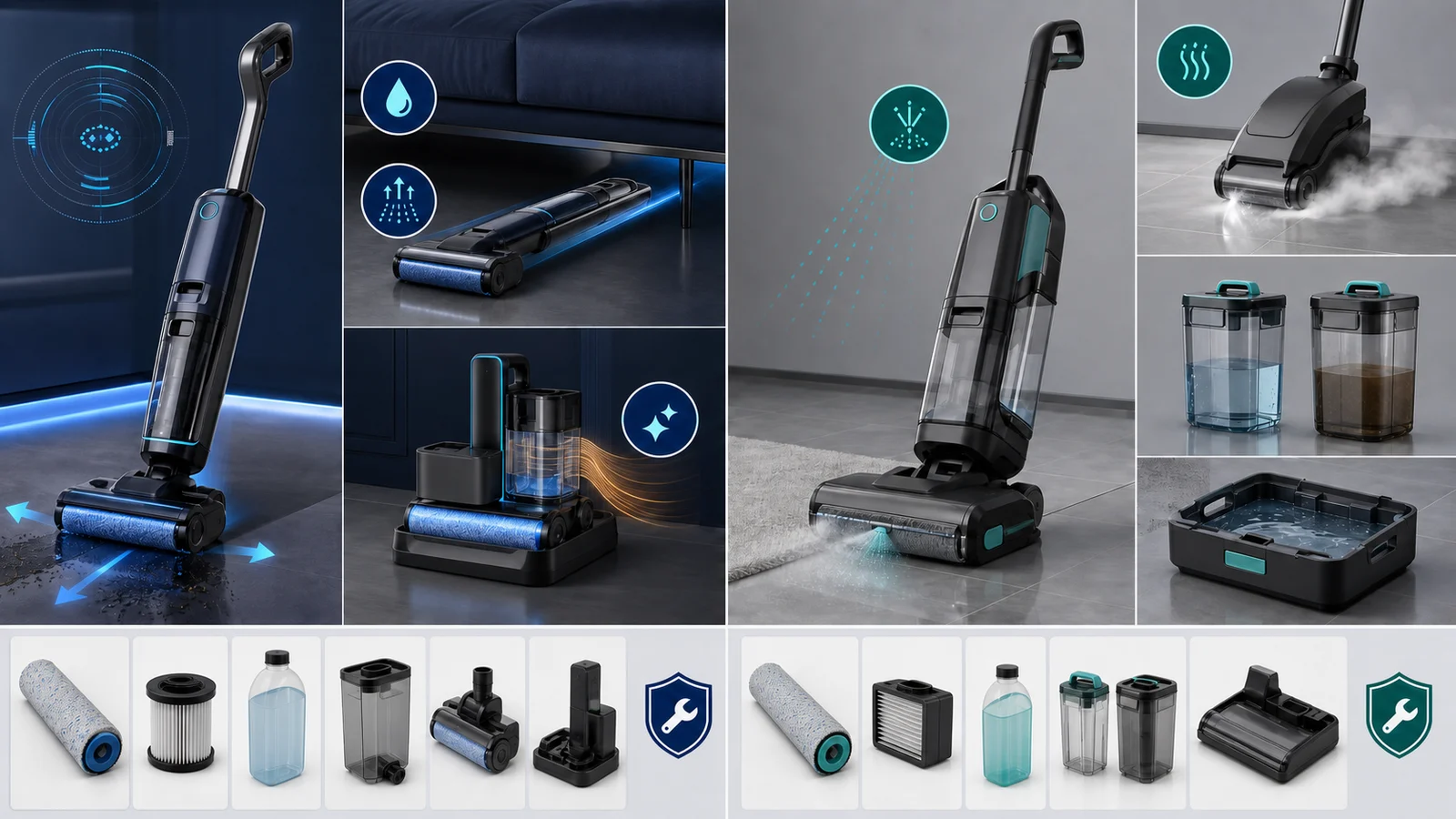
- Tineco's current FLOOR ONE flagships emphasize cordless hard-floor use, sensor-led control, lay-flat access and dock-based hot washing or drying.
- The CrossWave family spans corded and cordless architectures, with selected models supporting area rugs, vacuum-only operation or HydroSteam modes.
- Compare exact model numbers and the full ownership workflow—surface permissions, recovery, roller care, hose or tray cleaning, consumables, warranty and parts—not brand-level feature lists.
In this article 16 sections
Tineco and BISSELL CrossWave do not represent one simple premium-versus-value choice. Current Tineco FLOOR ONE flagships concentrate on cordless sealed-hard-floor washing, sensor-led automation, low-profile access and increasingly elaborate self-cleaning docks. The BISSELL CrossWave range includes both corded and cordless systems, selected area-rug permissions, manual solution control, vacuum-only capability on some models and a distinct HydroSteam route.
The better purchase depends on the exact model, floor mix and tolerance for after-use maintenance. “Tineco” and “CrossWave” are families, not specifications.
Direct Answer: Which System Fits Which Buyer?
Choose a current Tineco FLOOR ONE model when the priority is a refined cordless hard-floor workflow: automatic soil sensing, assisted movement, close edge access, lay-flat cleaning on selected models and dock routines that wash and dry the roller.
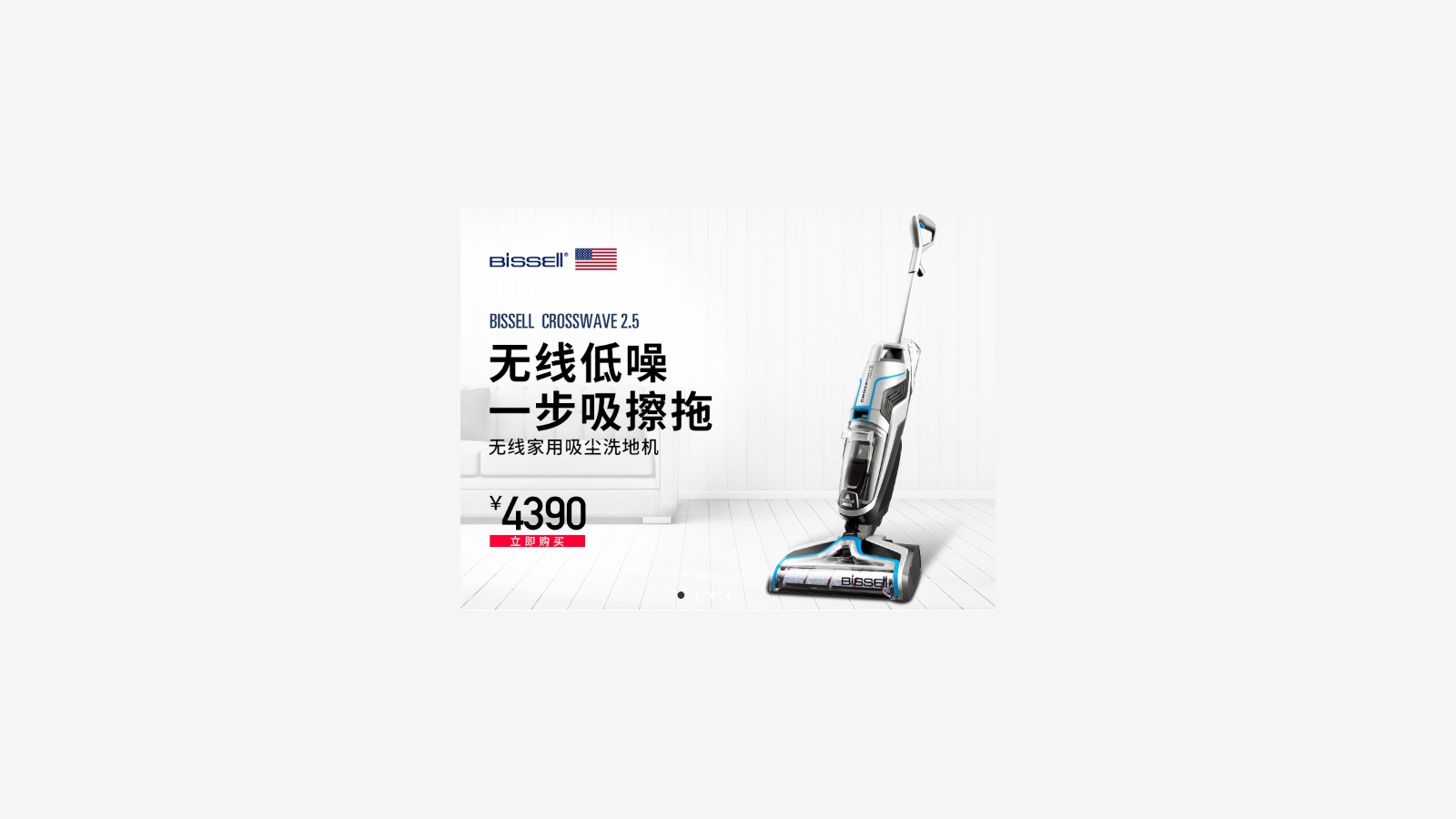
Choose a suitable CrossWave model when the priority is broader format choice. BISSELL offers corded machines for uninterrupted runtime, cordless machines, selected models approved for area rugs, and HydroSteam models for compatible sticky or oily messes. The CrossWave OmniForce Edge also adds a vacuum-only mode, which is useful when dry pickup should not consume solution.
Neither conclusion applies to every model. A buyer should first shortlist a model number, then verify its manual, included tools, local warranty and replacement-parts page.
Current Product Systems Are Not Equivalent
Four official examples show why family-level comparisons can mislead:
- Tineco FLOOR ONE S9 Artist Steam is a 285 W cordless machine with a 0.88 L clean-water tank, 0.75 L dirty-water tank, 180-degree lay-flat body, automatic soil sensing, steam mode and a dock routine stated as five-minute drying with 85°C hot air.
- Tineco FLOOR ONE Stretch S6 is a lighter lay-flat cordless route. Tineco lists a 5.1-inch flat profile, 0.8 L clean-water tank, 0.72 L dirty-water tank and up to 40 minutes of runtime.
- BISSELL CrossWave HydroSteam Plus 35151 is corded, with a 25-foot cord, two tanks, a self-cleaning cycle and modes for hard floors, area rugs and SteamWash.
- BISSELL CrossWave OmniForce Edge 3933 is a 25 V cordless model with up to 30 minutes of runtime, a four-hour charge time, vacuum-only and power-mop modes, and permissions for sealed hard floors and area rugs.
These are reference models, not universal brand definitions. Specifications, bundles and permissions can differ by market.
Traditional CrossWave Logic vs FLOOR ONE Smart Control
The traditional CrossWave interaction is direct: the user selects a surface mode, holds a trigger to dispense solution, moves the machine over the mess, then makes recovery passes. This gives the operator explicit control over where liquid is applied.
Tineco's FLOOR ONE concept adds an optical or electrical soil-sensing loop. The machine reads contamination and adjusts water flow and suction or roller behavior within its control logic. A display or color ring communicates the perceived soil level. This reduces decision-making but also adds sensors, firmware, display hardware and calibration dependencies.
Automation is not the same as cleaning performance. A sensor can improve consistency, yet it cannot compensate for a worn roller, blocked inlet, dirty filter, wrong detergent or poor contact on an uneven floor.
Pickup, Roller Contact, Water and Recovery
Both systems depend on the same physical chain:
- solution reaches the floor or roller;
- the powered roller agitates the soil;
- a scraper or squeegee controls the wet film;
- airflow lifts liquid and debris;
- a separator and dirty-water tank keep liquid away from the fan.
The useful question is not only advertised suction. Recovery depends on inlet geometry, seals, squeegee pressure, roller condition, air-path restriction and machine speed.
For a fair trial, weigh or measure the applied solution and recovered liquid on the same flooring, soil and pass pattern. Inspect residual streaking in side light. Repeat with a partly loaded dirty tank and a used filter. A product that looks strong only with clean parts is not representative of ownership.
Edge Cleaning, Lay-Flat Access and Mobility
Selected Tineco models push rollers and suction inlets close to one or more edges. The S9 Artist Steam lists triple-sided edge cleaning and a 12.85 cm lay-flat height. The Stretch S6 is also designed for low furniture.
Lay-flat is an architecture change, not a hinge claim. When the body reclines, dirty water must remain controlled. Tineco describes a three-chamber dirty-water separation system on the Stretch S6. Buyers should still test backward pulls, turns and near-full tanks under low furniture.
CrossWave models generally use a more conventional upright body. That can be simpler to park and service, but access under low furniture varies. OmniForce Edge emphasizes edge reach and cordless handling; HydroSteam Plus accepts the weight and cord of a steam-capable architecture.
Self-propulsion or powered-wheel assistance can reduce push force, but control feel matters. Test slow edging, quick direction changes and one-handed steering, not only straight showroom passes.
Sensors, Automatic Modes and Displays
Tineco's iLoop system is designed to visualize detected dirt and regulate the cleaning response. It suits households that want fewer manual decisions and a stronger feedback loop.
BISSELL's cited CrossWave examples are more mode-led. The operator chooses hard floor, area rug, SteamWash, vacuum or power-mop behavior depending on the machine.
For procurement, evaluate:
- how the sensor responds to clear liquids, dark liquids and dry debris;
- whether automatic dosing over-wets easy soil;
- whether error messages identify a recoverable cause;
- whether the machine remains useful if an app or voice prompt is unavailable;
- whether firmware or calibration can be serviced locally.
A richer interface raises perceived value, but every added control layer needs diagnostics and support documentation.
Self-Cleaning, Hot Washing, Drying and Hygiene
Self-cleaning means the machine rotates and rinses parts of the brush path while docked. It does not mean the entire wet system becomes clean or dry without human work.
Tineco's current premium direction combines self-cleaning with hot wash or hot-air drying. On the S9 Artist Steam, Tineco states a five-minute, 85°C hot-air drying routine. That can reduce the time a wet roller remains in an odor-prone state, provided airflow reaches the relevant surfaces.
CrossWave HydroSteam Plus includes a self-clean cycle, while other CrossWave systems use a rinse-and-cleanout tray. The owner still needs to remove hair, rinse components and let them dry.
For either brand, the after-use routine should include:
- emptying and rinsing the dirty-water tank;
- removing solids and hair from the inlet and roller;
- cleaning the filter as instructed;
- rinsing the tray or dock;
- leaving washable parts in the specified drying condition.
Tineco's own support guidance still tells owners to empty the dirty-water tank, maintain sufficient clean water for self-cleaning and clean the brush after use. The presence of a self-clean button does not eliminate those steps.
Steam, Hot Water and Marketing Temperature
Steam features are model-specific. Do not infer that every Tineco or CrossWave produces steam.
Tineco describes the S9 Artist Steam as using HyperSteam. Its product page states that the advertised 320°F figure refers to internal heater output, not outlet steam temperature. That caveat is important: heater temperature, delivered temperature and floor-contact temperature are different measurements.
BISSELL's CrossWave HydroSteam Plus combines vacuuming, washing and steam in a corded platform. BISSELL's use instructions separate SteamWash, Area Rug and Hard Floor modes. This is also a reminder to match mode to surface.
Steam can help loosen certain sticky or oily soils, but it adds power, heater, temperature-control, scaling and surface-compatibility requirements. Follow the flooring manufacturer's instructions; heat and moisture can damage unsuitable floors or finishes.
Sealed Floors, Area Rugs and Pet Messes
Current Tineco FLOOR ONE support commonly limits use to non-carpeted sealed floors such as vinyl, tile and sealed wood. The machine normally expects water in wet-cleaning modes and should not be treated as a general carpet vacuum.
Selected CrossWave models explicitly include area rugs in their surface list. That can be valuable in mixed-floor homes, but it does not turn the product into a full-size carpet extractor. Rug construction, dye stability, backing and drying conditions still matter.
For pet homes, test more than colored water. Use representative hair lengths, food particles and approved artificial soils. Inspect the separator, comb, roller ends, inlet and tank corners. Odor control depends more on complete soil removal and drying than on a “pet” label.
Solution, Rollers, Filters and Consumables
Both brands specify compatible cleaning formulas. Unapproved detergents can foam, attack seals, leave residue or interfere with liquid separation. A procurement decision should include formula cost and availability, not only machine price.
Check the local store for:
- main brush rollers and any hard-floor or area-rug variants;
- filters and screens;
- cleaning solution;
- dirty-tank seals, caps and floats;
- clean-water tank valves;
- trays, docks, adapters and charging parts.
Also record the replacement procedure. A low-cost roller is less useful if it is out of stock or tied to a model-specific dock assembly.
Weight, Runtime, Cord and Handling
Cordless machines trade unlimited connection time for battery aging and charging. Tineco lists up to 75 minutes for the S9 Artist Steam in a stated lay-flat Auto-mode condition, but 30 minutes in steam mode. The Stretch S6 is listed at up to 40 minutes. Runtime claims therefore require mode and test-condition context.
BISSELL's CrossWave HydroSteam Plus avoids battery limits but adds cord management. OmniForce Edge lists up to 30 minutes and a four-hour charge time.
Tank capacity also changes handling. A larger clean-water tank reduces refills but increases carried mass. Compare:
- ready-to-use weight with water;
- handle force at normal recline;
- turning radius;
- push and pull force on wet roller;
- stair carrying;
- parking stability;
- cord or charger storage.
Noise should be assessed across cleaning, self-cleaning and drying. A short cleaning cycle followed by a loud dock routine can matter in apartments.
Warranty, Repair, Parts and Channel
Tineco's cited S9 support page states a two-year warranty for household use. BISSELL lists two-year coverage for the cited OmniForce Edge and HydroSteam Plus examples in the applicable U.S. channel. Other models and markets differ.
Warranty duration alone is a weak service metric. Before purchase, verify:
- who sold the machine and who accepts the claim;
- whether battery, dock and accessories have the same coverage;
- whether local parts pages list the exact model number;
- whether shipping a wet appliance is required;
- whether a replacement rather than repair ends support for the original serial number;
- how long filters, rollers, tanks and seals are expected to remain available.
BISSELL's official support pages expose model-specific troubleshooting and spare parts for issues such as spray, suction, leaks and brush rolls. Tineco also provides model support, FAQs and product-care resources. The quality of local execution matters more than the existence of a global support page.
Verification Table
| Decision factor | Tineco reference | BISSELL CrossWave reference | What to verify |
|---|---|---|---|
| Primary architecture | Cordless smart hard-floor washer | Corded or cordless multi-surface family | Exact model and local manual |
| Surface scope | Sealed hard floors on cited FLOOR ONE models | Sealed hard floors; area rugs on selected models | Floor/rug manufacturer permission |
| Liquid control | Sensor-led automatic adjustment | Mode and trigger-led control on cited models | Applied and recovered water |
| Low access | Lay-flat on S9 Artist Steam and Stretch S6 | Model dependent | Height, turns and near-full tank |
| Heat | Steam on selected S9; hot-air dock drying | HydroSteam on selected CrossWave | Delivered temperature and surface safety |
| After-use care | Dock self-cleaning/drying plus manual tank and brush care | Self-clean cycle or rinse tray plus manual care | Hair, residue, odor and drying |
| Runtime | Mode-dependent cordless claims | Corded unlimited connection or model-specific battery | Real floor plan and mode |
| Service | Model/market-specific warranty and parts | Model/market-specific warranty and parts | Seller, serial, stocked parts |
Conclusions
Tineco's strongest proposition is an integrated smart hard-floor experience: cordless movement, sensor-led control, low-profile access on selected models and increasingly automated dock hygiene.
BISSELL CrossWave's strongest proposition is architectural breadth: mature wet-dry roller logic, corded and cordless choices, selected area-rug capability, vacuum-only operation on OmniForce Edge and steam on HydroSteam models.
For retailers and suppliers, the comparison also shows two valid product strategies. One builds differentiation through sensors, motion assistance and dock automation. The other builds a family around surface modes, tools, price points and a recognizable cleaning method. Both still depend on the fundamentals of roller contact, water distribution, recovery and maintainability.
For brand and company context, see Who Owns Tineco? and Who Owns BISSELL?. For the underlying product logic, read How BISSELL CrossWave Changed Hard-Floor Cleaning and the Hard-Floor Washer Market Guide.
FAQ
Is Tineco better than BISSELL CrossWave?
Not universally. Tineco is compelling for a smart cordless sealed-floor workflow; CrossWave offers more format and surface variety. Compare exact models and local support.
Can Tineco FLOOR ONE clean area rugs?
The cited FLOOR ONE support guidance is for non-carpeted sealed floors. Do not use a model on rugs unless its exact manual explicitly permits it.
Can BISSELL CrossWave vacuum without water?
Some models can. CrossWave OmniForce Edge has a vacuum-only mode. Do not assume older or different CrossWave models work the same way.
Does self-cleaning mean the roller never needs removal?
No. Both systems still require tank emptying and periodic roller, inlet, filter and tray or dock care.
Which is better for sticky kitchen messes?
A steam-capable Tineco or CrossWave can help on compatible sealed floors, but delivered heat, detergent, agitation and recovery all matter. Verify floor compatibility first.
Which has better parts support?
It depends on country, seller and model age. Check the exact model's official parts page before buying rather than assuming from brand size.
Source Note
Specifications were checked against official U.S. product and support pages for Tineco FLOOR ONE S9 Artist Steam, Tineco FLOOR ONE Stretch S6, BISSELL CrossWave HydroSteam Plus 35151, BISSELL CrossWave OmniForce Edge 3933 and related support pages on July 25, 2026. Local configurations can change.
Explore 2026 new models