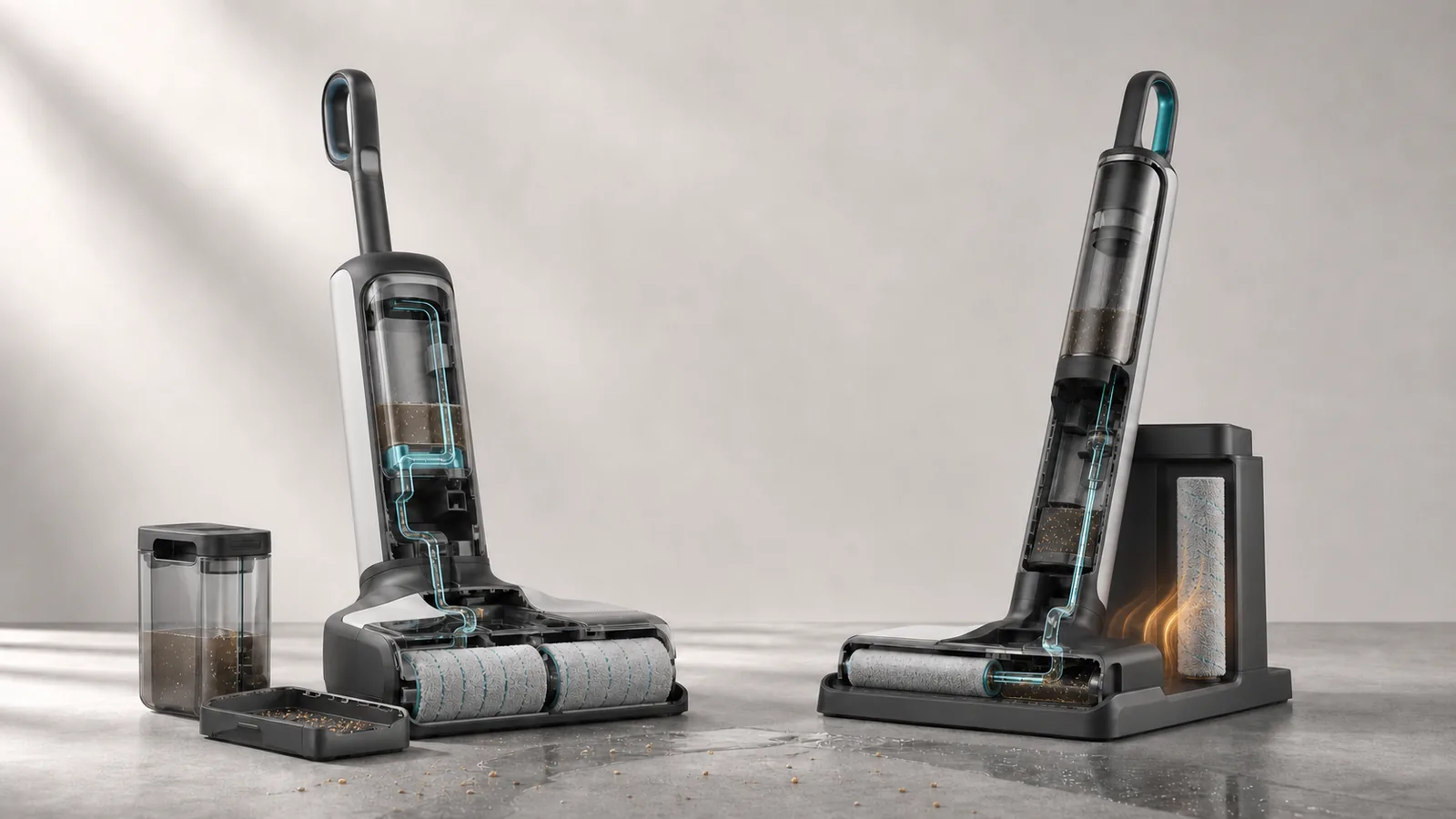
- WashG1 uses two counter-rotating absorbent rollers and separates large debris at the cleaner head without a vacuum motor; Floor One uses a wet-dry vacuum path with roller, scraper and dirty-water filtration.
- Choose WashG1 for simple solid-liquid disposal and full-width two-direction rolling; choose a matched Floor One for lay-flat reach, smart flow control, steam or hot-air drying.
- Self-clean cycles do not replace washing and drying rollers, tanks, trays, filters and debris channels after use.
In this article 15 sections
Choose Dyson WashG1 when you want a dedicated hard-floor cleaner that uses two absorbent rollers, keeps larger solids in a removable head tray and avoids a vacuum-motor air path. Choose Tineco Floor One when lay-flat reach, smart dirt sensing, steam, suction-only modes or heated brush drying are more important. The decisive difference is architecture, not a single suction number.
WashG1 and Floor One both collect wet and dry household messes from sealed hard floors. Inside, however, they move water, air and debris in fundamentally different ways.
WashG1 vs Floor One: Quick Answer
| Decision | Dyson WashG1 | Tineco Floor One family |
|---|---|---|
| Pickup principle | Counter-rotating absorbent rollers; extraction pump moves dirty liquid | Roller and scraper plus wet-dry vacuum airflow |
| Large solids | Debris brush bars move solids into removable head tray | Solids travel through recovery path to dirty tank/filter area |
| Roller layout | Two full-width motorized microfiber rollers | Usually one powered brush roller by model |
| Water control | Three hydration levels plus MAX | iLoop/Auto and Max controls vary by model |
| Low furniture | Conventional upright range | Stretch and Artist models can recline 180° to about 5.1 in profile |
| Steam | No | Selected S7/S9 Steam models |
| Drying | Self-clean, then rollers need manual drying | Selected FlashDry docks add heated brush drying |
| Warranty headline | Two-year US limited warranty | Two-year authorized-retailer household warranty on cited models |
This is a system comparison, not a laboratory pickup test. Tineco’s Pa or air-watt figures cannot directly rank a non-vacuum WashG1.
Two Different Cleaning Architectures
Dyson: hydrate, absorb, separate and pump
Dyson WashG1 uses two motorized microfiber rollers rotating in opposite directions. Water hydrates the rollers, which absorb spills and fine contamination. Separate debris brush bars remove larger solids and hair from the rollers into a removable tray. Dirty liquid is pumped into its own tank.
Dyson explicitly positions the machine as working without vacuum suction. The company argues that avoiding a vacuum motor also avoids exhausting air from the dirty-water path back into the room.
Tineco: wash and vacuum
Floor One machines use a powered roller, scraper and wet-dry suction path. Fresh solution washes the roller, the scraper removes dirty liquid, and vacuum airflow carries recovered material to the dirty-water tank. A dry filter and debris channel are part of the maintenance system.
Tineco’s MHCBS and iLoop functions vary by model. They can continuously refresh the roller and adjust water, solution or power response to detected soil. Stretch models use a multi-chamber dirty-water design so the recovery path continues working while laid flat.
Neither architecture is universally superior. The right one depends on the debris mix and how the user wants to clean the machine afterwards.
Wet and Dry Debris
Both brands state that pre-vacuuming is not necessary for ordinary hard-floor debris. That does not mean every object should enter the cleaner.
Remove:
- coins, glass and sharp fragments;
- long cords and ribbon;
- large food pieces that can block a tray or channel;
- grease volumes beyond household spills;
- plaster, ash or construction dust;
- pet waste requiring a controlled sanitation process.
WashG1’s tray is a clear advantage when the floor regularly contains cereal, hair or leaves: large material can be tipped into a bin instead of poured through a sink strainer with wastewater.
Floor One’s vacuum path can create strong pickup at the nozzle and supports a conventional wet-dry format. The trade-off is that hair and solids meet the scraper, debris channel, dirty tank and filter. Newer anti-tangle and three-chamber designs reduce problems but do not eliminate cleaning.
Roller Contact and Scrubbing
WashG1’s two rollers cover the head width and clean in both travel directions. Because each roller has its own motor, the machine can create balanced forward and backward contact. Dyson offers three hydration levels and MAX for more water on stubborn soil.
Floor One generally uses one brush roller against a scraper. Tineco says MHCBS continuously washes the roller with fresh water. Premium models add DualBlock combing, edge improvements, steam or higher-temperature self-cleaning.
Compare:
- dried-food removal after one and two passes;
- wet pickup without pushing a wave ahead;
- fine debris left at the rear edge;
- water left on grout and bevels;
- hair at roller ends;
- forward versus backward cleaning;
- roller access and replacement cost.
More water can loosen soil but lengthen drying and increase risk on sensitive seams. Use the lowest effective setting on sealed wood or laminate.
Solid-Liquid Separation
Dyson’s design separates large dry debris in the cleaner head before liquid reaches the dirty-water tank. This creates two disposal tasks:
- tip solids from the debris tray into a bin;
- pour wastewater from the tank into a suitable drain.
The separation reduces the unpleasant mixture of hair, crumbs and wastewater. It also creates a debris tray, mesh, brush bars and head surfaces that require rinsing.
Tineco keeps the machine closer to a conventional wet-dry vacuum. Some models use a strainer or multi-chamber tank to keep solids and foam away from the motor. Disposal is usually concentrated around the dirty tank, filter and channel.
For pet households, inspect how easily hair can be removed without touching sludge. For food-service-like messes, neither household product should be treated as a commercial sanitation machine.
Edge Reach and Under-Furniture Access
WashG1’s rollers span the width of the head and support edge cleaning across the front and sides of the roller area. Its conventional upright geometry is not designed around fully flat operation.
Tineco Stretch S6/S7 and S9 Artist platforms recline to 180 degrees. Tineco publishes an approximately 5.1-inch laid-flat profile on Stretch models and uses a three-chamber dirty-water system to isolate wastewater from the motor.
Choose a Stretch model if beds, sofas and cabinets have sufficient clearance. Check the complete body and handle arc, not only the head height. A furniture toe-kick may still block the tank or hinge.
Edge claims should be tested on both sides. Roller bearings, covers and drive modules often create a small unwashed strip even when marketing says “edge cleaning.”
Tanks, Runtime and Floor Area
WashG1 has a 27-ounce clean-water tank. Dyson’s launch material claims coverage up to 3,100 square feet under its conditions. That should not be read as guaranteed real-home coverage: water level, stain load, overlap and MAX use change the result.
Tineco tank capacity varies. Examples:
- Stretch S6: 0.8-liter clean and 0.72-liter dirty tanks;
- S7 Stretch Steam: 0.88-liter clean and 0.7-liter dirty tanks;
- S9 Artist Steam: 0.88-liter clean and 0.75-liter dirty tanks.
Runtime claims also vary by steam use, auto response and power mode. Large tanks reduce refills but increase handle or head mass. Test the machine with a full tank, not empty on a retail stand.
Steam or Standard Wet Washing?
WashG1 does not generate steam. It is designed for controlled water hydration and approved hard-floor solution.
Selected Tineco Floor One models add steam:
- S7 Stretch Steam combines lay-flat operation with steam;
- S9 Artist Steam publishes a higher-temperature HyperSteam system and steam runtime separate from normal cleaning.
Steam can help soften oily or dried stains. It can also create risk for unsealed wood, wax, adhesives, heat-sensitive finishes and people near the outlet. Follow the flooring manufacturer’s instructions, not only the appliance compatibility list.
For daily crumbs and footprints, steam may add complexity without enough benefit. Buy it when the stain profile requires heat.
Self-Cleaning Is Not Self-Maintaining
WashG1 runs a docked self-clean cycle of about 140 seconds. Dyson recommends doing this after every use. Tineco’s selected models use FlashDry or multi-step cycles; premium docks may wash the roller in both directions and dry it with heated air.
Both still need manual work.
WashG1 routine
- empty and rinse debris tray and mesh;
- remove hair from debris brush bars;
- empty and rinse dirty tank and float;
- rinse clean tank;
- wash rollers;
- squeeze excess water and dry vertically for at least 24 hours when removed;
- wipe the head and dock tray.
Dyson says the rollers are expected to need replacement at about 25 hours of total use—roughly six months under its stated assumption—and the screen tracks their life.
Floor One routine
- empty and rinse dirty tank after use;
- clean the dry filter and let it fully dry;
- remove hair from roller ends and scraper;
- clear the debris channel;
- run dock self-clean with enough clean water;
- remove and dry the roller if odor persists;
- clean the dock tray and charging contacts.
Tineco support advises cleaning the brush roller after each use. Heated drying reduces retained moisture but cannot remove lodged hair, grease or tank residue.
Odor, Foam and Cleaning Solution
Odor comes from organic residue plus time and moisture.
WashG1’s solid-liquid separation may reduce the mixture entering its dirty tank, but the wet rollers, debris brush bars, tray and mesh remain odor points. Dyson recommends its approved floor solution and warns against bleach or undiluted formulations.
Tineco warns that third-party solutions can create excessive foam, quickly filling the dirty tank and affecting recovery. Use the specified low-foam concentration.
For both:
- never store wastewater;
- rinse immediately after pet or food messes;
- dry components before closed storage;
- inspect seals and filters;
- descale only according to the manual.
More fragrance does not solve biofilm inside a hose, roller or tank.
Parts and Warranty
Dyson’s WashG1 parts page lists rollers, battery, charger and charging dock, although stock can change. Dyson lists a two-year US limited warranty for wet floor cleaners and one year for purchased tools, accessories and spare parts.
Tineco’s parts catalog covers model-specific brushes, filters, cleaning solution, tanks and kits. Current support for cited Floor One models states a two-year limited warranty for authorized-retailer private household use; separately purchased batteries or motorized components can have different terms.
Check:
- authorized seller;
- roller and filter stock;
- battery replacement route;
- tank and scraper availability;
- shipping and repair turnaround;
- household versus commercial-use exclusion.
Which Should You Buy?
Choose WashG1 if:
- solid-liquid separation at the head is a major hygiene preference;
- two full-width counter-rotating rollers fit the floor plan;
- vacuum exhaust from a dirty-water path is undesirable;
- the user accepts tray, brush-bar and roller drying work.
Choose Floor One if:
- low furniture requires a 180-degree Stretch design;
- iLoop automatic response is valuable;
- steam is needed for the actual floor and stain type;
- hot-air roller drying is worth the added dock complexity;
- local Tineco consumables and service are stronger.
Choose neither if:
- floors are unsealed or water-sensitive;
- carpet cleaning is required;
- the site needs commercial sanitation validation;
- users will not empty and dry the machine after each use.
Product-Development Lessons
WashG1 shows how solid-liquid separation can change disposal and eliminate the vacuum air path. Floor One shows how a mature wet-dry platform can add sensing, lay-flat operation, steam, traction and drying.
OEM teams should define:
- debris size and solid path;
- recovery principle and motor protection;
- roller hydration and scraping;
- edge geometry;
- tank sealing and float behavior;
- hair-release access;
- cleaning-solution chemistry;
- self-clean coverage;
- dry time and odor test;
- replacement roller and battery program.
See our floor washer OEM and ODM guide. For adjacent comparisons, read Tineco vs BISSELL CrossWave and Tineco vs Shark HydroVac.
FAQ
Does Dyson WashG1 use suction?
It does not use a conventional vacuum motor for floor pickup. Absorbent rollers collect liquid and fine soil, brush bars separate larger solids, and a pump moves dirty water to the tank.
Does Tineco Floor One vacuum and mop?
Yes. Floor One uses wet-dry vacuum recovery while washing with a powered roller. It should not be used as a waterless dry vacuum unless the exact model explicitly allows that mode.
Which is better for pet hair?
WashG1 keeps larger hair in a head tray; Tineco moves debris through a roller, scraper and recovery system. The better choice depends on how easily the owner can clean the relevant tray, channel, filter and roller ends.
Which reaches farther under furniture?
Tineco Stretch and Artist models are designed for 180-degree lay-flat cleaning. Measure furniture clearance and the full machine profile.
Does self-cleaning prevent odor?
No. It flushes part of the system. Tanks, rollers, filters, trays, brush bars and dock surfaces still need manual cleaning and complete drying.
Can either machine clean carpet?
No. These are dedicated sealed-hard-floor cleaners. Use a suitable carpet extractor or vacuum for carpet and rugs.
Bottom Line
WashG1 is a solid-liquid-separating wet roller machine; Floor One is a sensor-rich wet-dry vacuum platform. Choose the waste path and maintenance routine you prefer, then evaluate reach, steam, drying, parts and warranty. That is a more durable decision than comparing a suction number with a machine that does not use the same pickup principle.
Explore 2026 new models