- Tineco FLOOR ONE S6 emphasizes sensor-led sealed-hard-floor cleaning, automatic response, dual-edge reach and a dock-centered ownership workflow.
- Shark HydroVac MessMaster WD261 adds official area-rug permission, Stain Boost, odor-focused solution and a simpler multi-surface proposition, but its stated cordless runtime is shorter.
- The better system is the one whose surface permissions, water recovery, after-use cleaning, consumables and local parts fit the home—not the one with the longest feature list.
In this article 15 sections
Choose Tineco FLOOR ONE S6 when the priority is sensor-led cordless cleaning on sealed hard floors, close edge reach and a more automated interface. Choose Shark HydroVac MessMaster WD261 when the home also has compatible area rugs and values Stain Boost, odor-focused solution and a clear multi-surface workflow.
That direct answer applies to the reference models in this comparison, not every Tineco or Shark. Tineco sells several FLOOR ONE generations, steam models and lay-flat variants. Shark sells cordless WD261 and corded WD161 HydroVac versions. Always match the model number and regional manual.
Tineco vs Shark HydroVac at a Glance
| Decision | Tineco FLOOR ONE S6 | Shark HydroVac MessMaster WD261 |
|---|---|---|
| Primary surface | Sealed hard floors | Sealed hard floors and compatible area rugs |
| Control approach | iLoop sensor and automatic cleaning response | Multi-surface cleaning with normal and Stain Boost logic |
| Water system | Separate clean and dirty tanks; continuous fresh-water roller washing concept | Separate clean and dirty tanks; hydro-mopping and recovery |
| Edge design | Dual-sided edge cleaning on the cited S6 | Verify edge gap on the exact floor and wall |
| Self-care | Self-clean cycle plus centrifugal drying claim | Continuous brushroll cleaning plus dock rinse cycle |
| Cordless runtime | Manual: about 35 minutes Auto, 28 minutes Max | Product page: 23 minutes |
| Charge time | About 4–5 hours | 4 hours |
| Rug permission | Do not assume; cited FLOOR ONE guidance focuses on non-carpeted sealed floors | Officially lists area-rug surface cleaning |
| Warranty | Commonly two years for household use; confirm channel | Product page lists three years for the unit and two years for parts |
Prices are not included because promotions change. Compare the delivered bundle, formula, spare roller, filter, return policy and warranty provider.
The Shared Floor-Washer Architecture
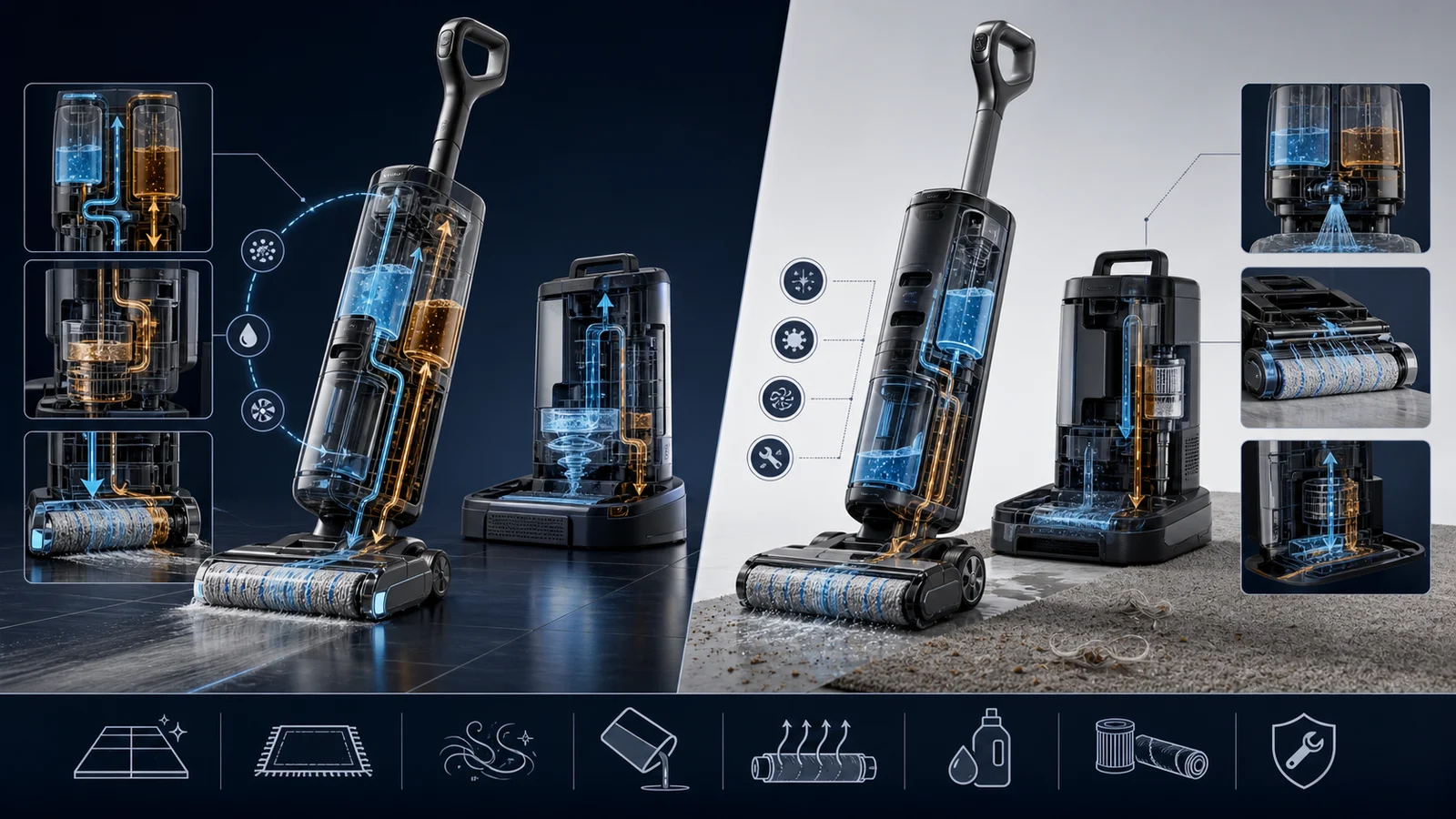
Both products combine four jobs in one pass:
- deliver water and cleaning solution;
- rotate a wet brushroll against the surface;
- pick up loose debris and dirty liquid;
- separate recovered material into a dirty-water tank.
This is different from a cordless stick vacuum, which expects a dry airflow path. It is also different from a carpet extractor, which usually has a spray-and-recovery system designed for deeper textile cleaning.
The comparison therefore depends less on one advertised suction number and more on the entire fluid path:
- how evenly solution reaches the roller;
- whether debris blocks the inlet;
- roller-to-floor contact;
- squeegee and scraper geometry;
- recovered-water separation;
- filter and float behavior;
- cleaning of the roller, tray and dirty tank.
A strong motor cannot compensate for a worn roller, damaged seal or foaming detergent.
Tineco's Sensor-Led FLOOR ONE Approach
Tineco positions FLOOR ONE as a smart hard-floor system. Its official floor-washer overview says iLoop sensing detects messes and adjusts suction and water flow, while the display communicates the response.
The FLOOR ONE S6 product page also describes:
- MHCBS continuous fresh-water cleaning of the roller;
- dual-sided edge cleaning;
- a digital display;
- self-cleaning;
- centrifugal air drying.
The advantage is reduced user decision-making. The machine can increase or reduce its cleaning response instead of asking the operator to manage every spill manually.
The trade-off is system complexity. Sensors, control boards, display logic and error detection add parts that must remain clean and diagnosable. A retailer should test clear liquid, dark liquid, fine dust and mixed debris because not every type of contamination is equally easy to sense.
Shark HydroVac's Multi-Surface Approach
Shark gives HydroVac a direct message: vacuum, mop and self-clean while handling wet and dry messes.
The cordless WD261 product page lists:
- sealed-hard-floor and area-rug use;
- a two-tank system;
- Stain Boost with additional cleaning solution;
- continuous brushroll cleaning;
- a rinse cycle on the dock;
- odor-neutralizing multi-surface concentrate;
- an LED display.
This is attractive for a home where hard floors meet entry rugs or low-pile area rugs. But “cleans area rugs” should not be translated into deep extraction. Test wetness, recovery, backing compatibility, dye stability and drying time. Follow the rug manufacturer's care instructions.
Shark also sells a corded WD161. Its 20-foot cord removes battery runtime from the decision but adds cord handling. That can be a better fit for repeated large-area cleaning.
Wet Messes, Dry Debris and Hair
Both machines are intended to collect wet and dry household messes through a wet-cleaning architecture. Neither should be treated as a substitute for every dry vacuum or shop vacuum.
For dry cereal, pet hair and crumbs, evaluate:
- inlet size;
- whether particles stay suspended in the dirty tank;
- hair accumulation at roller ends;
- separator and screen access;
- how easily solids can be removed without touching dirty water.
For liquid and sticky soil, evaluate:
- solution application;
- number of cleaning and recovery passes;
- residual wetness;
- streaks under side lighting;
- cleaning around grout and texture;
- dirty-water carryover during turns.
Tineco's automatic response may improve consistency when soil changes across a room. Shark's Stain Boost gives the user a direct high-solution option. Neither feature proves superior removal without a controlled test on the same floor and soil.
Sealed Hard Floors and Area Rugs
This is the clearest buying difference.
The cited Tineco FLOOR ONE guidance focuses on non-carpeted sealed surfaces such as tile, vinyl and sealed wood. Do not place the S6 on rugs merely because a retailer calls it a wet-dry vacuum.
Shark explicitly includes area rugs for the WD261. This adds flexibility, but permissions still have limits. Avoid delicate, unstable, hand-dyed or non-colorfast textiles unless their manufacturer allows wet cleaning.
For sealed wood and laminate, ask the flooring manufacturer:
- whether wet roller cleaning is permitted;
- acceptable moisture level;
- restrictions around joints and damaged coatings;
- compatible cleaning chemistry;
- whether heat or steam is prohibited.
The floor warranty has more authority than the appliance's general surface list.
Water Tanks, Runtime and Room Size
The Tineco S6 manual lists approximately:
- 0.8 L clean-water tank;
- 0.7 L dirty-water tank;
- 35 minutes in Auto;
- 28 minutes in Max;
- 4–5 hours to charge.
Shark lists the WD261 at:
- 23 minutes of battery life;
- 4 hours to charge;
- 9.3-inch cleaning path;
- 14.68 pounds.
These numbers do not reveal complete-room productivity. A floor washer can stop because the clean tank is empty or the dirty tank is full before the battery ends.
For a real home, record:
- square feet cleaned per tank;
- number of refills and dirty-tank dumps;
- battery remaining;
- time spent removing hair or debris;
- time spent on the self-clean and manual rinse routine.
If 23 minutes is insufficient, the corded HydroVac is a different Shark architecture. If low furniture is the priority, compare a current Tineco Stretch or other lay-flat model rather than assuming the upright S6 has the same access.
Edge Cleaning and Handling
Tineco makes a specific dual-edge claim for the S6. That can reduce the uncleaned strip beside cabinets and baseboards.
An edge claim should be measured from the active wet roller or suction inlet, not the outer plastic housing. Test:
- right and left edges;
- forward and backward passes;
- toe kicks;
- inside corners;
- wall marks from wet wheels;
- debris pushed into the edge rather than recovered.
Shark does not need to win an edge-specification contest to be the better machine for every room. Steering, parked stability, handle force and rug transition can matter more than a few millimeters beside a wall.
Self-Cleaning Is Not Hands-Free Maintenance
Tineco and Shark both automate part of roller cleaning. Neither empties the dirty tank, removes all hair or guarantees that every wet surface dries without attention.
After each use:
- empty the dirty-water tank;
- remove and dispose of solids;
- rinse the tank, separator and accessible screen;
- inspect the roller ends and inlet;
- run the approved self-clean or rinse cycle;
- clean the tray or dock;
- leave washable parts as the manual instructs;
- check the clean tank before storage.
Tineco's S6 adds centrifugal drying to its dock routine. Shark emphasizes continuous brushroll cleaning and a rinse cycle. The practical question is what remains wet six, twelve and twenty-four hours later.
Odor normally comes from retained organic soil, stagnant water and slow drying. A scented or odor-neutralizing solution cannot replace physical removal.
Antimicrobial Brushroll and Odor Claims
Shark says the WD261 brushroll is treated to resist mold and mildew growth on the brushroll. Shark also states that the treatment does not protect against disease-causing organisms.
That means:
- it is not a disinfecting claim;
- it does not sanitize the floor;
- it does not remove the need to rinse and dry the roller;
- it does not cover the dirty tank, inlet or dock.
Shark's odor-neutralizing concentrate can be useful in pet homes, but the cleaning result should be judged after the fragrance dissipates. Inspect whether the source material was recovered.
Cleaning Solution and Foaming Risk
Both manufacturers specify compatible solution. Substituting dish soap, bleach, essential oil or a high-foam cleaner can create problems:
- foam reaching the separator or filter;
- incorrect full-tank detection;
- seal or plastic damage;
- residue and wheel slip;
- pump or water-path blockage;
- warranty disputes.
Check the dilution ratio on the exact bottle and manual. Include formula cost in annual ownership calculations, especially for frequent pet or kitchen cleaning.
Parts, Warranty and Support
Shark's WD261 page lists replacement brushroll and filter kits, which is useful evidence of a current consumables path. It also lists a three-year warranty for the unit and two years for parts in that US channel.
Tineco provides an extensive manual and product-support index for FLOOR ONE generations. Household warranty language commonly states two years, but coverage must be confirmed for the seller, model and country.
Before purchase, verify:
- exact model number;
- authorized seller;
- proof-of-purchase requirement;
- battery and dock coverage;
- brushroll, filter, tank and seal availability;
- cleaning-solution stock;
- repair versus whole-unit replacement;
- shipping rules for a used wet appliance;
- support after the model leaves retail.
A longer warranty has limited value if the required consumable or tank assembly is unavailable.
Retailer and Distributor Checklist
For a retail assortment, test both products through the full customer journey:
- unboxing and assembly;
- filling without drips;
- dry debris and wet spill pickup;
- sticky soil;
- wall edges;
- hair removal;
- hard-floor and permitted-rug transitions;
- dirty-tank emptying;
- self-cleaning;
- next-day odor and wetness;
- error recovery;
- replacement-part ordering.
Track likely return reasons. Buyers often return floor washers not because they cannot clean, but because they dislike the after-use work, cannot use the product on an expected surface or cannot source formula and rollers.
The floor-washer OEM/ODM guide explains how these differences affect product development. The hard-floor washer market guide provides the broader category and supplier context.
Frequently Asked Questions
Is Tineco better than Shark HydroVac?
Tineco S6 is stronger on sensor-led hard-floor automation and dual-edge positioning. Shark WD261 offers official area-rug use and an odor-focused multi-surface proposition. The better fit depends on surfaces and maintenance preferences.
Can Shark HydroVac clean carpets?
Shark specifies area-rug surface cleaning for WD261. That is not the same as deep-cleaning installed carpet. Follow the textile manufacturer's instructions.
Can Tineco FLOOR ONE S6 clean area rugs?
Do not assume so. The cited Tineco guidance focuses on non-carpeted sealed floors. Use only surfaces permitted by the exact manual.
Which one has longer runtime?
The cited Tineco S6 manual lists about 35 minutes in Auto and 28 minutes in Max. Shark lists 23 minutes for WD261. Real runtime depends on mode, battery condition, tank stops and floor resistance.
Does self-cleaning prevent odor?
It can reduce residue in the brush path, but the owner must still empty and rinse the dirty tank, remove hair and let wet components dry.
Can I use any floor cleaner?
Use the manufacturer-approved formula and dilution. Unapproved products can foam, leave residue or damage the fluid path.
Which warranty is longer?
Shark's US WD261 page lists three years for the unit and two years for parts. Tineco household coverage is commonly two years. Confirm the exact seller, country and exclusions before buying.
Is Tineco owned by Ecovacs?
Tineco and Ecovacs are related through the Qian family and corporate history, but their legal and operating structures require more nuance. See Who Owns Tineco?.
The Bottom Line
Tineco FLOOR ONE S6 and Shark HydroVac MessMaster WD261 share the same basic wet-roller logic, but they package it differently.
Tineco prioritizes automatic soil response, dual-edge hard-floor cleaning and a smarter dock-centered experience. Shark prioritizes an easy-to-understand multi-surface proposition, area-rug permission, Stain Boost and odor-focused consumables.
Choose from the home outward: surface permissions first, then water recovery, runtime, after-use cleaning, solution, spare parts and warranty. That order prevents a long feature list from hiding the ownership work that determines whether a floor washer is used every week or stored after a month.
Explore 2026 new models