- Dyson launched its first self-emptying cordless vacuum in 2026, years after LG and Samsung had adopted the same product direction.
- Supply-chain sources say Xinbao developed the V10 Konical auto-emptying system and is also developing Dyson's new suction floor washer.
- The projects show Chinese suppliers moving from manufacturing execution into product development for an international premium brand.
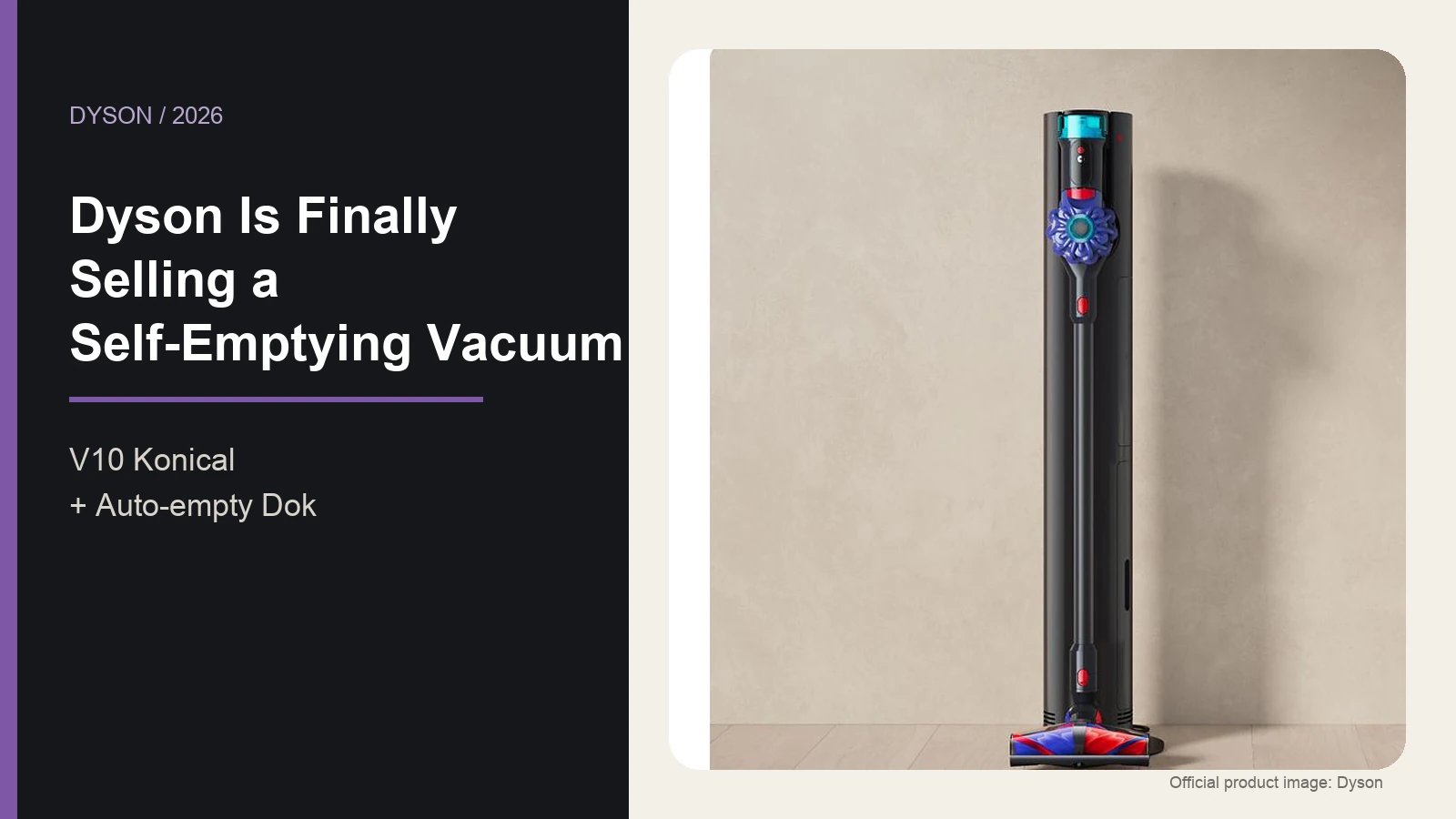
On March 19, 2026, Dyson unveiled its first self-emptying cordless vacuum.
The V10 Konical is still recognizably a Dyson cordless vacuum. The difference comes when the cleaning is done: place it back on the Auto-empty Dok, and the dock pulls the debris out of the bin before recharging the machine. In the US, the vacuum is priced at $499.99 and the dock at $149.99.
Dyson presents auto-emptying as a cleaner, more convenient upgrade. But for the floorcare industry, this is not a new product direction.
LG launched a CordZero cordless vacuum with an All-in-One Tower in 2021. Samsung's Bespoke Jet followed in 2022 with a charging dock that also emptied the dustbin automatically. Across the cleaning appliance supply chain, a group of smaller manufacturers had developed similar systems even earlier.
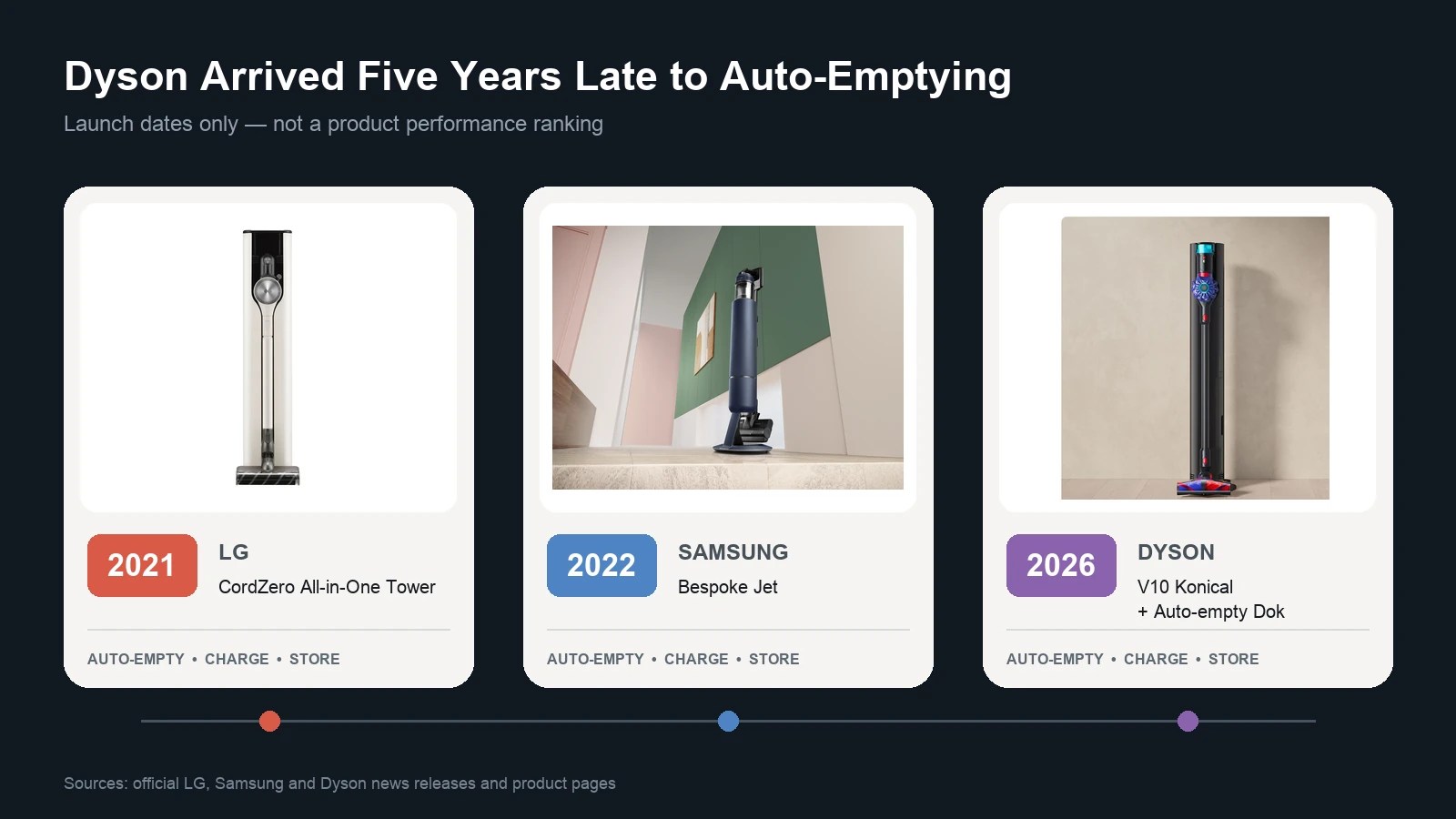
Dyson did not begin selling its first self-emptying cordless vacuum until 2026. Its product roadmap has fallen behind the industry.
Dyson invented the bagless cyclonic vacuum and pioneered the cordless vacuum powered by a digital motor. It led the cleaning industry for an entire era. But Dyson's new products are no longer defined by Dyson alone, and its product roadmap no longer leads the market.
There is another change behind this product that deserves more attention.
According to my supply-chain sources, the actual development partner for the V10 Konical and its auto-emptying system is Guangdong Xinbao Electrical Appliances. Monthly orders for the product have already reached tens of thousands of units.
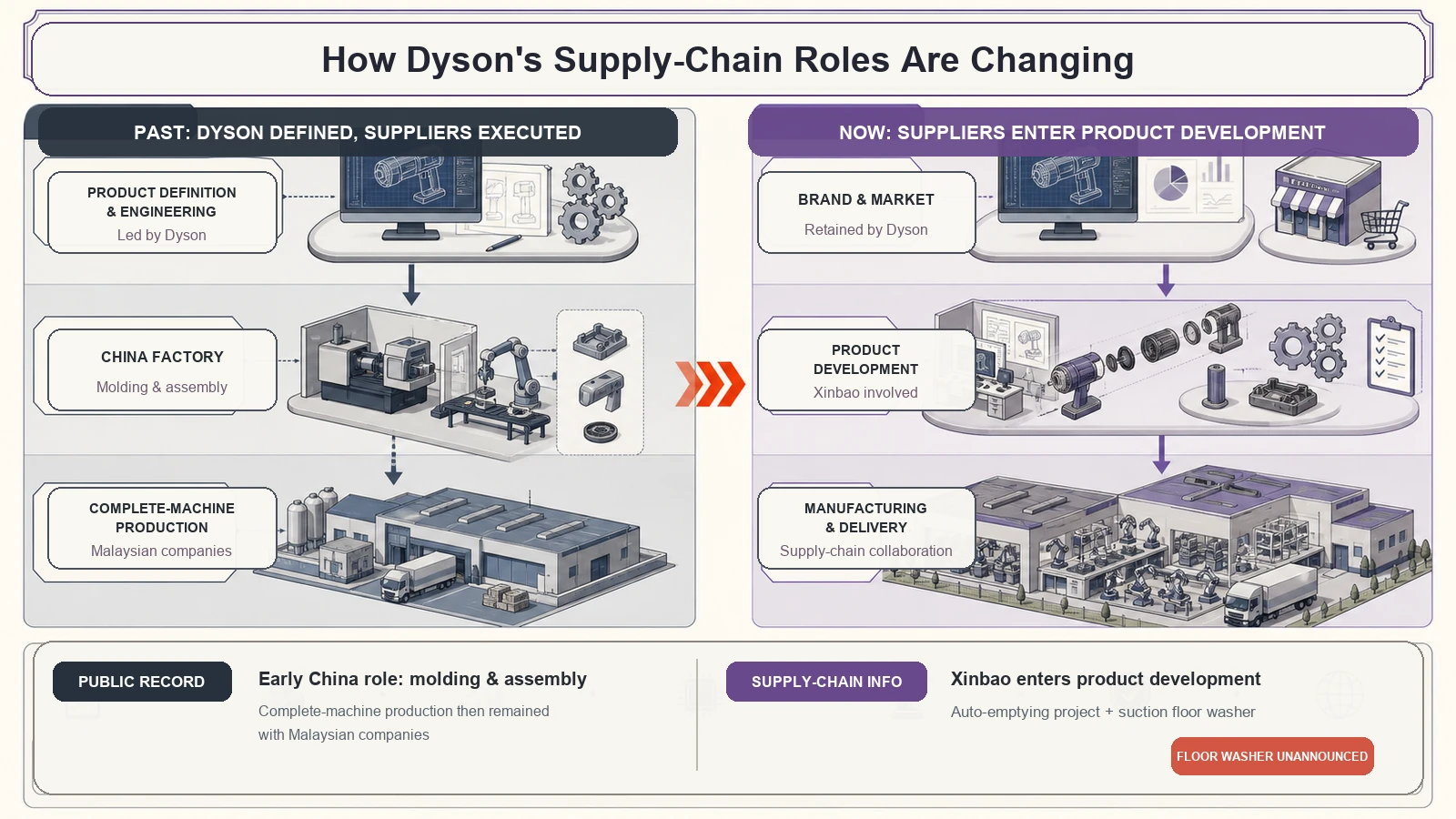
Xinbao is not simply manufacturing a product from Dyson's drawings. It is now participating in product development, crossing a line that Dyson rarely opened to outside suppliers in the past.
Dyson has manufactured vacuum cleaners in China before.
Around 2006, Dyson assigned production of the DC14 to Jiangsu Midea Chunhua. Dyson funded the equipment, moved the molds over from Malaysia and selected the core suppliers. Midea Chunhua was mainly responsible for injection molding and assembly, while British engineers kept the product and production system under Dyson's control.
After that partnership ended, Dyson's complete machines were manufactured for years by local companies in Malaysia. Now, for the first time, a Chinese contract manufacturer has entered a Dyson project as a product developer.
The change is tied to Dyson's product performance over the past several years.
In 2018, Dyson launched the V10 and announced that it would stop developing new corded vacuums. At the time, Dyson could still change the direction of the industry with a single product. It continued to invest in motors, cyclones and sensing technologies and launched multiple new machines, but Dyson's floorcare products have been largely underwhelming since the V10.
The basis of competition in cleaning appliances was changing at the same time. Robot vacuums moved into the all-in-one dock era. Hard floor washers went through several rapid product cycles in China. Cordless vacuums began adding auto-emptying. Dyson continued to focus on the performance of the machine itself while other companies started redesigning everything that happens after the machine is put away.
The V10 Konical is not even built on Dyson's latest flagship platform. Dyson chose a mature machine, added a separate dock and made that dock compatible with the V8 Cyclone as well. It looks more like a lower-risk way to add a feature that the rest of the industry had already made mainstream.
Dyson did not define auto-emptying first, but its brand and retail reach can still turn the product into tens of thousands of units a month. For Xinbao, the value of a project like this goes beyond manufacturing revenue. It also creates an opportunity to enter Dyson's development system for future products.
According to my sources, Dyson is also developing a new hard floor washer, with Xinbao again responsible for development. Unlike the earlier WashG1, the new machine will use vacuum suction.
The WashG1 does not use suction to recover dirty water and debris. Instead, it relies on two rollers and scraper bars to separate them. Dyson once positioned this structure as its differentiated approach. The return of suction in the new product puts Dyson back on the more mainstream technical path used across the hard floor washer industry.
From the self-emptying vacuum to the new hard floor washer, Dyson is finding it increasingly difficult to develop its next generation of floorcare products entirely through its existing internal system. It needs mature solutions from Chinese suppliers, as well as the faster product cycles of China's supply chain.
In the past, Dyson treated suppliers as part of its manufacturing system while keeping core product development firmly in-house. Now it is asking Chinese suppliers to help fill gaps in a product roadmap that has already fallen behind.
That does not diminish the value of the Dyson brand. What is changing is where each side sits in product development. Dyson still controls the brand and the market, while Chinese suppliers are beginning to provide capabilities that once existed only inside Dyson.
Xinbao is involved in developing both the self-emptying vacuum and the new hard floor washer. This is not simply a supplier winning more orders. It is a change in the old division of labor between the brand and its supply chain.
The industry has already moved ahead, and Dyson is now using Chinese suppliers to catch up. The V10 Konical will not redefine the vacuum cleaner, but it could mark the beginning of a shift in Dyson's supply chain.
Handing product development to Xinbao is only the beginning. Dyson and Xinbao still have to redraw the line between them: will Dyson continue to define the products while Xinbao turns them into reality, or will Chinese suppliers also begin to decide the product direction?
Explore 2026 new models
From brand to model
Specifications, versions & buying considerations
Cordless vacuumsNarwal V50 ↗Specifications, versions & buying considerations
Cordless vacuumsNarwal V50 Cube ↗Specifications, versions & buying considerations
Robot vacuumsDyson R1 Nurovi Dry ↗Specifications, versions & buying considerations
Robot vacuumsDyson R2 Nurovi Wash+Dry ↗Specifications, versions & buying considerations