- CameraJet combines a 100,000-pixel camera with automatic targeted rinsing, priced at $499.99 in the US.
- Denny expects CameraJet to remain a niche product, drawing a parallel with the Dyson Zone headphones.
- Dyson's vacuum development is becoming more pragmatic through Chinese supplier partnerships, but CameraJet follows its expensive engineering-led approach.
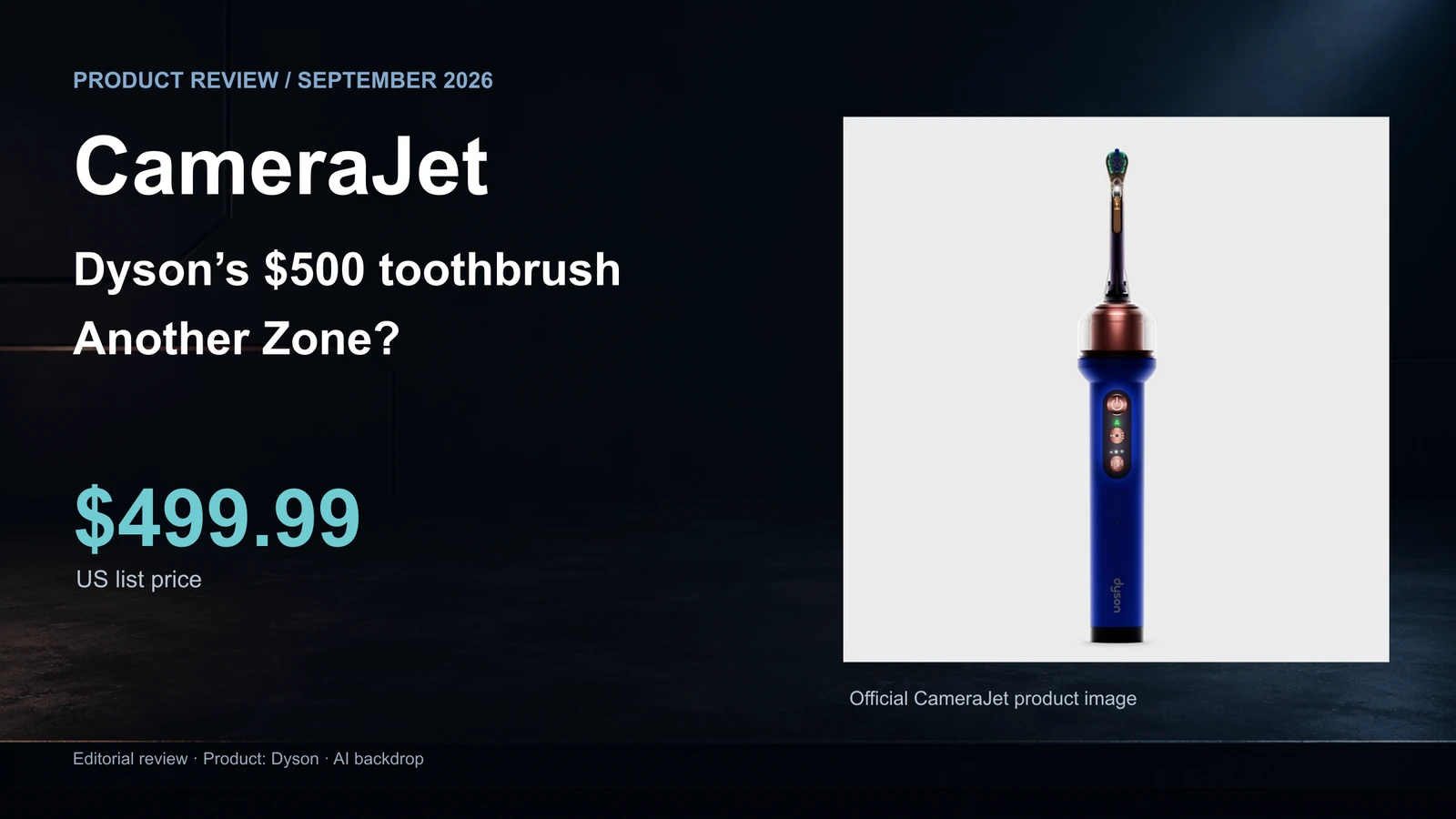
On September 1, Sir James Dyson unveiled CameraJet, Dyson's first electric toothbrush, in Paris. It costs $499.99 in the United States. After six years of development, Dyson has put a camera and an automatic rinsing system into a toothbrush, aiming to clean between teeth while the user brushes.
CameraJet has a 100,000-pixel macro camera that analyzes 28 images per second. Dyson calls its vision system Gap Optical Targeting. As the brush moves, the algorithm looks for gaps between teeth and triggers a burst of liquid. The time from detection to spraying can be as short as 0.1 seconds. During development, Dyson collected 470,000 dental images to train the machine-learning system. Dyson's launch announcement
With a conventional water flosser, the user has to find each gap and aim the nozzle. CameraJet tries to do that automatically during brushing. How well it handles different tooth alignments and the speed at which people move the brush will directly affect the experience.
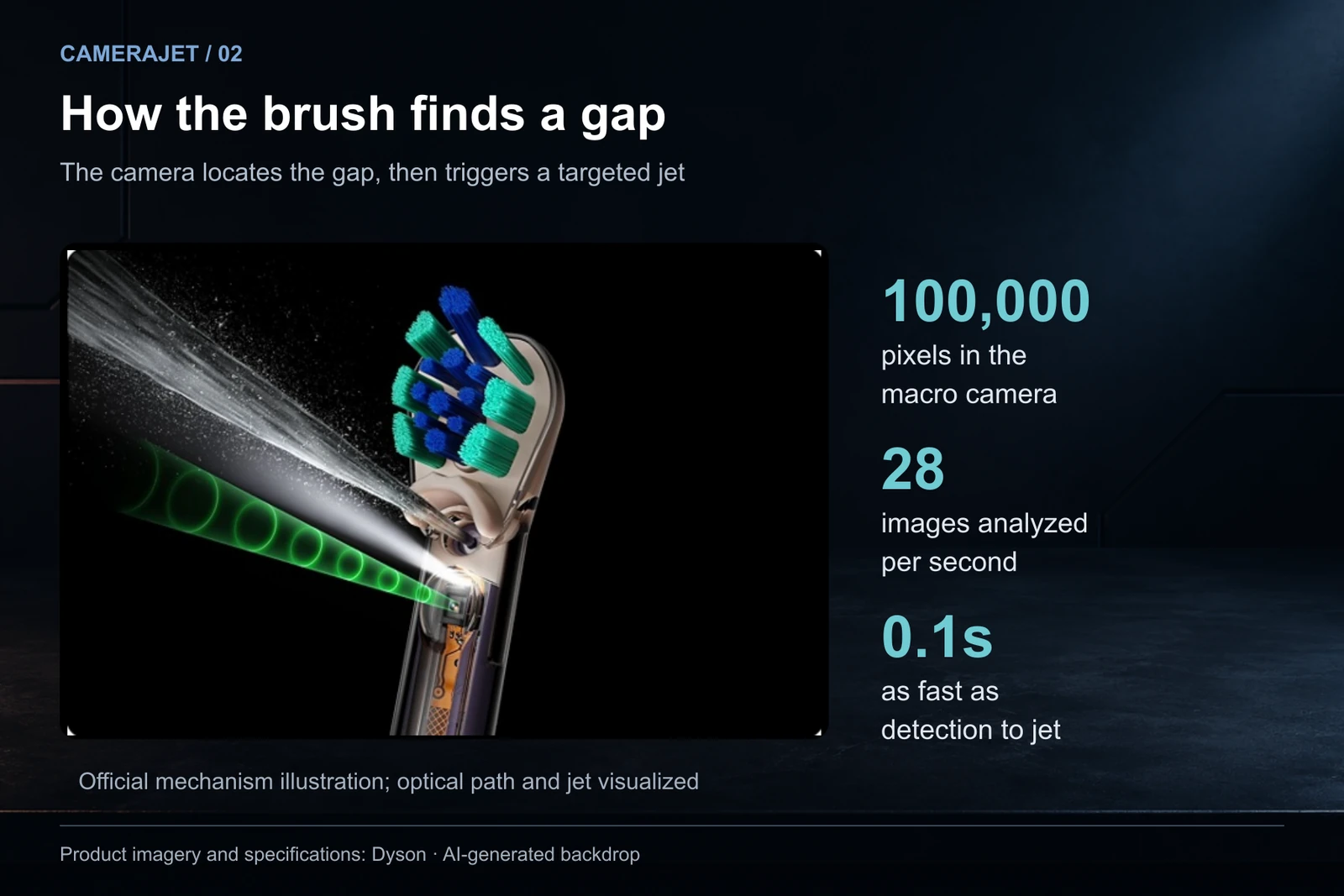
The rinsing system uses a conical jet, delivering up to approximately 0.15 milliliters per burst. Dyson aims to remove plaque with a wider spray pattern. Its comparison of jet performance comes from laboratory testing on simulated plaque.
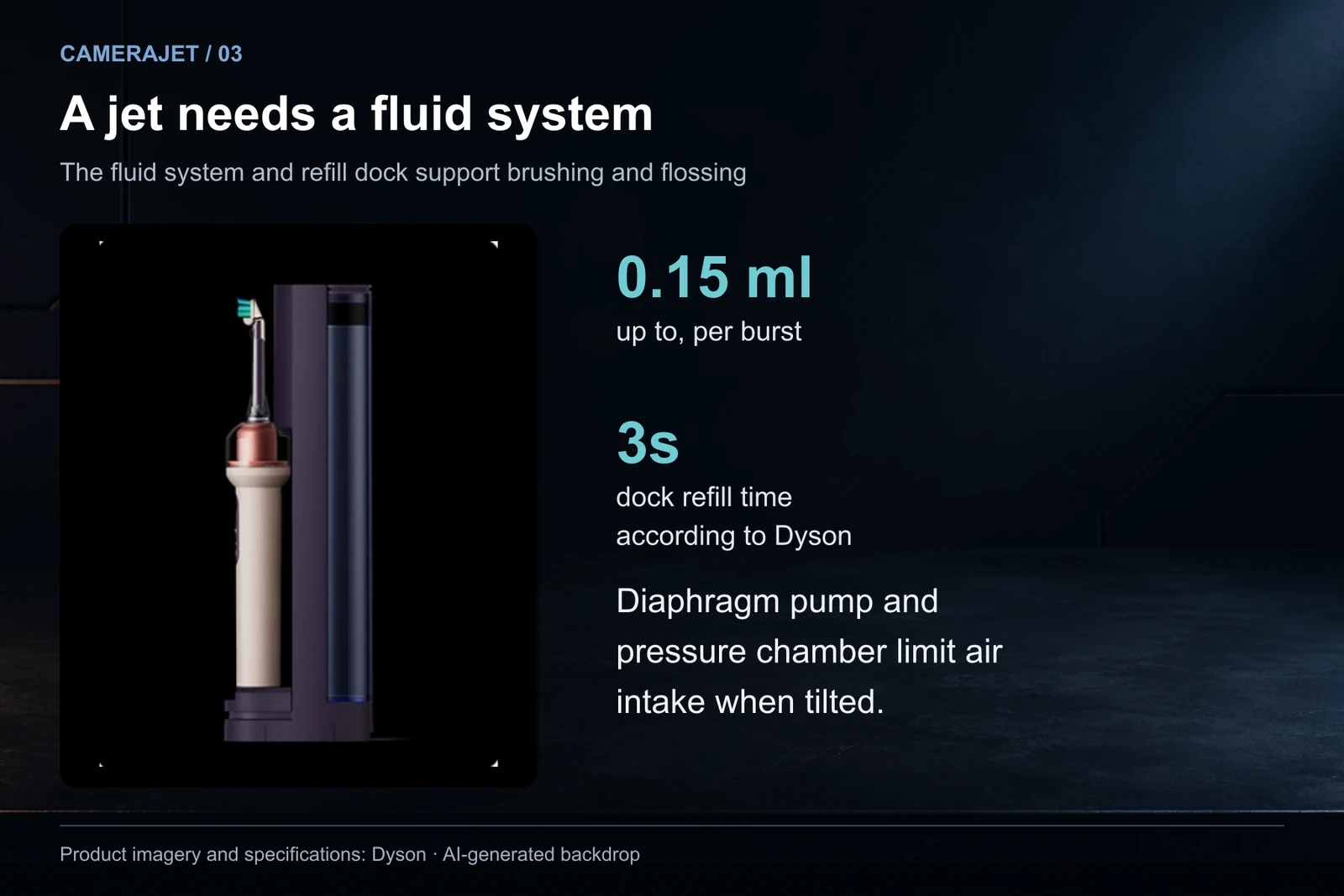
The liquid-delivery system has also been designed for the task. A diaphragm pump and pressure chamber reduce air intake when the toothbrush is tilted, allowing it to keep spraying when held horizontally to clean the inside surfaces of the teeth. The dock both charges and refills the device; Dyson says a button press refills it in three seconds. Dyson's technical explanation
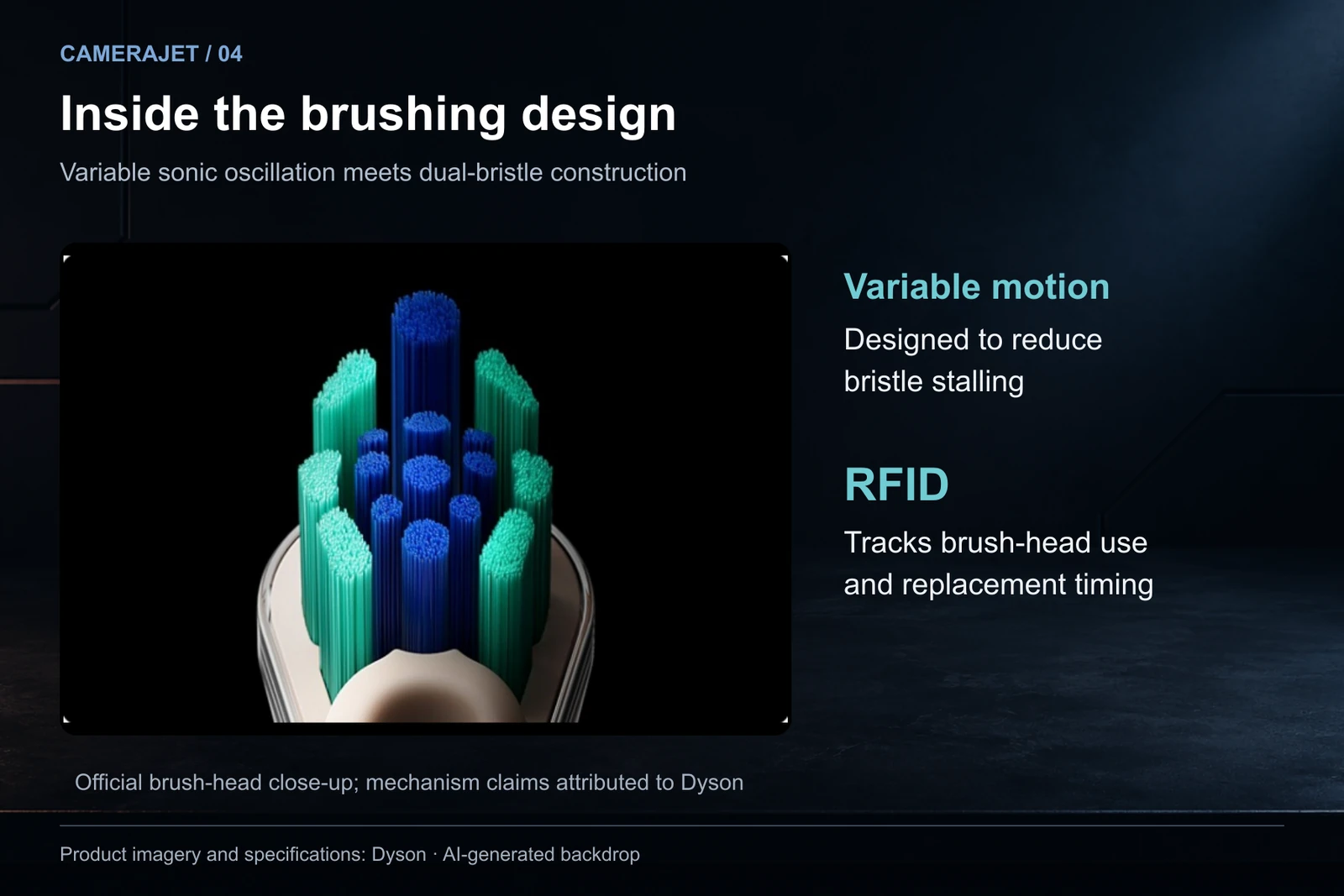
The brushing mechanism uses variable sonic oscillation. Dyson says some bristles on conventional sonic toothbrushes can stop moving when pressed against a tooth, so it changes the oscillation angle to help keep them in motion. The brush head combines bristles of different firmness and uses RFID to track usage and prompt replacement. Dyson's brushing technology
Users can brush and rinse together, or use either function separately. Brushing intensity is adjustable, with feedback when too much pressure is applied. The device has an IPX7 water-resistance rating and a replaceable battery, so battery aging need not mean replacing the entire toothbrush. CameraJet product details
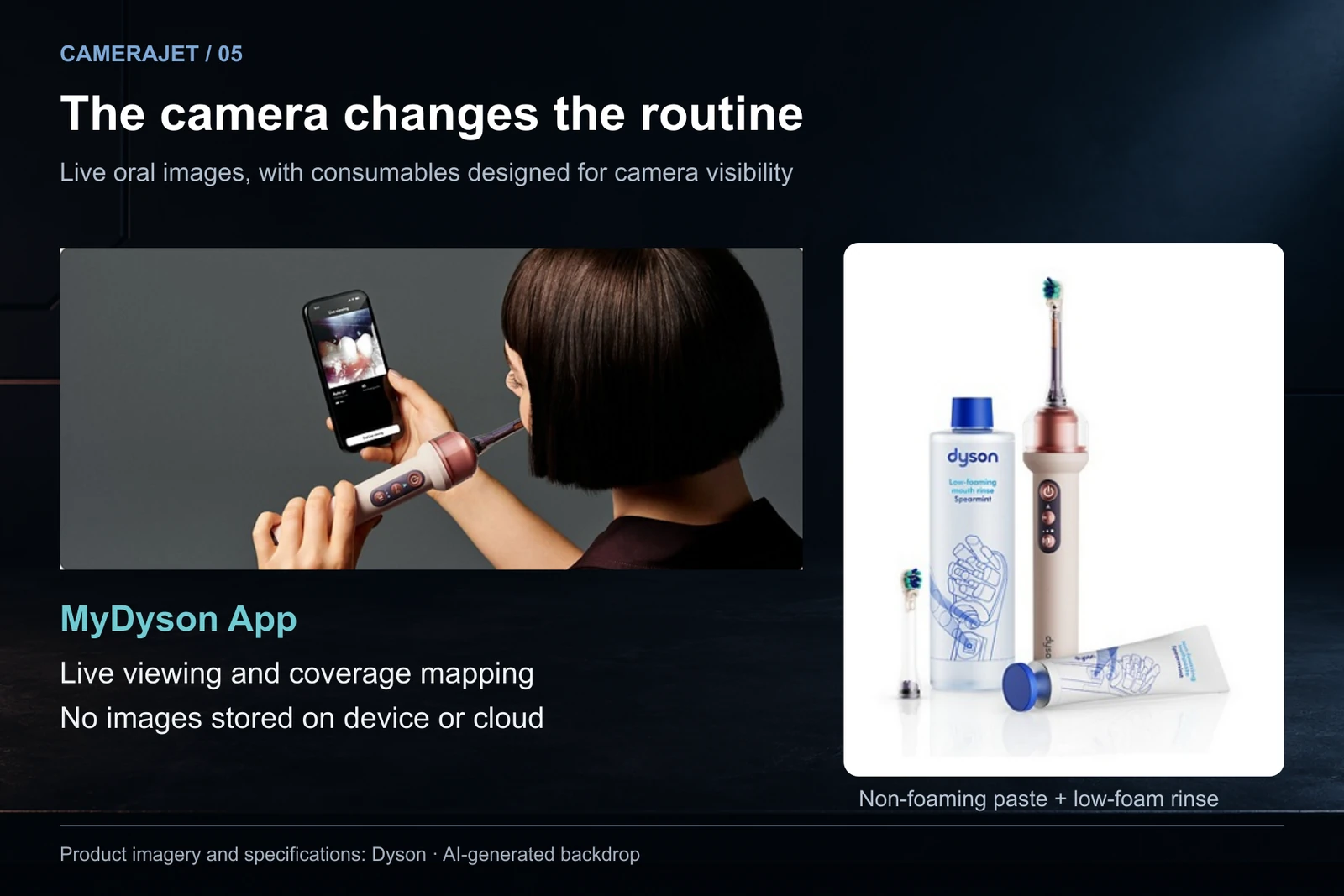
The camera can also stream live oral images to the MyDyson app, where users can check cleaning coverage. Watching the phone is not a required step every time they brush. Dyson says oral images are not stored on the device or in the cloud. Dyson's connectivity information
The camera has even influenced the toothpaste formulation. To reduce foam blocking its view, Dyson developed a non-foaming toothpaste without SLS, a common foaming agent, along with a low-foaming mouthrinse. CameraJet is therefore an oral-care system designed to work with matching consumables, and the cost extends beyond the toothbrush itself. Dyson's consumables
These details show that Dyson has done substantial engineering work. Automatically finding a gap and spraying it is also more meaningful than simply adding a camera to a toothbrush. Even so, I am not optimistic about sales.
Compared with electric toothbrushes already on the market, I do not see a startling improvement in the experience. Brushing and interdental rinsing already have mature solutions. CameraJet combines them at a price 10–20 times that of many mass-market electric toothbrushes. I have yet to see a convincing reason for consumers to pay that much more for the added functions.
It reminds me of the Dyson Zone air-purifying headphones.
Zone combined air purification with headphones. It was a complex engineering project that drew plenty of attention at launch. Yet I have never seen anyone wearing a pair in everyday life. CameraJet will probably be much the same: eye-catching at launch, with relatively few people willing to buy it and keep using it.
Dyson's earlier vacuums and high-speed hair dryers needed much less explanation. Consumers could feel the difference as soon as they used them. Cyclonic separation and high-speed digital motors changed the vacuum cleaner, and Supersonic later helped create the high-speed hair-dryer market. Other companies studied Dyson's products before deciding where to go next.
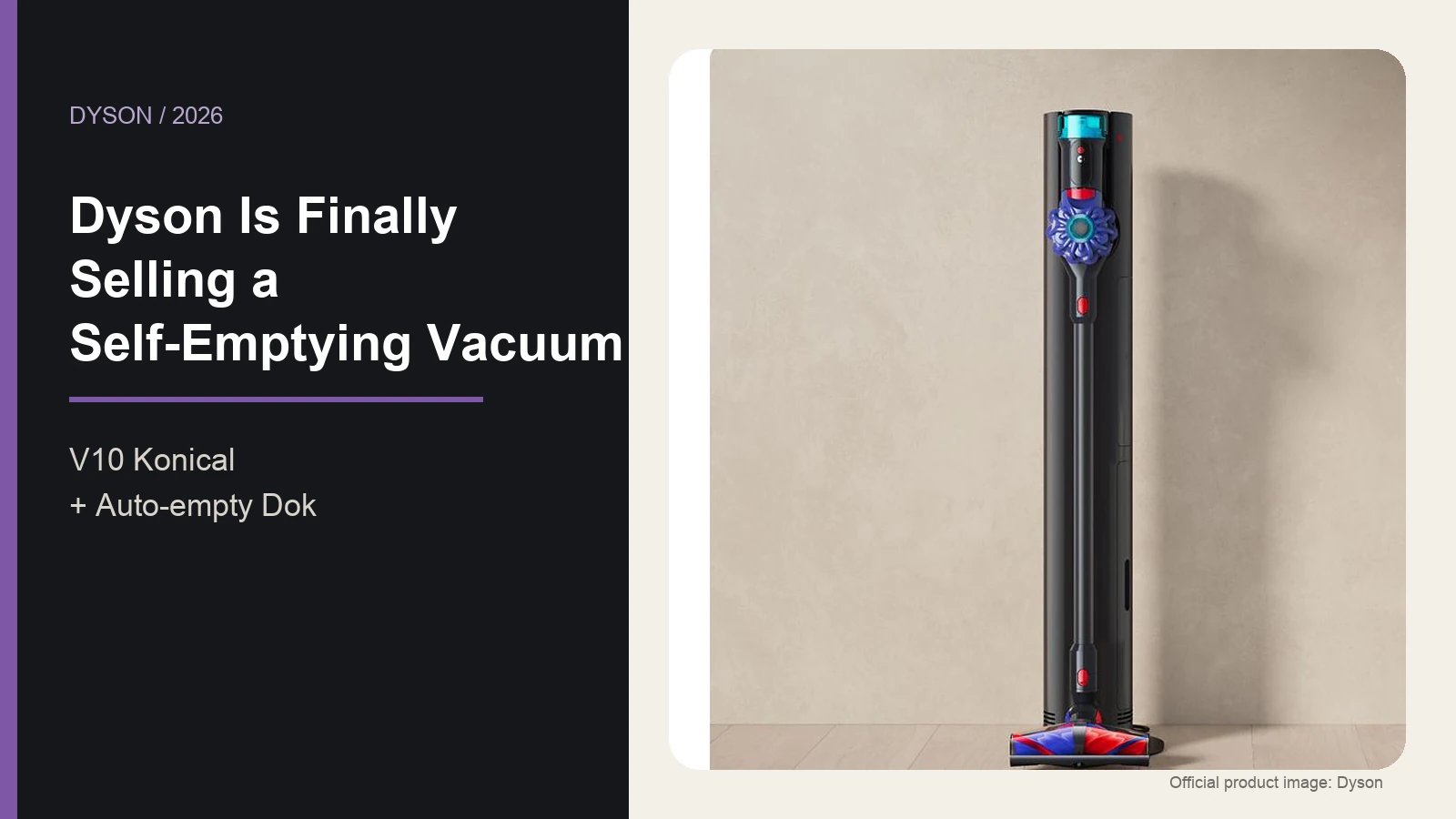
Since the V10, however, Dyson's floorcare products have become increasingly underwhelming. Chinese brands have driven rapid advances in robot vacuums and hard floor washers, leaving Dyson behind. The days when it defined the product and others followed have passed.
From what I know of the supply chain, Dyson is now working with suppliers in mainland China to develop new vacuums, with more pragmatic pricing as well. That is a positive change. Chinese suppliers are closer to the market and can help Dyson develop products more efficiently and regain competitiveness.
CameraJet shows little of that adjustment. Dyson is still trying to use complex technology to support a price far above mass-market products. Six years of development can tell us how difficult something was to build; it does not prove consumers need the resulting toothbrush. In its current form and at its current price, I expect CameraJet to remain a niche product.
James Dyson is now 79 and has not announced a retirement date. His son Jake Dyson is already chief engineer, but a company so dependent on its founder's judgment still needs to establish its next product direction. Dyson's official information
Dyson has proved that it can build complex products. Whoever leads it next needs to decide which products are worth building. Otherwise, after CameraJet, there may well be another Zone.