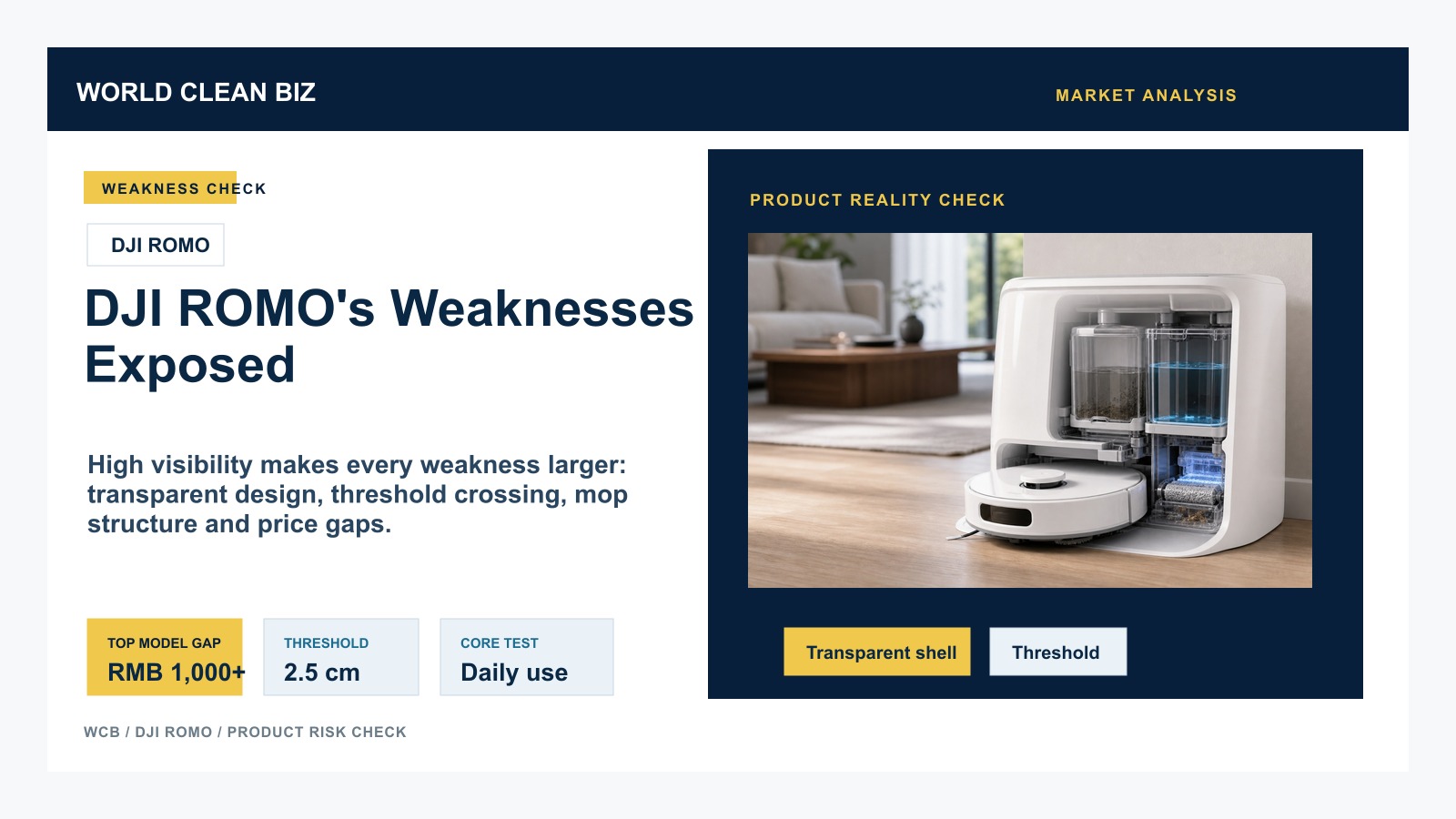
- Choose DJI ROMO P when small-object avoidance and a highly transparent dock-and-robot design are the priority, subject to local availability and service.
- Choose Roborock Saros 10R when low furniture clearance, liftable hardware, automatic mop removal and a more established regional accessory ecosystem matter more.
- Do not compare only suction claims: test cable avoidance, hair pickup, carpet transitions, edge mopping, dock hygiene, privacy settings and local repair response.
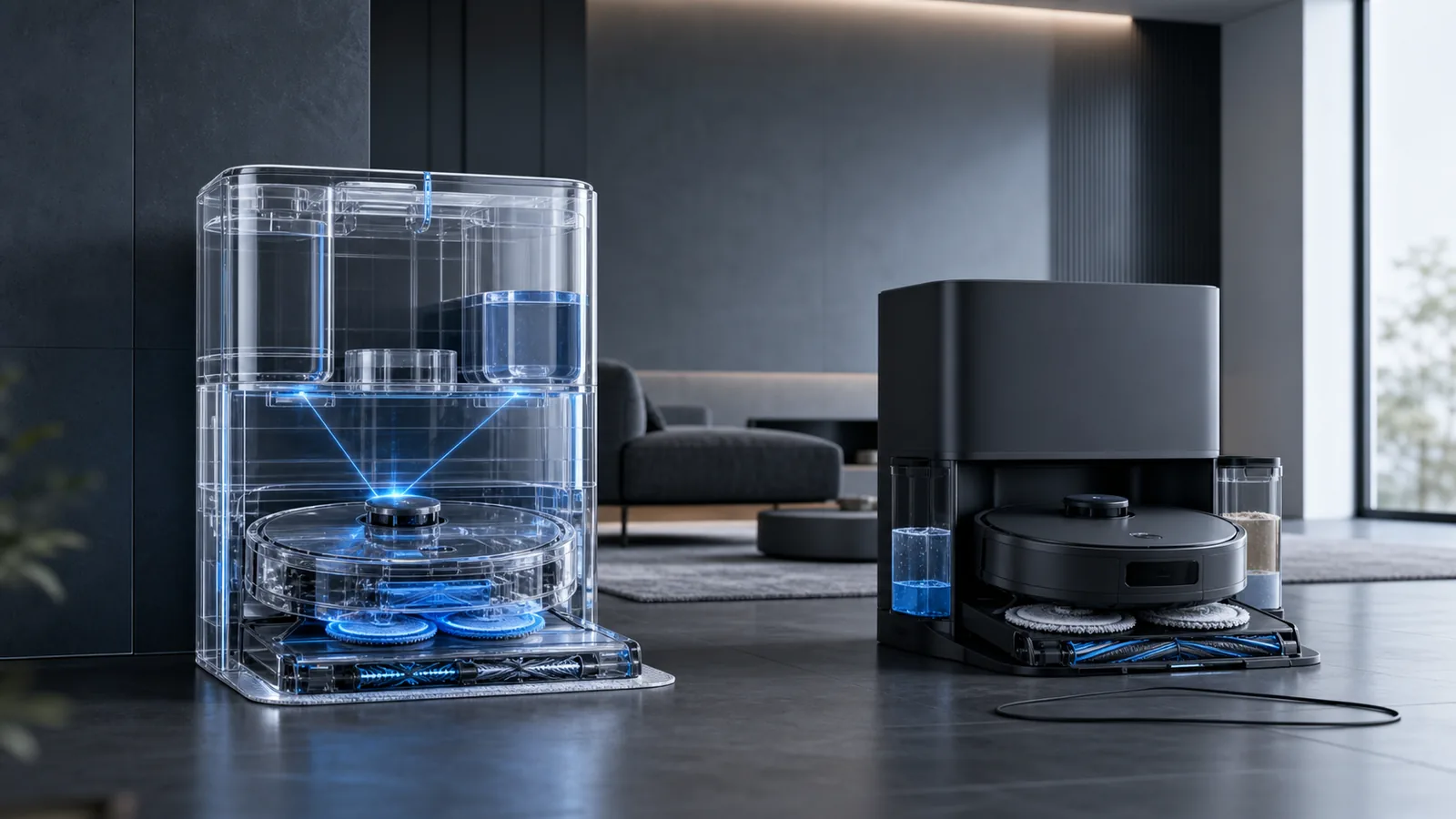
In this article 11 sections
Choose DJI ROMO P if fine obstacle avoidance is your first filter and the product has an authorized service route in your market. Choose Roborock Saros 10R if you need a 7.98 cm low-profile robot, liftable chassis and brushes, automatic mop removal and a mature dock workflow. Neither is automatically better at cleaning every floor.
This comparison uses ROMO P and Saros 10R as sold in their applicable regions. Bundles, plumbing versions, app functions and warranty terms can differ.
DJI ROMO P vs Roborock Saros 10R at a Glance
| Decision factor | DJI ROMO P | Roborock Saros 10R |
|---|---|---|
| Navigation concept | Binocular fisheye vision plus solid-state LiDAR and fill light | StarSight 2.0 with dual-transmitter solid-state LiDAR, 3D sensing, RGB camera and lateral sensing |
| Robot height | Confirm the local ROMO specification | 79.8 mm official specification |
| Obstacle focus | Fine-object and cable avoidance is a central proposition | Object recognition plus VertiBeam lateral avoidance and low-profile coverage |
| Main cleaning architecture | Dual roller arrangement and dual spinning mop system, depending on market specification | DuoDivide split main brush, FlexiArm side brush and dual spinning mops |
| Carpet strategy | Check mop lift and carpet rules in the local app/manual | Liftable chassis/brushes/mops and dock-based automatic mop removal |
| Dock | Dust emptying, mop washing/drying and solution/water automation vary by dock version | 10-in-1 Dock 4.0 with hot-water wash, warm-air drying, detergent and removable modules |
| Best fit | Obstacle-dense homes and buyers accepting a newer cleaning brand | Low furniture, mixed floors and buyers prioritizing lifecycle support |
Manufacturer recognition counts and performance claims use internal methods. They are not a shared independent test.
Navigation and Obstacle Avoidance
DJI applies sensing and autonomy experience from other product categories to ROMO. Its manual identifies binocular fisheye lenses, LiDAR, an infrared sensor and a fill light. That combination is designed to build depth information and preserve detection in dim areas.
Saros 10R removes the traditional raised laser turret. Roborock’s StarSight system uses solid-state time-of-flight sensing, an RGB camera and lateral obstacle detection. The flat top helps the robot reach under lower furniture.
For both products, test objects that create expensive failures:
- charging cables lying parallel and perpendicular to travel;
- thin black cords on dark flooring;
- socks, tissue and pet toys;
- table bases and cantilever chairs;
- mirrors and glass doors;
- pet waste substitutes;
- low scales and floor vents;
- objects at the edge of a carpet.
Record avoidance rate, false avoidance, missed floor area and manual rescues. A robot that avoids everything but leaves wide uncleaned halos is not necessarily more autonomous.
Low Furniture, Thresholds and Recovery
Saros 10R’s 79.8 mm body is a clear selection advantage where sofas and cabinets have roughly 80–100 mm of clearance. Measure at the lowest structural point, not the visible front edge.
Its AdaptiLift chassis can raise sections of the robot and Roborock states up to 4 cm for qualifying double-layer thresholds. That does not mean every 4 cm vertical step is traversable. Shape, friction, approach angle, mop state and descent risk matter.
ROMO’s manual instructs owners to use an auxiliary ramp for thresholds above 2.5 cm and sets conditions for ramps below 4 cm. This is an operating rule, not a claim that the bare robot climbs a 4 cm step.
For split-level homes, test:
- transition strips with the mop wet;
- black thresholds that can affect cliff sensors;
- return-to-dock after crossing;
- wheel marks on soft flooring;
- recovery after lifting or moving the robot.
Vacuuming and Hair Handling
Suction in pascals cannot predict pickup by itself. Airflow, brush contact, inlet sealing, roller speed, carpet agitation and the dust path determine the result.
Saros 10R uses a split DuoDivide main brush that directs hair toward the central inlet and an asymmetric side brush designed to shed hair. This architecture reduces long strands wrapping around a continuous axle.
ROMO’s roller and airflow design should be judged on the same workload:
- fine dust on hard floor;
- rice or cereal near walls;
- hair embedded in medium-pile carpet;
- hair across roller ends and bearings;
- litter at a door track;
- pickup after several dock-empty cycles.
Open the rollers after each standardized run. “Zero tangle” should mean less maintenance in your home, not that inspection is unnecessary.
Mopping and Edge Coverage
Both use active mop systems rather than a passive cloth. The meaningful questions are:
- pressure and contact consistency;
- clean-water delivery;
- edge reach around right-angle corners;
- how quickly pads become dirty;
- carpet detection and lift height;
- whether the dock rewashes after a dirty zone;
- residual water and streaks after drying.
Saros 10R can leave its mops at the dock for configured vacuum-only or carpet tasks. That is valuable in homes with substantial carpet because lifted wet pads can still carry moisture or odor.
ROMO’s dock and mop-cleaning cycle emphasize automation. Validate whether the exact P bundle includes the functions and consumables shown in regional marketing. Transparent tanks look easy to inspect but still require physical rinsing of biofilm-prone surfaces.
Dock Automation and Maintenance
Roborock lists hot-water mop washing, dock self-cleaning, detergent dispensing, dust emptying, water refilling and warm-air drying on Dock 4.0. Its removable wash modules improve physical access.
DJI offers different dock configurations, including tank and region-limited plumbed versions. Confirm:
- clean- and dirty-water capacities;
- dust-bag part number;
- detergent compatibility;
- drying temperature and duration;
- plumbing pressure and drain requirements;
- tray removal without tools;
- odor-control procedure;
- whether the robot can operate if one consumable is unavailable.
No dock is maintenance-free. Owners still need to rinse the dirty tank, clean hair from rollers, wipe sensors, inspect seals and dry stagnant areas.
App, Camera and Privacy
Both products use cameras or image sensors as part of navigation. Buyers should examine:
- whether obstacle images are stored;
- whether remote viewing exists and is disabled by default;
- local versus cloud processing;
- account sharing and transfer;
- deletion of maps and recordings;
- encryption and multi-factor authentication;
- security-update horizon.
Roborock states that Saros 10R stores no images and cites TÜV Rheinland smart-home security certification plus ETSI EN 303 645 alignment. Read the scope of the certification rather than treating it as a blanket privacy guarantee.
DJI buyers should review the ROMO privacy policy and permissions for the exact app region. A strong avoidance system does not require granting every optional remote-access feature.
Consumables, Warranty and Channel Risk
Roborock has an established robot-vacuum accessory market in many countries. ROMO is newer and may have narrower regional availability.
Before purchase or stocking:
- obtain filter, roller, side-brush, mop and dust-bag SKUs;
- confirm cross-model compatibility;
- price a 24-month consumable basket;
- identify the local repair center;
- ask whether batteries, pumps and dock modules are replaceable;
- verify warranty exclusions for plumbing, detergents and commercial use;
- confirm who pays two-way freight.
For retailers, the best technical product can become the worse SKU if spare parts and turnaround times are uncertain.
Which One Should You Buy?
Choose DJI ROMO P when:
- small-object avoidance is the primary problem;
- the local ROMO configuration includes the dock functions you need;
- you value visible tank and dust-path inspection;
- authorized consumables and service are already available;
- you accept the platform risk of a newer entrant.
Choose Roborock Saros 10R when:
- low furniture clearance is critical;
- carpets benefit from automatic mop removal;
- thresholds and complex furniture require liftable hardware;
- your region has proven Roborock parts and repair;
- you prefer a mature app and accessory ecosystem.
For the broader market context, see our DJI ROMO launch analysis. Compare established competitors in Roborock vs Ecovacs robot vacuums, or use the robot vacuum OEM and ODM guide for sourcing.
FAQ
Is DJI ROMO P better at obstacle avoidance than Saros 10R?
ROMO P is strongly positioned around fine-object avoidance, but the answer depends on floor color, lighting and object type. Run the same cable, sock, toy and pet-waste tests in the intended home.
Which robot is better under low furniture?
Saros 10R has an official height of 79.8 mm and no raised LiDAR turret. Measure furniture clearance and leave margin for uneven floors.
Can Saros 10R remove its own mops?
Yes. Its dock can automatically detach mops for configured tasks. The feature must be enabled and the dock kept clean.
Does DJI ROMO use LiDAR?
The official manual lists LiDAR as part of a navigation and obstacle-avoidance module that also includes binocular fisheye lenses.
Which has lower ownership cost?
Compare the local machine price plus two years of bags, filters, rollers, mops, detergent, shipping and expected repair. Regional support can outweigh a small purchase-price difference.
Sources
- DJI ROMO official user manual
- Roborock Saros 10R official product page
- TechRadar ROMO P and Saros 10R obstacle-avoidance comparison
Sources were checked on July 26, 2026. Prices, functions, bundles and regional service can change.