- DJI’s brand halo gives ROMO unusual launch attention in robot vacuums.
- The product still has to compete on cleaning performance, docking experience and everyday reliability.
- ROMO raises pressure on Roborock, Ecovacs and Narwal, but does not automatically overturn the category.

In this article 5 sections
On August 6th, the highly anticipated DJI ROMO robot vacuum cleaner was released. To capitalize on this wave of attention, I promptly watched various influencer reviews. DJI's promotional efforts were quite robust; many influencers did sponsored posts, making it one of the most closely watched products in recent years within the robot vacuum industry.
Here are some basic configurations of DJI’s ROMO:
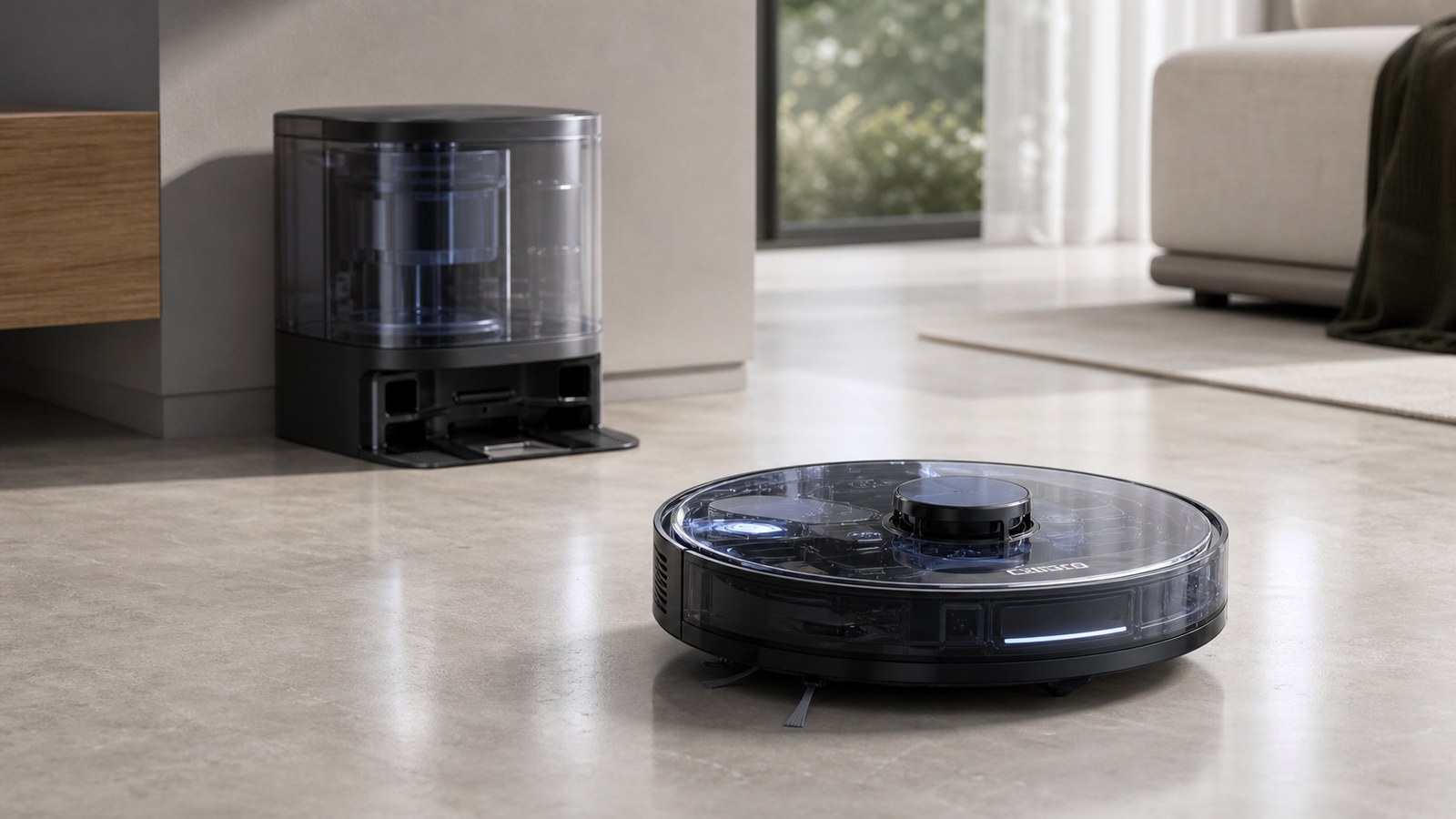
Currently, there are three models: ROMO A, ROMO S, and ROMO P. Among these, ROMO S is the base model, all in white. The ROMO A features a transparent design for both the robot vacuum cleaner and the base station, which remains white. The ROMO P has both the robot vacuum cleaner and the base station designed as transparent.
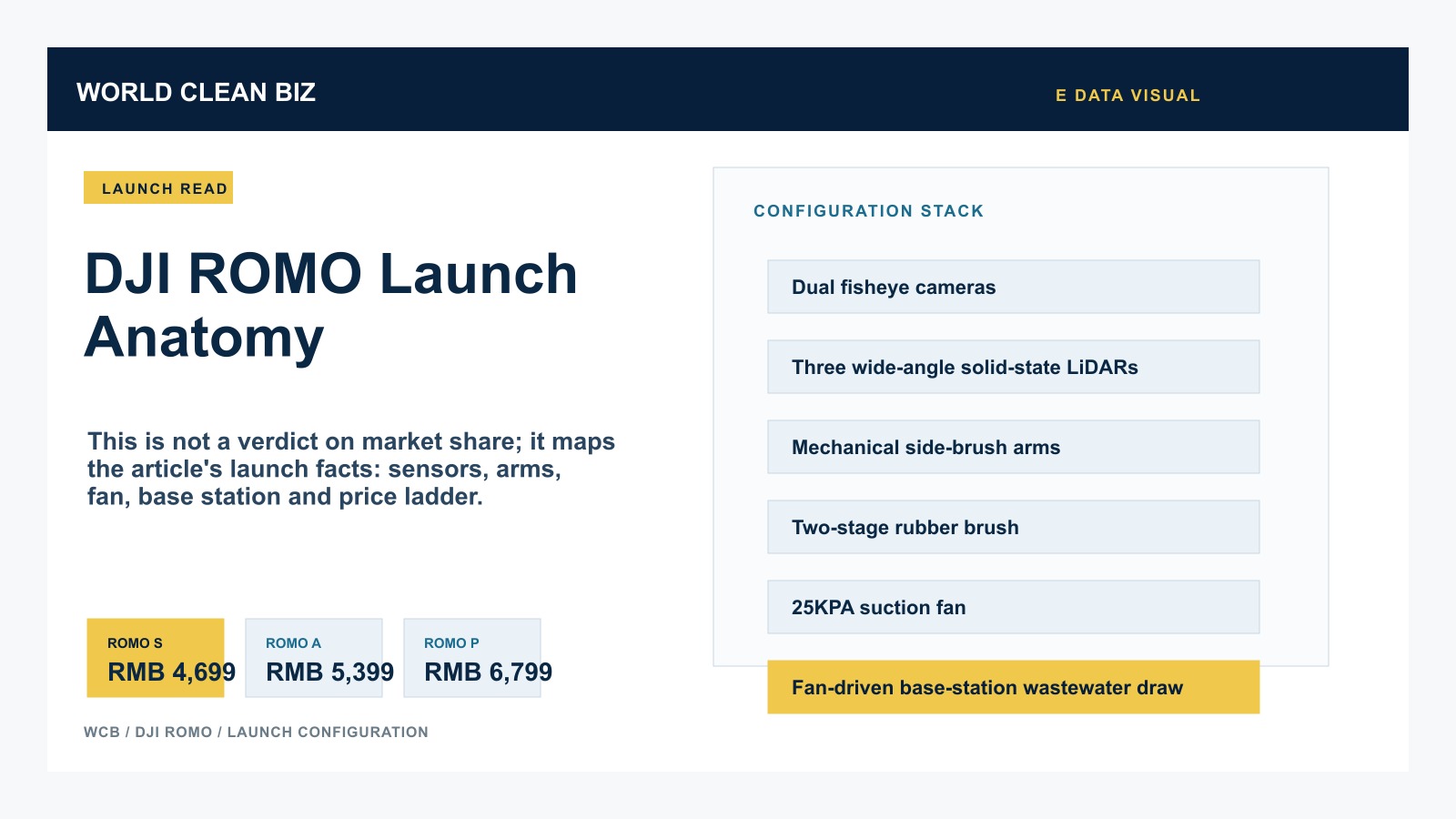
In terms of host configuration, DJI equipped it with dual fisheye cameras along with three wide-angle solid-state LiDARs, providing a wider field of view compared to ordinary single-lens systems. Two side brushes are fitted with mechanical arms that can be deployed at any time for cleaning. The middle brush has been replaced with a two-stage rubber brush, preventing hair from getting tangled. The robot vacuum cleaner's suction fan is self-developed with nine blades, achieving 25KPA of vacuum while increasing airflow and reducing noise. The body houses a 164-milliliter water tank, using two circular cloths instead of the current trend of roller brushes or tracks. These circular cloths also come equipped with mechanical arms that can be extended.
Regarding the base station, it comes standard with clear water tanks, dirty water tanks, and base stations. The base station features a high-pressure hot water cloth washing function followed by a high-temperature drying process. Unlike other companies in the industry using sewage pumps to remove wastewater, DJI uses a vacuum cleaner-like fan to draw up the wastewater. This method ensures that all types of waste can be effectively cleaned, leaving less residue on the cleaning plate.
Based on several review videos, here are some highlights of DJI's product:
- Relying on dual fisheye cameras and three wide-angle solid-state LiDARs, DJI ROMO can gather more information than other robot vacuums. With more information intake comes timely and precise judgment. From the reviews, it appears that DJI’s obstacle avoidance function is indeed better, especially in terms of decision-making speed. It remains unclear whether this is due to a more powerful chip.
- The host's suction fan uses a self-developed suction fan with enhanced performance, greater airflow, and lower noise. Currently, most industry players use brushless motors from vacuum cleaners, which increase suction but reduce airflow. This aligns with my previous predictions about DJI’s direction.
- The middle brush utilizes a two-stage rubber brush, first introduced by Dyson in their floor brushes. This design prevents hair from getting tangled and works well when combined with the powerful suction fan.
- Mechanical arms are used for both side brushing and cloths. From the review videos, these mechanical arms appear to be quite responsive, frequently triggering to clean corners. This is likely related to their algorithms and camera systems.
- The body includes a mopping water tank. It does not support real-time live water cleaning but still performs well with dual rotating disks. DJI’s product also shows good results. When passing over carpets, it supports cloth lifting functions.
- The base station features hot water cloth washing functionalities and innovative self-cleaning mechanisms. Traditionally, sewage is pumped up using a pump, leaving some solid waste behind in the base station. DJI has expanded the wastewater outlet to directly use a fan to draw up the sewage and waste. This reduces residue left in the base station. I believe this will be an industry trend in the future.
Here are my personal views on DJI ROMO:
- From review videos, it is evident that DJI excels in obstacle avoidance and mechanical arm functions with faster response times and excellent overall cleaning performance. These advantages stem from their drone technology. However, these improvements are not solely due to algorithms; significant hardware investments have also been made, leading to increased costs. Competitors can replicate similar results, making it difficult for the top players in the industry to differentiate significantly.
- The improvement in suction fans was mentioned in my previous article and is indeed necessary. Coupled with a powerful fan, the base station’s self-cleaning standards will improve. This direction will likely be followed by other major players this year.
- Over-the-threshold capabilities were not discussed in any of the videos I watched. Upon reviewing ROMO's chassis and wheel size, there doesn’t seem to be much difference compared to others.
- Pricing for DJI’s models: The basic ROMO S is priced at 4,699 RMB (before national subsidies), ROMO A at 5,399 RMB, and ROMO P at 6,799 RMB. What are the differences between these models? After careful consideration, it appears that all configurations are similar. The only difference is that ROMO A has a transparent cover for the robot vacuum cleaner compared to ROMO S’s white plastic cover, while ROMO P has a transparent plastic base station instead of a white one. The cost difference between white and transparent plastic parts is likely around several dozen RMB, but the price difference is much higher.
The pricing strategy for the transparent version ROMO P serves as an anchor, making the standard version ROMO S appear more cost-effective.
Analysis of ROMO S Price and Productivity
The price of the ROMO S on JD.com after national subsidies is around 3799 RMB, which is about a 3-400 RMB difference compared to the Roborock P20 and Narwal Freo 002. Considering DJI's premium pricing, their product essentially competes directly with these models. This price point should still be quite competitive; it remains to be seen how the other brands will respond.
Productivity Evaluation
From a performance perspective, ROMO currently appears to have strong productivity, capable of competing head-to-head with its competitors. It excels in areas that consumers can perceive, such as obstacle avoidance, fan performance, and base station self-cleaning functions. Although it lacks the mainstream feature of on-board live water self-cleaning for washing floors, I do not see this as a significant issue.
Design
The design is somewhat similar to Roborock P20, making it difficult to determine who drew inspiration from whom. Currently, all promotional materials use the fully transparent version of ROMO P.
Future Prospects
In the coming month, after large-scale market launches, real consumer feedback will determine the future success of this product. Based on initial assessments, there don't seem to be any significant weaknesses.
First Product Completion
As a first product, its completion level is very high. It's hard to imagine what DJI's next generation product might bring; does the dominance in the drone industry truly make such an impact?
Before the product was released, I had a negative view of DJI ROMO. However, based on this product, my evaluation has turned more positive. The cleaning robot market is about to enter a period of intense competition.