- Floor-washer manufacturing cost cannot be compared until the roller, water path, recovery target, battery, lay-flat design, self-cleaning dock, heat and accessory scope are frozen.
- A 100-unit planning model makes supplier assumptions visible, but final numbers must come from matched RFQs, tooling evidence, compliance scope and tested yield.
- Leaks, residual water, odor, roller wear, battery service and dock failures can create more commercial cost than a modest BOM saving.
In this article 25 sections
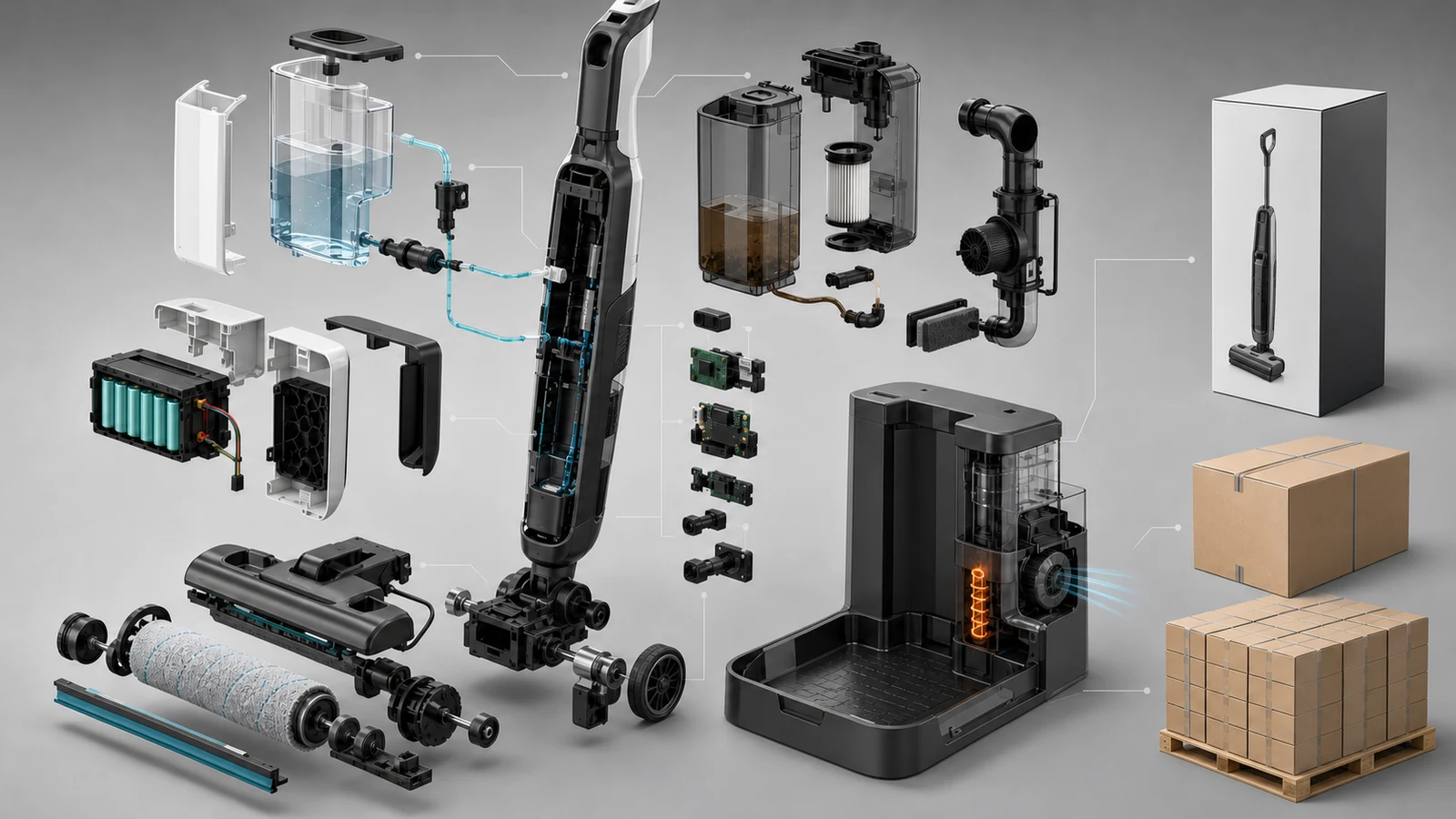
A household floor washer has no credible universal manufacturing cost. A basic ambient-water roller washer, a lay-flat model and a premium machine with hot floor washing, heated self-cleaning, hot-air drying and drive assist are different products. Freeze the complete water path, cleaning target, battery, dock and service scope before comparing factory quotations.
Use a 100-unit planning model to expose where cost sits. Replace every planning assumption with a matched supplier BOM, tooling quote, test result and logistics calculation before making a buying decision.
Define the Cost Boundary
Separate:
- BOM and conversion cost;
- ex-works or FOB price;
- tooling and engineering;
- compliance and quality;
- landed cost;
- warranty and returns;
- channel cost.
Commercial floor-washer cost = normalized factory price + allocated tooling and compliance + quality and logistics + warranty and return reserve
Do not compare a bare factory quote with a landed and supported product.
Freeze the Product Tier
| Product tier | Typical architecture | Cost pressure |
|---|---|---|
| Essential washer | Single roller, ambient water, simple display, basic self-cleaning | Core wet path and reliability |
| Lay-flat smart washer | Low body, dirty-water separation, sensors, edge cleaning, assisted drive | Mechanical packaging and controls |
| Heated premium washer | Hot floor mode or steam, heated self-cleaning, drying, advanced dock | Thermal system, materials, safety and service |
| Combination platform | Washer plus detachable vacuum or multiple heads | Extra motor, tools, joints, packaging and tests |
Freeze the exact tier before requesting price.
Roller, Scraper and Floorhead
The floorhead contains several cost and failure drivers:
- roller core and textile;
- bearings and end caps;
- scraper;
- hair comb;
- roller motor and transmission;
- spray or distribution bar;
- suction inlet;
- edge geometry;
- cover and seals.
Roller pressure affects cleaning and pushing force. Scraper pressure affects water recovery, hair handling and roller wear.
Request tests for:
- roller runout;
- water distribution;
- wet and dry hair;
- sand and crumbs;
- edge residual;
- wear after repeated cycles;
- bearing contamination;
- removal and installation.
A low-cost roller that quickly deforms creates recurring consumable and return cost.
Clean-Water Path
The clean-water system can include:
- tank;
- valve;
- pump;
- tubing;
- flow sensor;
- manifold;
- heater;
- detergent dosing;
- seals and connectors.
Cost increases when the design needs precise metering, hot water or separate solution control.
Validate:
- flow at every mode;
- prime time;
- dry-run protection;
- leak behavior;
- clog resistance;
- detergent compatibility;
- storage at temperature extremes.
Small savings in pumps or tubing can create inconsistent wetting or field leaks.
Dirty-Water Recovery Path
The recovery path can include:
- suction inlet;
- duct;
- separator;
- dirty tank;
- float or liquid detection;
- filter;
- seals;
- suction motor;
- exhaust.
Lay-flat use makes the design harder. Liquid must remain separated from the motor while the body changes angle.
Dreame’s current H15 Pro Heat specifications, for example, list 650 ml used-water capacity standing and 400 ml while flat. That is a product example, not a cost benchmark, but it shows that usable capacity can change with orientation.
Test:
- maximum fill at every angle;
- sudden stop and turn;
- foam;
- fine debris;
- filter loading;
- tank removal;
- spill during carrying;
- liquid reaching protected zones.
Suction Motor and Air Path
Peak pascals do not define cost or cleaning.
Select the motor with:
- required airflow under wet restriction;
- temperature margin;
- noise target;
- service life;
- separator pressure loss;
- available power.
The motor, impeller, duct, seals and control logic form one system.
Oversizing can increase battery, noise and heat. Undersizing can leave residual water.
Battery, BMS and Charger
Battery cost includes:
- cells;
- pack structure;
- BMS;
- sensing;
- connectors;
- charger;
- thermal design;
- testing;
- transport documentation.
PHMSA states that lithium batteries offered for transport must pass applicable UN 38.3 tests and have the required test summary available. Match the document to the battery design actually shipped.
For EU-bound products, the EU Batteries Regulation introduces phased requirements including information, replaceability and spare-part obligations. The regulation and later guidance discuss exceptions for wet appliances. Do not assume an exception; obtain legal and laboratory interpretation for the design and launch date.
Cost future service:
- battery removal method;
- seal replacement;
- service labor;
- spare availability;
- firmware pairing if any;
- disposal and producer obligations.
Sensors, Display and Controls
Possible components:
- dirt sensor;
- water-level detection;
- angle sensor;
- wheel speed sensing;
- temperature sensors;
- display;
- voice;
- wireless module;
- main controller.
Each sensor adds hardware, calibration, software, validation and false-alarm risk.
Define what action the sensor changes. Remove sensors that do not improve cleaning, safety or diagnosis.
Drive Assist and Steering
Powered wheels can reduce push effort. They add:
- wheel motor or transmission;
- controls;
- sensing;
- wiring;
- structural parts;
- calibration;
- noise and failure modes.
Test with full tanks, on turns and when changing direction. A poor assist algorithm can feel worse than a passive wheel.
Cost the user interface as well as the motor.
Lay-Flat Mechanical Cost
A low body changes:
- tank geometry;
- liquid separation;
- duct routing;
- center of gravity;
- hinge;
- seals;
- wiring;
- structural reinforcement.
Measure the full body height, not only the floorhead.
Ask the factory to identify which parts and tests are unique to lay-flat use. A cosmetic hinge change does not create safe wet operation at 180 degrees.
Self-Cleaning Dock
A basic dock stores and charges. An advanced dock may wash the roller, heat water and dry with warm air.
Dock cost can include:
- pump;
- heater;
- fan;
- PTC element;
- ducts;
- temperature control;
- tray;
- charger;
- sensors;
- power supply;
- thermal protection.
Self-cleaning also creates maintenance requirements. Soil remains in the tray, scraper, roller ends and dirty tank.
Test after hair, mud, grease and detergent foam. Open the machine after the automated cycle.
Hot Water, Steam and Drying
Separate:
- water heating for the floor;
- steam generation;
- hot water for self-cleaning;
- hot air for roller drying.
Each function has different temperature, power, materials and safety requirements.
Dreame states that its H15 Pro Heat heating-module outlet can reach 85°C while the roller reaches a lower temperature under its lab conditions. Tineco lists separate runtime for normal and steam modes on the S7 Stretch Steam. These examples show why thermal claims must be linked to location and mode.
Thermal cost includes:
- heater;
- insulation;
- heat-resistant tubing and seals;
- sensors;
- control software;
- power electronics;
- safety devices;
- additional test time.
Do not add heat only for a larger marketing number.
Tanks, Materials and Cosmetic Parts
Transparent tanks require:
- suitable resin;
- polished tooling;
- cosmetic inspection;
- stress-crack resistance;
- detergent compatibility.
The machine also combines hard plastics, elastomers, seals, roller textiles and metal fasteners in a wet chemical environment.
Validate:
- detergent soak;
- hot-water exposure;
- UV and color;
- drop with partial fill;
- latch cycles;
- tank distortion;
- odor retention.
A 100-Unit Planning Model
This is an illustrative buyer model, not an industry average or quotation.
| Cost block | Essential washer | Lay-flat smart washer | Heated premium washer |
|---|---|---|---|
| Floorhead, roller and drive | 22 | 20 | 17 |
| Water and recovery systems | 19 | 20 | 19 |
| Battery and charging | 18 | 18 | 18 |
| Plastics, tanks and structure | 18 | 17 | 15 |
| Sensors, UI and controls | 7 | 10 | 11 |
| Dock and thermal systems | 4 | 7 | 14 |
| Assembly, test and factory overhead | 8 | 8 | 8 |
| Packaging and included consumables | 4 | 4 | 4 |
| Total | 100 | 104 | 106 |
The last two columns exceed 100 to show that added architecture breaks the original budget. Normalize after the configuration is frozen.
Use the table to force trade-offs, not to claim market pricing.
Tooling and Engineering
Separate tooling for:
- main housings;
- clean and dirty tanks;
- floorhead;
- roller parts;
- dock;
- wheels;
- accessories;
- seals and overmolded parts.
Also budget:
- industrial design;
- mechanical and fluid engineering;
- electronics;
- firmware;
- fixtures;
- leak-test equipment;
- end-of-line performance test;
- packaging.
Ask who owns the molds and test equipment, and what happens after the supplier relationship ends.
Compliance
The required standards depend on market, architecture and claims.
Potential workstreams:
- household appliance safety;
- vacuum and floor-treatment requirements;
- battery and charging safety;
- electromagnetic compatibility;
- radio approval;
- materials restrictions;
- battery and waste obligations;
- lithium transport;
- marking and instructions.
UL identifies UL 1017 as a standard used for vacuum cleaners, blower cleaners and household floor finishing machines, but the exact route can change with the product. Obtain a current laboratory standards map.
Budget for pre-checks and retests. Water, heat and battery systems interact.
Quality and Yield
Critical end-of-line checks can include:
- leak;
- pump flow;
- suction current;
- liquid detection;
- roller rotation;
- charging;
- display and sensor;
- dock wash and dry;
- noise;
- appearance.
Cost per accepted unit = total production and rework cost ÷ units passing the agreed acceptance criteria
Measure first-pass yield and final yield separately. Rework can hide an unstable process.
Reliability Program
Test:
- repeated tank cycles;
- roller removal;
- hair and fiber;
- detergent;
- hard-water scale;
- long-term storage with residual moisture;
- drop and vibration;
- battery cycles;
- charger and dock;
- thermal protection;
- hose and seal aging.
Run soiled-life tests, not only clean-water cycles.
Warranty and Return Reserve
Typical cost drivers:
- leaks;
- low recovery;
- odors;
- hair wrap;
- cracked tanks;
- blocked pumps;
- false dirty-water alarms;
- battery decline;
- dock drying failure;
- unavailable rollers and filters.
Price:
- replacement roller;
- filter;
- tanks;
- dock tray;
- charger;
- battery service;
- shipping;
- technician labor.
A premium product can need a larger reserve because it has more subsystems and higher replacement cost.
Packaging and Logistics
Floor washers ship with long handles, tanks, rollers, dock and consumables.
Packaging decisions affect:
- box volume;
- handle assembly;
- scratch protection;
- tank movement;
- lithium shipping;
- retail presentation;
- drop performance.
Measure volumetric freight as well as unit weight.
Landed cost = factory price + tooling and compliance allocation + inspection + origin charges + freight + insurance + duty and tax + destination handling
Then add returns, warranty, warehousing and channel fees.
MOQ and Component Risk
MOQ can be driven by:
- cells;
- custom tanks;
- roller textile;
- colors;
- display;
- heater;
- packaging.
Ask which components are standard and which are buyer-specific.
Locking a custom cell or display at low volume can create future shortages. A slightly more common component may lower lifecycle cost.
RFQ Cost Template
Require:
Frozen product
- floor and soil target;
- roller and scraper;
- clean-water flow;
- recovery target;
- battery and runtime;
- lay-flat angle;
- heat and drying;
- sensors and UI;
- dock;
- consumables.
Cost
- BOM by system;
- assembly and test;
- EXW and FOB;
- MOQ and breaks;
- tooling and NRE;
- compliance;
- packaging;
- spares;
- warranty allowance.
Evidence
- drawings;
- performance tests;
- life tests;
- battery documents;
- compliance map;
- change control;
- production yield.
Cost Reduction
Lower-risk options:
- remove a feature that has no measured user value;
- standardize battery and charger;
- simplify display;
- reduce cosmetic part count;
- share roller or filter platform;
- improve assembly and leak testing;
- reduce package volume.
High-risk options:
- cheaper seals;
- smaller recovery motor without matched test;
- untraceable cells;
- reduced thermal protection;
- omitted soil-life testing;
- weak latches;
- unsupported consumables.
Remove complexity before removing reliability margin.
Frequently Asked Questions
How much does a floor washer cost to manufacture?
It depends on the water path, recovery, battery, lay-flat design, sensors, dock, heat, tooling, volume and compliance. Use matched RFQs; a universal public number is not reliable.
What is the biggest cost block?
No single block always dominates. Floorhead and wet path, battery, plastics and dock/thermal systems are usually the main design groups.
Does hot washing add only a heater?
No. It can add sensors, controls, insulation, power electronics, heat-resistant materials, safety devices and more testing.
Why is lay-flat design expensive?
It changes liquid separation, tank geometry, ducts, hinge, wiring and validation, not only the handle angle.
What hidden cost matters most?
For many programs it is field quality: leaks, odor, poor recovery, battery service and unavailable consumables can outweigh a small BOM saving.
Bottom Line
Floor-washer manufacturing cost follows architecture and evidence. Freeze the wet path, battery, dock and thermal functions; normalize supplier scope; test yield and field risks; then calculate landed and supported cost. A cheap BOM is not a cheap product when it creates leaks, odors or replacement machines.
Continue with the floor washer OEM and ODM guide, the hard-floor washer market and OEM analysis, and the cleaning-appliance MOQ and hidden-cost guide.