- A robot vacuum is strongest at frequent autonomous floor coverage; a cordless vacuum is strongest when the user must target stairs, furniture, edges and deeper or unpredictable messes.
- Do not compare suction claims across the two categories as if they were the same test. Compare the complete cleaning result on each floor and the human time required.
- Many homes get the best result from a robot for maintenance plus a simpler cordless vacuum for tasks the robot cannot reach.
In this article 17 sections
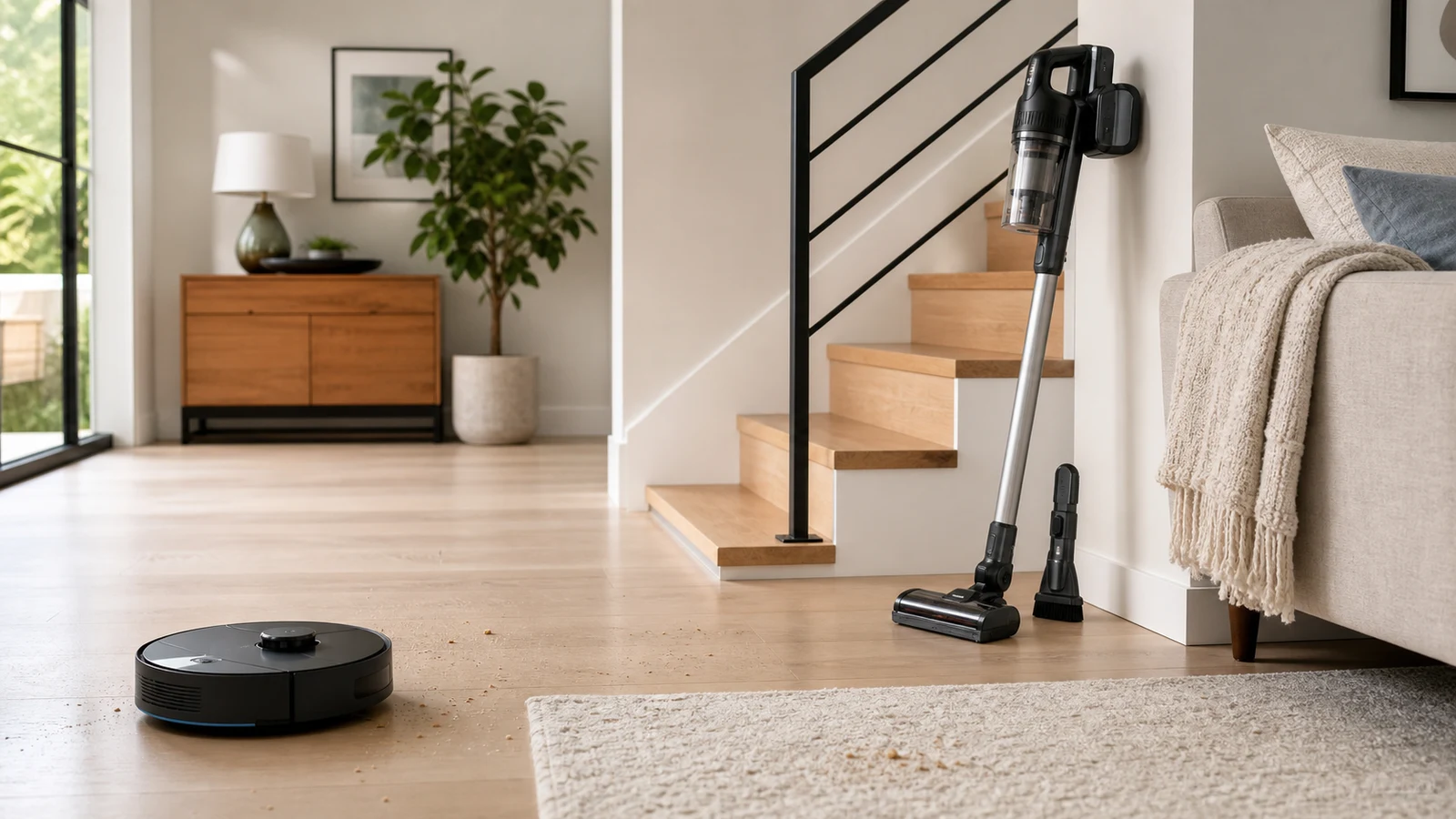
Choose a robot vacuum when your priority is frequent, mostly unattended cleaning of accessible floors. Choose a cordless vacuum when you need direct control over stairs, sofas, edges, cars, concentrated dirt and deeper cleaning. For many homes, the most effective system is a robot for daily maintenance plus a simpler cordless vacuum for everything the robot cannot reach.
The categories solve different labor problems. A robot trades peak cleaning power and reach for repetition. A cordless vacuum concentrates the user’s effort exactly where it is needed.
Robot Vacuum vs Cordless Vacuum at a Glance
| Decision | Robot vacuum | Cordless vacuum |
|---|---|---|
| Main value | Automated frequency | Directed cleaning power and reach |
| Open floors | Strong fit | Strong but requires user time |
| Stairs | Cannot clean | Strong fit with suitable tool |
| Upholstery and car | Cannot clean | Strong fit with handheld tools |
| Under furniture | Good if height and route allow | Depends on wand and floorhead |
| Corners and edges | Variable | User can target them |
| Deep carpet work | Model and carpet dependent | User can repeat and agitate directly |
| Large sudden mess | Can be slow or scatter debris | Fast targeted response |
| Human work | Preparation, rescue and maintenance | Full cleaning session |
| Main ownership risk | App, dock, navigation and service complexity | Battery, filters and manual effort |
Neither column guarantees performance. Test the exact machine on the actual floors.
The Key Difference Is Frequency vs Control
A robot can clean while the owner is doing something else. Scheduled repetition prevents some dirt from accumulating.
A cordless vacuum starts only when someone picks it up. The owner controls:
- pressure and speed;
- number of passes;
- tool and angle;
- attention to visible dirt;
- movement between floors;
- cleaning of stairs and upholstery.
This makes a cordless machine stronger for exceptions. It also makes its result dependent on the user’s time and technique.
A robot’s result depends on access. Closed doors, cables, toys, thresholds, low furniture and map errors can leave areas untouched.
Compare Complete Results, Not Suction Numbers
Robot brands often advertise pascals. Cordless brands may publish air watts, motor speed, runtime or relative claims. These are not automatically comparable.
Floor pickup depends on:
- airflow;
- pressure;
- nozzle seal;
- brush agitation;
- floor contact;
- travel speed;
- filter loading;
- debris type;
- repeated passes.
International standards separate the categories. IEC/ASTM 62885-7 covers methods for measuring household dry-cleaning robots, including debris removal on hard floors and carpet and fiber removal from carpet. IEC 62885-2:2026 covers mains-operated and cordless dry vacuums and explicitly directs robot evaluation to Part 7. A larger marketing number across two different products is not a standardized head-to-head result.
Use matched household tests instead.
Hard Floors
Robot vacuums are well suited to frequent collection of:
- dust;
- crumbs;
- hair;
- tracked soil;
- light litter.
Potential failures include side-brush scattering, missed edges and material pushed by exhaust air.
A cordless vacuum lets the user slow down, change the head and attack a specific area. It is faster after cooking, plant repotting or a concentrated spill.
Test both with the same debris on the same floor. Observe material left after one normal pass, not only maximum mode.
Carpet
Carpet requires agitation and airflow through resistance.
A robot has limited weight and a fixed cleaning path. It can maintain surface debris through frequent passes, but deep or embedded material depends heavily on brush contact and carpet type.
A cordless vacuum allows slower passes and repeated work. A powered floorhead can be moved against different pile directions. The user can also see and revisit the dirty area.
For homes with substantial carpet:
- test low, medium and high pile separately;
- inspect hair at brush ends;
- check whether the robot climbs rugs;
- test cordless runtime in the real power mode;
- compare residue after one and two passes;
- record maintenance after the test.
Do not infer carpet performance from hard-floor pickup.
Stairs, Furniture and Cars
A robot stays on the floor level it is placed on and cannot clean stairs. It cannot vacuum a sofa, mattress, shelf or vehicle.
A cordless vacuum converts into a handheld or uses small tools. Dyson’s current Gen5 product page, for example, lists a hair tool for pet beds, car seats and stairs and a built-in crevice tool. Shark’s current PowerBoost handheld page similarly emphasizes stairs, furniture and car use. These examples show the category’s reach; they do not prove that one model is best.
If these above-floor tasks are weekly requirements, a robot alone is incomplete.
Measure:
- handheld weight;
- balance;
- tool fit;
- hose or wand flexibility;
- run time in the required mode;
- emptying after fine upholstery dust;
- storage for tools.
Edges and Corners
Round robots cannot put their main brush into a square corner. Side brushes and extending mechanisms reduce the residual, but geometry remains.
A cordless floorhead also has edge limitations, yet the user can turn it, make another pass or fit a crevice tool.
Test:
- a straight baseboard;
- an inward corner;
- table legs;
- kitchen toe-kicks;
- the edge of a rug;
- the wall beside a pet bed.
Count the time required to finish missed areas manually after the robot. That is part of its labor cost.
Under Furniture
A low robot can reach places the owner rarely cleans. It loses this advantage if it wedges beneath a crossbar or cannot enter because of a rug edge.
Measure the lowest clearance throughout the furniture footprint, not only at the front. Add margin for uneven floors.
A cordless vacuum with a flexible wand or low-profile head can reach under some furniture, but the user must do the work and may not reach the full depth.
The best system can be a robot for routine under-bed coverage and a cordless tool for edges and occasional deep work.
Preparation and Rescue Work
Robot vacuum marketing often calls cleaning “hands-free.” The owner may still need to:
- clear cords and small objects;
- open doors;
- move light rugs;
- remove wet or unsafe debris;
- recover the robot;
- edit maps;
- clean sensors;
- remove hair;
- service the dock.
iRobot’s current products illustrate the automation model: mapping, scheduling, recharge-and-resume and, on selected systems, automatic emptying and mop servicing. Those functions reduce handling only when navigation, dock transfer and maintenance work correctly in the home.
Run a seven-day trial and count interventions. A robot that requires a rescue every day is not delivering autonomous labor value.
Maintenance Burden
Robot vacuum
- main and side brushes;
- wheel axles;
- sensors;
- onboard filter;
- bin seals;
- dock bag or cyclone;
- mop pads and wash tray on combo systems;
- app, firmware and connectivity.
Cordless vacuum
- floorhead and brush;
- filter;
- bin and cyclone area;
- wand and tools;
- battery and charger;
- wall dock or stand.
Robot systems usually contain more autonomous and dock components. Cordless vacuums place more cleaning labor on the owner but can be mechanically simpler.
Ask whether filters are washable, how long they must dry and whether a spare is recommended. Never operate without the required dry filter.
Battery and Runtime
Runtime claims need context:
- power mode;
- floorhead;
- floor type;
- battery age;
- temperature;
- tool use;
- whether the claim includes a second battery.
A cordless vacuum needs enough useful runtime to finish the selected route. A robot can return to charge and resume, but that extends elapsed cleaning time and requires reliable navigation.
For multi-level homes, a robot may need manual transport or another unit. A cordless moves with the user.
Hygiene and Emptying
A self-empty robot dock can reduce direct bin handling. Bagged docks add recurring cost. Bagless docks require emptying and cleaning.
A cordless bin is emptied more frequently and may release dust if the opening is poorly controlled.
Observe the full disposal process:
- removal from the machine;
- contact with debris;
- dust plume;
- material trapped at the seal;
- filter access;
- cleaning and drying;
- recurring bags or filters.
Do not use a filter label alone to make a health claim. Whole-system leakage and handling matter.
Three-Year Cost
Robot cost inputs
- robot and dock;
- bags, filters and brushes;
- mop pads and solution if applicable;
- battery or wheel repair reserve;
- app or cloud dependency;
- owner preparation and rescue time;
- manual finishing tool;
- service and shipping.
Cordless cost inputs
- vacuum and tools;
- filters and brush parts;
- replacement battery reserve;
- charging;
- user cleaning time;
- possible second battery;
- service and shipping.
Use:
Three-year ownership cost = purchase + consumables + repair reserve + energy + value of user time + required secondary tools
Time value should reflect the buyer’s decision. A busy household may value automation highly. Another user may prefer a short, controlled cleaning session and avoid robot complexity.
Which System Fits Which Home?
Choose a robot first when:
- most cleaning is on one accessible floor;
- daily dust, crumbs or pet hair is the problem;
- the household will prepare the route;
- under-furniture coverage matters;
- scheduled cleaning creates real value;
- local parts and service are available.
Choose a cordless first when:
- the home has many stairs;
- sofas, mattresses or cars need cleaning;
- messes are concentrated and unpredictable;
- carpet deep cleaning matters more than daily automation;
- storage is limited;
- the user wants direct control without mapping or cloud features.
Choose both when:
- daily floor maintenance and weekly detail cleaning are separate jobs;
- pet hair accumulates continuously;
- the robot handles the main floor while the cordless handles stairs;
- the household wants automation without paying for the most complex robot dock.
A mid-range robot plus a serviceable cordless vacuum can produce more complete coverage than one flagship product forced to do everything.
Our robot-vacuum pet-hair guide provides a dedicated test for shedding homes. Product teams can use the robot vacuum OEM/ODM guide and cordless vacuum manufacturing-cost guide for B2B evaluation.
Seven-Day Home Test
- Map every accessible room.
- Run the robot on a normal daily schedule.
- Count preparation and rescue minutes.
- Inspect edges, carpet and under furniture.
- Use the cordless on the same residual areas.
- Clean stairs and upholstery.
- Record emptying and filter work.
- Compare total active human minutes.
- Price annual consumables.
- Decide whether the second machine closes a real gap.
FAQ
Can a robot vacuum replace a cordless vacuum?
It can replace much routine floor cleaning in a suitable home. It cannot clean stairs, upholstery, cars or many concentrated above-floor tasks.
Is a cordless vacuum more powerful?
Some cordless systems can deliver stronger directed cleaning, but headline specifications are not directly comparable across categories. Test the result on the target floor.
Which is better for pet hair?
A robot can collect hair frequently. A cordless can target embedded carpet hair, furniture and stairs. Many pet homes benefit from both.
Which costs less over time?
A simple cordless often has a lower purchase cost. A robot can justify higher cost by saving active time. Include bags, brushes, batteries, repairs and the required secondary tool.
Do I need an auto-empty dock?
Not always. It is valuable when bin handling is frequent and transfer works reliably. It adds size, consumables and maintenance.
Final Decision
Do not ask which vacuum is universally better. Ask which cleaning work should be automated and which work still needs a person. The robot wins frequency. The cordless wins reach and control. The best system covers both without buying complexity that the household will not maintain.