- A planning budget is roughly $32–48 for a basic existing ODM platform, $50–80 for a midrange pet/hair platform and $85–140+ for a premium sensing platform at meaningful volume; these are scenarios, not supplier quotes.
- Battery, main motor, powered floorhead, plastic tooling, filtration, certification and yield are the largest cost levers.
- Never compare an EXW quote with a landed unit cost: add NRE amortization, testing, lithium transport, duty, inspection, warehouse intake and warranty reserve.
In this article 15 sections
A realistic early-stage factory budget is about $32–48 per unit for a basic existing ODM cordless vacuum, $50–80 for a midrange pet-hair platform and $85–140 or more for a premium high-power, sensor-rich platform at meaningful volume. These are 2026 planning scenarios—not live supplier quotes, market averages or promised prices.
The final landed cost can be materially higher after tooling amortization, certification, lithium-battery transport, duty, inspection, financing, warehouse intake and warranty reserve. A low factory quote is not a complete business case.
Define the Cost Boundary First
Ask what the number includes.
| Cost term | Typical boundary |
|---|---|
| BOM | Purchased components and materials only |
| Conversion cost | Assembly labor, line overhead, test and loss |
| Factory cost | BOM plus conversion and factory overhead |
| EXW | Product available at the factory; buyer handles most logistics |
| FOB | Product delivered through named export port under agreed Incoterm |
| Landed cost | Product, freight, insurance, duty/tariff, brokerage and arrival charges |
| Warehouse cost | Landed cost plus inspection, handling, labeling and inbound storage |
| Fully loaded unit economics | Warehouse cost plus warranty, returns, finance, channel and operating costs |
Require the supplier to state Incoterm, port, currency, tax treatment, packaging and validity date. Never compare one supplier’s bare machine EXW price with another supplier’s FOB price including battery, tools and retail carton.
Three Product-Tier Budgets
The following assumes an established Asian appliance supply chain, an existing or semi-custom household stick-vacuum platform and annual volume around 10,000 units. A smaller first order can cost more.
| Tier | Illustrative factory budget | Typical configuration |
|---|---|---|
| Basic ODM | $32–48 | standard brushless motor, modest battery, simple powered head, basic filtration, few tools |
| Midrange pet/hair | $50–80 | larger battery, improved motor control, anti-tangle head, sealed filtration, display or dirt response |
| Premium platform | $85–140+ | higher-output motor, multi-sensor head, large branded-cell pack, display, multiple motorized tools, premium finish |
The ranges exclude brand margin, retailer margin, VAT/sales tax and promotional spending. They also exclude major new tooling unless amortized.
If a quote is far below the relevant range, investigate what is missing:
- battery energy or cell grade;
- charger certification;
- powered head and accessory set;
- filtration and seals;
- motor life;
- test scope;
- packaging;
- spare parts;
- warranty allowance;
- normal production yield.
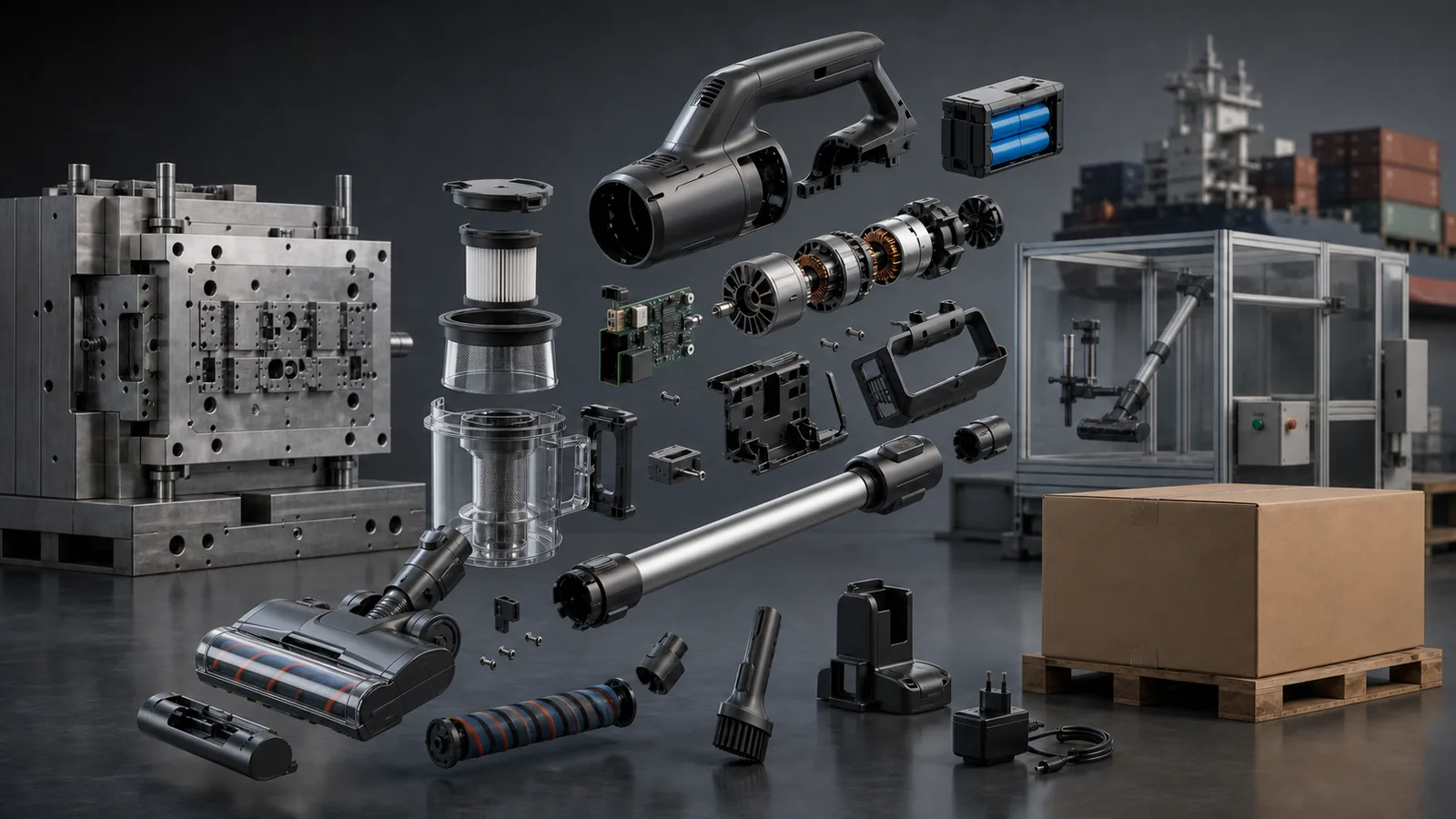
BOM: Where the Money Goes
1. Battery pack
The battery is often the largest single subsystem. Cost is driven by:
- watt-hours, cell format and series/parallel arrangement;
- cell manufacturer and traceability;
- capacity consistency and internal resistance;
- battery-management IC and MOSFETs;
- temperature sensor, fuse and current protection;
- housing, latch, connector and busbars;
- pack assembly, welding and ageing;
- removable versus integrated design;
- certification and transport documentation.
Do not buy on amp-hours alone. Compare nominal voltage, watt-hours, continuous discharge current, peak current, thermal rise, cycle-life test and low-voltage cutoff.
A new cell, capacity, voltage or protection design can affect UN 38.3 applicability. The UN Manual of Tests and Criteria requires lithium battery types to meet subsection 38.3 transport testing, and a test summary must be available.
2. Main motor and air path
The main vacuum motor is not a standalone performance number. Its cost depends on:
- motor type, speed and power density;
- impeller geometry and balance;
- bearings and motor life;
- acoustic treatment;
- thermal design;
- controller and power devices;
- inlet restriction and cyclone loss;
- sealing from floorhead to bin;
- EMC suppression.
A cheaper high-speed motor may create noise, heat, brush wear or early bearing failure. Specify air watts or pickup tests at the complete machine level, plus locked-rotor, blocked-air and thermal-abnormal tests.
3. Powered floorhead
The head can rival the main body in complexity:
- secondary motor and controller;
- gear or belt drive;
- roller material and anti-tangle comb;
- bearing and end-cap access;
- swivel, hose and current path;
- LED lighting;
- floor, dirt or direction sensors;
- large-debris opening and edge seal;
- height, push force and carpet compatibility.
Adding a second roller, active hair cutting or optical dust light affects tooling, electronics, service parts and patents—not just BOM.
4. Plastics and mechanical structure
Plastic cost depends on mass, resin, color, flame rating, transparency, texture and reject rate. Mechanical design includes:
- main shell and hand grip;
- dust cup and cyclone;
- release latches;
- tube and electrical connectors;
- filter housings;
- battery rails;
- dock or wall mount;
- accessory locks;
- fasteners, springs and seals.
Premium appearance can add paint, in-mold decoration, laser marking, soft-touch parts and tighter cosmetic inspection. Every visible Class-A surface increases yield risk.
5. Electronics, charger and user interface
Cost grows with:
- main control PCB and motor drive;
- current, voltage and temperature sensing;
- LED segment or color display;
- dirt sensor;
- floorhead communication;
- charging base and adapter;
- firmware, diagnostics and update method;
- wireless module, if any.
Wireless features introduce account, app, security and additional radio-compliance work. Do not add Wi-Fi simply to improve a specification sheet.
6. Filtration, bin and tools
Sealed filtration is a system, not a filter-media claim. Budget for gaskets, joints, cyclone geometry and complete-machine leakage tests.
The tool bundle can include:
- crevice and dusting tools;
- combination nozzle;
- mini motorized pet tool;
- flexible hose or adapter;
- spare filter;
- wall dock or floor stand.
Each tool adds mold, packaging volume, inventory and after-sales compatibility.
A Percentage-Based BOM Model
For early modeling, use shares rather than pretending component quotes are fixed:
| Subsystem | Planning share of factory cost |
|---|---|
| Battery pack | 22–30% |
| Main motor, fan and control | 15–22% |
| Powered floorhead | 15–25% |
| Plastics, tube and mechanicals | 12–18% |
| Electronics, display and sensors | 5–12% |
| Bin, cyclone, filters and seals | 4–8% |
| Charger, dock and accessory tools | 8–15% |
| Assembly, testing, packaging and factory overhead | 8–15% |
The percentages overlap because actual configurations differ. Build the model from the selected architecture and verified quotations; do not simply add every maximum.
Tooling and NRE
Tooling is not one line called “mold fee.” Separate:
- industrial design and mechanical engineering;
- electrical and firmware development;
- prototypes and appearance models;
- soft tools and rapid molds;
- production injection molds;
- jigs, gauges and line fixtures;
- acoustic and airflow iteration;
- EVT, DVT and PVT builds;
- reliability samples and destructive tests;
- packaging tooling;
- certification sample changes.
Illustrative planning allowances:
| Project scope | NRE/tooling scenario |
|---|---|
| Color, logo, rating label and carton | $2,000–10,000 |
| Light cosmetic, tool or firmware changes | $10,000–40,000 |
| New external plastics and multiple molds | $80,000–250,000 |
| New motor/battery/air-path/floorhead platform | $250,000–800,000+ |
These are not quotes. Cavity count, mold steel, hot runner, texture, expected life, trial rounds and ownership terms can move the result significantly.
Amortize transparently:
`tooling and NRE / expected sellable units in committed program`
A $150,000 program spread over 10,000 units adds $15 before finance and risk. At 100,000 units it adds $1.50. Do not amortize over an aspirational forecast without contractual volume.
Certification and Compliance Budget
The current IEC 60335-2-2:2026 covers household electric vacuum cleaners, including battery-operated appliances and motorized cleaning heads, in conjunction with IEC 60335-1. North American certification commonly uses the applicable UL/CSA vacuum and battery-powered appliance requirements as confirmed by the selected NRTL.
For the European Union, assess the product against:
- Low Voltage Directive 2014/35/EU;
- EMC Directive 2014/30/EU;
- RoHS Directive 2011/65/EU and amendments;
- Battery Regulation (EU) 2023/1542;
- RED if an intentional radio is included;
- WEEE, packaging and national producer-responsibility duties.
For the United States, the final path can include NRTL safety listing, EMC/digital-device evaluation, battery transport, California Proposition 65 assessment, packaging/label rules and retailer-specific requirements.
Use $15,000–50,000 as a first planning allowance for a relatively stable one-platform safety/EMC/battery-transport program in one major market family. Multiple regions, a new battery, wireless radio, failures or redesign can push the total much higher. Get a written test plan from the lab; this range is not a lab quotation.
Compliance work also consumes:
- engineering samples;
- test fixtures;
- destructive units;
- travel and factory audits;
- documentation;
- retest time;
- component traceability;
- annual surveillance fees where applicable.
Lithium-Battery Shipping
Lithium logistics begins in design.
Maintain:
- UN 38.3 test report and test summary;
- cell and pack specifications;
- safety data and emergency information;
- watt-hour marking;
- production quality records;
- package configuration;
- state-of-charge controls when applicable;
- carrier acceptance documents.
IATA’s 2026 battery guidance is based on the applicable ICAO Technical Instructions and 67th Edition Dangerous Goods Regulations. It is guidance, not a substitute for the regulations or a trained dangerous-goods shipper.
Battery changes can interrupt shipping even when the vacuum still works. Lock the cell, BMS, configuration and factory before certification and pilot production.
MOQ, Yield and Quality Cost
MOQ affects more than price:
- battery-cell purchase lot;
- custom color minimum;
- carton and manual printing;
- accessory molding;
- assembly-line changeover;
- finished-goods storage;
- spare-parts production.
Negotiate a pilot MOQ separately from mass-production pricing. A sensible program might use engineering builds, a small validation lot, then a staged production ramp.
Yield is a hidden cost. Track:
- incoming cell and motor rejects;
- air-leak failures;
- floorhead noise;
- cosmetic defects;
- battery calibration;
- charger failures;
- end-of-line functional failures;
- rework and scrap;
- returned-product no-fault-found rate.
Ask for first-pass yield and final yield, not only “AQL passed.” A supplier can ship a lot after extensive rework while hiding an unstable process.
Warranty Reserve and Spare Parts
The factory price often excludes the brand’s real failure cost.
Create a reserve for:
- replacement battery;
- main body or floorhead;
- charger;
- outbound and return shipping;
- diagnostics and labor;
- retailer deduction;
- customer-service handling;
- unsellable returns;
- parts stock after discontinuation.
Model:
`failure rate × average claim cost + retailer return allowance + service overhead`
Specify spare-parts purchase rights, price validity, minimum support period and the ability to order batteries, filters, rollers, motors, PCBs, chargers and latches. A low-cost product with no battery or floorhead supply creates poor lifetime economics.
Packaging, Freight and Landed Cost
Packaging cost depends on:
- carton volume and dimensional weight;
- molded pulp, foam or corrugated inserts;
- accessory count;
- drop and vibration requirements;
- dangerous-goods labels and documents;
- retail graphics and languages;
- pallet pattern and container utilization.
Then calculate:
`EXW or FOB price`
`+ origin handling and inland freight`
`+ ocean, rail or air freight`
`+ insurance`
`+ duty, tariff and trade-remedy charges`
`+ brokerage, port and documentation fees`
`+ inspection and relabeling`
`+ warehouse inbound and storage`
`+ finance and inventory carrying`
`+ warranty and returns reserve`
Duty must be verified at shipment against HS classification, origin, customs value, trade measures and import date. Do not write a fixed tariff percentage into a long-term product plan.
ODM vs Custom Development
Existing ODM platform
Best when speed, lower NRE and known certification matter. The risks are shared appearance, limited differentiation, component substitutions and channel conflict.
Semi-custom platform
Changes visible parts, battery, tools, color, firmware or floorhead while retaining proven architecture. This often provides the best balance, but every changed safety-critical component must be reviewed.
Full custom platform
Justified when airflow, ergonomics, patents, battery ecosystem or industrial design creates durable advantage. Budget more time for iteration, certification and yield stabilization.
Do not pay full-custom NRE for a product whose sales forecast only supports a private-label program.
RFQ Template: What to Request
Ask every supplier for the same boundary:
- model and platform revision;
- complete BOM at controlled level;
- cell manufacturer, pack Wh and BMS;
- motor and complete-machine test data;
- floorhead motor, roller and hair test;
- filter-media and sealed-system evidence;
- included tools, charger and packaging;
- EXW and FOB price at several quantities;
- MOQ by color, carton and battery;
- tooling/NRE breakdown and ownership;
- certification reports and gap list;
- UN 38.3 report and test summary;
- pilot, mass-production and capacity plan;
- first-pass yield and reliability plan;
- component-change control;
- warranty terms and spare-parts commitment;
- Incoterm, port, payment and quotation validity.
Require golden samples, signed specification, critical-component list and engineering-change approval before deposit.
Where to Reduce Cost Safely
Good cost-down targets:
- simplify cosmetic parts and finishes;
- share tools and filters across SKUs;
- reduce low-value accessories;
- improve carton cube;
- optimize fasteners and assembly;
- use a proven battery platform;
- improve yield before negotiating pennies from components.
Do not casually reduce:
- cell grade and protection;
- charger isolation;
- motor thermal margin;
- wire size and connectors;
- flame-rated material;
- floorhead guarding;
- filter sealing;
- abnormal-operation protection;
- reliability sample size.
Cost reduction that creates battery, fire, recall or return risk is not savings.
FAQ
How much does it cost to manufacture a cordless vacuum?
For early planning at meaningful volume, use about $32–48 for a basic existing ODM platform, $50–80 for midrange and $85–140+ for premium. Obtain controlled quotations for the exact specification.
What is the biggest BOM item?
The battery is commonly the largest single subsystem, followed by the main motor/air path and powered floorhead. Architecture changes the ranking.
How much does tooling cost?
Simple branding can be a few thousand dollars. New visible plastics can require tens or hundreds of thousands. A new complete platform can exceed several hundred thousand dollars.
Does the factory quote include certification?
Sometimes existing reports are referenced, but market-specific testing, new battery work, labels, surveillance and retests may be excluded. Require a certification responsibility matrix.
Why does landed cost change after ordering?
Freight, duty, trade measures, port fees, exchange rates, inspection, rework and warehouse charges can change. Define Incoterm and refresh the landed model before each purchase order.
Can I use the supplier’s UN 38.3 report?
Only if the shipped cell and pack configuration genuinely match the tested type and the required test summary is available. Changes in energy, voltage, cells, protection or construction need technical review.
Bottom Line
The correct cordless-vacuum cost is a model, not a magic factory number. Start with a controlled architecture and BOM, add tooling amortization, certification, yield, lithium logistics and warranty, then calculate duty and warehouse cost at the actual shipment date. A comparable RFQ and a stable change-control process are the fastest route to a defensible product budget.
For the development process, read our cordless vacuum OEM and ODM guide, cordless vacuum manufacturers in China and hidden risks in cordless vacuum development.