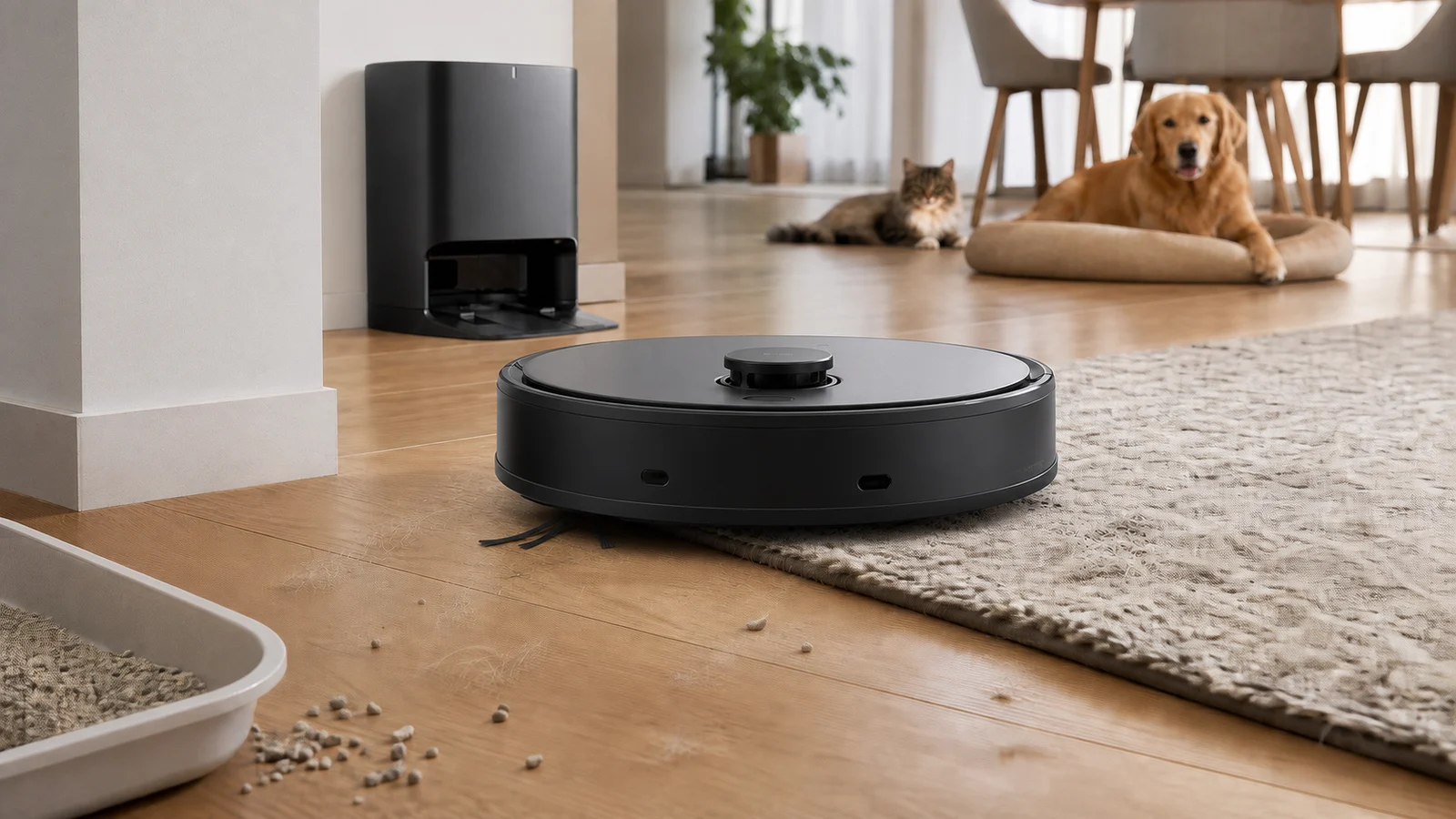
- The best pet-hair robot is the one that removes the household's actual fur from its actual floors without moving the maintenance burden to brush ends, side-brush hubs or the dock.
- Test hard-floor fur, embedded carpet hair, long-hair tangles and dock transfer separately; suction pressure alone cannot predict the result.
- Include bags, filters, brushes, odor control, cleaning time, returns and parts in the annual cost—not just the robot's purchase price.
In this article 14 sections
The best robot vacuum for pet hair is not necessarily the model with the largest suction number. Choose the system that removes your pet’s real fur from your real floors, transfers the hair through the dock reliably, avoids pet hazards and stays easy to maintain after weeks of daily use.
Pet-hair performance is a chain. Floor contact loosens hair, airflow carries it, the bin holds it, the dock transfers it, filters contain fine material and the owner cleans the parts. One weak link can make a powerful robot frustrating.
Start With the Pet-Hair Task
“Pet hair” describes several different cleaning problems:
| Task | Typical failure |
|---|---|
| Loose short fur on hard floor | Side brush scatters it or exhaust airflow pushes it away |
| Embedded fur in carpet | Weak agitation leaves hair woven into fibers |
| Long pet hair or human hair | Hair wraps around brush ends, axles and side-brush hubs |
| Hair along walls and furniture | Round robot or poor edge brush misses the strip |
| Hair plus litter or kibble | Fast side brush scatters granules |
| Hair inside the onboard bin | Dense fur blocks dock transfer |
| Dander and fine dust | Leakage or careless emptying returns particles to the room |
Count the pets, note coat length and identify the highest-shedding season. Then map floor types and the rooms where fur accumulates. A short-haired dog on hard flooring creates a different requirement from two long-haired cats on medium-pile carpet.
Brush Design Matters More Than a Label
Robot vacuums use bristled rollers, rubber rollers, mixed-material rollers, single brushes and dual counter-rotating brushes. Manufacturers increasingly market “anti-tangle” designs, but the term has no universal test.
A rubber brush can reduce the number of bristles around which hair winds. Dual rollers can improve contact and material transfer. A comb or cutting feature may strip hair from the roller. None of these prevents hair from reaching end caps and bearings.
Inspect five locations after every test:
- center of the main brush;
- both removable end caps;
- fixed drive end and bearing;
- side-brush hub;
- wheel and caster axles.
A robot that keeps the visible brush clean but packs hair behind an end cap has not eliminated maintenance. It has hidden it.
The side brush deserves special attention. Long arms may sweep wall edges well, yet pet hair can wind tightly around the hub. Some current designs change bristle angle, use two arms instead of three or add anti-tangle geometry. Ask how the side brush is removed and whether the user can clear the shaft without tools.
Suction, Airflow and Sealing
Suction pressure in pascals is widely advertised because it creates an easy comparison. It is not a complete pickup measurement.
Static pressure helps overcome resistance. Airflow transports particles. The brush must first release embedded hair, and the nozzle must keep enough contact with the floor. A dirty filter, leaking bin seal or blocked duct can reduce performance even while the motor remains powerful.
Do not compare:
- one brand’s maximum Pa with another brand’s “times stronger” claim;
- spot-clean maximum mode with normal whole-home mode;
- a new filter result with a filter loaded after weeks of pet use;
- hard-floor pickup with carpet pickup.
For carpet, look for automatic boost, stable brush contact and enough traction to cross the rug without lifting or bunching it. Test the lowest-power daily mode as well as maximum. A robot that only succeeds at its loudest setting may not fit overnight scheduling.
Hard Floor and Carpet Need Separate Tests
Loose fur on hard flooring is light and mobile. A high-speed side brush can throw it outside the cleaning path. Some robots recognize granular material and slow the side brush, but ordinary fur may still move in exhaust air.
Carpet is the opposite problem. Fur can become mechanically embedded. The robot needs repeatable agitation and enough passes. High pile can reduce nozzle seal, increase wheel load and interfere with small side brushes.
Use the same prepared material:
- spread a measured or photographed amount of short fur over one square meter of hard floor;
- work the same type of fur lightly into a defined carpet area;
- place equal long strands across both surfaces;
- add a small, counted quantity of dry litter away from the pet.
Run one pass in the recommended automatic mode. Photograph residue, inspect tangles and weigh or estimate recovery. Run a second pass and record the added gain. A second pass that dramatically improves results may be acceptable if scheduling time and battery capacity allow it.
Edge, Corner and Furniture Performance
Pet fur migrates to baseboards, under sofas and around table legs. This makes edge coverage more important than a clean open-floor demonstration.
Measure robot height and the lowest furniture opening. Leave a safety margin for uneven floors, rugs and furniture sag. A robot that fits under most of a sofa but wedges under one crossbar can require more rescues than a taller model excluded with a no-go zone.
Test:
- a straight wall;
- an inward corner;
- a chair-leg cluster;
- the underside of the main pet bed;
- the wall beside the feeding area.
Extendable side brushes can improve reach, but they also add joints and control logic. Evaluate residual hair and weekly cleaning time, not the promise of “100% edge coverage.”
The Dock Must Transfer Hair Reliably
Self-emptying is valuable in a shedding household only if the dock can remove compressed fur from the robot’s bin.
Hair forms springy mats. A narrow outlet, sharp duct turn or partially loaded filter can leave a plug behind. The app may report a completed empty cycle while the bin remains full.
Test the dock after:
- one normal daily run;
- a heavy-shedding carpet run;
- litter mixed with fur;
- a week without manual bin inspection;
- a partly filled dock bag or cyclone bin.
Open the onboard bin after each transfer. Record remaining material and any manual clearing.
Bagged docks contain debris in a disposable bag and may reduce direct dust exposure. They create recurring cost and dependence on compatible bags. Bagless cyclone docks avoid bag purchases but require the user to empty and clean the container, which can release fine dust.
For allergy-sensitive buyers, observe the entire disposal event. A filter rating does not help if a cloud escapes during emptying.
Our self-emptying robot vacuum market guide explains the dock formats and service implications.
Filtration Is a System, Not One Filter
Pet homes contain hair, dander, fine soil and litter dust. Filtration performance depends on:
- filter media;
- seal around the filter;
- bin and duct seals;
- exhaust location;
- dock transfer leakage;
- bag or cyclone design;
- replacement interval;
- how the user handles dirty parts.
Do not assume “HEPA-style,” “high efficiency” and a certified whole-system claim mean the same thing. Ask the supplier for the exact test standard, particle size, efficiency, airflow and whether the result covers the complete machine or only the material.
A highly efficient filter that clogs rapidly can reduce airflow. Check whether it is washable, how long it must dry and whether washing changes the warranty. Keep a dry spare if the manufacturer permits washing.
Odor Control and Consumables
Pet hair carries skin oils and environmental odor. A warm dock containing fur, dirty mop water and damp filters can become an odor source.
Odor-control bags, deodorizing cartridges, silver-ion modules and hot-air drying can help manage parts of the system. They do not replace:
- emptying dirty water promptly;
- drying washable parts completely;
- removing hair from seals and ducts;
- cleaning the dock tray;
- replacing saturated filters;
- using only approved solution.
Avoid adding fragrance, disinfectant or essential oil unless the manufacturer explicitly approves it. Chemicals can foam, damage plastics or seals, leave floor residue and create exposure risks for pets.
Calculate 12-month consumables:
| Item | Quantity input |
|---|---|
| Dock bags | Actual change interval during shedding season |
| Robot filters | Manufacturer interval adjusted for visible loading |
| Main and side brushes | Wear and tangle damage, not calendar alone |
| Mop pads or roller | Wash cycle and replacement life |
| Cleaning solution | Local approved product and shipping |
| Odor cartridge or deodorizer | Optional recurring use |
| Battery reserve | Warranty and expected service horizon |
The cheapest robot can become expensive if proprietary consumables are unavailable or sold only in bundles.
Pet Waste, Bowls and Toys
Obstacle recognition is a risk-reduction feature, not permission to ignore the floor.
Current robots may identify cords, socks, toys, bowls and pet waste with cameras and depth sensors. Performance varies with object size, color, lighting, angle, firmware and floor pattern. No system should be treated as infallible around wet or solid pet accidents.
Use this operating rule:
- inspect the floor before every unattended run;
- schedule after the pet’s established routine;
- exclude litter boxes, puppy-pad zones and unpredictable accident areas;
- remove strings, feather toys, cords and thin chew items;
- keep food and water bowls inside a protected zone if collisions are possible.
Do not use a robot vacuum or mop to clean fresh urine, vomit or feces. Stop the robot, isolate it, follow the manufacturer’s contamination-cleaning instructions and clean the floor manually with a pet-safe method.
Mopping Has a Narrower Role
A combo robot can remove dry paw prints, light tracked soil and everyday films from sealed hard flooring. It should not be used to spread an unknown pet mess.
For pet homes, test:
- carpet detection and mop lift;
- edge of washable rugs;
- water flow near feeding areas;
- dirty-water retention and dock odor;
- whether hair clogs the wash tray or scraper;
- approved solution and floor-material limits.
If the household’s main need is embedded carpet fur, paying for an advanced mop dock may produce less value than better carpet agitation and reliable auto-emptying.
A Seven-Day Pet-Hair Test
A single demonstration can hide maintenance. Run a sample for seven days.
Day 1: Map and safety
Build the map, define pet zones, measure low furniture and test common obstacles in bright and dim light.
Day 2: Hard-floor fur
Use a prepared short-hair load. Record scatter, first-pass residue, edge residue and bin transfer.
Day 3: Carpet fur
Use the same load on the main rug. Record pickup, repeat-pass improvement and brush contact.
Day 4: Long-hair tangle
Add a controlled quantity of long strands. Inspect the roller center, end caps, bearings, side brush and wheels.
Day 5: Fur plus litter
Use dry litter and fur. Check scatter, duct blockage, filter loading and dock transfer.
Day 6: Normal whole-home run
Run the preferred schedule. Record noise, pet reaction, interventions, missed zones and runtime.
Day 7: Maintenance audit
Time every cleaning task. Photograph the brush ends, bin, filter, dock inlet, bag or cyclone, wash tray and seals. Price the parts used.
This method reveals whether “anti-tangle” means two minutes of weekly work or twenty.
Retailer and Distributor Scorecard
A retailer needs more than an impressive demo. Score each candidate on:
- hard-floor short-fur pickup;
- carpet embedded-fur pickup;
- long-hair wrap after repeated cycles;
- edge and corner residue;
- fur-and-litter scatter;
- onboard-bin-to-dock transfer;
- disposal dust exposure;
- pet-waste avoidance evidence and limitations;
- brush, filter and dock cleaning time;
- bag and consumable availability;
- parts, repair and firmware support;
- return rate and contamination handling.
Do not publish a “pet model” badge without defining the test behind it. Product teams and OEM buyers can adapt the same protocol during sample approval; see our robot vacuum OEM/ODM guide.
How to Choose
Prioritize a dual-rubber or proven anti-tangle system when long hair is the main burden, but inspect the end caps.
Prioritize carpet agitation, automatic boost and repeatable navigation when embedded fur is the problem.
Prioritize sealed bagged auto-emptying when the user wants less direct dust contact and accepts bag cost.
Prioritize bagless collection when recurring bag supply is a concern and the user can empty and wash the cyclone safely.
Prioritize strong obstacle recognition and conservative schedules where toys, bowls and possible accidents create risk.
Choose a simpler vacuum-only model when mopping does not address the household’s main task.
Brand reputation is useful, but field performance, parts and service decide ownership. Our Roborock vs Roomba comparison shows how two established ecosystems can take different brush, navigation and dock approaches.
FAQ
What is the best robot vacuum for pet hair?
The best model is the one that passes a test with your pet’s coat and floor types while keeping brush, dock and filter maintenance acceptable. There is no universal winner for short fur on hardwood, long hair and embedded carpet fur.
Is higher suction better for dog hair?
It can help, but brush agitation, floor contact, airflow, sealing and cleaning speed are also critical. Compare recovery in the same test, not Pa alone.
Are rubber brushes better for long hair?
Rubber designs often reduce wrapping around bristles, but hair can still collect at brush ends, bearings, side brushes and wheels. Inspect all of those points.
Do self-emptying docks handle pet hair?
Good systems can, but dense fur may bridge in the onboard bin or duct. Test dock transfer after a heavy-shedding run and with a partly filled bag or cyclone.
Is a bagged dock better for allergies?
A sealed bag may reduce contact during disposal, but whole-system sealing, filters and the change procedure matter. Do not infer medical benefit from a bag alone.
Can a robot vacuum clean pet accidents?
No. Fresh liquid or solid pet waste should be cleaned manually. Even robots with waste recognition can miss an object, and spreading contamination can damage the machine and home.
How often should a robot vacuum run with pets?
Daily maintenance can prevent fur buildup in many homes, but the schedule should reflect shedding level, floor area, noise tolerance, battery capacity and pet routine.
How much do consumables cost?
Costs vary by model and market. Calculate bags, filters, brushes, mop parts, solution and shipping for 12 months, then add the owner’s cleaning time and expected parts availability.