- Choose DJI ROMO P when low-profile solid-state LiDAR, fine-object sensing, twin rotary pads, bagged dust isolation and its hygiene extras fit the home—and official regional support is confirmed.
- Choose DEEBOT X11 OmniCyclone when a continuously refreshed roller mop, published multi-threshold ability, task-time charging and a bagless cyclone dock matter more.
- Do not choose from suction pressure alone: brush design, airflow, carpet behavior, dock hygiene, consumables, app region and after-sales support determine the better system.
In this article 13 sections
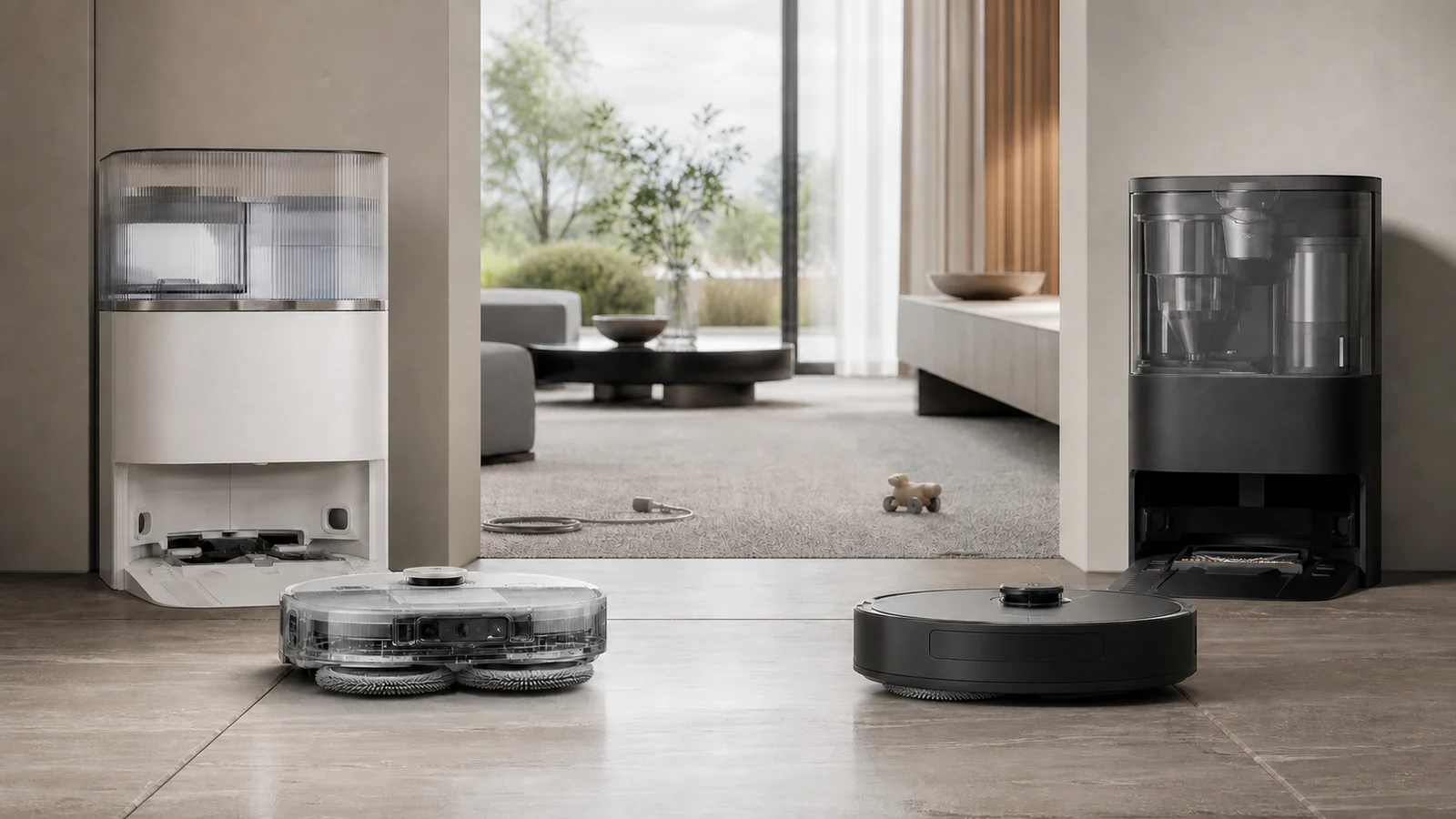
Choose DJI ROMO P when low-profile perception, careful avoidance of thin household objects, twin rotary mops, a bagged dock and hygiene functions fit your priorities—and DJI can support the product in your market. Choose ECOVACS DEEBOT X11 OmniCyclone when a continuously refreshed roller mop, stronger published threshold handling, in-task charging and a bagless cyclone dock are more valuable.
The two systems are not simply a 25,000 Pa robot versus a 19,500 Pa robot. Their mopping hardware, dust disposal, navigation stack and regional support create larger ownership differences than the suction number.
Quick Comparison
| Decision factor | DJI ROMO P | ECOVACS DEEBOT X11 OmniCyclone |
|---|---|---|
| Positioning | Hygiene-focused flagship with transparent robot and dock | Flagship roller-mop robot with bagless cyclone dock |
| Navigation and avoidance | Binocular fisheye vision plus wide-angle solid-state LiDAR | dToF navigation plus AIVI 3D 3.0 RGBD avoidance |
| Published suction | Up to 25,000 Pa | Up to 19,500 Pa; ECOVACS also publishes 18 L/s airflow |
| Hair system | Dual anti-tangle roller brushes | ZeroTangle 3.0 main and ARClean side brush |
| Mopping | Two rotary mop pads; 164 mL onboard tank | OZMO Roller 2.0 continuous-water roller at 200 rpm |
| Edge work | Dual extendable cleaning arms | TruEdge 3.0 roller extension of 0.59 in |
| Threshold claim | Confirm on the exact regional specification and in the home | 0.94 in single threshold; up to 1.57 in compound/track threshold |
| Energy strategy | Published battery life up to about three hours | 6% charge in three minutes during mop-wash breaks |
| Dust disposal | Large dust bag in hygiene dock | PureCyclone bagless collection |
| Dock wash | High-pressure jet washboard cleaning and hot-water mop washing | 167°F / 75°C hot-water soak wash |
| Market certainty | Sales, app and service vary by country | Current US product and support pages are available |
All performance numbers above are manufacturer claims collected from different tests. They are useful for screening, not for declaring a laboratory winner.
Confirm the Exact Product and Market First
“ROMO P” should mean the P Water Tank Version, not ROMO S or ROMO A. P adds the transparent base station and hygiene features such as UV treatment and automatic deodorizing. Core navigation and 25,000 Pa suction are shared across the family.
“X11” should mean DEEBOT X11 OmniCyclone. ECOVACS can sell closely related station or regional variants, and bundles may include different solutions or accessories.
Before comparing a quotation, record:
- full model and region code;
- water-tank or plumbing configuration;
- included dust bags, detergent, brushes, filters and mop parts;
- app-store country and account region;
- local warranty provider and repair address;
- battery, motor and dock warranty exclusions;
- replacement-part SKUs and delivery time;
- firmware support and end-of-life policy.
This step is especially important for ROMO. DJI sells ROMO in multiple markets, but availability and official support are not uniform worldwide. An imported unit can appear attractive until the buyer discovers that the app region, consumables or warranty path do not match.
Navigation and Small-Object Avoidance
DJI brings a low-profile sensor architecture to ROMO. The robot combines high-performance binocular fisheye cameras with wide-angle solid-state LiDAR. Because the LiDAR does not require a large rotating tower, the robot is designed to perceive without the conventional raised turret that often sets furniture-clearance limits.
DJI describes millimeter-level obstacle sensing and close cleaning around thin objects. The company also states important conditions: visual performance can fall on glossy or low-texture surfaces and requires some ambient light. Cables, mirrored furniture, black objects and transparent items therefore still need a home trial.
ECOVACS combines dToF navigation with AIVI 3D 3.0 RGBD perception. Its system uses color and depth information to classify and approach obstacles, while the navigation sensor supports mapping and route planning. ECOVACS also promotes a vision-language model for more contextual object handling.
Neither architecture makes floor preparation obsolete. A good test set includes:
- a dark charging cable on light flooring;
- a pale cable on a patterned rug;
- a low sock near a wall;
- a small toy with thin legs;
- a reflective chair base;
- a pet bowl and a simulated spill kept outside electronics;
- a dim corridor leading into a bright room.
Run the same route several times. Record contact, avoidance distance, missed floor area, false no-go behavior and whether the robot resumes its original cleaning line.
The earlier DJI ROMO P vs Roborock Saros 10R comparison explains the low-profile navigation trade-off in more depth.
Vacuuming, Hair and Carpet
ROMO P carries the larger pressure claim at 25,000 Pa. DJI pairs that motor with dual anti-tangle roller brushes and automatically changes suction and side-brush behavior for granular debris. DJI has published a zero-tangle result under a controlled one-gram hair test; that should not be translated into “never tangles” in a long-haired household.
X11 publishes 19,500 Pa, a 100 W motor and 18 L/s airflow. Its BLAST architecture emphasizes airflow as well as pressure. ZeroTangle 3.0 combines the main brush with an ARClean side brush intended to reduce hair wrapping at both collection stages.
Pressure is not the same as pickup. Carpet performance also depends on:
- brush contact and agitation;
- sealed airflow from floor to bin;
- automatic carpet boost;
- wheel traction and cleaning speed;
- hair length, fiber type and carpet pile;
- filter loading over time.
For a pet-home trial, weigh or photograph a repeatable mix of short fur, long hair and granular litter. Test hard floor, rug edge and the most difficult carpet. Then inspect the main brush ends, side-brush hub, intake, dust box and dock transfer path.
X11’s Triple Lift system changes which component touches the floor: it can raise the roller mop on carpet, raise the side brush around large debris and raise the main brush near detected liquid. ROMO offers separate vacuum, mop, vacuum-and-mop and vacuum-then-mop modes. Buyers with delicate rugs should test both detection accuracy and the physical lift clearance rather than relying on a mode name.
Rotary Pads vs Roller Mopping
This is the central hardware difference.
ROMO P uses two circular rotary mop pads. The pads provide repeated scrubbing, and dual extendable arms help them reach along edges and into corners. The robot carries a 164 mL water tank and can apply cleaning solution or floor deodorizer to the pads.
X11 uses OZMO Roller 2.0. ECOVACS supplies fresh water continuously to a cylindrical roller, which rotates at a published 200 rpm while a scraper manages dirty water and debris. TruEdge 3.0 can extend the roller 0.59 in toward a wall.
A roller can maintain a more continuously refreshed contact surface during a dirty pass. Rotary pads offer broad, simple scrubbing coverage and are easy to inspect and replace. Neither method guarantees stain removal.
Test the systems on:
- dried coffee or safe colored water;
- a thin oily kitchen film;
- tracked fine soil;
- grout transitions;
- a wall edge and inward corner;
- a clean floor immediately after the dirty zone, to check redeposition.
Use manufacturer-approved solution only. Too much detergent can leave residue, attack seals or create foam in the recovery path.
Thresholds and Low Furniture
ECOVACS publishes the clearer threshold specification. TruePass uses an adaptive mechanical four-wheel-drive system. The company lists 0.94 in for a single threshold and up to 1.57 in for a track-style or compound threshold under its conditions.
Those numbers do not mean the robot will cross every object of that height. Edge profile, width, surface grip, approach angle and the drop on the far side all matter. A rounded transition strip is different from a sharp metal lip.
DJI’s low-profile solid-state sensing can be attractive under beds and cabinets, but the exact clearance still needs measurement. Add 3–5 mm of safety margin for uneven floors and furniture sag. A robot that barely fits can damage its top surface or trap itself after a rug shifts.
Measure every critical opening and threshold before purchase. Photograph it next to a ruler and include the evidence in a dealer quote.
Runtime and Task Completion
DJI publishes battery life up to approximately three hours for the ROMO family. That is a useful ceiling, not an expected runtime in maximum suction with frequent carpet boost and mopping.
ECOVACS approaches long tasks differently. X11’s PowerBoost can add a stated 6% charge in three minutes while the robot is already at the dock for mop washing. ECOVACS claims the system can sustain cleaning across up to 10,764 sq ft / 1,000 m² without a conventional long charging interruption.
The real comparison is task completion:
- how often the robot returns to wash;
- how much charge it gains or loses per visit;
- time spent navigating to and from the dock;
- whether it resumes in the correct place;
- clean-water and dirty-water capacity;
- carpet proportion and suction mode;
- final completion time and intervention count.
A three-hour battery and a fast opportunistic-charge strategy can both work. The better system is the one that finishes the buyer’s map within the allowed schedule.
Dock Design: Bagged Hygiene vs Bagless Economy
ROMO P uses a large dust bag in its Health-Guard dock. A sealed disposable bag can reduce direct contact with collected dust when changed correctly. It also creates a recurring consumable and requires reliable bag supply.
DJI’s station uses high-pressure water jets to wash the washboard and a large waste outlet to remove debris. Its “200 days maintenance-free” claim applies to the washboard under test conditions—not to filling water, emptying the dirty tank, cleaning hair, wiping seals or replacing bags and filters. P adds UV and deodorizing functions, but these features do not replace physical cleaning.
X11’s OMNICYCLONE dock uses a PureCyclone bagless dust collector. That avoids buying dust bags and lets a user see the collected material. Emptying a reusable bin can, however, release fine dust. Allergy-sensitive households should test the emptying method and clean the cyclone and seals on schedule.
The X11 station uses 167°F / 75°C hot-water soak washing for the roller and supports two cleaning liquids. The heavy-duty solution may be sold separately. Hot water can help with oily soil, but dirty tanks, tubing and seals still require routine inspection.
Model the dock over one year:
| Cost or task | ROMO P | X11 OmniCyclone |
|---|---|---|
| Dust handling | Replacement bags | Reusable cyclone bin cleaning |
| Mop part | Twin pads | Roller and scraper-related wear parts |
| Water system | Tanks, washboard, waste path | Tanks, roller wash path, waste path |
| Liquid | Cleaning solution and optional deodorizer | Standard and optional heavy-duty solution |
| Hygiene work | Bag change plus tank and seal cleaning | Bin emptying plus cyclone, tank and seal cleaning |
“Bagless” is not maintenance-free, and “hygiene dock” is not self-sanitizing forever.
App, Privacy and Cloud Support
Both products depend on mobile apps for mapping, schedules, room settings, restricted zones and firmware. Both also use cameras for navigation.
DJI lists ROMO security certifications including ETSI EN 303 645 and a UL Solutions Diamond IoT Security Rating. DJI also publicly disclosed that a backend validation issue affecting ROMO and DJI Home was identified in late January 2026 and remediated. The useful procurement lesson is not to ignore the product or to assume certification prevents every defect. Ask how a supplier receives advisories, deploys patches and verifies completion.
For either system, document:
- whether camera viewing can be disabled;
- where cloud data is processed for the account region;
- how maps and video-derived data are deleted;
- account transfer when a unit is returned or resold;
- functions that remain available without internet;
- multi-factor authentication and household sharing;
- minimum supported phone OS;
- security-contact and update policy.
Distributors should include factory reset and account removal in every return inspection. A refurbished robot must not retain the previous customer’s map or credentials.
Consumables, Repair and Warranty
ECOVACS currently provides a US support page for X11 with manuals, FAQs and links to rollers, brushes, filters, cleaning liquids and kits. That visible parts path lowers—but does not eliminate—service risk.
DJI has ROMO support materials and store listings in supported markets. Before importing or distributing it, verify that the exact country has official sales, compatible power, a working app region, local warranty handling and replenishment stock.
Ask both suppliers for:
- 24-month demand estimates for brushes, filters, mops/roller, bags and solution;
- battery, wheel module, pump and dock repair procedures;
- diagnostic log access and privacy controls;
- DOA and repeat-repair replacement rules;
- labor reimbursement and shipping responsibility;
- firmware-support duration;
- parts availability after model discontinuation.
For a broader brand-positioning view, see our Dreame vs ECOVACS robot vacuum comparison and DJI ROMO launch analysis.
Final Decision
Choose DJI ROMO P when:
- fine-object sensing and low-profile navigation perform well in the actual home;
- twin rotary pads and extendable arms match the floor plan;
- a bagged dust path and P’s hygiene extras are preferred;
- the buyer accepts recurring bags and approved liquids;
- official regional sales, App, parts and warranty are documented.
Choose X11 OmniCyclone when:
- roller mopping produces better results on the buyer’s recurring soils;
- thresholds need the published TruePass range;
- PowerBoost helps finish a large map;
- a bagless dock is preferred and the user can manage dust during emptying;
- established ECOVACS support exists in the target market.
Choose neither from a specification sheet alone if the home has critical cables, mirrored furniture, delicate rugs, sharp thresholds, severe allergies or no authorized service route. A repeatable sample-unit trial is the correct final gate.
Buyer and Dealer Test Checklist
- Confirm exact SKU, power standard, app region and seller authorization.
- Measure low furniture and every threshold.
- Run a repeated small-object obstacle course in bright and dim light.
- Test hair, litter and carpet with the same prepared load.
- Compare rotary-pad and roller-mop redeposition on the same stain.
- Record one full clean, wash, charge and resume cycle.
- Empty each dust system and assess dust exposure and cleanup time.
- Inspect clean and dirty water paths after one week.
- Price one year of all consumables and shipping.
- Confirm warranty, parts, firmware and security-response terms in writing.
FAQ
Is DJI ROMO P better than DEEBOT X11?
Not universally. ROMO P emphasizes low-profile sensing, twin rotary mops, bagged disposal and hygiene extras. X11 emphasizes a refreshed roller mop, published threshold ability, in-task charging and a bagless dock. The better choice depends on floors, obstacles, allergy needs and local support.
Which one has stronger suction?
DJI publishes up to 25,000 Pa for ROMO P, while ECOVACS publishes 19,500 Pa and 18 L/s airflow for X11. Because pressure and airflow were not measured in one independent test, the figures do not by themselves prove better pickup.
Does ROMO P have a roller mop?
No. ROMO P uses two rotating circular mop pads. DEEBOT X11 uses the cylindrical OZMO Roller 2.0 system.
Which dock is cheaper to maintain?
X11 avoids disposable dust bags, but its cyclone bin needs emptying and cleaning. ROMO P adds recurring bag cost but may reduce direct dust contact. Compare local consumable prices and user labor, not bag price alone.
Which is better for pet hair?
Both have anti-tangle brush strategies. Test the household’s actual hair length on both carpet and hard floor, then inspect the main brush ends, side brush and dock transfer path. Manufacturer tangle claims are not a substitute for that test.
Can X11 cross higher thresholds?
ECOVACS publishes up to 0.94 in for a single threshold and 1.57 in for certain compound or track thresholds. Shape and grip matter, so measure and test the buyer’s exact transition.
Is DJI ROMO P available in the United States?
Do not assume so from a foreign DJI Store listing or an English-language media page. Confirm the current official sales, app and warranty status for the buyer’s country before ordering.
Are robot-vacuum cameras a privacy risk?
They create a data-governance responsibility. Review camera controls, account security, cloud region, deletion, factory reset, firmware and vulnerability-response practices for either product.