- Choose Little Green 1400B for its 48-ounce clean tank, compact established platform and broad BISSELL parts ecosystem.
- Choose CleanSlate Pet FH14000V for its 7-inch WidePath and TightSpot tool combination, removable dirty-tank lid and two-year cited household warranty.
- Do not decide from an unsupported suction percentage: compare recovery, residual moisture, tool seal, cleanup time and replacement-part access on the exact SKU.
In this article 16 sections
Choose the BISSELL Little Green 1400B if you prefer a slightly larger clean-water tank, a familiar compact platform and a visible catalog of model-specific parts. Choose the Hoover CleanSlate Pet FH14000V if a wide tool for stairs and cushions, a separate tight-space tool, removable dirty-tank lid and the cited two-year household warranty matter more.
Neither is automatically the stronger extractor. The brands do not publish directly comparable air-watt, sealed-suction and airflow data for these models. A useful comparison therefore has to follow the entire spray–agitate–recover–clean–store workflow.
This article compares the current US Little Green 1400B and CleanSlate Pet FH14000V. Accessories, warranty and specifications can change by suffix, retailer and country.
Little Green vs CleanSlate at a Glance
| Decision point | BISSELL Little Green 1400B | Hoover CleanSlate Pet FH14000V |
|---|---|---|
| Product type | Corded portable carpet and upholstery extractor | Corded portable carpet and upholstery extractor |
| Clean-tank capacity | 48 oz | 40 oz |
| Dirty-tank capacity | Not stated on the current product page | 23 oz |
| Hose | Current page lists 4 ft in specs and 4.5 ft in marketing copy | 4.5 ft |
| Cord | 15 ft | 15 ft |
| Main tools cited | 3-inch Tough Stain, Spraying Crevice, HydroRinse | 7-inch WidePath, TightSpot, Hose Rinse |
| Weight | 9.65 lb | Confirm exact retail SKU |
| Warranty cited | One-year limited household warranty | Two-year limited household warranty |
| Best fit | Compact spot work and buyers valuing a mature parts catalog | Mixed large and narrow stains with more specialized included heads |
Sources: BISSELL’s current 1400B listing, BISSELL’s current user guide, Hoover’s current CleanSlate page, and the Hoover product-support page. Specifications above are manufacturer data, not an independent laboratory result.
First, Understand What Both Machines Do
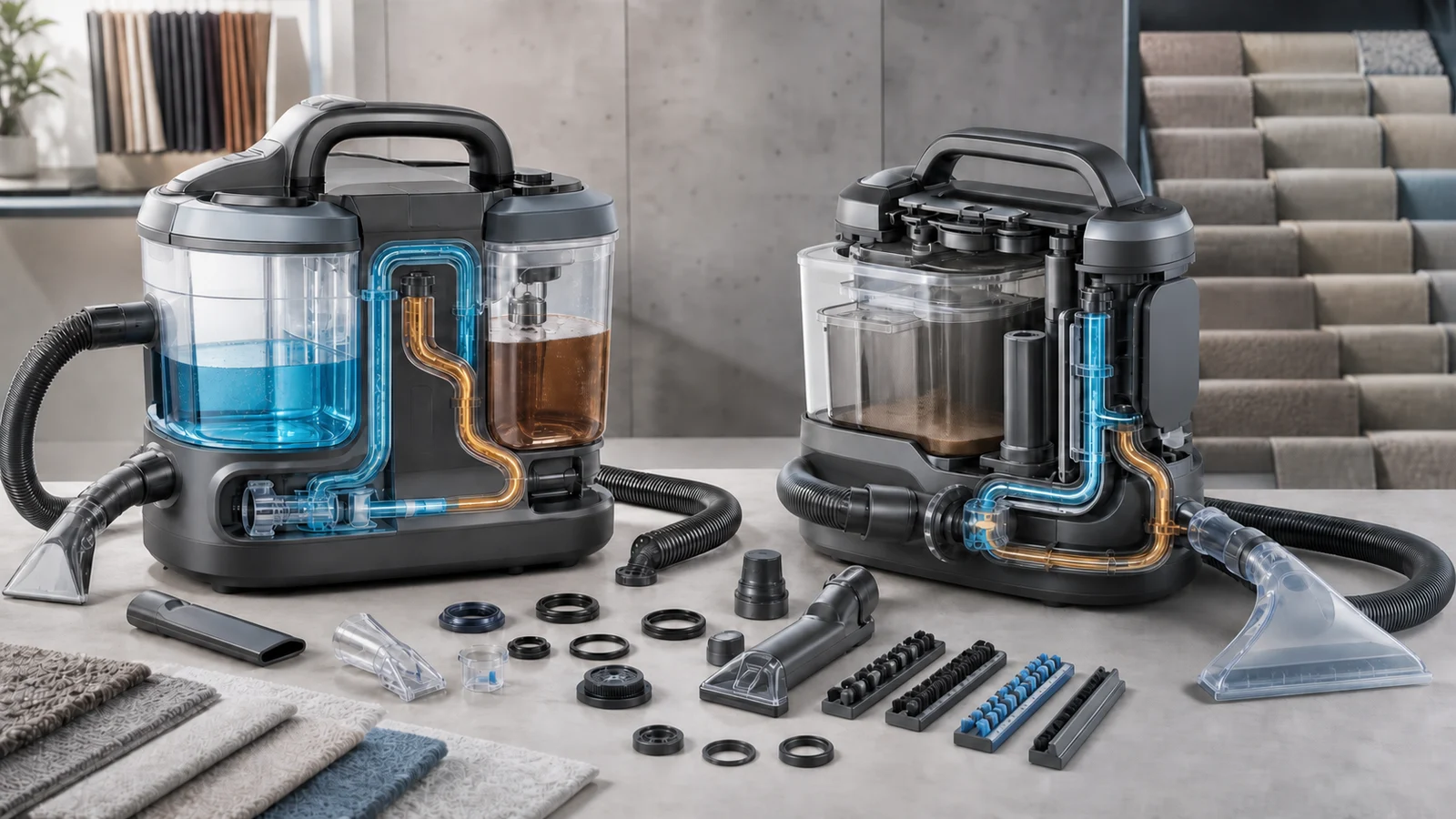
Both machines use the same basic extraction sequence:
- clean solution is sprayed onto a wet-cleanable textile;
- a brush or rubber-nub tool agitates the soil;
- the operator releases the spray trigger;
- the nozzle is pulled slowly across the surface to recover liquid;
- wastewater travels through the hose into a separate recovery tank.
They are not dry vacuums. Loose crumbs, grit and hair should normally be vacuumed first. They are also not steam cleaners, and the cited models do not heat their own water.
If you are still deciding between a portable extractor and a full-size machine, start with our portable carpet cleaner buying guide and spot cleaner vs carpet cleaner comparison.
Suction: Why a Percentage Is Not Enough
Hoover has used promotional imagery claiming a suction advantage over Little Green. The current page does not provide the complete standard, measurement points, specimen condition and repeatable protocol needed to translate that percentage into an independent buying conclusion.
For a wet extractor, the useful outcome is not a motor claim alone. It is:
- how much applied solution is recovered;
- how much moisture remains after two or three dry passes;
- whether the nozzle keeps a seal on flat and contoured surfaces;
- whether the air path loses performance as the recovery tank fills;
- whether foam, hair or debris obstructs the tool, filter or hose;
- how long the textile takes to dry under the same ventilation.
Motor input watts, airflow, sealed suction and air watts describe different things. A brand should not be declared the winner when the two product pages do not publish the same measure under the same method.
A Practical Recovery Test
For retail evaluation, use matched upholstery panels:
- vacuum and weigh each dry panel;
- apply the same measured water-and-approved-formula quantity;
- use the same number of wet and dry strokes;
- weigh the panel immediately and again after a fixed drying period;
- record liquid in the recovery tank, visible residue, edge leakage and operator time.
Repeat the test with the narrow and wide tools. A wide nozzle may cover more area, while a smaller head may keep a more consistent seal on curved cushions or car seats.
Tanks: Capacity Versus Usable Workflow
Little Green lists a 48-ounce clean tank. CleanSlate lists a 40-ounce clean tank and a 23-ounce dirty-water tank.
The larger Little Green clean tank may reduce refills during a longer session, but nominal capacity is not the same as usable cleaning area. Formula ratio, spray habits, stain pretreatment and the recovery-tank stop point all affect the session.
CleanSlate's published 23-ounce recovery capacity means the dirty tank can become the limiting volume before all 40 ounces of solution are consumed. That is not necessarily a defect: wastewater includes soil and foam, and a safety margin helps protect the motor. It does mean operators should learn the maximum line and audible change.
Evaluate:
- visibility of the fill and max lines;
- ease of filling without spilling;
- how positively each tank seats;
- whether caps and gaskets are easy to inspect;
- whether a hand fits into the recovery tank for rinsing;
- whether tanks dry fully before storage.
Hose and Cord Reach
Both current pages cite a 15-foot cord. Hoover lists a 4.5-foot hose. BISSELL’s page currently contains a small internal discrepancy: the specifications say 4 feet while marketing copy says 4.5 feet. Measure the retail unit if reach is critical.
Total reach is not just cord plus hose. The outlet location, machine placement, stair geometry and need to keep the base level determine usable access.
For car detailing, confirm that the base can sit securely outside the vehicle while the tool reaches the far seat and footwell. Pulling the machine by the hose can damage fittings and should not be treated as normal reach.
Tool Strategy: Small Head or WidePath
BISSELL Little Green 1400B
The current package lists:
- a 3-inch Tough Stain Tool for focused extraction;
- a Spraying Crevice Tool for narrow areas;
- a HydroRinse tool for flushing the hose.
This combination favors spot work, seams, vehicle interiors and small upholstery zones. The narrower primary tool can take more passes on a broad stair tread or sofa cushion.
Hoover CleanSlate Pet FH14000V
The current package lists:
- a 7-inch WidePath Tool for larger spots and stair treads;
- a TightSpot Tool for crevices;
- a Hose Rinse Tool;
- interchangeable bristle and rubber-nub inserts on the multipurpose tool.
That gives CleanSlate a clearer included-tool split between broad coverage and tight access. A wider head still needs full surface contact; on heavily contoured upholstery, test whether its lips seal consistently.
For either machine, detachable transparent covers, bristle inserts and nozzle channels matter because hair and sticky residue accumulate where the operator cannot see them.
Heat and Steam: Do Not Confuse Warm Water With Heating
The Little Green 1400B is not the Little Green HydroSteam. The CleanSlate Pet FH14000V is not a steam extractor.
Both manuals permit warm tap water up to 140°F/60°C. That is an input-water instruction, not an onboard heater specification. Do not expect either base model to maintain temperature as water travels through the tank, pump, hose and textile.
Hotter is not always safer. Heat can set some stains, affect adhesives and damage delicate fibers. Follow the textile label, formula directions and machine manual.
Residual Water and Drying Time
Users often interpret a damp cushion as weak suction. Residual moisture can instead come from:
- spraying on every pass rather than separating wet and dry strokes;
- moving the nozzle too quickly;
- lifting one edge of the extraction opening;
- overdosing formula and creating foam;
- using too much pretreatment;
- cleaning absorbent padding rather than only the surface fabric;
- poor ventilation.
After agitation, release the trigger and make several slow dry passes. Keep the nozzle in full contact, then ventilate the area. Hoover’s manual says to keep people and pets off carpet until it is dry; BISSELL similarly directs users to test fabric and follow wet-cleaning restrictions.
Neither machine should be sold with a guaranteed drying-time claim.
Maintenance: The Real Ownership Difference
Portable extractors move organic residue through a warm, dark hose. If the tanks and air path are stored wet, odor and biofilm complaints become predictable.
Little Green after-use routine
BISSELL’s guide directs users to:
- run the HydroRinse tool with the machine on;
- empty and rinse the dirty tank;
- remove and rinse the tool lens;
- rinse the tool;
- remove, rinse and correctly reinstall the duckbill gasket;
- allow components to dry before storage.
CleanSlate after-use routine
Hoover directs users to:
- attach the Hose Rinse Tool and flush with warm water;
- let the unit run briefly after flushing;
- empty and rinse the recovery tank;
- remove and rinse tool inserts and the hand tool;
- clear the debris filter and air path when needed;
- store without solution in the tanks.
CleanSlate’s removable dirty-tank lid and removable bristle components may make inspection easier. Little Green’s mature platform has extensive model-specific support content. The better design is the one the owner will actually clean after every use.
Cleaning Formula and Surface Safety
Both manufacturers specify approved low-foaming formulas. Household dish soap is a poor substitute: foam can occupy recovery volume, travel toward the motor and distort pickup behavior.
Before cleaning upholstery:
- check the care label;
- use only textiles marked for wet cleaning, such as W or W/S under the Hoover guidance;
- avoid S-only fabrics;
- test an inconspicuous area for color transfer;
- do not use on silk or velvet unless the material manufacturer explicitly allows it;
- protect wood below rugs and around furniture;
- keep spray away from electrical components.
These base machines are for household use. Their cited warranties exclude commercial cleaning, rental or other income-generating use.
Parts and Repairability
A spot cleaner is exposed to seals, caps, latches, brushes, clear covers and flexible hose assemblies. These low-cost components often determine whether the product remains usable.
BISSELL’s current 1400B parts page lists items such as the collection tank, duckbill gasket, tank cap, hose storage bracket and clips, while its accessory catalog covers multiple tools and formulas.
Hoover’s current support page lists the clean and dirty tanks, tank lid, hose assembly, hose-rinse tool, TightSpot tool and cord clip. The hose assembly page identifies compatibility across several FH14000, FH14010 and FH14050 variants.
Availability can change. Before purchase, search the exact suffix—not just “Little Green” or “CleanSlate”—and check:
- tank and cap availability;
- complete hose assembly availability;
- tool compatibility;
- shipping time and cost;
- whether warranty service replaces the unit or repairs components;
- whether parts remain available in the buyer’s country.
For retailers, a visible parts tree and a small local inventory of tanks, caps, tools and hose assemblies can prevent avoidable returns.
Warranty and Channel Fit
The current BISSELL 1400B guide states a one-year limited warranty. Hoover’s CleanSlate support page and manual state a two-year limited warranty for household use.
That does not make Hoover universally better. Warranty handling depends on:
- the exact model suffix;
- country of purchase and use;
- authorized-seller status;
- proof of purchase;
- exclusions for wear, misuse and incompatible formula;
- whether freight is covered;
- replacement inventory.
Parallel-imported machines may also have voltage and plug incompatibilities. Confirm the local listing and written terms before ordering.
Which One Should You Buy?
Choose BISSELL Little Green 1400B if:
- a 48-ounce clean tank is useful for your normal sessions;
- most jobs are focused spots, seams and car interiors;
- you value an established support library and visible model-specific parts;
- the compact 9.65-pound published weight matters;
- a one-year cited household warranty is acceptable.
Choose Hoover CleanSlate Pet FH14000V if:
- you want a 7-inch head for broader stains and stair treads;
- a dedicated TightSpot tool is important;
- a removable dirty-tank lid and tool inserts improve your cleanup routine;
- the current two-year cited household warranty is meaningful in your market;
- local Hoover parts and service are readily available.
Choose neither base model if:
- you need dry-debris pickup without pre-vacuuming;
- you need steam;
- you regularly clean full rooms rather than spots;
- you need a machine warranted for commercial use;
- your textiles prohibit wet cleaning.
Retailer and Distributor Acceptance Test
Do not approve a spot-cleaner SKU from a countertop demonstration. Test the full ownership loop:
- run matched fresh, oily and protein-based stains;
- compare narrow-tool and broad-tool recovery;
- measure residual moisture after fixed dry passes;
- inspect spray uniformity and edge leakage;
- record fill, carry, dump and rinse time;
- leave the cleaned machine for 24–48 hours and inspect odor;
- remove and reinstall tanks, caps, inserts and covers repeatedly;
- check carton protection for tank latches and hose fittings;
- simulate the top five return complaints;
- verify stock and lead time for replacement tanks, hoses and tools.
For brands developing their own product, our spot-cleaner OEM/ODM guide explains water-path validation, tooling and supplier controls. For company context, see who owns BISSELL.
Frequently Asked Questions
Is Hoover CleanSlate more powerful than BISSELL Little Green?
Hoover promotes a suction advantage, but the current public material does not provide a complete common test method that lets buyers reproduce the percentage. Compare recovered liquid, residual moisture and tool sealing on the exact SKUs.
Does either machine make steam?
No. The Little Green 1400B and CleanSlate Pet FH14000V are spray-extraction machines. Other family variants may add different functions.
Which has the larger clean-water tank?
The cited Little Green 1400B lists 48 ounces; the cited CleanSlate lists 40 ounces.
Which has better tools?
CleanSlate offers a stronger broad-versus-tight split with a 7-inch WidePath and TightSpot tool. Little Green offers a compact stain tool plus spraying crevice tool. The better set depends on the surfaces being cleaned.
Can they clean car seats?
Both brands list auto interiors as a use case. Vacuum dry grit first, verify the upholstery permits wet cleaning, minimize solution near electronics and allow complete drying.
Can I use dish soap?
No. Use the low-foaming formula specified for the machine. Excess foam can reduce usable recovery capacity and risk internal contamination.
Which is easier to maintain?
Both include a hose-rinse tool. CleanSlate adds a removable dirty-tank lid and removable tool inserts; Little Green provides a detailed cleaning routine for its tool lens and duckbill gasket. Actual ease should be tested with the exact package.
Bottom Line
Little Green 1400B is the conservative choice for a compact, widely recognized spot-cleaner platform with a larger cited clean tank and visible parts catalog. CleanSlate Pet FH14000V offers a more differentiated tool set, published clean and dirty tank capacities, and a longer cited household warranty.
The defensible decision is not “which brand has more suction.” It is which exact SKU removes the target soil with less residual moisture, cleans out faster, has replacement parts in the destination market and creates fewer preventable returns.