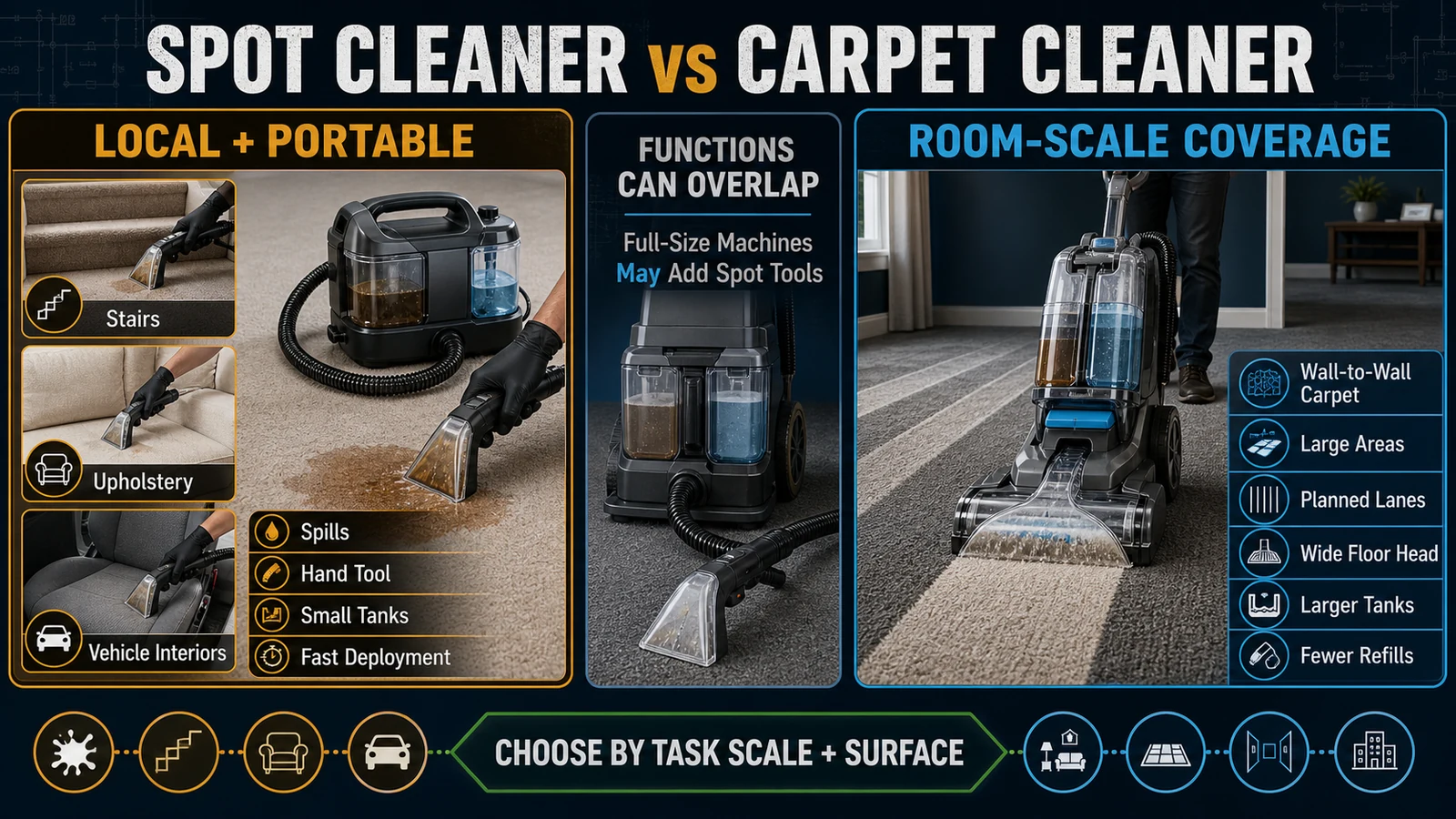
- Choose a spot cleaner for isolated spills, stairs, upholstery and vehicle interiors; choose a full-size carpet cleaner for efficient room-scale carpet cleaning.
- The categories overlap because full-size machines may include hoses and handheld tools, but tank capacity, cleaning path and primary operating posture still change productivity.
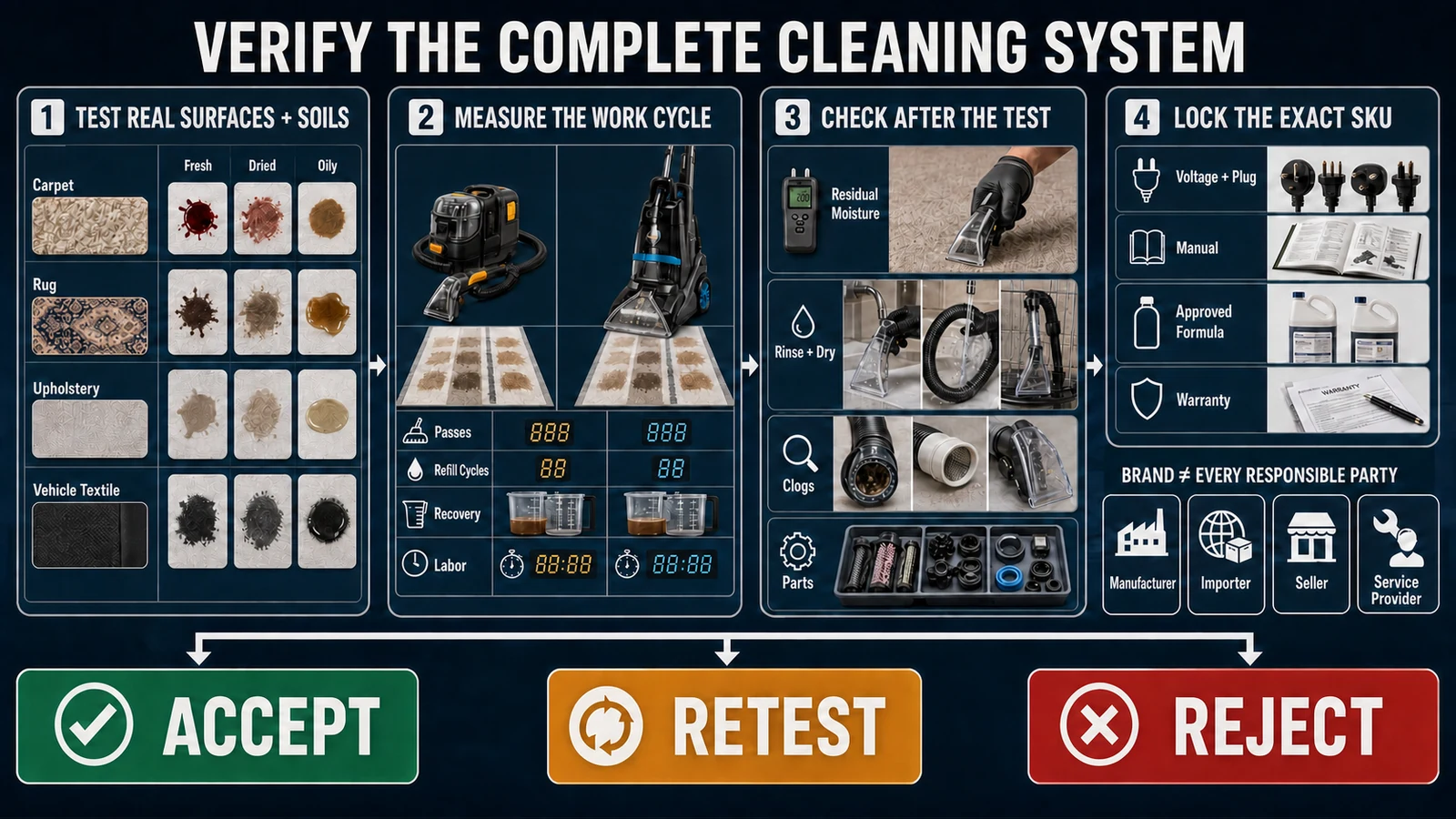
- Professional buyers should validate soil removal, residual moisture, refill cycles, cleanability, approved chemistry, parts and the responsible legal entities on the exact regional SKU.
In this article 14 sections
Choose a spot cleaner for isolated spills, stains, stairs, upholstery and vehicle interiors. Choose a full-size carpet cleaner when the main job is cleaning wall-to-wall carpet or large carpeted areas efficiently. Both types commonly spray cleaning solution, agitate soil and recover dirty liquid; the practical difference is the working scale, cleaning path, tank capacity, handling and time required to cover the job.
The boundary is not absolute. Many full-size carpet cleaners include a hose and handheld tool for spot work, while some two-in-one models detach into a portable unit. A spot cleaner can technically be moved across a whole carpet, but its small tanks and hand-operated head make consistent room-scale coverage slow and refill-intensive.
For a homeowner, the choice starts with the surface and frequency of the mess. For a distributor, importer, rental operator or private-label buyer, it must also include recovery performance, residual moisture, cleanability, approved chemistry, replacement parts, regional compliance and the party responsible for warranty service.
Spot Cleaner vs Carpet Cleaner: Quick Answer
| Decision point | Portable spot cleaner | Full-size carpet cleaner |
|---|---|---|
| Primary job | Target isolated stains and hard-to-reach textile surfaces | Clean larger carpeted areas with repeated floor passes |
| Typical form | Carryable base, hose and handheld cleaning tool | Upright or floor machine with a wider powered cleaning head |
| Best-fit surfaces | Carpet spots, stairs, rugs, upholstery and vehicle interiors when the care label permits wet cleaning | Wall-to-wall carpet, rooms and larger rugs approved for the machine |
| Coverage method | Operator guides a small hand tool over the affected zone | Operator pushes or pulls a wider chassis across planned lanes |
| Tank and interruption profile | Smaller capacity; more frequent filling and emptying on large jobs | Larger capacity; fewer interruptions for room-scale work |
| Agitation | Manual brush, tool insert or motorized handheld brush, depending on model | Powered brushroll, rotating brushes or another floor head, depending on model |
| Spot-work capability | Core function | Often available through a hose or attachment, but not universal |
| Main selection risk | Buying portability, then expecting efficient whole-room throughput | Buying capacity, then finding the chassis awkward for stairs, cars or quick spills |
What Is a Spot Cleaner?
A spot cleaner—also called a portable carpet cleaner or portable spot-and-stain cleaner—is a compact wet-cleaning machine built around a hose and handheld tool. The operator sprays water and an approved formula onto a limited area, works the surface with the tool and uses suction to recover the liquid and loosened soil into a dirty-water tank.
BISSELL’s current carpet-cleaner buying guide describes portable machines as tools for accidental spills and stains on carpets, stairs, upholstery and cars. It also says that their capacity makes them unsuitable for efficient wall-to-wall cleaning. That is a useful category description, not a universal rule about a fixed maximum area.
Current product architecture supports the same distinction. The BISSELL SpotClean Pro uses a five-foot hose, handheld tools and a 0.75-gallon tank in a 13-pound unit. Hoover’s CleanSlate combines a compact base with a seven-inch wide tool, a narrow tool and a hose-rinse accessory. These details vary by model, but they show how reach, tool geometry and fast response shape the category.
A spot cleaner is therefore a good fit when the mess is local but the surface is difficult to bring to a floor machine: a drink spill on carpet, a stained stair tread, an approved sofa cushion, a fabric vehicle seat or a pet accident on a rug. It is not a dry vacuum and should not replace dry debris removal before wet cleaning.
For the component layout, specification fields and supplier-verification questions behind this format, see the World Clean Biz carpet spot extractor technical profile.
What Is a Full-Size Carpet Cleaner?
A full-size household carpet cleaner is designed to move over the floor in lanes. It normally has a wider cleaning path, larger clean- and dirty-water tanks and a powered brush system integrated into the floor head. The operator can cover a room with more consistent overlap than is practical with a small handheld tool.
For example, the current BISSELL ProHeat 2X Revolution Pet Pro lists an 11-inch cleaning path, one-gallon clean and dirty tanks and a 12-row brush, while also including a hose for above-floor work. Shark’s CarpetXpert lists a 10-inch path and a high-speed brushroll, plus handheld stain tools.
Those examples make the overlap clear: a full-size cleaner can perform spot work if the exact configuration includes a compatible hose and tool. Its primary advantage remains room-scale coverage, not exclusive access to a cleaning technology that portable units lack.
The household upright is also not automatically a commercial carpet extractor. Commercial machines may be self-contained units or box-and-wand systems with different duty cycles, pump specifications, recovery capacity, service arrangements and test records. The Carpet and Rug Institute’s current extractor listings record attributes such as wet and dry passes, cleaning path and solution and recovery capacity. Procurement documents should name the required architecture and duty rather than using “carpet cleaner” for every wet-extraction machine.
The World Clean Biz carpet extractor technical profile explains how professional self-contained and box-and-wand systems differ from consumer portable and upright machines.
Is a Spot Cleaner the Same as a Carpet Cleaner?
In the broadest sense, a spot cleaner is one type of carpet-cleaning machine. In retail navigation, however, “carpet cleaner” often means a full-size upright, while “spot cleaner” means a portable hose-and-tool unit.
Both may contain:
- a clean-water or solution tank;
- a separate dirty-water recovery tank;
- a pump or solution-delivery path;
- brushes or another means of agitation; and
- a suction and recovery path.
The meaningful distinction is how those systems are packaged for the task. A small tool concentrates operator effort on a limited zone. A wide floor head creates repeatable lanes across a room. Tank capacity and ergonomics determine how many interruptions and manual passes the job requires.
This is why motor wattage, amperage or a single “suction” claim cannot settle the comparison. Cleaning outcome depends on solution delivery, agitation, recovery, chemistry, surface construction, soil type, operator technique and dry passes. Brand claims tied to a particular test and included formula should not be converted into a universal cross-category ranking.
Which Machine Fits Each Cleaning Job?
Fresh spills and isolated stains
A spot cleaner is usually the practical first choice because it can be carried to the incident and cleaned afterward without preparing a full room. The stain still needs the correct treatment. More solution and harder scrubbing are not automatically better, particularly on delicate fibers, backing or upholstery.
Stairs, upholstery and vehicle interiors
The hose-and-tool format is normally easier to position. Verify reach, tool width, hose flexibility and whether the machine can remain stable while the operator works. For a full-size cleaner, confirm that the required attachment is included rather than pictured as an optional accessory.
One room or wall-to-wall carpet
A full-size cleaner is usually more efficient because the floor head controls path width and overlap while the larger tanks reduce refill cycles. The buyer should still measure usable tank volume, furniture handling, edge work and the number of dry passes—not only the advertised path.
Large rug
Either category may work, but material compatibility comes first. Check the rug manufacturer’s care instructions, colorfastness, backing and whether wet cleaning is permitted. Moving a portable tool over a large rug may be slow; placing a delicate or poorly anchored rug under an upright brush system may also be unsuitable.
Mixed household or rental use
The answer may be a full-size machine with a real spot-cleaning kit, two separate machines or a two-in-one architecture. Compare the actual workflow: storage, deployment time, stairs, refilling, dirty-water disposal, end-of-job cleaning, parts and downtime. A multifunction label has value only when every required mode performs acceptably.
Which One Should You Buy?
Choose a spot cleaner when most jobs are isolated spills, pet accidents, stairs, upholstery or vehicle interiors and fast deployment and compact storage matter more than room-scale productivity.
Choose a full-size carpet cleaner when you regularly clean one or more complete rooms and need a wider path, larger tanks and more consistent overlap. If you need both tasks, compare a full-size cleaner with a real hose-and-tool kit against buying two machines; do not assume that every upright includes usable spot-cleaning accessories.
For a rental fleet or professional operation, make the decision with total job time: setup, cleaning, refilling, recovery-only passes, drying, machine cleaning and parts downtime. Purchase price alone can favor the wrong format.
Can You Use a Spot Cleaner on a Whole Carpet?
Technically, yes: the handheld head can be moved across a larger area. Operationally, it is usually a poor match for whole-room cleaning.
The limitations accumulate:
- the narrow tool requires many manual passes;
- overlap and solution application are harder to keep consistent;
- smaller tanks create more fill-and-empty cycles;
- the operator spends more time bent, kneeling or reaching;
- local over-application can increase residual moisture; and
- total labor rises even if the purchase price is lower.
The correct statement is therefore not “a spot cleaner cannot clean a whole carpet.” It is “a spot cleaner is not designed for efficient and consistent room-scale coverage.” A small apartment with one limited area may accept that compromise; a rental fleet, hospitality operator or cleaning contractor should measure the labor and turnaround consequences.
Carpet Cleaner, Vacuum, Steam Cleaner and Extractor Are Not Interchangeable
A dry vacuum removes dry particulate using airflow and filtration. It normally belongs before wet cleaning because loose soil, hair and debris should not be pushed into the wet path unless the exact machine is approved for it.
A portable spot cleaner or full-size carpet cleaner applies liquid and recovers dirty solution. Many consumer products do not generate steam even when shoppers use “steam cleaner” as a casual synonym.
A vapor steam cleaner generates hot vapor for approved surfaces. It is a different architecture and may be unsuitable for materials, adhesives or finishes that tolerate a carpet extractor.
A commercial carpet extractor is specified for professional duty and may use a self-contained head or a separate hose and wand. Capacity, pressure, airflow, recovery, electrical load, parts and service expectations require their own comparison.
Distributors should preserve these boundaries in category pages, customs descriptions, manuals and customer-support scripts. Ambiguous naming creates returns and unsafe surface assumptions.
Surface Compatibility Comes Before Machine Choice
Before wet-cleaning upholstery, read the furniture or textile manufacturer’s instructions. Rug Doctor’s current portable spot-cleaner support says that upholstery marked W or W/S can be considered for water-based cleaning, while S, X or “Dry Clean Only” should not be cleaned with its spot machine. It also instructs users to test an inconspicuous area and allow it to dry before continuing.
That guidance should not be simplified into “all W-labeled fabric is safe with every machine and chemical.” The exact formula, colorfastness, construction, age and manufacturer instructions still matter. Wool, jute, sisal, natural dyes and layered upholstery can require specialist care.
Chemical compatibility matters to the equipment too. BISSELL’s guide notes that portable and full-size machines can use different formulas. A buyer should record the approved formula family, dose, local labeling, SDS availability, shelf life and whether third-party chemicals affect performance or warranty. Avoid improvised detergents that may foam, leave residue or damage seals.
Residual Moisture and Cleanability Matter as Much as Stain Removal
A visually improved stain does not prove that the process is acceptable. Too much retained liquid can extend drying time, affect backing or cushioning and delay the next room, vehicle or rental turn.
Rug Doctor’s upholstery-tool instructions tell the operator to release the spray trigger and repeat a pass to recover more liquid, while warning against overwetting. The Carpet and Rug Institute also warns in its spot-treatment guidance that some cleaning residues can attract soil and that rinsing and moisture control matter.
Professional validation should therefore record:
- cleaning passes and recovery-only passes;
- solution dispensed and dirty liquid recovered;
- residual moisture or an agreed drying endpoint;
- visible wicking or stain return after drying;
- sticky residue or accelerated resoiling; and
- the time required to rinse the tool, hose, tanks and seals.
There is no credible universal drying time for every machine. Fiber, pile, backing, cushion, liquid dose, recovery technique, temperature, humidity and airflow all change the result.
How B2B Buyers Should Test a Spot Cleaner or Carpet Cleaner
A demonstration on one fresh colored spill is not an adequate procurement test. Build a sample plan around the intended channel and use case.
1. Lock the exact product identity
Record the model, regional SKU, rated voltage, plug, tank and tool set, formula, manual revision and warranty market. A shared product name does not guarantee identical accessories or legal documentation across countries.
2. Use representative surfaces and soils
Separate fresh water-based spills, dried stains, oily soil, pet contamination, traffic film, carpet, rug, upholstery and vehicle textile. Do not combine them into one average score. Exclude any substrate that the surface or machine manufacturer does not approve.
3. Measure the complete work cycle
Record setup, filling, cleaning passes, recovery-only passes, refill and dump cycles, manual finishing, drying window and end-of-job cleaning. For a full-size cleaner, include furniture and edge work. For a spot cleaner, include carrying, hose management and operator posture.
4. Inspect the dirty path
Check hair and debris collection, spray consistency, nozzle visibility, hose flushing, tank corners, float system, seals, odors and the ability to dry the machine after use. A machine that cleans the carpet but is difficult to clean between users can become a fleet problem.
5. Verify parts and service
Hoover’s current CleanSlate support page, for example, lists separate clean- and dirty-water tanks, hose-related parts and a rinse tool. That is evidence for one current product family, not a promise for another SKU or market. Obtain a model-specific parts list, prices, lead times, service territory and end-of-life policy in writing.
Verify Who Is Responsible Before the Order
The logo on the machine does not answer every contractual question. The trademark owner, brand operator, legal manufacturer, OEM or ODM factory, importer, contract seller, formula supplier, authorized service provider and warranty obligor may be different entities.
For private-label and distribution projects, request:
- invoice and contract seller identity;
- legal manufacturer and factory scope;
- importer or responsible economic operator for the destination market;
- exact-model declarations, reports and labels;
- approved chemistry and formula supplier responsibilities;
- warranty provider, exclusions and service route;
- replacement-parts ownership and forecast; and
- change-control rules for pumps, motors, hoses, tanks, tools, plastics and formulas.
World Clean Biz’s guides to OEM vs ODM cleaning products and finding reliable cleaning-product suppliers in China explain why product development, manufacturing and commercial responsibility must remain separate.
Brand ownership can also affect channels without proving who made a specific unit. See who owns BISSELL and Sanitaire and who owns Hoover for company and regional context. Always return to the rating label, manual, invoice and warranty for the exact machine.
FAQ
What is the main difference between a spot cleaner and a carpet cleaner?
A spot cleaner uses a portable base, hose and handheld tool for isolated stains and hard-to-reach surfaces. A full-size carpet cleaner uses a wider floor head and larger tanks for efficient room-scale carpet cleaning.
Is a portable carpet cleaner the same as a spot cleaner?
Usually, yes. Brands commonly use “portable carpet cleaner,” “spot cleaner” and “spot-and-stain cleaner” for overlapping hose-and-tool products. Check the physical functions rather than relying only on the category name.
Can a full-size carpet cleaner remove spots?
Yes, if its floor head can reach the area or the exact model includes a compatible hose and spot tool. Full-size and spot-cleaning functions can coexist in one product.
Can I use a spot cleaner on a sofa?
Only when the sofa manufacturer’s care instructions permit water-based extraction and the exact machine and formula are compatible. Check the label, test a hidden area and do not use a wet cleaner on S, X or dry-clean-only upholstery.
Does a carpet cleaner vacuum dry dirt?
Do not assume so. Most wet carpet cleaners are designed to recover cleaning liquid and suspended soil, not replace a dry vacuum. Pre-vacuum unless the exact manual says otherwise.
Is a carpet cleaner a steam cleaner?
Not necessarily. Many carpet cleaners use hot tap water or heated solution but do not generate vapor steam. Verify whether the product is a wet extractor or a true vapor-steam machine.
Which is better for a rental fleet?
Choose by the rental mission. Spot cleaners are portable and useful for upholstery, cars and local incidents; full-size machines offer better room-scale throughput. Fleet buyers should compare turnaround, misuse risk, cleaning between users, parts and backup capacity.
Final Answer
Choose a spot cleaner when the main work is local, irregular or difficult to reach. Choose a full-size carpet cleaner when the main work is planned, room-scale carpet cleaning. If both jobs matter, compare a full-size unit with attachments, a two-machine program and a genuine two-in-one design against the same surfaces, soils, recovery and labor criteria.
For professional procurement, the winning machine is not the one with the loudest suction claim. It is the exact regional SKU that produces the required clean and dry result, can be cleaned and serviced between jobs, has compatible chemistry and parts, and comes with clearly assigned manufacturing, sales and warranty responsibility.