- Define the surface, cleaning chemistry and product architecture before comparing spot-cleaner factories.
- Validate stain removal, water recovery and residual wetness separately under controlled conditions.
- Audit the complete clean-water and recovery paths, then connect every critical component to production tests, spare parts and change control.
In this article 13 sections
A spot cleaner OEM or ODM project should start with the target stains, fabrics, cleaning chemistry and water-recovery requirement—not a factory catalog or a peak suction claim. Buyers need to validate the pump, spray pattern, vacuum system, nozzle, hose, tanks, seals, formula compatibility, residual moisture, maintenance and production controls as one extraction system.
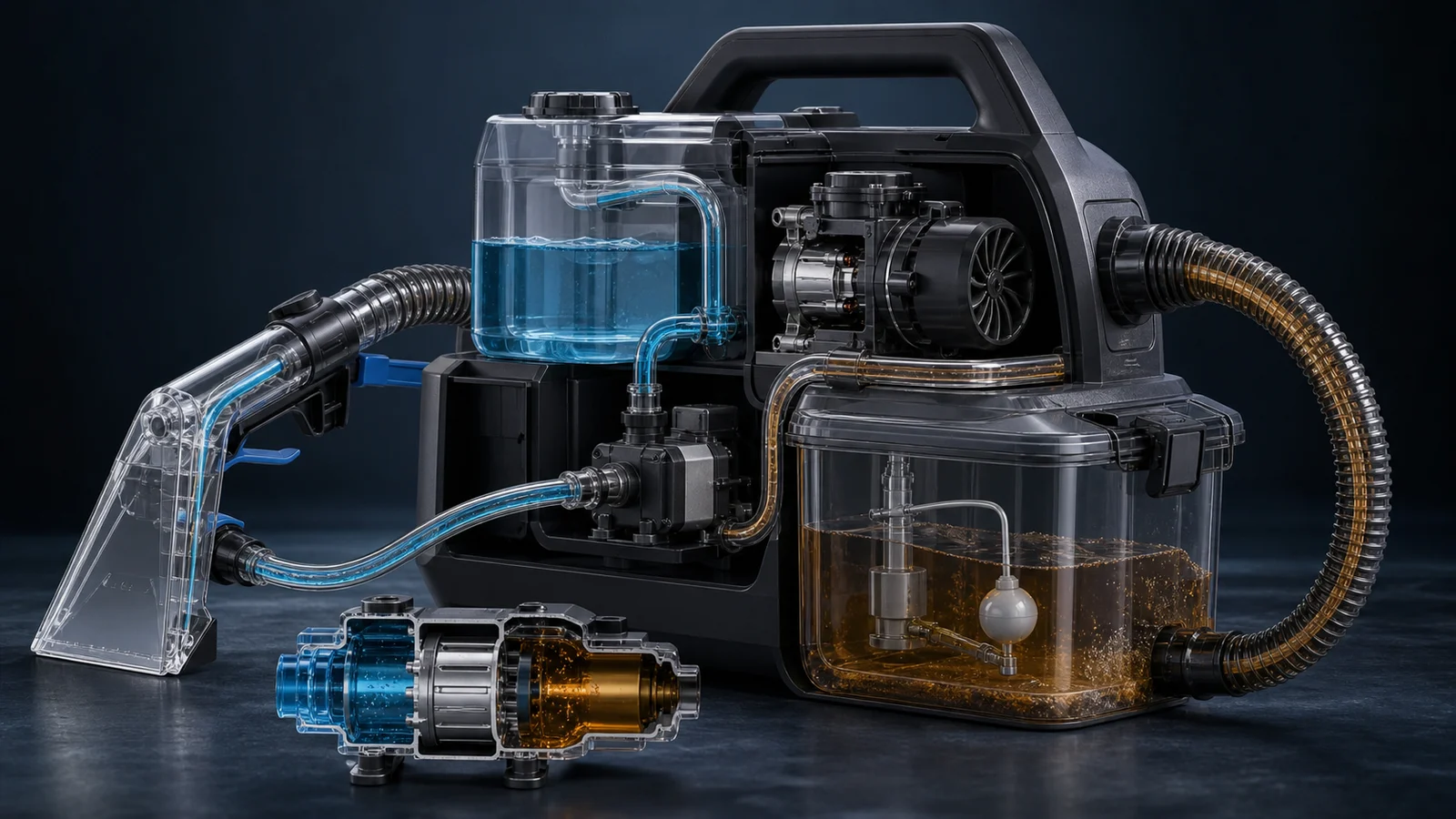
Portable spot cleaners look mechanically simple because the user sees two tanks, one hose and a hand tool. Inside, however, a clean-water circuit and a dirty-water circuit must operate beside a mains-powered motor, electronics and seals. A weak valve, kinked hose, warped tank, foaming formula or poorly seated lid can turn an acceptable laboratory sample into leaks, odors, low recovery and expensive returns.
This guide covers portable extraction cleaners for carpet, upholstery, stairs and vehicle interiors. Commercial extractors have different duty cycles, service expectations and safety routes; buyers comparing those machines should use the commercial carpet extractor buying guide.
Define the Spot Cleaner Before Requesting Quotations
The phrase “spot cleaner” can describe several product architectures.
| Architecture | Main advantage | Main constraint | Typical project position |
|---|---|---|---|
| Corded portable extractor | Stable power for pump and vacuum motor | Cable, storage and electrical-market variants | Mainstream household carpet, upholstery and auto cleaning |
| Cordless portable extractor | Mobility and quick setup | Battery mass, runtime, power ceiling and transport exposure | Small spills, stairs and premium convenience |
| Heated-water or heat-maintaining model | Stronger temperature story without steam generation | More thermal controls and energy demand | Mid- to premium-tier differentiation |
| Steam or heated-vapor hybrid | Broader treatment modes | Condensation, temperature, scale, materials and safety complexity | Premium platform requiring a separate validation program |
The product requirements should state the primary surfaces, expected stain types, tool count, cleaning radius, clean- and dirty-tank capacity, solution temperature, noise target, storage orientation, retail channel, warranty period and target markets.
Specify the limits too. A portable unit designed for household spots is not automatically suitable for daily vehicle-detailing duty. An upholstery tool is not automatically safe for every fabric. A heat function does not prove sanitization. A wet-extraction system is not a dry vacuum for loose debris unless the manufacturer explicitly designs and validates that mode.
The existing Spot Cleaner vs Carpet Cleaner guide helps define the consumer category. An OEM brief must go further by converting the use case into measurable acceptance criteria.
Map the Complete Clean-Water Path
The delivery circuit normally includes the clean-water tank, cap or valve, filter or strainer, pump inlet, pump, tubing, joints, trigger valve and spray nozzle. Each interface creates a possible restriction or leak.
Buyers should ask the supplier for a water-path drawing with component numbers, materials, connection methods and nominal flow. The drawing should match the production-intent sample and bill of materials.
Tank and valve
Verify filling, cap engagement, valve opening, venting and installation feedback. Test the tank when full, nearly empty, hot or cold within declared limits, tilted during carrying and repeatedly installed. A valve that works on a new tank can stick after formula residue dries around it.
Pump and tubing
Pump pressure alone is not enough. Record flow at the tool, prime time, current draw, sound, temperature and delivery stability. Run the system with the longest production hose, actual fittings and intended formula. Test dry-start behavior, intermittent trigger use and recovery after the tank runs empty.
Trigger and spray nozzle
The spray must land where the suction opening can recover it. Measure spray width, distribution, overspray and change after repeated formula cycles. A wide visual spray pattern can wet areas beyond the recovery path. A narrow jet can over-wet one point and encourage excessive passes.
The supplier should control nozzle geometry, orifice, alignment and assembly position. These are performance parts, not cosmetic plastic details.
Treat Suction as a Recovery System
The recovery circuit begins at the tool opening and continues through the hose, separator or deflector, dirty-water tank, float shutoff, filter, motor/fan and exhaust.
Peak vacuum at a bare inlet does not show how much liquid remains in carpet or upholstery. Tool geometry, seal against the surface, airflow, hose restriction, motor behavior and operator stroke all affect recovery.
ASTM’s air-performance work includes suction, airflow and air-power methods. ASTM also distinguishes ideal air performance from cleaning with a real tool on a real surface. A buyer’s report should identify the fixture, measurement point, hose and tool, motor state, tank condition and sample size.
Then test the complete extraction task. ASTM F11.35 currently lists separate methods for wet-extraction cleaning-effectiveness and carpet-wetness assessment. The separation matters: a product can improve visual soil removal while leaving too much water behind.
Use at least three outcome groups:
- cleaning result on defined stains and representative materials;
- liquid recovery as a mass balance under a controlled application and pass count;
- residual wetness or drying result after the prescribed extraction strokes.
Keep the operator method controlled. Trigger timing, downward force, tool angle, stroke speed and the number of dry passes can change the result more than a small specification difference.
Leakage, Residual Water and Odor Are Design Problems
Official support pages reveal the field failures a development plan should anticipate. BISSELL’s Little Green HydroSteam leakage guidance points users to tank fill level, filters, floats, tank damage, lid seating, hose connections and water remaining in the hose. Its SpotClean guidance also checks tank damage, valve operation and hose leakage.
These are not reasons to copy a competitor’s design. They are evidence that the failure tree must include:
- clean-tank cap, valve, vent and tank seam;
- pump fittings and internal tubing;
- trigger valve and spray-tool joints;
- recovery-tool seal and hose cuffs;
- dirty-tank lid, gasket, float and filter;
- tank overfill and foam carryover;
- water trapped in low points after shutdown;
- storage in the wrong orientation.
Run static leak tests, operating leak tests and post-use storage tests. Condition parts with the target formula, temperature cycles and repeated removal. Inspect the machine immediately after use and again after storage.
Odor develops when dirty liquid, fibers and formula remain in the hose, tool or tank. The product should let users access, rinse and dry the areas that accumulate residue. A hose-rinse feature helps only if it clears the actual low points and the instructions lead to a dry storage condition.
The Hoover CleanSlate support page lists solution tanks, dirty-water tanks, hose assemblies, rinse tools and narrow tools as service parts. A private-label program should assign its own part codes, inventory policy and replacement instructions before launch.
Heating and Cleaning Formula Change the Materials Risk
Warm solution, active heating and steam are different claims. Record where temperature is measured, how quickly it changes, the maximum at the outlet and behavior under low flow, scale buildup or an empty tank.
IEC 60335-2-2:2026 includes spray-extraction appliances within stated solution-pressure, flow and nozzle-temperature limits. The correct safety route still depends on the market, electrical design, product scope and intended use. Commercial spray-extraction machines are treated separately in the IEC scope.
A heating or steam system adds items such as thermal cutoffs, temperature sensors, heater materials, scale management, condensation paths and cooldown instructions. Do not approve it from a visible vapor demonstration.
Formula compatibility needs its own test matrix. Use the production concentration and examine tanks, caps, valves, tubing, adhesives, gaskets, pump components, tool plastics and labels after repeated cycles and storage. Evaluate:
- swelling, cracking, discoloration and stress whitening;
- valve sticking and nozzle deposits;
- foam generation and float response;
- odor after incomplete rinsing;
- corrosion of metal parts;
- performance change after aging.
If the product is restricted to specified formulas, the manual, packaging and commercial plan must support that limitation. If a retailer expects broad solution compatibility, validation must be broader.
Design Tools Around the Cleaning Task
Tool width, bristle pattern, clear plastic geometry and suction opening determine how the operator agitates, sees and recovers the solution.
An upholstery tool should be assessed on fabric snagging, edge contact, overspray and recovery at different angles. A narrow tool must reach seams without becoming too restrictive. A pet-stain tool may isolate contaminated liquid, but it adds seals and cleaning steps. An automotive kit needs reach under seats, controlled spray near trim and storage that keeps wet tools away from clean accessories.
For every tool, control material, drawing revision, spray location, opening dimensions, hose retention and cleaning instructions. Verify that the tool supplied in the retail box is the tool used for performance claims.
Build a Production-Intent Validation Matrix
Benchmark samples establish the user and performance target. Engineering samples verify pump, vacuum, water paths and controls. Production-intent samples must use final molds, hose, seals, formula, motor, pump, electronics, cord or battery, packaging and instructions.
| Test group | Minimum question |
|---|---|
| Cleaning | Does the defined method remove representative water- and oil-based soils from declared surfaces? |
| Recovery | How much applied liquid is recovered after controlled wet and dry passes? |
| Residual wetness | How much water remains, and how does drying change by surface? |
| Water delivery | Are flow, pattern and prime time stable across tank level and repeated use? |
| Leakage | Do tanks, valves, joints, hose and lids remain dry in operation, carrying and storage? |
| Formula aging | Do wetted materials and pump performance remain stable after repeated cycles? |
| Reliability | Do trigger, hose, cuffs, tank latches, caps, wheels and cord storage survive the agreed cycles? |
| Abnormal operation | What happens with blocked airflow, stuck float, empty clean tank, full dirty tank or excessive foam? |
| Transport | Does packaged vibration and drop create cracks, loose joints, valve damage or leaks? |
| Maintenance | Can a user empty, rinse, unclog and dry the product without hidden residue? |
Set numerical or observable pass/fail criteria before testing. “Works well” and “no obvious leak” are not acceptance criteria.
Compliance Is a Model-Specific Evidence Package
Do not accept one certificate logo as proof of global compliance. The applicable route depends on the product, voltage, cord or battery system, heater, target market and household or commercial claim.
Request an index connecting each report to the legal manufacturer, factory, exact model, variant differences, critical components, standard edition, label and manual. For cordless designs, add cell and pack identity, BMS, charger, transport test summary and production change control.
Review substance, chemical, packaging and labeling obligations for each market with qualified compliance specialists. Cleaning-formula claims may create a separate regulatory and documentation path from the appliance itself.
Normalize Cost, MOQ and Tooling Scope
Current quotations should be compared on identical scope. Break each offer into:
- main chassis, tanks and production platform;
- vacuum motor/fan, pump and electronics;
- heater or battery system, if present;
- hose, trigger handle and standard tools;
- seals, filters and service parts;
- formula sample and compatibility scope;
- color, finish, logo and packaging;
- molds, fixtures and engineering charges;
- safety and performance testing;
- inspection, reliability samples and golden units;
- spare-parts allocation and warranty assumptions;
- freight, palletization and battery handling where applicable.
Separate finished-unit MOQ from color, carton, formula, motor, pump and service-part commitments. A shared platform can reduce tooling but may limit appearance ownership, territory exclusivity and control over component changes.
Audit the Factory Behind the Platform
The audit should prove identity, engineering control and repeatable production.
Product and intellectual property
- Which legal entity owns or is authorized to offer the platform?
- Which factory performs final assembly and test?
- Who owns the appearance, molds, water-path design, electronics and firmware?
- Which elements can be exclusive by market or channel?
Engineering and supplier control
- Can the team explain pump curves, airflow, recovery and residual-wetness tests?
- Are motor, pump, hose, seals and tank materials controlled by approved specifications?
- How are formula compatibility and heater changes reviewed?
- Does the buyer receive notice before a component or sub-supplier changes?
Manufacturing evidence
- How are tank seams, valves, hose joints and gasket seating checked?
- Which electrical, leakage, flow, suction and functional tests run on every unit?
- Can a finished serial or lot be traced to pump, motor and critical material lots?
- Are rejected leaks analyzed by location and cause?
Service readiness
- Are tanks, caps, seals, hoses, tools, filters, pumps and motors available as parts or repair modules?
- Who owns troubleshooting content and translated instructions?
- How are return reasons coded and reported to engineering?
A polished sample room cannot replace production records. Follow one finished unit backward through its end-of-line result, assembly record, incoming lots and current drawings.
RFQ Checklist and Red Flags
Send a controlled RFQ with target surfaces and stains, architecture, tank sizes, hose and cord length, tools, formula, temperature mode, cleaning and recovery methods, residual-wetness target, noise, reliability cycles, compliance markets, packaging, customization, MOQ breakdown, service parts and warranty expectations.
Red flags include:
- only a peak Pa or pump-pressure claim;
- no controlled recovery or residual-wetness method;
- test reports for a visually similar but different model;
- inability to identify formula-contact materials;
- no leak test after transport or aging;
- no traceable pump, motor, valve, hose or seal specification;
- unclear platform ownership or factory identity;
- a quotation that excludes tools, certification, packaging or spares without saying so.
Final Buying Decision
The right spot cleaner OEM or ODM platform is the one that removes defined soils, recovers water consistently and remains clean, dry and serviceable after use. Select the architecture first. Map both water circuits. Test cleaning, recovery and residual wetness separately. Age the formula-contact materials. Challenge every seal and low point. Audit the factory’s component control and end-of-line evidence.
That evidence chain is more valuable than a low FOB quotation attached to an unverified sample. Buyers who need independent supplier screening, sample tests or RFQ support can use World Clean Biz’s cleaning product sourcing service.
Frequently Asked Questions
What is the difference between spot cleaner OEM and ODM?
An OEM project usually follows more buyer-controlled specifications, tooling or design. An ODM project configures an existing supplier platform. The contract must still define ownership, exclusivity, approved components, change control and test responsibility.
Is higher suction always better for a spot cleaner?
No. Liquid recovery depends on pressure, airflow, tool seal, hose restriction, stroke method and the surface. Compare complete machines using the same tool and controlled application, recovery and residual-wetness methods.
Which parts create the most leakage risk?
Common risk points include tank seams and caps, tank valves, internal tube joints, trigger valves, hose cuffs, dirty-tank lids, gaskets and floats. The exact failure pattern must be established through sample and production data.
Should a spot cleaner include heat or steam?
Only when the target use, price tier and validation budget justify it. Heat and steam add temperature control, scale, condensation, materials, safety and maintenance requirements that a basic extraction platform does not have.
What should buyers test before placing an order?
Test cleaning effectiveness, water delivery, liquid recovery, residual wetness, leakage, formula compatibility, hose and latch durability, abnormal operation, packaging and user maintenance on production-intent samples.