- A household spot cleaner can serve occasional car interiors, while a detailing business should prioritize recovery, hose reach, tank workflow, durability and serviceability over compact size alone.
- A spray extractor, steam machine and wet/dry vacuum perform different jobs; one should not be presented as a universal substitute for the others.
- Measure recovered water, remaining moisture and total vehicle cycle time on the exact fabrics before choosing equipment or promising a drying time.
In this article 20 sections
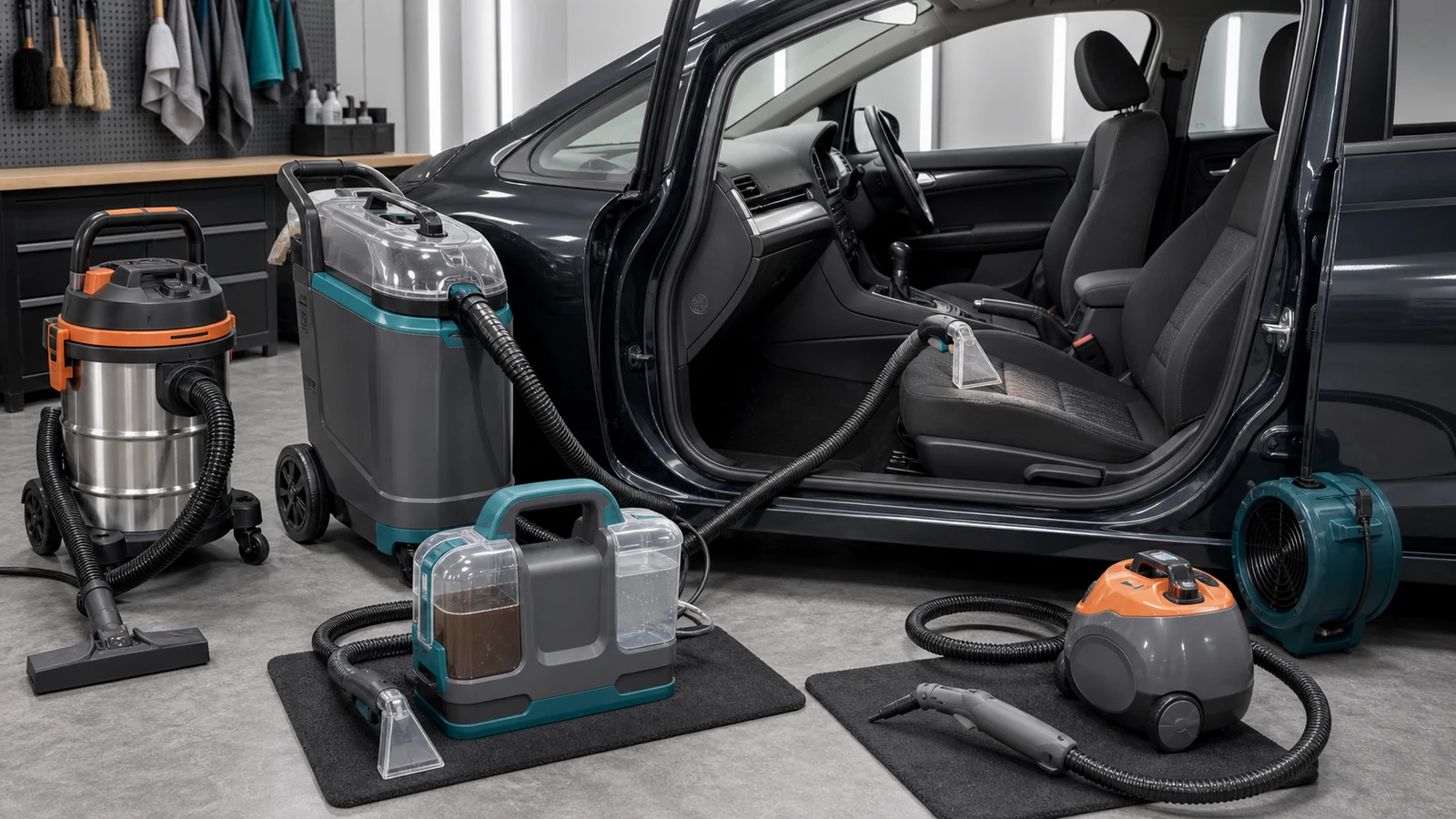
A portable spot cleaner is a good fit for occasional car-seat, carpet and mat extraction when the operator can work with small tanks and allow enough drying time. A detailing business should choose by water recovery, hose reach, tool contact, duty cycle, cleanup time and local parts support—not by compact size or one suction claim. High-volume work often justifies a professional spray extractor.
The equipment must match the material and the service promised. Fabric seats, carpet, headliners, leather, touchscreens and seat electronics do not share one cleaning method.
Spot Cleaner vs Extractor vs Steam vs Wet/Dry Vacuum
| Equipment | Primary job | Strength | Limitation |
|---|---|---|---|
| Portable spot cleaner | Spray, agitate and recover small textile areas | Compact, accessible, suitable for occasional use | Small tanks, shorter hose, lighter duty cycle |
| Professional spray extractor | Controlled solution delivery and high-rate recovery | Productivity, tools, serviceability and lower residual moisture potential | Higher cost, size and setup |
| Steam machine | Heat and vapor for selected hard surfaces and compatible textiles | Crevices, controlled low-water treatment, grease loosening | Not a substitute for bulk soil extraction; material risk |
| Wet/dry vacuum | Dry debris and approved liquid pickup | Strong general pickup and shop utility | Does not meter cleaning solution through an upholstery tool by itself |
Many detailers use a dry vacuum first, then a spray extractor for compatible textiles, with steam reserved for selected tasks.
How Spray Extraction Works
Kärcher describes the method clearly: water and detergent are sprayed into the textile, then vacuumed back out with loosened soil. The company recommends removing dry debris first, following detergent dosing, extracting evenly and allowing ventilation and drying.
The practical result depends on:
- solution volume;
- spray pattern;
- dwell time;
- agitation;
- nozzle seal;
- airflow and pressure under load;
- number of wet and dry passes;
- fabric and foam construction;
- ambient temperature and humidity.
More water is not automatically deeper cleaning. Water that is not recovered remains in the seat or carpet.
Start With the Vehicle Materials
Create a map before applying liquid.
Generally suitable after verification
- automotive carpet;
- removable textile mats;
- many fabric seat faces;
- some fabric door inserts;
- cargo-area carpet.
High-risk or different-process areas
- headliner;
- perforated leather;
- suede or microsuede;
- natural leather;
- seat controls and connectors;
- occupancy sensors;
- heated or ventilated seat components;
- speaker grilles;
- screens and switches;
- damaged foam or delaminating fabric.
Check the vehicle manufacturer’s care guidance and the chemical label. Test an inconspicuous area for color transfer, water marks and texture change.
Why Headliners Need Special Control
A headliner is usually a layered assembly. Excess liquid, heat or scrubbing can affect adhesive or deform the surface.
Do not treat it like a removable floor mat. Use the least moisture and agitation needed, support the material and stop if the surface begins to separate.
A machine being marketed for upholstery does not mean every automotive textile is extraction-safe.
Suction Claims vs Water Recovery
Marketing may publish watts, air watts, pascals or relative suction. These figures do not directly state how dry the seat will be.
Recovery depends on:
- tool lip and seal;
- hose diameter and length;
- airflow under wet load;
- separator and tank design;
- foam control;
- operator angle;
- dry passes;
- textile and cushion.
Run a matched test:
- weigh or measure the applied solution;
- clean a defined seat or carpet area;
- measure recovered liquid;
- record extraction passes;
- measure surface and cushion moisture at fixed intervals;
- record time until the vehicle is ready for handover.
Apparent liquid recovery = recovered liquid ÷ applied cleaning liquid
This does not capture moisture already present or evaporated, but it creates a consistent comparison.
Portable Spot-Cleaner Benchmark
BISSELL’s current U.S. Little Green 1400B is an example of the household portable format. The official page lists:
- car interiors among intended surfaces;
- 48 oz clean-tank capacity;
- 4 ft hose;
- 15 ft cord;
- 9.65 lb weight;
- 3-inch stain tool and spraying crevice tool.
Those specifications show why the format is easy to carry. They also show what to verify for a vehicle: whether the hose reaches the far side without moving the machine, whether the tanks cover one service and whether the tool is narrow enough for bolsters and seams.
Kärcher’s SE 2 Spot is another compact spray-extraction example. Its 2025 launch information lists a 1.8 m hose, 4.5 m cord and 4 kg weight with an upholstery spray-extraction nozzle.
These are format examples, not a ranking.
When a Professional Extractor Makes Sense
Upgrade when the business needs:
- several vehicles per day;
- larger solution and recovery tanks;
- longer hose;
- durable connectors;
- replaceable pump or vacuum components;
- controlled spray pressure;
- faster tank handling;
- commercial tools;
- parts and service;
- repeatable recovery.
Kärcher positions its Puzzi range for professional spray extraction and emphasizes lower residual moisture. Verify that claim on your materials and workflow.
The economic threshold is not the purchase price alone.
Equipment minutes per vehicle = setup + dry vacuuming + pretreatment + extraction + tank handling + machine cleanup
A machine that saves fifteen minutes per vehicle can be more valuable than a cheaper unit with frequent refills and slow cleanup.
Hose, Cord and Vehicle Reach
Set the machine outside the vehicle and test:
- front passenger footwell;
- rear bench center;
- seatback;
- cargo area;
- under-seat access.
The hose must reach without pulling the machine over or rubbing a dirty hose against clean trim.
Cordless portability can help mobile work, but battery runtime must cover the actual extraction mode. A power inverter must be sized and installed for the equipment rather than assumed from a plug adapter.
Tool Geometry
The upholstery tool controls contact and visibility.
Inspect:
- width;
- transparent recovery window;
- spray position;
- lip stiffness;
- edge seal;
- trigger control;
- bend radius;
- ability to reach seams.
A wide tool covers a seat center quickly. A narrow tool reaches bolsters and tight areas. A crevice spray tool can access rails but may concentrate water.
For a business, a two-tool system can be more productive than one compromise tool.
Heat and Steam
Separate three functions:
- heated cleaning solution;
- steam or vapor applied to the surface;
- heat used only to maintain water or clean the machine.
Heat can loosen oily soil, but it can also affect dyes, adhesives, leather finishes and plastics.
Do not assume a product named “ProHeat,” “HydroSteam” or similar delivers the same process. Read the manual for the exact model.
Use steam only on materials and components approved for it. Keep heat away from sensitive electronics and avoid trapping moisture.
Cleaning Chemistry
The solution must fit:
- machine material;
- fabric;
- soil;
- extraction process;
- local workplace handling;
- customer expectations.
Follow dilution instructions. Excess detergent can leave residue that attracts soil or produces foam in the recovery path.
Maintain:
- labeled bottles;
- current safety data sheets where applicable;
- separate tools for incompatible chemicals;
- rinse process;
- wastewater handling appropriate to local rules.
Do not mix products unless their manufacturers explicitly allow it.
Drying and Handover
Drying time changes with:
- applied water;
- recovery;
- cushion thickness;
- temperature;
- humidity;
- airflow;
- door and window position;
- number of seats cleaned.
Never promise one universal drying time from a product page.
Use:
- repeated dry passes;
- fans or air movers positioned safely;
- ventilation;
- measured moisture checks;
- clear customer handover instructions.
Avoid returning a vehicle with trapped moisture, closed windows and no ventilation plan.
Tank Workflow
Small tanks are not automatically a problem for one vehicle. They become a problem when the operator interrupts each seat.
Record:
- clean-water capacity;
- usable recovery capacity before float shutoff;
- fill and drain time;
- spill risk;
- filter or separator handling;
- cleaning time after the vehicle.
Dirty tanks need easy access and full drying. Hidden corners create odor and biofilm risk.
Maintenance and Durability
After every job:
- empty and rinse tanks;
- flush the hose if required;
- remove debris from the tool;
- inspect seals;
- clean the float and separator;
- dry parts;
- check cord and hose damage.
Weekly or by workload:
- inspect spray jets;
- descale as approved;
- check pump output;
- inspect vacuum seals;
- clean filters;
- check tool lips.
For commercial purchasing, ask for exploded parts diagrams and component lead times.
Mobile Detailing Requirements
A mobile operator must also plan:
- clean-water supply;
- wastewater storage;
- generator or inverter capacity;
- extension-cord safety;
- weather protection;
- vehicle payload;
- noise;
- machine stabilization;
- chemical storage.
Compactness has value when the entire system fits safely. It does not excuse undersized recovery.
Cars per Day and Business Fit
Calculate capacity from the slowest resource.
Maximum practical vehicles per day = available production minutes ÷ complete minutes per vehicle
Complete minutes include loading, setup, cleaning, drying management, machine cleanup and travel when mobile.
Track:
- average textile area;
- service tier;
- severe-soil frequency;
- refills;
- wastewater events;
- rework;
- dry-time delay;
- equipment downtime.
Use the data to decide when a second machine or larger extractor is justified.
Buying Checklist
Performance
- matched water-recovery test;
- tool seal and visibility;
- spray consistency;
- repeat dry-pass result;
- fine debris handled by prior dry vacuum.
Fit
- hose reaches the full cabin;
- cord or battery supports the work;
- tools fit bolsters and rails;
- tanks cover the intended service.
Ownership
- hose and tool replacements;
- seals, filter and tank parts;
- pump and motor service;
- warranty for commercial use;
- local repair path.
Safety
- material compatibility;
- chemical instructions;
- electrical condition;
- ventilation;
- wastewater handling.
Which Equipment Should You Buy?
Occasional owner
A compact spot cleaner is usually sufficient for compatible seats, mats and carpet. Prioritize easy cleanup and replacement tools.
Weekend or low-volume detailer
Choose a robust portable extractor only after timing the full job. Keep a separate dry vacuum.
Full-time mobile detailer
Prioritize hose reach, tank workflow, power system, durability and fast parts access.
Fixed-location shop
A professional extractor with commercial tools and service support can reduce handling time and downtime. Add air movement and a controlled drying area.
Frequently Asked Questions
Can I use a household spot cleaner for car detailing?
Yes, for compatible textiles and low-to-moderate workload. Test recovery, reach, drying and duty cycle before using it commercially.
Is a wet/dry vacuum the same as an extractor?
No. A wet/dry vacuum can collect approved liquid, but a spray extractor also meters cleaning solution through a textile tool.
Does more suction mean faster drying?
Not by itself. Tool seal, airflow under load, solution volume, fabric and dry-pass technique determine remaining moisture.
Should I use steam on car seats?
Only when the exact material and components allow it. Heat and moisture can affect dyes, adhesives, leather finishes and electronics.
What is the best machine for a detailing business?
The one that delivers the required result at the lowest complete minutes per vehicle with reliable parts and service.
Bottom Line
A spot cleaner can be a useful car-detailing tool, but it is one part of the process. Map the materials, dry-vacuum first, control solution, measure recovery and price the full vehicle cycle. For professional work, productivity and serviceability matter more than a dramatic suction or heat claim.
For adjacent decisions, see the portable carpet cleaner buying guide, the spot cleaner OEM and ODM guide, and the BISSELL HydroSteam vs Shark StainStriker HairPro comparison.