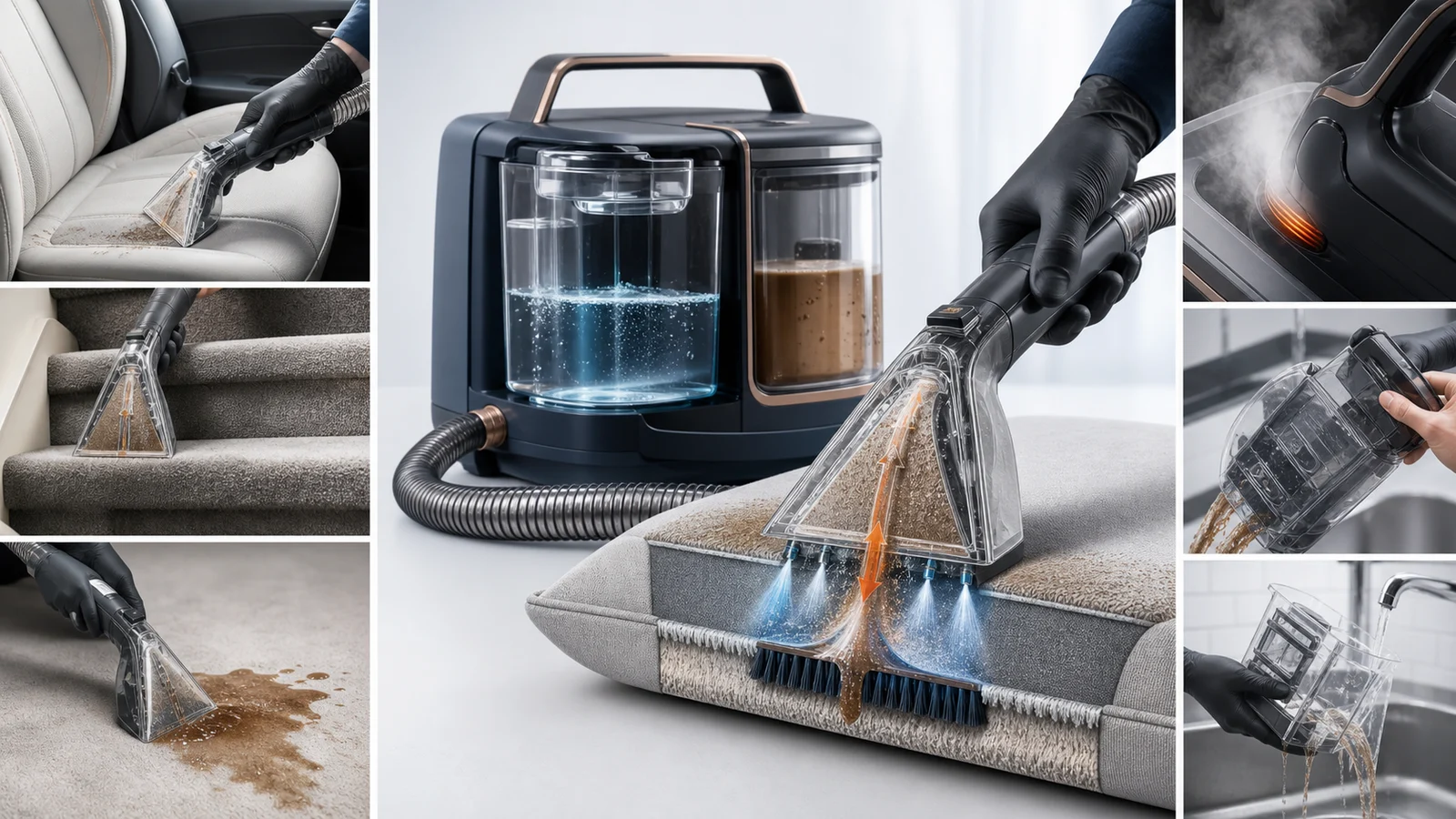
- Judge a portable extractor as a spray-agitate-recover system; suction numbers alone do not predict stain removal or drying.
- Separate ambient-water, temperature-maintaining and steam-producing designs because their power, safety, scaling and surface constraints differ.
- Before purchase or sourcing approval, test recovery, hose cleanout, tank access, tool durability, noise, carry balance, consumables and spare parts with representative soils and fabrics.
In this article 18 sections
The best portable carpet cleaner is not the model with the largest suction claim. It is the machine that applies the right amount of solution, agitates the stain without damaging the surface, recovers most of the dirty liquid, leaves an easy-to-clean hose and tank, and remains supportable after the included formula is gone.
This guide covers compact spray-extraction machines, often called spot cleaners, portable carpet cleaners or portable upholstery cleaners. They are designed for local stains, stairs, sofas, pet beds and car interiors—not as direct substitutes for full-width upright extractors or dry vacuums.
Start With the Cleaning System, Not Peak Suction
A portable extractor has four essential jobs:
- deliver water and approved formula to the target;
- loosen soil through chemistry, dwell time and brush action;
- pull suspended soil and liquid through the tool and hose;
- separate and store dirty water without carrying it into the motor.
Each stage limits the next. More airflow cannot remove a stain that was not wetted or loosened. Heavy spray can make a machine look active while extending drying time. A strong sealed-suction reading can be lost through a narrow, corrugated, leaking or partially blocked hose.
Buying decisions should therefore use outcome tests: stain removal, recovered-liquid ratio, residual moisture, passes required and cleanup time.
Choose the Use Case First
Portable machines work best when the floor plan and mess fit the format.
Carpet spots and pet accidents
Look for a compact stain tool, controllable spray and a dirty-water path that handles hair and small solids without blocking. Odor removal depends on extracting the contamination, not masking it with fragrance.
Upholstery
The tool must avoid over-wetting foam and internal padding. Check the furniture care code and manufacturer guidance. Delicate, dry-clean-only, unstable-dye, velvet, leather and moisture-sensitive materials may be unsuitable.
Car interiors
Reach matters: hose length, tool thickness, cord or battery runtime and the ability to place the base securely outside or inside the vehicle. Test under seats and around bolsters.
Stairs
Carry balance, hose reach and stable placement are more important than tank size. A machine that tips when the hose is pulled creates a spill and fall risk.
Larger carpet areas
A portable tool can clean a section, but repeated hand passes are slow and inconsistent. A full-size extractor is usually more appropriate for rooms.
Spray Delivery and Dosing
The spray pattern should cover the tool width without flooding beyond it. Inspect:
- jet count and distribution;
- trigger effort and response delay;
- pump consistency as the clean tank empties;
- drips after the trigger is released;
- accessibility of jets for descaling or blockage removal;
- compatibility of seals and tubes with the approved formula.
Manual triggers give the operator direct control. Automatic dosing can improve consistency but may over-apply water on small upholstery sections. In either case, make a wet pass followed by deliberate dry recovery passes.
Formula concentration matters. Too much detergent can create foam, leave sticky residue and attract future soil. Follow the machine's tank markings and chemical instructions rather than estimating a stronger mixture.
Agitation: Brush Geometry and Surface Risk
Many portable tools use fixed bristles; the operator supplies the scrubbing motion. Some use powered brushes. Powered agitation can improve consistency but adds hair wrapping, seals, gears, current draw and cleaning work.
Evaluate:
- bristle stiffness and tip finish;
- brush contact across curved upholstery;
- visibility through the extraction nozzle;
- access to the brush and suction slot;
- whether the tool traps hair behind a non-removable cover;
- whether a rubber or gentle tool is offered for sensitive surfaces.
Aggressive scrubbing is not always better. It can fuzz carpet, disturb upholstery yarns or spread the stain. Chemistry and dwell time should do part of the work.
Suction, Airflow and the Complete Recovery Path
Manufacturers may publish watts, amperage, pascals, sealed suction, airflow or no suction figure at all. These are not directly interchangeable.
At the fabric, recovery depends on:
- motor and fan performance;
- tool-to-surface seal;
- nozzle slot and internal losses;
- hose diameter, length and corrugation;
- tank seals and float;
- filter or separator restriction;
- foam level;
- operator angle and speed.
A transparent tool helps the user see when liquid pickup declines. It is useful, but the clear plastic should also resist cracking and be removable or flushable where soil accumulates.
For supplier comparison, measure dry and wet pickup at the tool with the production hose, tool and partly filled tank—not at an open motor inlet.
Water Recovery and Drying Time
Recovery ratio is more meaningful than tank size. In a controlled test:
- condition and weigh a fabric or carpet sample;
- apply a known amount of solution;
- use a fixed number of wet and dry passes;
- measure recovered liquid;
- weigh the sample immediately and at timed intervals.
The test reveals residual moisture and repeatability. It should be repeated on low-pile carpet, a representative upholstery fabric and a car-seat geometry if those are target uses.
Drying time depends on applied water, recovery, material, padding, room temperature, humidity and airflow. A product can improve drying by applying less liquid or recovering more—without a heater.
Do not store cushions or close a vehicle while materials remain damp. Prolonged moisture can lead to odor or material damage.
Heat Claims: Three Different Architectures
“Heated cleaning” can describe materially different systems.
User-added warm water
The machine accepts warm tap water within the manual's temperature limit but has no active heater. This is the simplest architecture.
Temperature maintenance
A heater or motor waste heat helps maintain the temperature of water placed in the tank. BISSELL describes Heatwave Technology on selected ProHeat products as helping maintain water temperature. That does not mean the machine starts with cold water and produces high-temperature steam.
Steam generation
A flow-through heater intentionally produces steam or a steam-water mixture. BISSELL's Little Green HydroSteam models use a built-in flow-through heater and offer SteamWash, Steam and Wash modes. BISSELL lists about 30 seconds for the steam-ready indicator on the cited support page.
Steam generation adds heater power, temperature sensors, pressure and flow control, scale management, thermal protection and new surface restrictions. It can help with some sticky or oily messes, but it is not automatically suitable for every carpet, upholstery, adhesive or vehicle material.
When comparing claims, ask for delivered temperature, measurement location, flow rate, warm-up state and surface instructions.
Corded vs Cordless
Corded portable cleaners can sustain motor and heater power without runtime limits. The trade-offs are cord management, outlet access and storage.
Cordless models improve quick response and vehicle access but divide battery energy among pump, motor, brush and electronics. BISSELL's current Little Green Cordless 3682, for example, lists up to 20 minutes in Turbo mode and up to 35 minutes in Eco mode, with a four-hour charge time. Those mode conditions matter.
For cordless evaluation, test:
- cleaning performance at full and low charge;
- runtime under realistic trigger use;
- charging time and adapter temperature;
- battery replacement availability;
- storage-charge guidance;
- shipping and recycling obligations.
For corded machines, check cord length, strain relief, plug temperature and whether the cord and hose can be stored without kinking.
Tank Capacity, Carry Weight and Stability
Large tanks reduce interruptions but add weight and volume. Official BISSELL examples show the range:
- Little Green Cordless 3682: about 33.8 oz clean-water and 37 oz dirty-water capacity, with a listed 7.2 lb machine weight;
- Little Green Pet Pro 3909: 64 oz clean-water and 48 oz dirty-water capacity, with a listed 11 lb weight;
- Little Green HydroSteam 3532: 64 oz clean-water, 51.1 oz dirty-water and 13 lb listed weight.
These figures are model examples, not minimum requirements.
Check whether the machine can be carried one-handed when partially filled, whether tank latches remain secure, and whether hose pull can tip the base. The dirty tank should be easy to pour without contaminating the handle or clean-water side.
Hose Length, Tool Reach and Cleanout
Longer hoses improve reach but add pressure loss, retained water and storage complexity. BISSELL's cited current models use hoses from roughly four to five feet.
Hose quality is a major ownership issue. Inspect:
- bend radius at the base and handle;
- reinforcement and fatigue resistance;
- cuff seals;
- transparent sections that reveal residue;
- ability to rinse from tool to tank;
- retained water after hanging or storage;
- replacement-hose availability.
Some machines include a hose-rinse or HydroRinse-style tool that recirculates clean water through the hose. This is useful, but it does not replace checking the tool head, cuffs and tank inlet.
A procurement durability test should include repeated pulls, twists, drops of the hand tool, hot-and-cold cycles and storage wraps.
Tools and Real Surface Coverage
A common three-inch stain tool is precise for spots. Five- or six-inch tools cover more area but require sufficient flow and recovery across the full slot. Crevice tools can reach vehicle seams; pet tools may isolate solids; multi-surface tools may add squeegees or alternate bristles.
Do not judge a bundle by tool count. Verify:
- each tool has a defined use and cleaning method;
- spray aligns with the suction slot;
- translucent parts resist staining;
- latches survive repeated changes;
- spare tools fit the exact hose interface;
- tools can drain before storage.
Accessories create margin and differentiation, but proprietary interfaces can also create long-term support risk.
Noise, Electrical and Thermal Behavior
Portable extractors run close to the user, often in enclosed vehicles. Measure sound at the operator's ear as well as at one meter. Listen for tonal motor noise, pump pulses and air leaks.
For heater-equipped or cordless models, monitor:
- plug, adapter and battery temperature;
- motor exhaust near fabrics or hands;
- thermal cutout behavior;
- steam-ready and low-water interlocks;
- leakage after shutdown;
- recovery after a blocked tool.
Never use a consumer wet appliance outside its approved environment or to collect flammable liquids. Local safety, EMC, materials, labeling, battery and transport requirements depend on market and configuration.
Maintenance Is Part of Performance
The machine is not finished when the stain disappears. A robust routine is:
- make final dry passes;
- empty and rinse the dirty-water tank;
- remove hair and solids from the tool and inlet;
- flush the hose according to the manual;
- rinse filters, floats or screens where permitted;
- wipe the clean-tank valve and cap;
- let parts and hose drain and dry before closed storage.
Tank corners, lid channels and float cages should be reachable with ordinary cleaning tools. A tank that cannot be cleaned will become an odor source.
In a product trial, time the entire cleanup. A machine that saves two minutes on the stain but adds ten minutes of unpleasant disassembly may not earn repeat use.
How to Compare Current Models
Use a requirements matrix rather than a feature count.
| Decision factor | Entry portable | Cordless portable | Heated or steam portable |
|---|---|---|---|
| Best fit | Occasional spots near outlets | Quick jobs, vehicles, stairs | Compatible sticky or oily soils |
| Power | Corded motor and pump | Battery-limited system | Corded heater plus motor on common designs |
| Main trade-off | Cord and basic toolset | Runtime, charge and battery aging | Weight, cost, scale and surface restrictions |
| Test priority | Recovery and hose cleanout | Low-charge performance | Delivered heat and thermal safety |
| Ownership priority | Tanks, formula, tools | Battery and charger | Descaling, heater and service |
Current BISSELL examples illustrate the spread. Little Green Pet Pro 2891 uses a 0.75-gallon tank, five-foot hose and 20-foot cord. Little Green Cordless 3682 emphasizes mobility and two runtime modes. Little Green HydroSteam 3532 adds three heat-related modes with a 64 oz clean tank and 51.1 oz dirty tank. A buyer should use the same matrix for other brands instead of treating this lineup as the whole market.
Supplier and Retailer Verification Checklist
Before approving a portable carpet cleaner, request:
- product requirement specification and supported surfaces;
- spray flow and pattern data;
- tool-level suction and airflow method;
- recovery and residual-moisture test;
- representative stain protocol and pass count;
- hose flex, pull and storage-cycle results;
- tank latch, seal, drop and chemical-resistance results;
- foam and float-shutoff validation;
- heater temperature-control and scaling tests where applicable;
- battery runtime, cycle, transport and service plan where applicable;
- noise and thermal data;
- cord, strain relief and tip-over tests;
- packaging drop and vibration results;
- pilot-production yield and leak records;
- formula, tools, hoses, tanks and filters availability;
- warranty failure coding and spare-parts commitment.
Retail demonstrations should use standardized stains and measured solution. A water-only pass on a clean rug proves little.
For OEM/ODM teams, connect this category review to the broader Cleaning Appliance Factory Audit Guide and Compliance and Certification Guide. For adjacent sourcing decisions, see the Floor Washer OEM/ODM Guide and Car Vacuum Cleaner OEM/ODM Guide.
FAQ
Is higher suction always better in a portable carpet cleaner?
No. Tool sealing, airflow, hose losses, water application and operator technique determine actual recovery. Compare recovered liquid and residual moisture.
Does a portable carpet cleaner heat its own water?
Some do not, some maintain the temperature of added warm water, and some generate steam. Read the exact model's description and manual.
Can a spot cleaner remove pet odor?
It can remove contaminated liquid and soil, which is essential. Results depend on how deeply the contamination entered, compatible chemistry, extraction and complete drying.
Can it clean a whole room?
Technically, but the small hand tool makes coverage slow and uneven. A full-size extractor is usually better for large carpet areas.
Is cordless strong enough?
Cordless machines can be effective for local spots. Verify runtime and recovery in the intended mode; do not compare battery voltage alone.
How often should the hose be cleaned?
After dirty or formula-bearing use, follow the manual's flush and drying procedure. Waiting until odor appears is too late.
Can steam be used on any upholstery?
No. Check the surface manufacturer's instructions and care code. Heat and moisture can damage sensitive fibers, dyes, adhesives, foams and finishes.
Final Buying Rule
Buy the machine whose complete workflow you can verify: compatible surface, controlled spray, appropriate agitation, high recovery, manageable drying, practical reach, cleanable wet path and available parts. Peak suction, tank size and “heat” are inputs; repeatable clean-and-dry results are the outcome.
Source Note
Model examples and heat definitions were checked against official BISSELL product and support pages for Little Green HydroSteam 3532, Little Green HydroSteam Pet 3618, Little Green HydroSteam support, Little Green Cordless 3682, Little Green Pet Pro 2891 and Little Green Pet Pro 3909 on July 25, 2026. Model availability, bundles and warranty vary by market.