- Define the car-vacuum architecture and use case before comparing factories or prices.
- Verify suction, airflow, air power and real pickup with a controlled test method instead of relying on one peak Pa claim.
- Treat the battery, charging system, accessories, packaging, compliance files and spare parts as one product platform.
In this article 14 sections
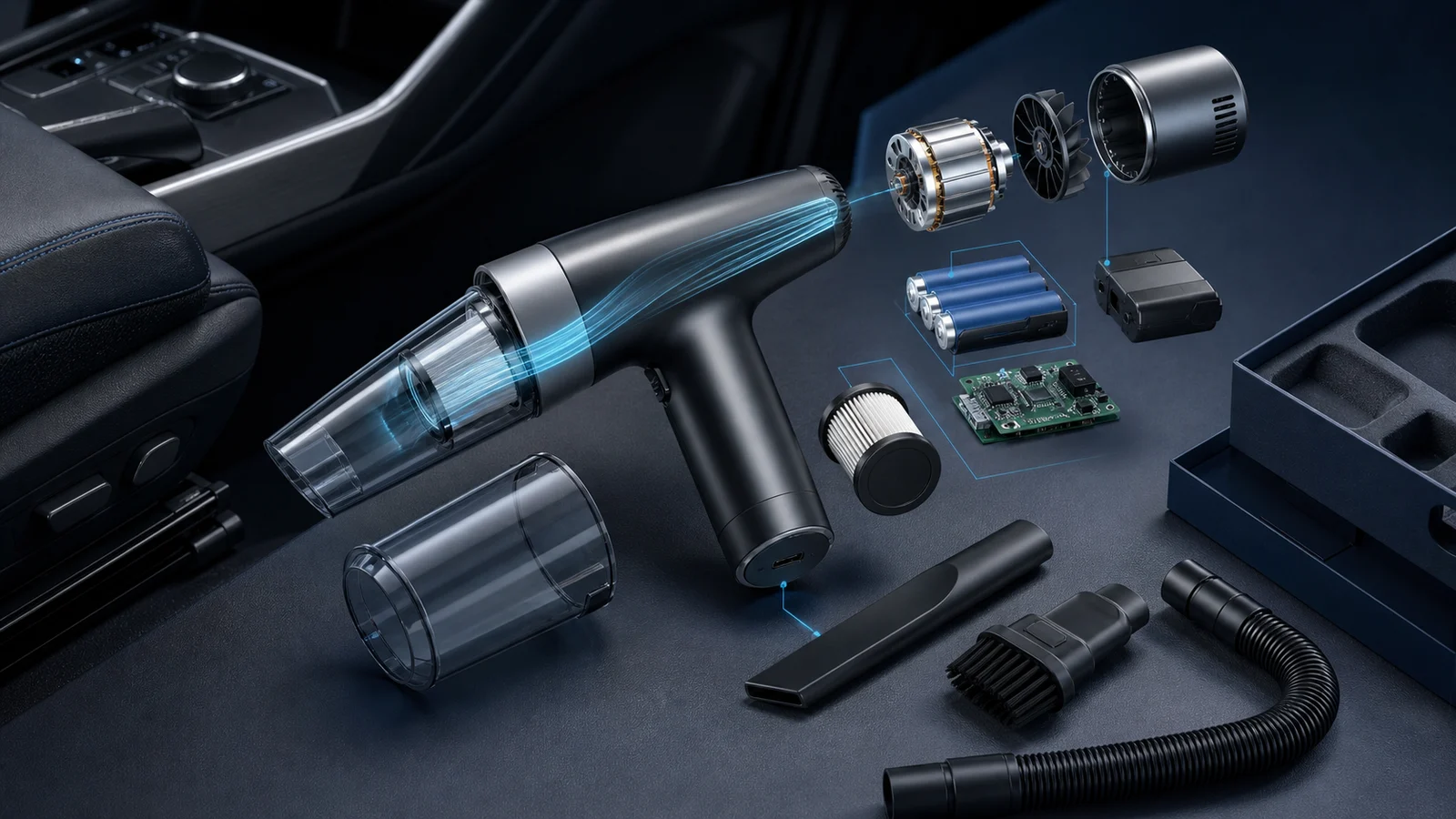
A car vacuum cleaner OEM or ODM project should begin with the product architecture, target vehicle, cleaning tasks and sales channel—not a supplier catalog. Buyers need to verify the motor and airflow system, battery and charging design, attachments, filtration, thermal behavior, compliance documents, reliability tests, packaging, spare parts and quality controls as one platform. A peak suction number and a low FOB quotation are not enough to select a product or factory.
A car vacuum is small, but the project is not automatically simple. The machine must reach narrow spaces, collect mixed debris, remain comfortable in one-hand use and survive storage and transport conditions that can be harder than those of an indoor handheld vacuum.
The category also contains several different products under one search term. A 12 V corded cleaner, a USB-C mini vacuum and a high-power cordless handheld do not share the same performance ceiling, battery risk, accessory system or cost structure.
Define the Product Before Contacting Car Vacuum Manufacturers
Start with the operating model.
| Product architecture | Main advantage | Main constraint | Suitable positioning |
|---|---|---|---|
| 12 V vehicle-powered corded vacuum | No internal traction battery and no runtime limit within the vehicle-power boundary | Cable management, socket current, fuse and vehicle compatibility | Entry-level, fleet kit or occasional cleaning |
| USB-C rechargeable mini vacuum | Compact, familiar charging interface and easy storage | Limited energy, heat dissipation, dust capacity and sustained performance | Crumbs, vents, consoles and quick touch-ups |
| Larger cordless handheld | More room for battery, motor, separator and attachments | Higher weight, cost, shipping burden and warranty exposure | Deeper seat, carpet, pet-hair and family-vehicle cleaning |
| Vacuum-and-blower combination | Broader use case and a strong accessory story | Air-path sealing, outlet safety, noise and claim confusion | Detailing, keyboards, inflatables and light debris |
This decision changes almost every downstream requirement. A buyer asking factories for “a powerful car vacuum” without choosing one of these architectures will receive quotations that are not comparable.
The product definition should include:
- the target retail price and channel;
- the primary debris: crumbs, sand, dust, pet hair or workshop particles;
- whether carpet, fabric seats and floor mats are important;
- expected use duration and duty cycle;
- whether the unit will normally stay in the vehicle;
- dry-only or specifically validated wet-pickup capability;
- accessory count and storage method;
- target markets and intended product claims;
- warranty length and replacement-parts plan.
If the product must also clean stairs and furniture, it may be better treated as a compact household handheld with a vehicle accessory kit. That gives the buyer more platform options, but it also moves the product closer to the crowded general-handheld market covered in the cordless vacuum cleaner OEM manufacturers guide.
The Motor Is Only One Part of the Air System
Motor speed is easy to print in a catalog. It is not a complete measure of cleaning performance.
The motor/fan system creates pressure difference and airflow. The inlet, cyclone or separator, filter, seals, dust cup, bends, attachment and exhaust path determine how much of that potential reaches the cleaning point.
A compact product can lose performance through:
- a narrow or sharply bent inlet;
- leaks around the dust cup or filter;
- a small filter that loads quickly;
- a separator that allows debris to block the filter;
- an attachment with too much restriction;
- heat protection that reduces or stops power;
- a nearly full dust cup;
- declining battery voltage under load.
For this reason, buyers should not approve a design from a motor data sheet. Test the complete production-intent unit.
Ask for a performance curve, not one peak number
A single maximum vacuum reading measures one operating point. Airflow is another. Air power combines pressure and flow, but it still does not guarantee pickup through a specific tool on a specific surface.
ASTM’s vacuum air-performance work includes suction, airflow and air-power methods. ASTM also warns that ideal air-performance testing does not represent the brush or nozzle working on a real floor. IEC 62885-4 provides performance measurement methods for cordless dry household vacuum cleaners.
An OEM validation report should identify:
- the standard or internal method;
- test fixture and measurement point;
- power mode;
- battery state and pack voltage;
- attachment or bare inlet;
- clean filter, loaded filter and full-bin condition;
- ambient conditions;
- sample size;
- result at the start and after sustained operation.
Then add application tests using defined quantities of representative debris in repeatable vehicle fixtures or real vehicles. A strong bare-inlet result can coexist with poor pickup if the crevice tool, filter or sealing system is weak.
Battery and Charging Design Determine the Risk Profile
The battery decision affects suction stability, runtime, charge time, weight, cell temperature, shipping and warranty cost.
A buyer should record the complete chain:
- cell manufacturer, model, chemistry and capacity;
- cell lot-control and incoming inspection;
- series/parallel pack configuration;
- BMS protection functions and thresholds;
- temperature sensing and pack thermal path;
- charger or USB-C input design;
- enclosure, insulation, wiring and connector controls;
- firmware or power-control behavior, if used;
- UN 38.3 test summary and transport classification;
- pack change-control and traceability.
Do not accept a cell certificate as evidence for the complete pack, or a transport test as evidence for all product-safety requirements.
The UNECE Manual of Tests and Criteria contains the UN 38.3 lithium-cell and battery transport tests. IATA states that manufacturers and subsequent distributors must make a test summary available for applicable cells and batteries. IATA also notes a 2026 air-transport state-of-charge change for lithium-ion batteries packed with equipment. The exact shipment configuration must be confirmed with the battery, logistics and dangerous-goods specialists for the route.
Battery verification should include normal charge and discharge, abnormal charger conditions, blocked-airflow operation, short-circuit protection, overcharge and over-discharge controls, cell imbalance, drop or impact after conditioning, storage recovery and repeated cycles. The applicable safety standard and test plan depend on the market and design.
For a broader discussion of pack quality and BMS failure risk, see Hidden Risks in Cordless Vacuum Development.
USB-C Is a System, Not a Connector Shape
USB-C can simplify the consumer experience, but it creates a new verification list.
A product may use:
- a USB-C receptacle with basic 5 V input;
- USB-C current advertisement without Power Delivery;
- a negotiated USB Power Delivery profile;
- a proprietary implementation that physically fits USB-C but does not behave as buyers expect.
The USB-IF Type-C program publishes functional, electrical, protocol and interoperability test resources. Its certified product search covers products that passed the USB-IF compliance program and are eligible for the relevant logos.
Buyers should test the production-intent vacuum with:
- the supplied cable and adapter;
- common compliant third-party sources;
- different cable orientations;
- insertion and removal during charging;
- low-power and high-power sources;
- hot and cold battery states;
- operation attempted during charging, if the design allows or blocks it;
- damaged or high-resistance cable simulations;
- connector-cycle and side-load tests;
- foreign material around the receptacle.
“USB-C charging” should not be used as a substitute for a declared input profile, charge-time test and compatibility matrix.
Attachments Decide Whether the Vacuum Works Inside a Car
Vehicle cleaning is an access problem. The accessory system can matter as much as maximum power.
Crevice tool
The tool must reach seat rails, console gaps and door pockets without creating excessive flow restriction. Verify insertion depth, wall thickness, retention and resistance to cracking.
Brush tool
A soft brush helps with dashboards and vents, while a stiffer brush may improve fabric agitation. Materials must not scratch representative trim. A retractable brush saves space but adds a wear point.
Flexible hose
A hose improves reach beneath seats but increases pressure loss, storage volume and joint leakage. Test kinking, repeated bending and cuff retention.
Pet-hair or fabric tool
A rubber or mechanical agitation tool can improve hair pickup. Claims should be supported on representative seat fabrics and carpets.
Blower nozzles
For dual-use products, define which outlet and attachments are safe. Do not let a “blower” claim imply suitability for high-pressure dusting, electronics service or inflation unless those uses are designed and tested.
Every accessory should have a drawing, material, fit tolerance, retention test and spare-part code. Buyers often approve the main unit while treating tools as packaging items. That is how loose attachments, cracks and poor pickup enter mass production.
Filtration, Dust Handling and Maintenance
A small dust cup fills quickly. The design should prevent debris from immediately covering the filter, allow emptying without excessive contact and make reassembly obvious.
Evaluate:
- gross debris separation before the fine filter;
- suction change as the bin and filter load;
- fine-dust leakage at seals and exhaust;
- filter retention and incorrect-installation risk;
- washable-filter instructions and drying time;
- replacement-filter supply;
- dust-cup latch life;
- hair wrapping and debris bridges;
- whether the machine can run without the filter installed.
“HEPA” is not a complete product claim. Buyers should identify the filter-grade claim, test method, test specimen, sealing condition and whether the statement applies to the filter media or the complete machine.
Dry-only labeling also needs attention. A car interior contains wet umbrellas, drink spills and damp mats. If the product is not designed for liquid pickup, the manual, labels, product page and nozzle design should not encourage that use.
Vehicle Heat Changes the Validation Plan
A portable vacuum may be stored in a parked vehicle. That possibility should influence the product risk assessment, materials, cell limits, labels and user instructions.
Do not convert a generic cabin-temperature estimate into a universal design temperature. Define target markets, review actual vehicle-storage scenarios and agree on conditioning profiles with the engineering and compliance teams.
At minimum, the development plan should examine:
- storage at the declared upper and lower temperature limits;
- recovery before charging or operation;
- battery and cell temperature after storage;
- plastic deformation and seal compression;
- adhesive, label and coating stability;
- display or indicator behavior;
- odor and material changes;
- dust-cup latch and accessory fit;
- thermal protection under a loaded filter.
The important question is not whether a sample turns on immediately after a hot test. It is whether the product remains safe, retains its performance and shows controlled behavior across the declared use and storage envelope.
Compliance Is a Market-by-Market Document Set
There is no single “global certificate” for a car vacuum.
IEC 60335-2-2:2026 addresses the safety of household and similar electric vacuum cleaners, including DC and battery-operated appliances. For North America, the official scope of UL 1017 includes battery-operated vacuum and blower cleaners. The exact route must be determined for the product, market, charger and intended use.
For the EU, the responsible economic operator must identify applicable legislation. The European Commission states that the manufacturer is responsible for conformity assessment, technical documentation, the EU Declaration of Conformity and CE marking. Relevant project reviews may include EMC, RoHS, battery, waste and charger requirements, depending on the configuration.
The EU Batteries Regulation includes portable-battery removability and replaceability obligations applying from February 18, 2027, with defined exceptions and related information and spare-part provisions. A product planned for EU sale across that date should not freeze an inaccessible pack architecture without a legal and engineering review.
Ask the supplier for a document index, not a folder of logos. The index should connect each report to:
- legal manufacturer and applicant;
- exact model and variants;
- PCB, battery, charger and motor versions;
- critical-component list;
- standards and report dates;
- issuing laboratory;
- production factory;
- label and manual version;
- change-control rules.
Build a Sample Validation Plan Before Tooling
Use three levels of samples:
- Benchmark samples establish target pickup, noise, weight, hand feel and accessory behavior.
- Engineering samples verify the proposed motor, pack, air path, filter and controls.
- Production-intent samples use final materials, tooling, firmware, battery, charger, accessories and packaging.
The test matrix should include:
| Test group | What to verify |
|---|---|
| Air performance | Suction, airflow, air power and decline under filter/bin loading |
| Cleaning tasks | Crumbs, sand, hair and dust in gaps, mats, seats and hard trim |
| Runtime | Each mode, start-to-stop behavior and usable performance over the run |
| Thermal | Motor, pack, electronics and connector temperature under normal and restricted flow |
| Reliability | Switch, latch, dust cup, filter, connector, tool fit, hose bend and motor cycles |
| Mechanical | Drop, vibration, attachment retention and packaged transport |
| Misuse | Blocked inlet, missing filter, wrong assembly and prohibited-liquid exposure |
| Charging | Compatible sources, cable conditions, abnormal input and charge recovery |
| User experience | Emptying, cleaning, storage, one-hand balance, noise and instructions |
Predefine pass/fail criteria. “No obvious problem” is not an acceptance standard.
Compare Cost, MOQ and Tooling on the Same Scope
MOQ and price depend on the platform, customization, supplier capacity, component commitments and packaging. They should be confirmed by current written quotations.
Normalize every quotation into these lines:
- main unit;
- motor/fan module;
- battery pack and cells;
- BMS and control electronics;
- charger, cable and adapter;
- filters and consumables;
- standard and optional attachments;
- plastics, finish and branding;
- packaging and printed materials;
- tooling and engineering charges;
- certification and test samples;
- inspection and reliability testing;
- spare-parts allocation;
- warranty reserve assumptions;
- logistics and dangerous-goods handling.
A low unit price may exclude the adapter, use a smaller pack, quote fewer tools, omit testing or rely on a shared mold with limited territory protection. Ask suppliers to identify every exclusion.
MOQ should also be split into finished-unit MOQ, color MOQ, packaging MOQ, cell purchase commitment and service-parts MOQ. These are often different numbers.
Audit the Supplier Behind the Sample
A supplier audit should establish identity, engineering control and production evidence.
Company and factory
- Which legal entity signs the contract and owns the bank account?
- Which site assembles the product?
- Which operations are outsourced?
- Who owns the mold, industrial design, electronics and firmware?
- Can the supplier prove the right to offer this platform?
Engineering
- Can engineers explain the air-performance curve and thermal limits?
- Who selects and approves cells, BMS, motor and charger?
- Are drawings, BOM revisions and software versions controlled?
- How are product changes communicated to the buyer?
Quality
- What incoming checks apply to cells, motors, plastics, filters and electronics?
- Which end-of-line tests run on every unit?
- Are air leaks, current, charging and safety functions checked?
- How are failed units analyzed and corrective actions closed?
- Can serial or lot records connect a finished unit to critical components?
Reliability and compliance
- Which tests can the factory run internally?
- Which reports come from external laboratories?
- Are test samples representative of the production BOM?
- What triggers retesting?
- Can the supplier provide the current UN 38.3 test summary and certification index?
After-sales
- Which parts remain available after production?
- How are batteries and chargers replaced?
- What failure data does the supplier return to the buyer?
- What happens if a critical component becomes unavailable?
The strongest audit evidence is not a clean showroom. It is a consistent chain from design revision to incoming material, assembly, test result, serial record and corrective action.
RFQ Checklist
Send suppliers a controlled RFQ containing:
- target markets and channel;
- product architecture and primary tasks;
- target dimensions, weight and storage method;
- performance metrics and test methods;
- runtime, battery and charging requirements;
- attachment and filter list;
- material, finish, logo and packaging scope;
- safety, EMC, substance, battery and transport document requirements;
- sample stages and acceptance tests;
- MOQ breakdown, tooling, unit-price assumptions and lead times;
- spare parts, warranty support and change control;
- ownership and territory requirements for molds and appearance.
Red flags include an unexplained peak-Pa claim, a pack report that does not match the proposed battery, refusal to identify the factory, test documents for a different model, no production change process, and a quotation that cannot be decomposed.
Final Buying Decision
The right car vacuum OEM or ODM platform is the one that meets a defined cleaning task with verifiable performance and a controllable risk chain.
Choose the architecture first. Measure the complete air system. Validate the exact battery and charger. Treat attachments as engineered parts. Test vehicle storage and loaded-filter behavior. Map each compliance document to the production BOM. Audit the factory’s revision, traceability and corrective-action controls.
That process produces a more defensible sourcing decision than comparing motor rpm, peak Pa and FOB price across unrelated catalog models. Buyers who need independent factory screening, sample validation or RFQ support can use World Clean Biz’s cleaning product sourcing service.
Frequently Asked Questions
What is the difference between car vacuum OEM and ODM?
In an OEM project, the buyer normally controls more of the product specification, design and tooling. In an ODM project, the supplier offers an existing platform that the buyer configures or customizes. The contract should define ownership, exclusivity, change control and responsibility rather than relying only on the label.
Is a higher Pa rating always better?
No. Pa describes pressure at a stated test condition. Cleaning also depends on airflow, air power, attachment restriction, sealing, filter loading and debris pickup. Compare complete products using the same method and condition.
Should a car vacuum use USB-C?
USB-C can improve convenience, but the design must define the input profile, charge time, source and cable compatibility, thermal limits and compliance claims. A USB-C-shaped connector alone does not prove Power Delivery support or interoperability.
What battery documents should a buyer request?
Request the cell specification, pack drawing, BMS specification, charger or USB-C input record, critical-component list, applicable safety reports, UN 38.3 test summary, transport classification and production change-control evidence.
Can a dry car vacuum pick up small liquid spills?
Only if the exact product is designed, labeled and validated for that use. A dry-only vacuum should not be marketed or demonstrated in a way that encourages liquid pickup.
What should be checked during a car vacuum factory audit?
Verify the legal entity, factory role, design ownership, motor and battery engineering, BOM control, incoming inspection, end-of-line tests, traceability, reliability equipment, document-to-model matching, corrective action and spare-parts support.