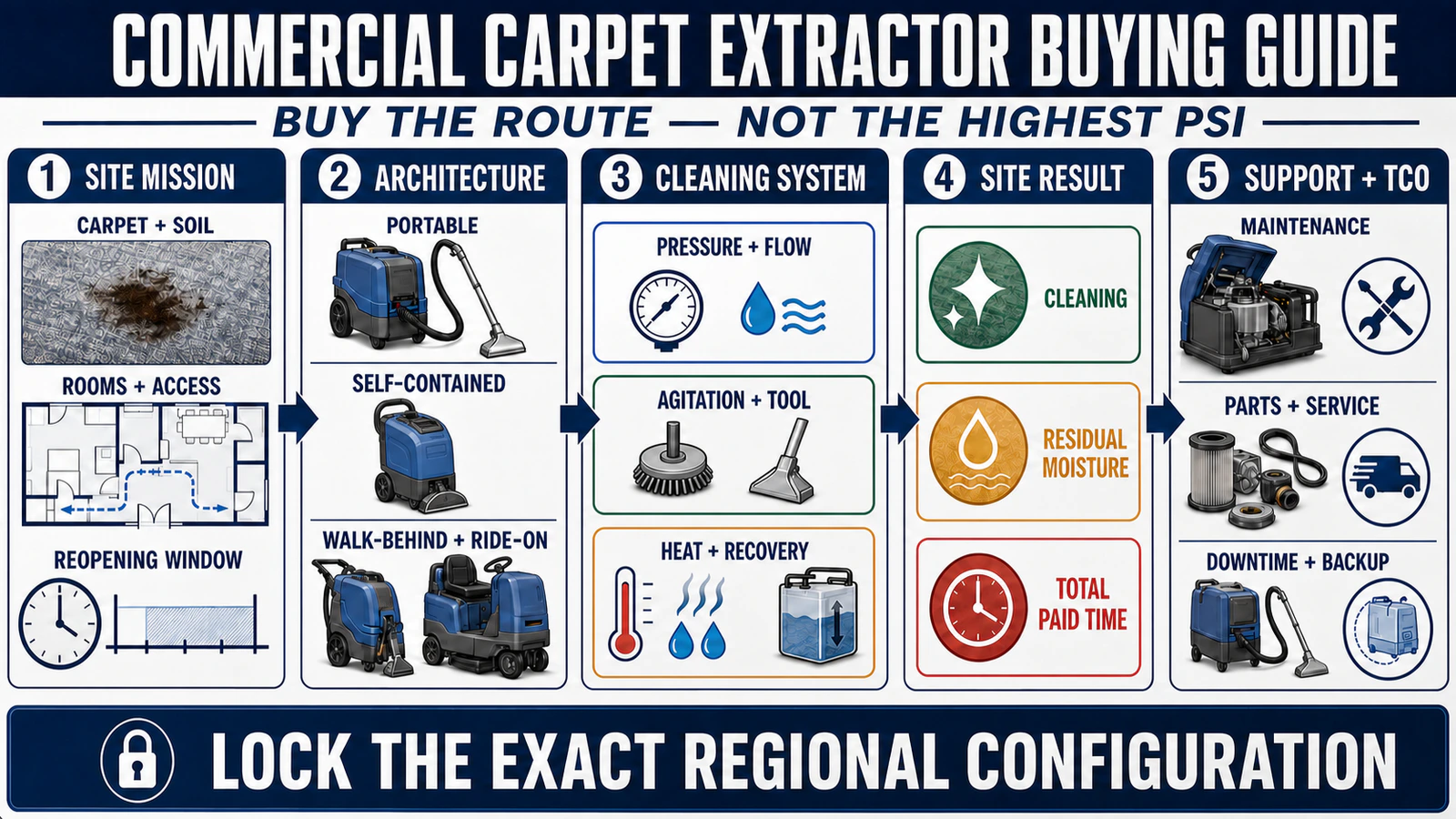
- Choose the extractor around the cleaning route, carpet, soil, access, utilities and reopening window—not the highest PSI or largest tank.
- Pressure, flow, heat, agitation, tool geometry and vacuum recovery work as one system; no single specification proves the cleaning and drying result.
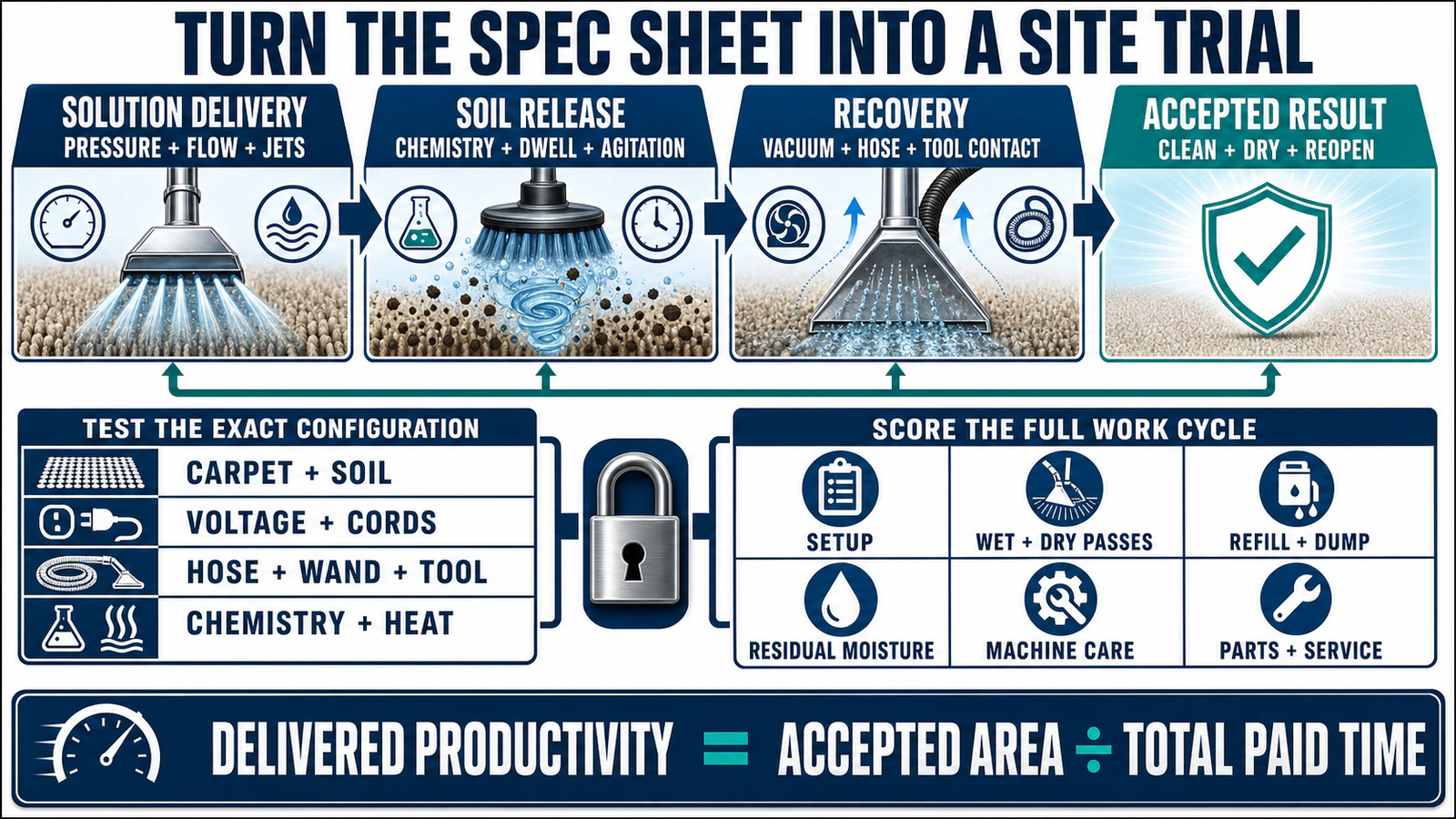
- Run a site trial on the exact regional configuration and compare setup, cleaning, refill, recovery, drying, maintenance, service and downtime before calculating total cost.
In this article 15 sections
Choose a commercial carpet extractor from the cleaning route backward. Start with the carpet, soil, rooms, access, water, power and required reopening time. Then select the machine format and compare solution delivery, agitation, recovery, tanks, tools and service as one system. The highest PSI, largest tank or presence of a heater does not identify the best machine.
A hotel room, furnished office, school corridor, vehicle interior and airport concourse do not impose the same work cycle. The winning extractor is the exact regional configuration that can reach the surface, produce an acceptable clean-and-dry result and repeat it without excessive setup, refill, maintenance or downtime.
This guide owns the commercial purchase decision. For the underlying process and equipment definitions, read What Is a Carpet Extractor?. Buyers comparing household uprights with portable spot machines should use Spot Cleaner vs Carpet Cleaner.
Commercial Carpet Extractor Buying Checklist
| Decision | Record before comparing models | Reject or retest when |
|---|---|---|
| Cleaning mission | Carpet construction, soil, area, frequency and required result | The demonstration uses an easier surface or soil |
| Facility route | Doors, lifts, stairs, furniture, water, drains, power, storage and transport | The machine or hoses cannot complete the real route |
| Architecture | Portable box-and-wand, compact self-contained, walk-behind, ride-on or contractor system | The format leaves routine areas or edges without a practical method |
| Solution system | Pressure, flow, jets, tools, chemistry and agitation | One headline specification substitutes for the complete system |
| Recovery and drying | Wet and dry passes, recovered liquid, residual moisture and reopening criterion | Visual improvement is accepted while the carpet remains too wet |
| Tanks and utilities | Usable tank cycle, filled weight, refill/dump route, cords, circuits or batteries | Rated capacity or runtime cannot be delivered on site |
| Maintenance | Rinsing, filters, jets, hoses, tanks, seals, brushes and drying the machine | End-of-job care is omitted from the labor calculation |
| Support | Exact-SKU parts, service territory, response, training, warranty and backup | Support exists for the brand but not the purchased configuration |
| Economics | Delivered labor, consumables, transport, downtime and useful life | Purchase price or brochure coverage is used as total cost |
Start With the Cleaning Route
Map a representative shift before opening a product catalog. Record the area and carpet construction, but also the route between work zones. Door widths, lifts, stairs, furniture, loading docks, parking, storage, water temperature, approved drains and electrical circuits can eliminate an otherwise capable machine.
The route also defines the real labor unit. A contractor may move a portable extractor once and clean several rooms through hoses. A facility operator may prefer a self-contained machine that moves as one unit. A ride-on can cover open carpet quickly, but turning, transport and manual edge work can consume the advantage in divided spaces.
Set the required result in operational terms. “Clean carpet” is incomplete. The acceptance criterion may include visible soil removal, no unacceptable appearance change, a maximum residual-moisture result, no wicking after drying and reopening before the next hotel arrival, school period or office shift.
The Carpet and Rug Institute’s Seal of Approval program evaluates extractors for cleaning effectiveness, surface appearance change and residual moisture. Those three measures are a stronger starting point than a suction adjective or pump-pressure claim, although certification still does not replace a site trial.
Choose the Machine Format Before Comparing Specifications
Nilfisk’s current commercial extractor category separates portable, compact, walk-behind and larger equipment. Treat these as operating architectures, not as a simple ladder from small to better.
Portable spot and upholstery extractors
A compact tank unit with a hose and hand tool fits stairs, upholstery, vehicle interiors and isolated incidents. Carry weight, tool control and fast cleanup matter more than room-scale path width. It is a poor default for large open areas if repeated hand strokes and small tank cycles dominate the shift.
Portable box-and-wand extractors
The tank and vacuum unit remain in one location while the operator moves a wand. This arrangement reaches under desks and into rooms while allowing larger tanks and longer hoses. It also adds hose routing, wand ergonomics and the risk that a remote machine blocks a corridor or occupies a different electrical circuit from the operator.
Kärcher’s current US Puzzi 50/35 C, for example, is listed with a 13-gallon solution tank, 11-gallon recovery tank and 200 PSI pump. Those figures describe one configuration; they do not prove that its fill cycle, wand or recovery will fit another buyer’s route.
Compact and self-contained walk-behind extractors
The tanks, floor head and recovery system move together. They can produce repeatable lanes in rooms and corridors with less hose handling. Furniture, stairs, edges and upholstery may still require an accessory kit or a second machine.
Clarke’s official EX40 manual lists different self-contained models and optional hand tools, wands and hoses. That is why the base chassis and accessory configuration must be locked together in a quote.
Large walk-behind and ride-on extractors
Large machines fit open facilities where walking time and tank interruptions are material. They require turning space, storage, transport, battery or charging plans, operator training and a separate edge strategy.
Tennant’s current R14 specification lists a 32-inch cleaning path, different cleaning speeds, a 24-volt battery system and a 73 dBA operator sound level. Those data help plan space, charging and operating conditions; rated speed still does not equal delivered square feet per shift.
Truck-mounted and contractor systems
A truck-mounted system can keep power and recovery equipment outside while long hoses reach the work. The purchase decision then includes vehicle access, hose distance, building security, noise, weather, wastewater handling and the cost of assigning a specialized crew. Facilities buying a service rather than a machine should specify the same carpet result and reopening criteria.
PSI Is One Input, Not a Cleaning Score
Pump pressure describes part of solution delivery. Flow, jet size, spray pattern, wand speed, carpet resistance and the distance through hoses influence how the liquid reaches the fiber. Chemistry, dwell and agitation loosen soil. Vacuum airflow, lift, seals, hose condition and tool contact influence how much liquid returns.
CRI’s tested-extractor registration form records voltage, amp draw, airflow, onboard heating, water lift, pump pressure, cleaning path, tank capacity, passes, speed and attachments. The form does not treat PSI as a standalone result.
Higher pressure can be useful in a compatible system, but it can also increase solution delivery, overspray or recovery demand. A 500 PSI box extractor is not automatically a better carpet purchase than a 200 PSI unit, and pressure settings intended for other tools or hard surfaces should not be transferred to carpet without the exact manufacturer’s instructions.
Ask suppliers to state pressure and flow at the tested configuration, including hose, jets and tool. During the trial, record the solution used per defined area and the dry passes needed to reach the reopening criterion. That connects the specification to the work.
Compare Recovery at the Carpet, Not Only at the Motor
Airflow and water lift describe different parts of a vacuum system. Neither value alone measures residual moisture at the carpet. Hose length and diameter, leaks, filters, tank seals, float systems, wand slots, glides and operator technique all change the delivered result.
CRI’s SOA-E-602 residual-moisture method weighs controlled carpet specimens before and after an extraction cycle. Its registration process also locks the tested model, attachment, wet and dry passes and speed. Buyers should apply the same discipline: compare matched configurations and record the procedure.
Recovered-tank volume is useful but incomplete. Some liquid remains in hoses, tools or the carpet, and the soil load changes the recovered mixture. Use a consistent field method: defined test area, measured solution input, fixed wet and dry passes, matched operator and an agreed residual-moisture or drying endpoint.
Do not promise one drying time across facilities. Carpet construction, liquid dose, recovery and building conditions all matter. Interface’s current carpet-tile maintenance guidance directs users to the specified maintenance process, while its published APAC instructions require complete drying before traffic returns. The carpet manufacturer’s current care and warranty documents take priority over a generic machine claim.
Verify What “Heated” Actually Means
The word “heated” can refer to hot water supplied by the building, an inline heater that raises or maintains solution temperature, or a different cleaning process. It does not prove that the machine turns cold water into a target temperature at full continuous flow.
Kärcher’s Puzzi 8/1 instructions list a maximum cleaning-solution temperature but no universal promise that every Puzzi machine heats its own water. Mytee’s current heated-extractor guidance tells users to begin with hot water, preheat the machine and allow for heater recovery during dry passes. Buyers must therefore verify inlet limit, heater output, warm-up, temperature under flow and the tested configuration.
Heat also changes electrical planning. Legend Brands’ official VersaClean portable-extractor manual states that heated units use two cords on separate grounded circuits. The exact cord count, voltage, frequency, plug and amp draw belong in the site survey and purchase order. An available wall receptacle does not prove that two outlets are on separate circuits.
Finally, temperature must fit the carpet, backing, dye system, chemistry and site rules. More heat is not a universal quality setting. Record the allowed method from the carpet manufacturer and reproduce it during the trial.
Tank Capacity Must Be Converted Into a Work Cycle
Larger solution and recovery tanks can reduce refill and dump interruptions. They also increase filled weight, turning effort, lift risk, transport load and end-of-job cleaning. Nominal capacity does not reveal usable solution per cycle or whether the recovery tank reaches its limit first.
Measure one representative cycle:
- move the machine from storage to the fill point;
- prepare the approved solution and fill safely;
- reach the work zone and set up cords, hoses or tools;
- clean the defined area with recorded wet and dry passes;
- return to an approved disposal point;
- empty, rinse and prepare the machine for the next cycle.
The best capacity is the one that reduces interruptions without creating a handling or route penalty. For stairs, vehicles and small rooms, a lighter machine may deliver more work per paid hour. For open public areas, a larger tank may be decisive.
Match Agitation, Wand and Accessories to the Surface
Extraction does not guarantee powered agitation. A box-and-wand system may depend on pre-spray, dwell and a separate brush process. A self-contained extractor may integrate cylindrical brushes. The correct route depends on the carpet manufacturer, soil and maintenance program.
Lock every working part in the configuration:
- wand or integrated head and its cleaning width;
- jet count, size and approved pressure range;
- powered brush or separate agitation method;
- hose length and diameter;
- upholstery, stair and crevice tools;
- glide, brush, filter and spray-tip replacements; and
- approved chemistry and dilution control.
This list belongs in the procurement record because a demonstration tool may not be included in the quoted SKU. It also affects operator posture. Wand height, trigger force, hose drag, forward and backward strokes and edge finishing can change fatigue and consistency across a shift.
Test material compatibility before performance. Interface’s published APAC carpet-tile instructions specify approved chemistry, extraction technique, dry passes and complete drying. Another carpet or upholstery system can set different limits. A supplier demonstration cannot override the surface manufacturer’s care instructions.
Facility Fit Includes Noise, Power, Water and Storage
Hotel and healthcare work may occur near occupied rooms. Schools and offices may offer only short cleaning windows. Vehicle detailing adds narrow access and upholstery tools. Large public facilities add transport, security and operator handover.
Record:
- machine and tool noise in the intended operating mode;
- cord routing, circuit availability and trip controls;
- battery runtime, charge time and charging location where applicable;
- permitted water source and maximum inlet temperature;
- approved wastewater route;
- machine dimensions, filled weight and tie-down method;
- hose and accessory storage; and
- ventilation or air-mover plan for the drying window.
Manufacturer sound, runtime and productivity figures should be tied to a stated standard or test condition. If the supplier cannot explain the condition, treat the figure as a catalog input and verify it on site.
Run a Site Trial on the Exact Configuration
A clean patch on new carpet is not a procurement trial. Test a representative route with the exact voltage, cords or battery, hoses, wand, jets, brushes, chemistry and heater configuration proposed for purchase.
1. Define the sample
Record carpet product and construction, backing or cushion, age, traffic condition and representative soil. Exclude surfaces that do not permit the process. Mark a defined area and establish the acceptance method before cleaning.
2. Record the complete clock
Start when the operator retrieves the machine. Separate transport, fill, setup, pre-vacuum, pre-treatment, agitation, extraction, dry passes, refill, dump, edge work, machine rinsing and storage. Net cleaning time alone hides the operating cost.
3. Measure input, recovery and drying
Record solution prepared and dispensed, recovered liquid, wet and dry passes, visible result, residual moisture or agreed proxy, airflow conditions and time to the reopening criterion. Recheck after drying for wicking, residue, odor or appearance change.
4. Stress access and utilities
Use the real doors, lifts, stairs, rooms, outlets, water and drain. Verify cord separation for heated units, hose management around corners, communication between operators and the effect of moving furniture.
5. Clean and inspect the machine
Kärcher’s current Puzzi instructions include emptying both tanks, rinsing with fresh water, cleaning filters and allowing the unit to dry. Perform the full routine during the trial. Check whether tank corners, float, seals, filters, jets, brushes, hoses and tools can be reached without unreasonable time or special improvisation.
6. Repeat the test
Run more than one cycle and include more than one trained operator. A machine that works only with the demonstrator, a fresh filter or an ideal circuit is not yet a repeatable facility system.
Calculate Delivered Productivity and Total Cost
Rated productivity usually begins with path width and travel speed. Delivered productivity subtracts everything the shift actually contains.
Use this structure:
Delivered productivity = accepted cleaned area ÷ total paid time
Total paid time includes transport, setup, pre-vacuuming, furniture, pre-treatment, extraction, dry passes, refill, dumping, edges, machine care and delays. An area is not accepted until it meets the cleaning and reopening criteria.
Then calculate total cost across the intended holding period:
Total cost = acquisition + financing + labor + chemistry + water and energy + accessories and consumables + preventive maintenance + repair + downtime and backup + disposal − residual value
Do not insert invented precision. Use the buyer’s wage, schedule, utility conditions, service rates and trial results. Run at least a base case and a disrupted case with a failed hose, pump, vacuum motor, heater or battery. Parts lead time can outweigh a small purchase-price difference.
Verify Maintenance, Parts and Commercial Responsibility
Request the operator manual, parts manual, preventive-maintenance schedule and priced wear list before the order. Hoses, jets, filters, seals, float components, tank lids, wheels, switches, pumps, vacuum motors, brushes, batteries and chargers need an identified supply route where fitted.
For each exact SKU, record:
- seller and invoice entity;
- legal manufacturer and factory scope;
- regional importer or responsible party;
- voltage, plug, certification and label configuration;
- included and optional tools;
- approved chemistry responsibility;
- warranty provider, exclusions and service territory;
- response time, labor rate and travel charge;
- parts stock, lead time and end-of-life policy; and
- loan, rental or backup-machine arrangement.
A brand-level dealer locator is not proof that the purchased model can be repaired locally. Private-label buyers should also connect the tested configuration to the responsible manufacturer and change-control process. See OEM vs ODM Cleaning Products and How to Find Reliable Cleaning Product Suppliers in China.
Commercial Carpet Extractor Procurement Red Flags
- The proposal ranks machines mainly by maximum PSI.
- “Heated” is listed without inlet temperature, heater output, warm-up, continuous-flow behavior or circuit requirement.
- Vacuum claims omit the hose, tool and test configuration.
- Tank capacity is quoted without filled weight, usable cycle or disposal route.
- Rated square-foot coverage excludes setup, refill, dry passes and machine care.
- A certification is shown without matching the model, attachment, setting and current record.
- The demonstration uses different carpet, chemistry, voltage or tools from the purchase configuration.
- The supplier cannot provide parts prices, service territory or a downtime plan.
- The carpet manufacturer’s maintenance instructions are absent from the trial.
- The contract does not identify who owes warranty and service performance.
FAQ
What PSI is best for a commercial carpet extractor?
There is no universal best PSI. Match pressure and flow to the carpet, tool, jets, chemistry, agitation and recovery system. Compare the clean-and-dry result on the exact configuration rather than ranking machines by maximum pressure.
Is a heated carpet extractor better?
Only when the heat system, carpet, chemistry, electrical supply and work cycle fit. Verify whether the machine heats cold water, raises incoming hot water or mainly maintains temperature, then test its temperature under normal flow.
Is a larger carpet extractor more productive?
It can be in large open areas, but tanks, turning, transport, furniture, edges and setup change delivered productivity. Compare accepted area per total paid hour on the real route.
Should a hotel buy a portable or self-contained extractor?
Rooms, stairs and upholstery often favor portable tools; corridors and open public areas can favor self-contained machines. Many hotels need a two-machine program or one floor machine plus a supported hand-tool configuration.
How should recovery be compared?
Use the same carpet, soil, solution input, wet passes, dry passes, hose and tool. Record recovered liquid, residual moisture or an agreed proxy, drying conditions and the reopening endpoint. Motor specifications alone are insufficient.
Does CRI certification replace a site trial?
No. CRI testing provides controlled evidence for the listed model and configuration. The facility must still verify carpet compatibility, utilities, access, labor, drying, maintenance, service and the exact regional SKU.
What should be included in a supplier demonstration?
Use the proposed machine, tools, chemistry and electrical configuration on representative carpet and soil. Time the full route, measure input and recovery, verify drying, perform end-of-job maintenance and repeat the cycle with facility operators.
How is carpet-extractor TCO calculated?
Add acquisition, labor, consumables, utilities, maintenance, repair, downtime and backup cost across the intended life, then subtract residual value. Use delivered productivity and local service data rather than brochure coverage.
Final Buying Decision
Buy the cleaning route, not the loudest specification. Select the architecture that can move through the facility, then judge pressure, flow, heat, agitation, recovery and tanks as one system. Verify the result on the exact carpet and regional configuration.
The best commercial carpet extractor produces an accepted clean-and-dry area within the operating window, can be maintained by the assigned team and has a credible parts and service route. That is the unit worth pricing over its full working life.