- A carpet extractor applies water or an approved cleaning solution and recovers the dirty liquid; it is different from a dry vacuum and does not necessarily generate steam.
- Portable, box-and-wand, self-contained walk-behind and ride-on extractors solve different access, area and productivity problems.
- B2B buyers should validate the complete work cycle, residual moisture, cleanability, exact regional SKU, parts, service and responsible legal entities—not one headline specification.
In this article 11 sections
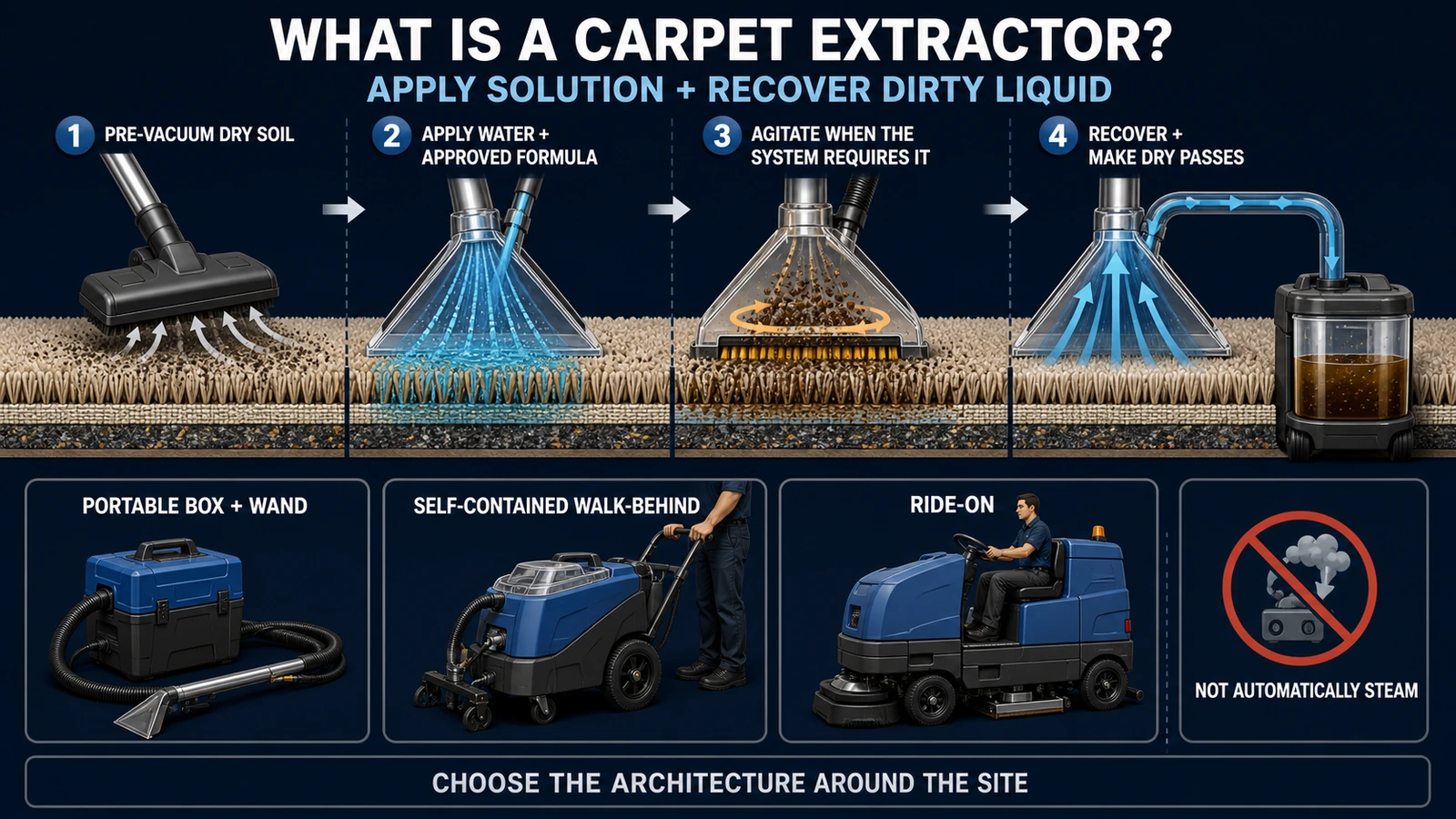
A carpet extractor is a wet-cleaning machine that applies water or an approved cleaning solution to carpet or upholstery and uses suction to recover the dirty liquid. Commercial extractors range from compact spot units and portable box-and-wand machines to self-contained walk-behind and ride-on equipment. They are not dry vacuums, and they do not necessarily generate steam or include a powered brush.
The name alone does not prove commercial duty. “Carpet cleaner,” “carpet washer,” “spray extractor” and “hot water extraction machine” overlap in product catalogs. Buyers should identify the actual architecture, application and test record before comparing models.
For a facility manager, contractor, distributor or private-label buyer, the decision goes beyond stain removal. Recovery, residual moisture, total labor, refill and dump cycles, machine hygiene, regional electrical configuration, parts and service all affect whether the equipment works as a commercial system.
Carpet Extractor at a Glance
| Equipment | Main function | Typical architecture | What it does not prove |
|---|---|---|---|
| Dry vacuum | Removes dry particulate through airflow and filtration | Upright, canister, backpack or ride-on | It does not wash and recover cleaning solution |
| Portable spot extractor | Treats small carpet or upholstery areas | Carryable tank unit, hose and hand tool | “Professional” does not prove room-scale productivity |
| Box-and-wand extractor | Keeps tanks and vacuum unit separate from the cleaning tool | Portable box/tank, solution hose, vacuum hose and wand | High pump pressure alone does not prove recovery or cleaning outcome |
| Self-contained extractor | Applies, agitates where fitted and recovers in a floor-machine chassis | Compact or full-size walk-behind | A wider path does not prove access around furniture or stairs |
| Ride-on extractor | Covers large, open carpeted areas | Operator platform, large tanks and integrated cleaning head | Rated productivity is not the same as net shift productivity |
| Vapor steam cleaner | Produces hot vapor for approved surfaces | Boiler, hose and steam tools | It is not automatically a carpet extraction system |
How Does a Carpet Extractor Work?
The Carpet and Rug Institute’s CRI 204 Commercial Carpet Standard defines an extractor as equipment that uses pressure, water or cleaning solution, and suction to remove deeply embedded soil or stains. It separately defines a vacuum as equipment that removes dry material by suction.
A professional extraction job normally contains several distinct stages.
1. Dry soil removal
Vacuum before adding liquid unless the specified process says otherwise. Hair, grit and loose particulate are easier to remove dry; wetting them increases the load on tools, hoses, filters and tanks.
2. Solution delivery
The machine or a separate sprayer applies water and an approved cleaning formula. Pump pressure, flow rate, spray-tip condition, path width and operator speed affect how much liquid reaches the carpet. More liquid is not automatically better.
3. Chemical action, dwell and agitation
The formula needs the correct dilution and contact time. Agitation may come from a powered brush, separate machine, wand stroke or another approved method. Some extractors have no powered brush, so “extractor” is not a synonym for “scrubber.”
4. Dirty-liquid recovery
The vacuum system pulls suspended soil and liquid into a dirty-water tank. Tool contact, airflow, lift, hoses, seals and dry passes all influence recovery.
5. Grooming and drying
The carpet must reach an acceptable condition before the space returns to service. CRI’s commercial maintenance guidance separates soil suspension, soil removal, finishing and drying, and identifies ventilation, air movers, HVAC and dehumidification as ways to accelerate drying. There is no universal drying time for every carpet, machine and building.
What Types of Carpet Extractors Are Available?
Nilfisk’s current commercial extractor category separates portable, compact, walk-behind and ride-on equipment. The useful distinction is not size alone; it is how the operator moves the cleaning head, solution and recovered liquid through the site.
Portable spot extractors
These machines use small tanks, a hose and a handheld tool for upholstery, vehicle interiors, stairs, spills and isolated stains. Their access is valuable, but a narrow tool and frequent tank cycles limit large-area throughput.
This category overlaps with Spot Cleaner vs Carpet Cleaner. A commercial spot extractor may have different components or duty expectations, but the exact model still needs verification.
Portable box-and-wand extractors
The machine remains in one position while the operator moves a wand connected by solution and vacuum hoses. It reaches under desks and around obstacles while supporting larger tanks and professional tools.
Buyers should test hose and cable routing through stairs, elevators, doors and corners, plus the distance to water and disposal. A specification sheet does not capture that labor.
Self-contained walk-behind extractors
The cleaning head, tanks and recovery system travel together. Repeatable lanes suit corridors and open carpeted areas; integrated brushes may add agitation, depending on the model.
Furniture, edges and small rooms still require a plan. Confirm whether a hose, hand tool or separate spotter is included, optional or unsupported.
Ride-on extractors
Ride-on machines target large open facilities where walking time and tank interruptions matter. They also add storage, transport, power, maintenance and training requirements; many small rooms can erase the advantage.
Truck-mounted systems
Contractors may use truck-mounted power and recovery systems with long hoses into a building. Access, hose distance, wastewater handling, site rules and contractor responsibility then become part of the specification.
Is a Carpet Extractor the Same as a Carpet Cleaner?
The terms overlap. In consumer retail, “carpet cleaner” often describes an upright household machine, while “carpet extractor” often signals professional wet recovery, separate hoses or heavier-duty equipment. Both can apply solution, agitate soil and recover dirty liquid.
Treat the words as category clues, not engineering definitions. Procurement documents should name the architecture, surfaces, duty, accessories and acceptance test.
“Hot water extraction” does not mean every machine has an onboard heater; water source, allowed inlet temperature and optional heat vary. “Steam cleaning” is often used for hot-water extraction, but a true vapor steam cleaner uses a different process.
Which Specifications Matter?
CRI’s private-label extractor registration records extractor type, power source, voltage, amp draw, airflow, onboard heating, water lift, pump pressure, cleaning path, solution and recovery capacity, wet and dry passes, speed and attachments. That list is a useful starting point because it prevents one headline number from replacing the system.
Cleaning path and physical access
Path width affects theoretical coverage. Chassis width, turns, furniture, edges, hoses and tools determine where it can work. Measure the site, not only an open corridor.
Solution and recovery tanks
Larger tanks can reduce interruptions but add filled weight. Compare usable capacity and the sequence of filling, recovery, disposal, rinsing and return.
Pump pressure and flow
Pressure and flow describe solution delivery. Jets, carpet, chemistry and operator speed also matter, so higher PSI is not a universal cleaning ranking.
Airflow, water lift and the recovery tool
Airflow and water lift describe different aspects of the vacuum system. Hoses, leaks, filters, seals, wand geometry and tool contact affect the carpet result; compare recovery and residual moisture under matched conditions.
Heat
For onboard or inline heat, verify chemistry, inlet temperature, warm-up, circuit demand and whether heat is part of the tested configuration. A heated extractor is not automatically a vapor steam machine.
Brushes and agitation
Record brush type, speed or pressure controls where relevant, pile compatibility, removal and cleaning. A box-and-wand unit may use a separate agitation step. Aggressive brushing is not appropriate for every textile.
Power and regional configuration
Lock voltage, frequency, plug, cord count, circuit load, battery platform and charger. A product family sold in several markets can contain materially different electrical and accessory configurations.
Certification Is Evidence, Not the Whole Purchase Decision
CRI’s Seal of Approval program evaluates extractor cleaning effectiveness, surface appearance change and residual moisture. Its current records identify the exact model, company, use type, extractor type, passes and certification period.
The SOA-E-602 residual-moisture method defines a controlled cleaning cycle using wet and dry passes, then calculates moisture from the carpet’s weight change. That is stronger evidence than an unqualified “powerful suction” claim.
It is still a controlled test, not a promise for every site. Carpet construction, soil, formula, pre-treatment, operator, humidity, airflow and maintenance can change the field result. Certification also does not replace destination-market electrical compliance, chemical documentation, material approval, warranty or service verification.
How Should a Facility Choose an Extractor?
Start with the work, not the catalog hierarchy.
| Operating situation | Likely starting architecture | Questions to verify |
|---|---|---|
| Hotel rooms and upholstery | Portable or compact extractor | Stairs, noise, hand tools, turnaround, hose and tank cleaning |
| Vehicle detailing | Portable box unit with upholstery tools | Tool access, hose reach, electrical supply, overspray and textile drying |
| Offices with furniture | Box-and-wand or compact self-contained unit | Under-desk reach, doors, cable routing, edge work and storage |
| School corridors and public areas | Self-contained walk-behind | Path, tank cycle, operator speed, dry passes and reopening window |
| Airport or large convention space | Large walk-behind or ride-on | Net shift productivity, transport, service, backup equipment and training |
| Rental fleet | Portable and/or household-style full-size units | Misuse, cleaning between users, missing tools, parts, instructions and backup stock |
The largest machine is not automatically the most productive. Net productivity includes setup, water access, furniture, travel, refill, dump, dry passes, drying, end-of-job cleaning and downtime.
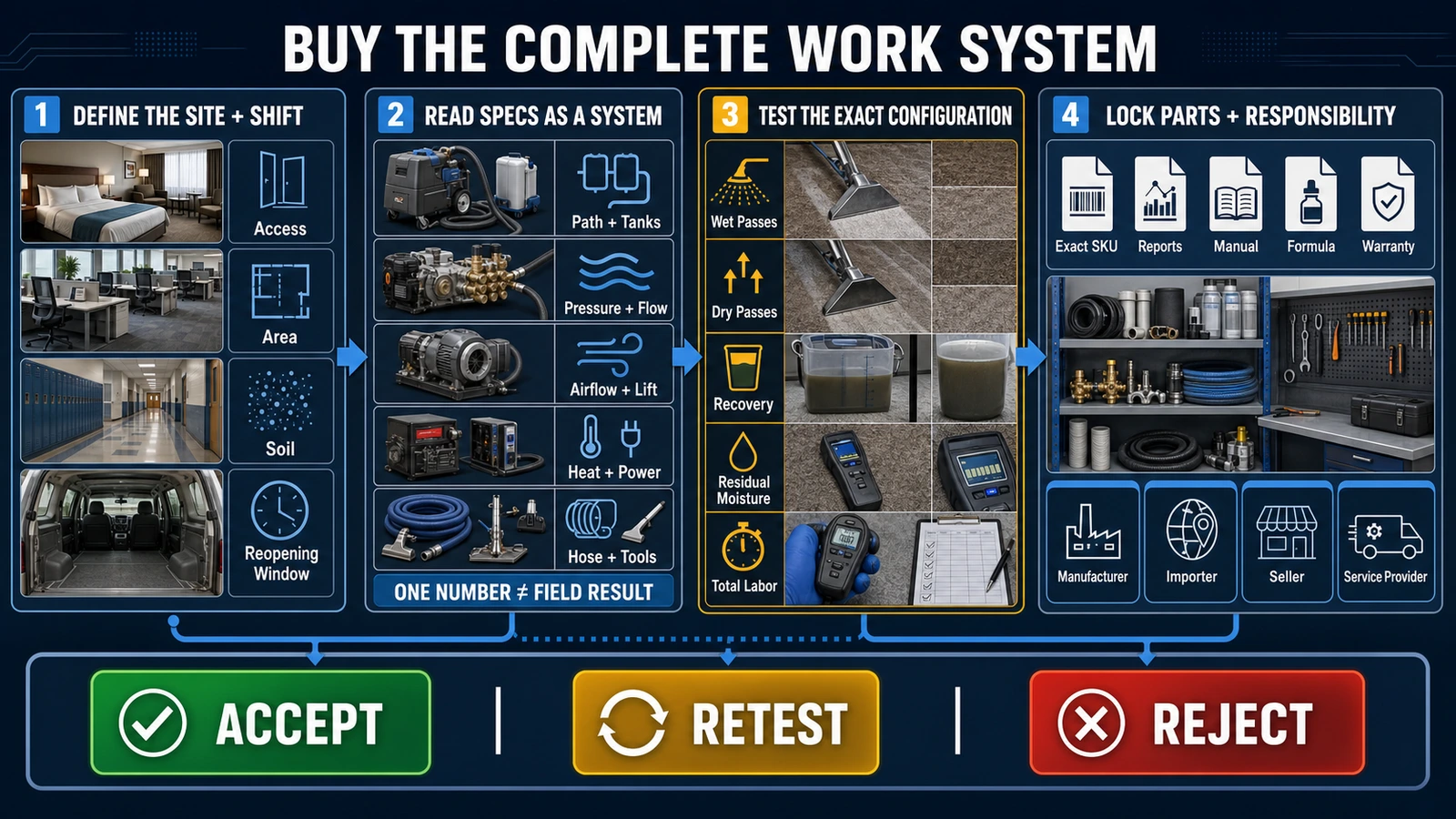
How B2B Buyers Should Test a Carpet Extractor
1. Lock the exact SKU and test configuration
Record the model, serial range, voltage, plug, cord or battery system, hoses, wand, jets, brushes, tanks, formula, manual revision and optional heater. If a certification is claimed, match the certificate and expiration to that configuration.
2. Use representative carpet and soil
Test the carpet construction, pile, backing and soil found in the target facility. Separate dry particulate, traffic film, water-based spills, oily soil and local stains. Exclude materials that do not permit the proposed wet process.
3. Measure the result and the work cycle
Record pre-vacuum time, wet passes, recovery-only passes, operator speed, solution dispensed, recovered liquid, residual moisture, visible appearance change and drying window. Then include furniture movement, edge work, refill, dump and travel.
4. Inspect and clean the machine
Kärcher’s current Puzzi 8/1 commercial instructions include emptying the tanks, rinsing the unit with fresh water, cleaning filters and allowing the machine to dry. Test whether operators can reach and clean the tank corners, float, seals, filters, jets, hose, wand and brush without excessive time or special tools.
5. Stress the service system
Run repeated cycles, not one demonstration pass. Ask for preventive-maintenance intervals, parts diagrams, prices, lead times, service territory, training, loan units and end-of-life support. Pumps, vacuum motors, hoses, jets, seals, tank lids, wheels, switches and brushes should have a documented route.
Verify the Responsible Parties
The brand on the tank does not identify every party behind the order. A trademark owner, brand operator, private-label customer, original tested-product manufacturer, legal manufacturer, OEM/ODM factory, importer, contract seller, service provider and warranty obligor can be different entities.
CRI’s private-label form requires the private-label product to be tied to a registered tested product and states that the specifications must be the same. That supports a certification relationship; it does not by itself prove corporate ownership, factory identity or who owes the buyer warranty service.
For a distribution or private-label project, request:
- the legal name on the quotation, invoice and sales contract;
- the legal manufacturer and factory scope for the exact SKU;
- destination-market importer or responsible economic operator;
- exact-model declarations, reports, labels and certificates;
- approved formulas, dilution and chemical-document responsibilities;
- warranty provider, service territory and exclusions;
- parts ownership, forecast, lead time and change control; and
- written notice rules for motors, pumps, electronics, hoses, tools, plastics and formulas.
World Clean Biz’s OEM vs ODM cleaning products and cleaning-product supplier verification guide explain why product development, manufacturing and contractual responsibility must remain separate. Commercial buyers can also compare this workflow with the equipment boundaries in Floor Sweeper vs Floor Scrubber.
FAQ
What is a carpet extractor used for?
It is used to wet-clean compatible carpet and upholstery by applying water or cleaning solution and recovering the dirty liquid. Common applications include offices, hotels, schools, public buildings, vehicle interiors and professional cleaning services.
Is a carpet extractor the same as a wet vacuum?
No. A wet vacuum is designed to pick up liquid. A carpet extractor also includes a controlled solution-delivery process and carpet-cleaning tools; agitation may be integrated or separate. Some machines combine functions, so verify the manual.
Does a carpet extractor use steam?
Not necessarily. Many use warm or hot water, and some have onboard or inline heat, but they do not generate vapor steam. “Steam cleaning” is often used informally for hot-water extraction.
Is higher PSI better for a carpet extractor?
Not by itself. Pressure, flow, jets, chemistry, agitation, operator speed, vacuum recovery, carpet construction and dry passes work together. Compare complete results under matched conditions.
Can a carpet extractor clean upholstery?
Only if the textile permits water-based extraction and the exact machine has an approved upholstery tool and formula. Check the care instructions and test an inconspicuous area.
How long does carpet take to dry after extraction?
There is no universal time. Liquid dose, recovery, dry passes, carpet and backing, cushion, temperature, humidity and airflow all matter. Set and test a site-specific reopening criterion.
Should a business rent or buy a carpet extractor?
Compare frequency, storage, operator training, cleaning between uses, service access and downtime. Rental can suit periodic work; ownership can suit frequent standardized work when maintenance and backup capacity are in place.
Final Answer
A carpet extractor is a complete wet-cleaning and recovery system, not a single suction or pressure specification. Choose the architecture around the site, access, carpet, soil, work frequency and reopening window. Then validate cleaning, appearance, residual moisture, labor, cleanability and service on the exact regional SKU.
For professional procurement, the best extractor is the machine that produces a repeatable clean-and-dry result within the available shift—and comes with traceable specifications, parts and clearly assigned manufacturing, sales and warranty responsibility.