- Choose by the pool and maintenance workflow, not by the longest feature list: shallow ledges, surface debris, fine particles, retrieval and storage can change the answer.
- Scuba V3 Ultra emphasizes six-zone cleaning, debris recognition and ultra-fine filtration, while AquaSense X makes its self-cleaning and charging station the center of the ownership experience.
- Before buying or stocking either platform, validate local availability, exact warranty terms, battery logistics, filter consumables and the service route for the sales region.
In this article 13 sections
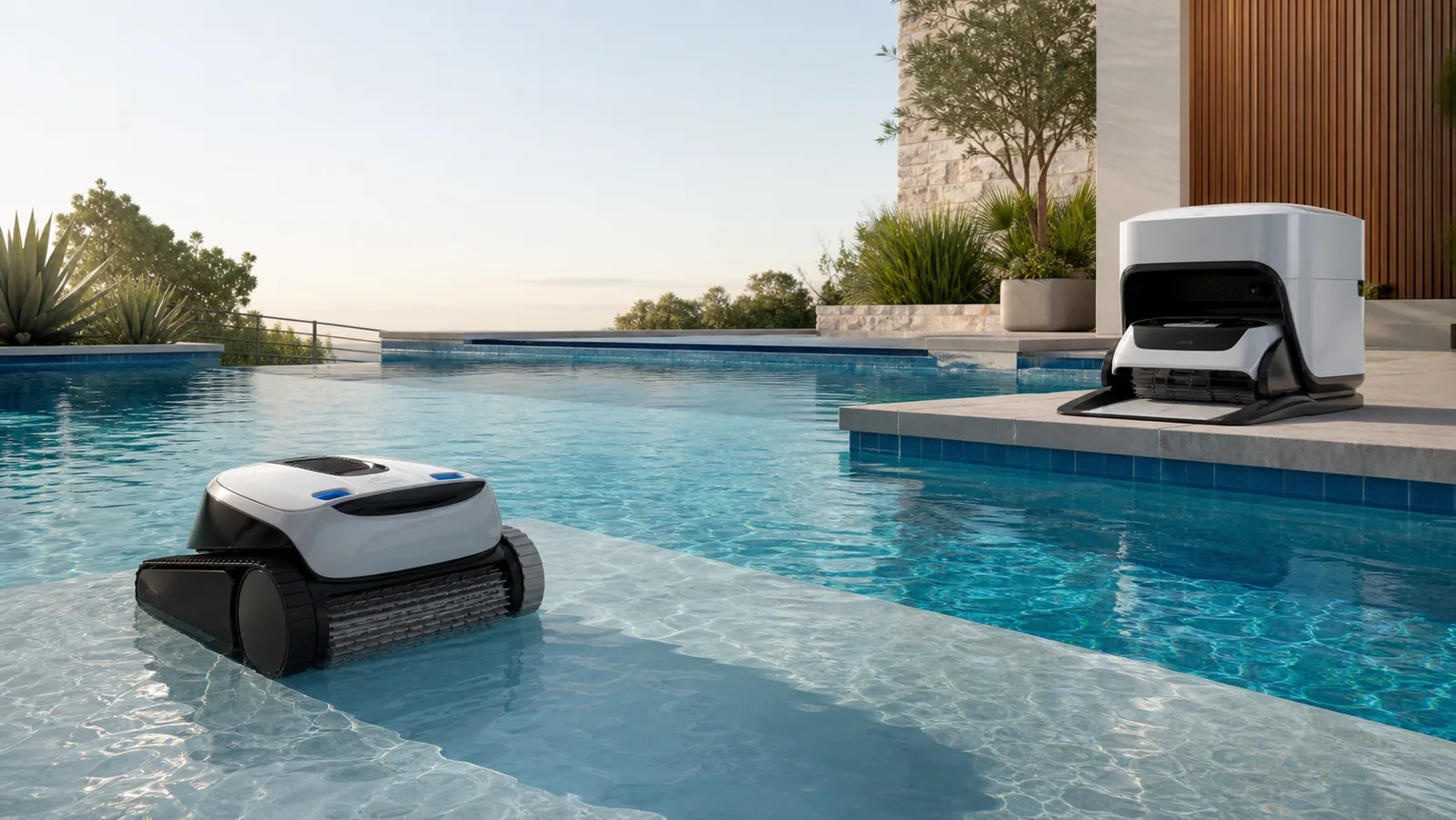
Choose the Aiper Scuba V3 Ultra when your priority is broad in-pool coverage—including shallow areas—and fine-particle filtration without committing deck space to a large service station. Choose the Beatbot AquaSense X when reducing filter handling is the priority and you can accommodate, maintain and pay for its self-cleaning charging station.
Both are premium cordless pool robots launched into the 2026 market. They are not simple substitutes. Aiper has built the Scuba V3 Ultra around multi-zone cleaning, debris recognition and filtration. Beatbot has built the AquaSense X around a robot-and-station system intended to automate charging and filter rinsing.
The better choice depends on the actual pool, debris and service route—not the number of sensors or the longest advertised runtime.
Aiper Scuba V3 Ultra vs Beatbot AquaSense X at a Glance
| Decision factor | Aiper Scuba V3 Ultra | Beatbot AquaSense X |
|---|---|---|
| Core proposition | Six-in-one pool coverage with debris recognition and fine filtration | Full-pool cleaning with an automated charging and self-cleaning station |
| Floor, wall and waterline | Yes, subject to pool geometry and surface | Yes, subject to pool geometry and surface |
| Surface work | Integrated surface-cleaning functions | Integrated surface skimming, but performance depends on floating-debris conditions |
| Shallow areas | Specifically promoted for shallow shelves down to a stated minimum depth | Adaptive cleaning is promoted for steps and platforms; validate the exact shelf geometry |
| Filtration priority | Multi-layer MicroMesh system promoted for very fine particles | Automatic station-based filter cleaning reduces routine basket handling |
| Deck requirement | Conventional charging and storage workflow | Large AstroRinse station needs a suitable deck location and periodic station care |
| Best fit | Buyers prioritizing pool-zone coverage and filtration | Buyers prioritizing automation and reduced filter-rinsing labor |
| Main risk to validate | Real coverage of the buyer’s shelves, steps and debris mix | Station size, weight, drainage, residue and the value of automation at its premium price |
This is a platform-level comparison, not a controlled performance test. Claims and specifications should be confirmed for the exact country, SKU and software version before purchase.
Start With the Pool, Not the Brand
Create a one-page pool profile before comparing either robot:
- pool length, width, depth and total area;
- in-ground or above-ground construction;
- plaster, tile, vinyl, fiberglass or another surface;
- floor-to-wall transition radius;
- steps, benches, tanning ledges and shallow shelves;
- drains, covers, ladders and other entrapment points;
- dominant debris: leaves, pollen, sand, silt, hair or insects;
- whether floating debris or settled debris causes more labor;
- where the cleaner will charge, drain and be stored;
- who will lift, rinse and maintain the system.
A premium robot can still be the wrong robot if the pool geometry defeats its traction or if the owner has nowhere practical to keep the charging system.
Cleaning Coverage
Floor, walls and waterline
Both platforms are positioned as full-pool cleaners. That does not guarantee equal results in every pool.
Wall climbing depends on traction, water flow, robot balance and the floor-to-wall transition. Waterline performance depends on whether the robot reaches the top, remains stable and travels laterally long enough to scrub the perimeter.
Ask for a demonstration in a pool with the same:
- surface material;
- wall angle;
- transition radius;
- step and bench design;
- water depth;
- debris load.
Do not treat a successful rectangular test pool as proof for a freeform pool with a beach entry and multiple shelves.
Shallow shelves and steps
Aiper makes shallow-area capability a central Scuba V3 Ultra message. Its official page describes cleaning in shallow areas down to 7.87 inches, while its JellyFloat system is promoted for surfacing, recovery and retrieval.
That is commercially important because benches and tanning ledges remain difficult for many submerged robots. But a minimum water-depth statement is not a promise that every ledge will be reached. Entry angle, shelf width, water depth and the route from the main floor all matter.
Beatbot promotes adaptive floor, step and platform cleaning for AquaSense X. Buyers should still ask for the permitted depth range and a video of the robot entering, cleaning and leaving a comparable shelf.
Surface debris
Both products address debris near the water surface, but surface performance is highly situational.
Floating leaves can move with wind, return jets and skimmer flow. A short integrated surface phase is different from a dedicated solar skimmer operating for much of the day. If leaves and insects are the dominant problem, compare:
- the integrated function;
- a separate surface skimmer plus a less expensive submerged cleaner;
- the owner’s existing skimmer and pump schedule.
The correct system may be two specialized robots rather than one premium all-in-one machine.
Navigation and Debris Recognition
Aiper describes the Scuba V3 Ultra as using cognitive AI, cameras and ultrasonic sensing to identify debris and adjust cleaning. Beatbot positions AquaSense X as an AI-driven system for complex pool environments.
The meaningful procurement questions are:
- How often does the robot repeat already-clean areas?
- Does it complete the pool before the battery reserve is reached?
- Can it recover from drains, corners and concave transitions?
- Does debris detection change the route or only the interface?
- What happens in cloudy water or low light?
- Is mapping retained between cycles?
- Which functions require the app, Wi-Fi or cloud access?
- Can diagnostics identify a blocked intake, traction problem or charging fault?
Sensor count alone is not a performance metric. A lower-specification navigation system with stable software can outperform a more complex system that frequently needs intervention.
Filtration: Fine Particles vs Automated Rinsing
Filtration is one of the clearest differences in buying logic.
Aiper promotes a multi-layer MicroMesh system and filtration down to a stated three microns. This makes the Scuba V3 Ultra interesting for fine silt and small organic particles. The claim should be evaluated with the real debris because fine media can load quickly, reduce flow and require more rinsing.
Ask:
- Is the fine layer installed for every cycle?
- How does flow change as the filter loads?
- Can the system handle leaves and fine silt in the same run?
- What is the replacement-filter price and lead time?
- Can each layer be replaced separately?
Beatbot’s AquaSense X changes the maintenance workflow through its AstroRinse station. The station is intended to empty or rinse the onboard filtration system while charging the robot.
That convenience has a counterweight: the station itself becomes pool equipment. It must be placed, supplied and periodically cleaned. Independent reviews have noted that residue and water can remain in the station, so “self-cleaning” should not be interpreted as maintenance-free.
For the buyer, the question is not which system has more technology. It is whether fine-particle capture or reduced manual filter handling removes more real labor.
Battery, Charging and Retrieval
Cordless cleaning removes a floating power cable, but it adds a propulsion battery and a charging workflow.
Compare:
- runtime for the selected cleaning mode;
- charging time from a normal end-of-cycle state;
- cycle coverage in the real pool;
- battery warranty and replacement route;
- charging-contact care;
- winter-storage instructions;
- safe retrieval after an interrupted cycle;
- lithium-battery shipping restrictions for warranty service.
Aiper promotes long floor and surface runtimes for the Scuba V3 Ultra. Beatbot’s main advantage is not merely runtime; AquaSense X returns to a system designed to charge and clean it.
Retrieval remains a practical issue. A robot filled with water and debris can be heavy. Validate whether the cleaner parks at the waterline, how water drains, whether a hook is included and whether the intended user can lift it safely.
The AquaSense X Station Changes the Buying Decision
The AquaSense X was listed at $4,250 on Beatbot’s U.S. site when checked on July 26, 2026. That price places it above many premium cordless cleaners.
The value case therefore depends on avoided labor:
- fewer manual filter rinses;
- a consistent charging location;
- less handling between cycles;
- easier routine for frequent pool cleaning.
The station also introduces requirements:
- sufficient deck space;
- a stable and level installation area;
- access to power;
- drainage and splash management;
- protection according to the installation instructions;
- periodic cleaning of the station;
- storage planning outside the swimming season.
For a small pool cleaned once a week, the automation premium may be difficult to justify. For a large pool with frequent debris and an owner who values low-touch operation, the station may be the defining feature.
App and Software
Confirm the exact functions available before, during and after an underwater cycle. Radio communication behaves differently through water, so some commands may be configured on the deck and executed later.
Evaluate:
- mode selection;
- mapping and cleaning records;
- scheduling;
- remote start limitations;
- battery and charging status;
- firmware-update process;
- multi-user access;
- diagnostic information;
- account and privacy requirements;
- behavior if the cloud service is unavailable.
For dealers, software support is part of the product. Staff need a repeatable process for pairing, updating, resetting and transferring a robot to a replacement owner.
Warranty, Parts and Service
Beatbot states a three-year warranty for the AquaSense X purchased through applicable official channels. Its warranty table includes the main body, battery, PCB, motors, sensors, plastic parts and power supply, while filter baskets and roller brushes have shorter consumable coverage.
For Aiper, confirm the current regional warranty on the exact Scuba V3 Ultra SKU. Do not assume that a warranty displayed in one country applies in another.
Before buying or stocking either robot, request:
- written warranty terms;
- authorized-seller requirements;
- battery and station coverage;
- inbound and outbound freight responsibility;
- expected repair turnaround;
- replacement-unit policy;
- parts list and current prices;
- local service-center address;
- diagnostic and RMA process.
An attractive feature set does not offset an uncertain repair route during a short swimming season.
Which One Should You Buy?
Choose Aiper Scuba V3 Ultra when:
- shallow shelves are a major cleaning requirement;
- fine silt or small particles dominate the debris;
- you want broad integrated pool-zone coverage;
- you prefer a more conventional charging and storage workflow;
- a local Aiper sales and warranty route is available.
Choose Beatbot AquaSense X when:
- rinsing filters is the main maintenance burden;
- the pool is cleaned frequently enough to justify station automation;
- there is suitable deck space, power and drainage;
- the owner accepts the station’s size and periodic maintenance;
- the three-year warranty and premium support route are valuable.
Consider another system when:
- a dedicated surface skimmer plus a submerged robot is more effective;
- the pool has unusual steps or geometry neither supplier can validate;
- local parts and battery service are unavailable;
- the automation premium exceeds the labor it can realistically save.
Dealer and Distributor Implications
These products require different sales conversations.
Scuba V3 Ultra should be demonstrated around coverage, shelf access, filtration and debris recognition. AquaSense X should be sold as an installed ownership system, including station placement, drainage, filter handling and support.
Dealers should avoid stocking either product without:
- trained setup and troubleshooting staff;
- a demo pool or documented test protocol;
- spare filters and wear parts;
- a battery and dangerous-goods return process;
- clear dead-on-arrival and seasonal service rules;
- a margin allowance for premium presales support.
For a broader channel framework, use the robotic pool cleaner distributor guide. For the rest of Beatbot’s lineup, see the Beatbot robotic pool cleaner buying guide.
FAQ
Is the AquaSense X completely maintenance-free?
No. Its station can reduce routine filter-rinsing labor, but the robot, station, brushes, flow path and charging system still require inspection and cleaning.
Can either robot clean every tanning ledge?
No universal claim is safe. Water depth, entry angle, shelf width, surface and the route from the pool floor determine whether a robot can access and leave a ledge.
Is a higher suction number always better?
No. Intake design, brush contact, filtration loading, leakage and navigation affect collected debris. Test the complete system with the target debris.
Do these robots replace pool circulation and sanitation?
No. A robotic cleaner removes debris and may perform supplementary functions, but circulation, filtration, water chemistry and sanitation still require a pool-specific operating plan.
Which is better for a dealer?
The better dealer product is the one supported by a reliable regional supply chain, spare parts, warranty logistics, training and enough margin to handle presales and after-sales work.
Sources
- Aiper Scuba V3 Ultra official product page
- Beatbot AquaSense X official product page
- Beatbot warranty policy
- WIRED: Beatbot AquaSense X review
Official pages and warranty information were checked on July 26, 2026. Product availability, price, software and terms can change. Confirm the exact regional SKU and written terms before purchase.
Explore 2026 new models
From brand to model
Specifications, versions & buying considerations
Pool robotsBeatbot AquaSense X ↗Specifications, versions & buying considerations
Pool robotsAiper Scuba V3 ↗Specifications, versions & buying considerations
Pool robotsAiper Scuba S3 ↗Specifications, versions & buying considerations