- Choose an Aiper by the exact pool classification, area, geometry and required cleaning zones—not by suction or AI language alone.
- A cordless pool robot removes cable handling but adds charging, battery aging, retrieval and service obligations that must be evaluated together.
- Authorized sales, written warranty terms, charger and battery support, filters and a practical repair route are essential for both homeowners and dealers.
In this article 13 sections
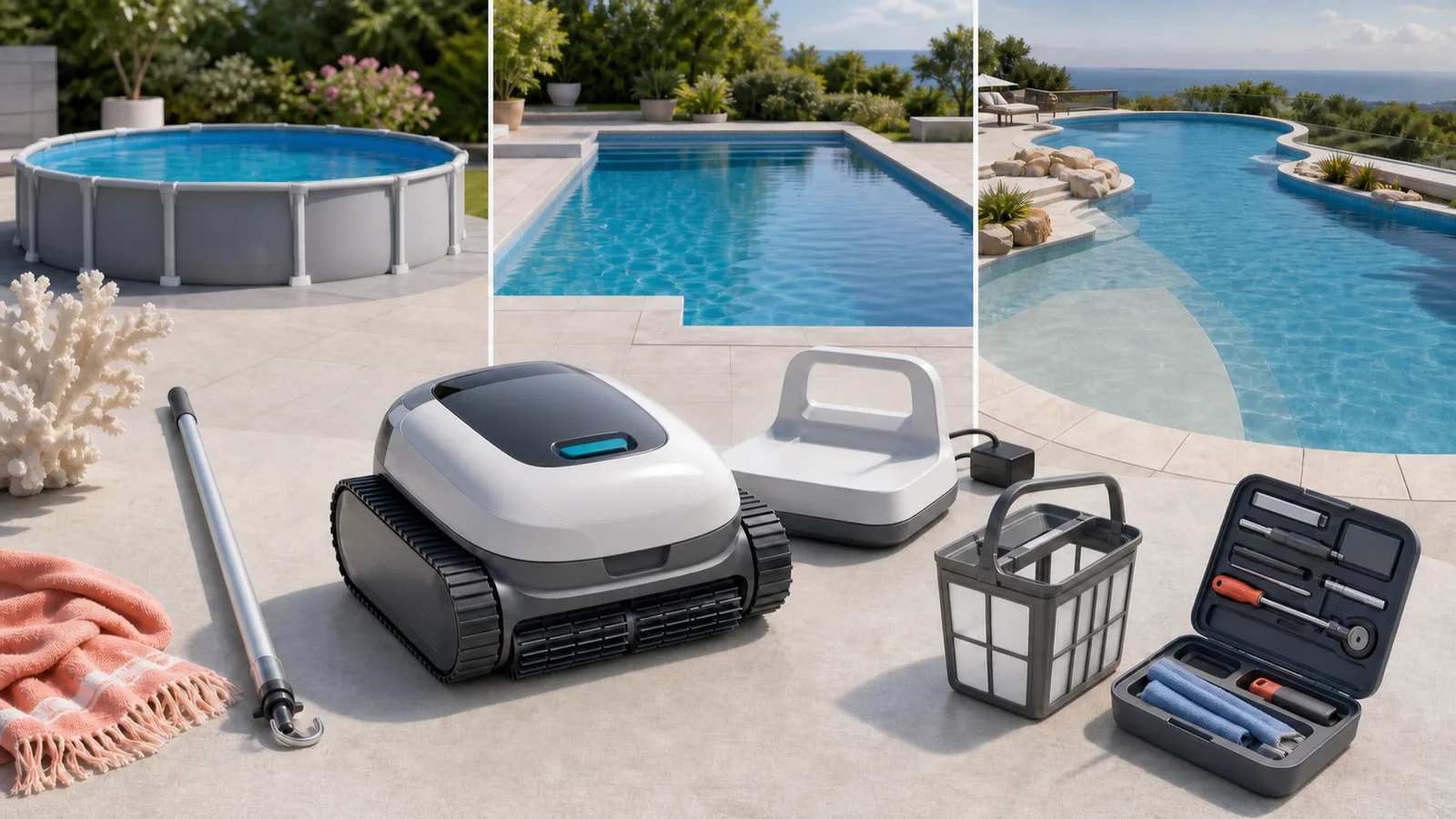
Choose an Aiper robotic pool cleaner by matching the exact model to your pool type, area, geometry, cleaning zones and debris. A small floor-only Scuba SE, a wall-and-waterline Scuba S1, a mapped Scuba X1 Pro and an all-zone Scuba X1 Pro Max are different tools. After pool fit, compare filtration, runtime, charging, wet handling, app functions and the authorized warranty route.
Aiper’s range changes quickly. Its current US catalog includes established Scuba S1 and X1 products as well as newer Scuba V3 and S3 platforms. Product names, included accessories and warranty terms may vary by market and seller. Use this guide as a shortlist framework, then verify the exact product page, serial-number market and written sales terms before ordering.
Aiper Model Comparison: A Current US Snapshot
The following model roles are based on Aiper US pages checked on July 26, 2026. The table is not a promise of availability in every country.
| Model | Listed pool fit | Listed cleaning scope | Cordless-system role | Best used as a shortlist for |
|---|---|---|---|---|
| Scuba SE | Above-ground; up to 860 sq ft / 30 ft | Floor only | Up to 90 minutes; three-hour charge; 2L, 180-micron tray | Small, relatively flat pools that do not need wall cleaning |
| Scuba E1 | Current above-ground catalog; up to 1,100 sq ft / 33 ft on comparison material | Floor only | Larger basket and dual-level filtration than the SE role | Flat pools needing finer-debris filtration; verify the current local product page |
| Scuba S1 | Current page describes above-ground and in-ground use; up to about 1,600 sq ft | Floor, walls, waterline and shallow areas on the current page | App monitoring, multiple modes and MicroMesh option | Medium residential pools needing more than floor-only cleaning |
| Scuba S1 Pro | In-ground; up to 2,150 sq ft / 66 ft | Floor, walls and waterline | Up to 180 minutes; four-hour charge; 5L dual-layer filter | Buyers prioritizing underwater scrubbing, horizontal waterline movement and fine filtration |
| Scuba X1 | In-ground; up to 2,150 sq ft / 66 ft | Floor, walls and waterline | Up to 180 minutes; four-hour charge; app and charging dock | Connected full-pool cleaning without the Pro mapping package |
| Scuba X1 Pro | In-ground; up to 2,150 sq ft / 66 ft | Floor, walls, waterline, elevated platforms and slopes | Up to 180 minutes; mapping, app and dock; optional ecosystem hardware varies | Complex geometry where written platform and slope claims matter |
| Scuba X1 Pro Max | In-ground; up to 3,230 sq ft / 100 ft | Floor, walls, waterline, surface, elevated platforms and slopes | Listed up to five hours floor or ten hours surface mode; wireless charging and caddy | Large or complex pools seeking one platform for underwater and surface work |
| Scuba V3 | Current 2026 in-ground range | Floor planning and horizontal waterline functions are emphasized | VisionPath, AI Navium, app alerts, dock and MicroMesh; 18.1 lb listed weight | Buyers prioritizing lighter handling and vision-based automation |
| Scuba S3 | Current 2026 in-ground range | Floor, wall and waterline modes | WavePath 2.0, dToF sensing, MicroMesh and quick water release | Buyers wanting a newer systematic-navigation and filtration package |
Some newer model pages do not expose every pool-size, runtime and box-content field consistently. That is a reason to request the current specification sheet—not a reason to fill the gaps with assumptions.
Start With Pool Type, Area and Geometry
An Aiper shortlist should begin with a pool survey:
- above-ground or in-ground construction;
- maximum length, surface area and depth;
- flat, sloped, bowl-shaped or multi-level floor;
- vinyl, fiberglass, tile, concrete or another contact surface;
- wall angle and floor-to-wall transition;
- steps, benches, shallow shelves and raised platforms;
- ladders, drains and permanent obstacles;
- typical leaf, sand, silt, pollen and hair load.
Pool area and length are both important. A long narrow pool can have a different route and battery requirement from a compact freeform pool with the same surface area. A product that is listed for 2,150 square feet can still struggle with a specific ledge, drain or transition.
The entry-level SE and E1 roles are floor-focused. Do not choose them for a purchase brief that requires wall or waterline cleaning. The S1, S1 Pro and X1 family move into broader cleaning zones, while X1 Pro and Pro Max add explicit claims for more complex features.
For an unusual pool, ask the seller to answer three questions in writing:
- Is this exact model approved for the pool classification and surface?
- Which zones are included in its stated cleaning scope?
- What happens if the robot cannot complete the required zones in the actual pool?
The above-ground versus in-ground pool robot guide explains why a lightweight floor cleaner and a full-pool climbing robot should not be treated as substitutes.
Define the Cleaning Zones
Floor only
Scuba SE is explicitly positioned for floor cleaning. That can be enough for a small above-ground pool with a flat floor and manual wall maintenance. It is not a lower-priced version of a full-pool robot; it is a narrower tool.
Floor and walls
Wall cleaning requires traction, sufficient water flow and a suitable transition. Confirm the current page’s surface compatibility, then test the wall behavior with a clean filter and brush. A robot that reaches the wall once has not proven repeatable coverage.
Waterline
Aiper uses horizontal waterline language on products such as S1 Pro, X1 Pro and newer V3 platforms. The important buying question is not the navigation trademark. It is whether the exact robot is specified to reach, remain at and move along the waterline in the buyer’s pool.
Steps, shallow areas, platforms and slopes
These are purchase-critical zones for some pools and difficult zones for robots. The current S1 page highlights shallow-area cleaning, while X1 Pro and X1 Pro Max pages list elevated platforms and slopes. Ask how shallow the robot can operate and whether the claim covers the full horizontal surface or only crossing it.
Water surface
Most underwater pool robots do not skim floating debris. X1 Pro Max is different because its current page lists a surface-cleaning mode. If leaves and pollen remain on the surface for long periods, compare that integrated role with a dedicated surface skimmer rather than assuming every Aiper can do both.
Understand the Cordless Trade-Off
Aiper’s main product proposition is cordless operation. Removing the floating cable can improve handling around the pool, but the ownership system still includes:
- an internal battery;
- a charger or charging dock;
- charging contacts and a dry charging location;
- a defined runtime for each mode;
- a retrieval method when the cycle ends;
- off-season storage;
- battery and charger service.
The right comparison is not “cordless versus cable.” It is “one complete ownership workflow versus another.”
A corded robot can run repeated cycles without recharging but requires a safely positioned power supply and cable management. A cordless Aiper clears the water of that cable, but may need several hours between cycles. The corded versus cordless robotic pool cleaner guide covers this category decision in detail.
For a high-debris pool, ask whether one battery cycle is sufficient when the filter is partly loaded. A runtime recorded in a controlled test does not guarantee the same area coverage in cold water, on walls or with heavy debris.
Runtime, Charging and Battery Aging
Runtime should be interpreted by cleaning mode. Floor-only operation, wall climbing and surface skimming can place different loads on the same battery platform.
Compare:
| Question | Why it matters |
|---|---|
| How long is the standard cycle? | “Up to” runtime may describe a different or lower-power mode |
| What is the full recharge time? | Determines whether a second cycle is practical on the same day |
| Is a dock included? | Product pages and channel bundles can differ |
| Must contacts be completely dry before charging? | Affects the real post-cycle routine |
| Can the battery be replaced locally? | Determines downtime and end-of-life cost |
| What battery behavior is covered by warranty? | Capacity decline and failure are not the same claim |
| How should the unit be stored off-season? | Poor storage can accelerate battery degradation |
For a dealer demonstration, time the full workflow: retrieval, draining, filter cleaning, drying and charging. A customer who sees only the robot moving underwater has not seen the ownership burden.
Navigation, AI and App Functions
Aiper currently uses several navigation and sensing descriptions, including WavePath, FlexiPath, VisionPath, ultrasonic sensing, dToF and AI Navium. These names describe different product generations and approaches. They should not be ranked without a pool-specific acceptance test.
Navigation quality should be evaluated through outcomes:
- Does the robot cover the full floor without excessive repetition?
- Does it escape the main drain and tight corners?
- Does it transition between floor levels?
- Does it climb the required walls?
- Does it maintain waterline movement?
- Can it find a predictable retrieval point?
- Does performance remain acceptable with a partly loaded filter?
An app can provide mode selection, history, alerts and updates. Underwater communication is a separate issue. Radio communication through water is limited, so confirm whether a feature works only before submersion, after surfacing or through an additional device such as HydroComm. Do not assume every app-connected Aiper provides live underwater control with the standard box contents.
Newer vision-equipped products also raise data questions. Aiper’s V3 page states that its vision system does not store or upload images. Buyers using a connected product should still review the current privacy terms, account requirements and update policy for their market.
Filtration and Debris
The best filter is the one that handles the dominant debris while maintaining water flow.
Scuba SE uses a simpler 180-micron floor-cleaning tray. S1 Pro and the X1 family use larger top-load baskets and combinations of standard and MicroMesh ultra-fine filtration on current pages. These configurations solve different jobs.
- Use a coarser path for leaves, twigs and a heavy post-storm load.
- Use a fine layer for sand, silt, dust and pollen after the larger debris is controlled.
- Check whether the fine element is included, optional or replaceable.
- Rinse after the cycle and inspect folds and seals for trapped material.
- Ask the replacement interval and local filter price.
A very fine filter can restrict flow when loaded. If wall climbing declines during the cycle, inspect filter loading before blaming navigation.
Filter capacity is also a route-planning limit. A five-liter basket has more debris volume than a two-liter tray, but basket volume does not prove fine-particle capture or better wall cleaning.
Retrieval, Wet Weight and Maintenance
The robot must be lifted from water after every normal cycle and before charging.
Compare dry weight, water-release speed, grip points, retrieval hook, parking behavior and caddy. Scuba V3’s current page emphasizes an 18.1-pound design, while larger X1 products have a different handling envelope and accessory system. The buyer should test the wet lift, not only read the dry specification.
Do not pull a robot from the pool by an electrical lead or charging component. Use the method described in the current manual. Rinse pool water from the robot, filter and moving parts, then allow charging areas to dry as instructed.
Consumables and service items can include:
- filter basket and MicroMesh element;
- brushes and rollers;
- tracks or drive components;
- charging dock, adapter or cable;
- retrieval hook and caddy;
- sealed battery service;
- app and firmware support.
Warranty, Authorized Sales and Repair
Aiper’s authorized sales channel page states that products bought from unauthorized resellers are not covered by its warranty policy. That makes seller verification a purchase requirement, not an administrative detail.
The Aiper support portal provides product support, videos, repair applications, warranty processing, service-progress inquiries and contact routes. Before buying, record:
- exact model and serial-number market;
- seller name and authorization status;
- written warranty term and exclusions;
- proof-of-purchase requirements;
- repair destination and shipping responsibility;
- expected charger, battery and filter support;
- whether replacement or depot repair is the normal remedy;
- support response time during the swimming season.
Do not use a warranty term copied from another country, model or marketplace bundle. Save the product page and policy that applied on the purchase date.
For a dealer, the warranty workflow should be tested before stocking the SKU. A “hassle-free” label is not a process description. Staff need an escalation contact, case requirements, return authorization path and expected turnaround.
A Practical Aiper Shortlist
| Buyer need | Models to investigate first | Mandatory verification |
|---|---|---|
| Small above-ground, flat floor | Scuba SE; Scuba E1 | Floor geometry, maximum area, filter grade, runtime and retrieval |
| Medium residential pool needing walls and waterline | Scuba S1; Scuba S1 Pro | Pool classification, shallow areas, mode runtime and app functions |
| Connected full-pool cleaning | Scuba X1 | Exact cleaning zones, dock contents and communication limits |
| Complex in-ground pool with platforms or slopes | Scuba X1 Pro | Written geometry claims, mapping behavior and optional ecosystem hardware |
| Large pool or combined surface/underwater role | Scuba X1 Pro Max | Actual area, wet handling, mode runtime, charging and service capacity |
| Newer vision or systematic platform | Scuba V3; Scuba S3 | Full current specification sheet, privacy, update policy and local launch support |
For alternative brand comparisons, see Aiper vs Beatbot, Aiper vs WYBOT and Dolphin vs Aiper. The Aiper ownership guide explains the company and Fluidra relationship without turning corporate ownership into a product-performance claim.
Dealer and Distributor Evaluation
An Aiper assortment should assign each SKU a customer job.
A defensible range may include:
- one small floor-only above-ground model;
- one mid-size floor/wall/waterline model;
- one mapped model for complex in-ground pools;
- one large-pool or all-zone flagship;
- a clearly separated new-technology line for vision or AI features.
For every SKU, create a matrix with pool type, area, length, surface, cleaning zones, runtime by mode, charging time, filter contents, box contents, warranty term, repair destination and consumable availability.
Do not stock adjacent models only because their feature lists differ. Stock them when the sales team can explain the customer problem each model solves.
Dealers should also keep a demonstration and first-cycle acceptance process. Record pool geometry, water temperature, debris, filter configuration, starting battery level, observed coverage, retrieval and post-cycle work. This makes returns diagnosable and improves qualification.
The Aiper dealer portal presents training, marketing and warranty support. A prospective dealer should confirm commercial terms, territory, service responsibility, parts access, returns, co-op marketing rules and how fast the range will be refreshed.
Frequently Asked Questions
Which Aiper is best for an above-ground pool?
For a small flat above-ground pool that needs floor cleaning, Scuba SE is a current entry role. Scuba E1 is positioned for a somewhat larger flat floor and finer filtration. If walls or waterline are required, move to a model whose current page explicitly lists those zones and confirms the pool classification.
Which Aiper cleans the waterline?
Current pages list waterline functions on selected S1, S1 Pro, X1, X1 Pro, X1 Pro Max, V3 and S3 products. This is not a feature of floor-only entry models. Verify the exact model and market page.
Does every Aiper work with the app underwater?
No assumption should be made. Some functions are selected before the robot is submerged, and some underwater communication may depend on additional hardware. Confirm the exact included equipment and feature limits.
Is a longer runtime always better?
No. Runtime must be matched to cleaning mode, pool area, debris and route efficiency. A shorter systematic cycle can be more useful than a longer cycle that repeats easy zones.
Does an ultra-fine filter replace the pool filtration system?
No. The robot removes debris from surfaces and water passing through its basket. It does not replace circulation, chemical control or the pool’s primary filtration system.
Where should I buy an Aiper?
Use Aiper’s current authorized-seller list or a seller whose authorization can be confirmed in writing. Unauthorized purchases may not receive Aiper warranty coverage.
Are Scuba V3 and S3 replacements for X1 and S1?
They are newer product platforms in the current US range, but do not assume a one-to-one replacement. Compare the exact cleaning zones, pool size, runtime, filtration, navigation, accessories and service support.
The Bottom Line
An Aiper buying decision should pass six gates: pool fit, cleaning zones, cordless workflow, filtration, navigation and service. The model name matters only after those requirements are written.
For a homeowner, the safest choice is the exact authorized model that can be charged, retrieved, cleaned and repaired without an impractical routine. For a dealer, the strongest range is not the largest range. It is the one with clear SKU roles, verified claims, trained qualification and a functioning warranty path.
That process turns Aiper’s fast-moving model lineup into a manageable decision instead of a feature-list contest.
Explore 2026 new models