- Choose cleaning zones before model names: Sora 10/30 and AquaSense 2 do not continuously skim the water surface, even when they can park there.
- Measure shallow ledges, steps, pool depth and floor area; platform capability and advertised maximum coverage are not interchangeable.
- Verify the local warranty, authorized seller, charger, filter availability and service route because coverage differs by model, market and use case.
In this article 14 sections
For a straightforward floor, wall and waterline robot, start with Sora 10 or AquaSense 2. Choose Sora 30 when shallow ledges matter but floating debris does not. Choose Sora 70 when you also need active water-surface cleaning. Move to AquaSense 2 Pro or Ultra for premium navigation, surface cleaning and water-clarification features. AquaSense X is the low-touch flagship with an automatic filter-cleaning station.
That short answer only works after you measure the pool. A robot that performs well in a rectangular pool can still miss a shallow tanning ledge, narrow step, raised drain or complex freeform transition.
2026 Beatbot Product Lines
Beatbot’s current range has two main buying routes.
Sora: performance and value
- Sora 10: floor, walls and waterline; approximately 12-inch minimum depth for shallow areas; 5L debris basket; no active surface skimming.
- Sora 30: floor, walls, waterline and shallower platforms; approximately 8-inch shallow-water capability; 6L basket; no active surface skimming.
- Sora 70: adds water-surface cleaning, a 6L basket and optional fine filtration to a five-zone cleaning route.
Sora is the easier range to understand by coverage. The model number rises as shallow-water access, surface cleaning and ownership features increase.
AquaSense: premium automation
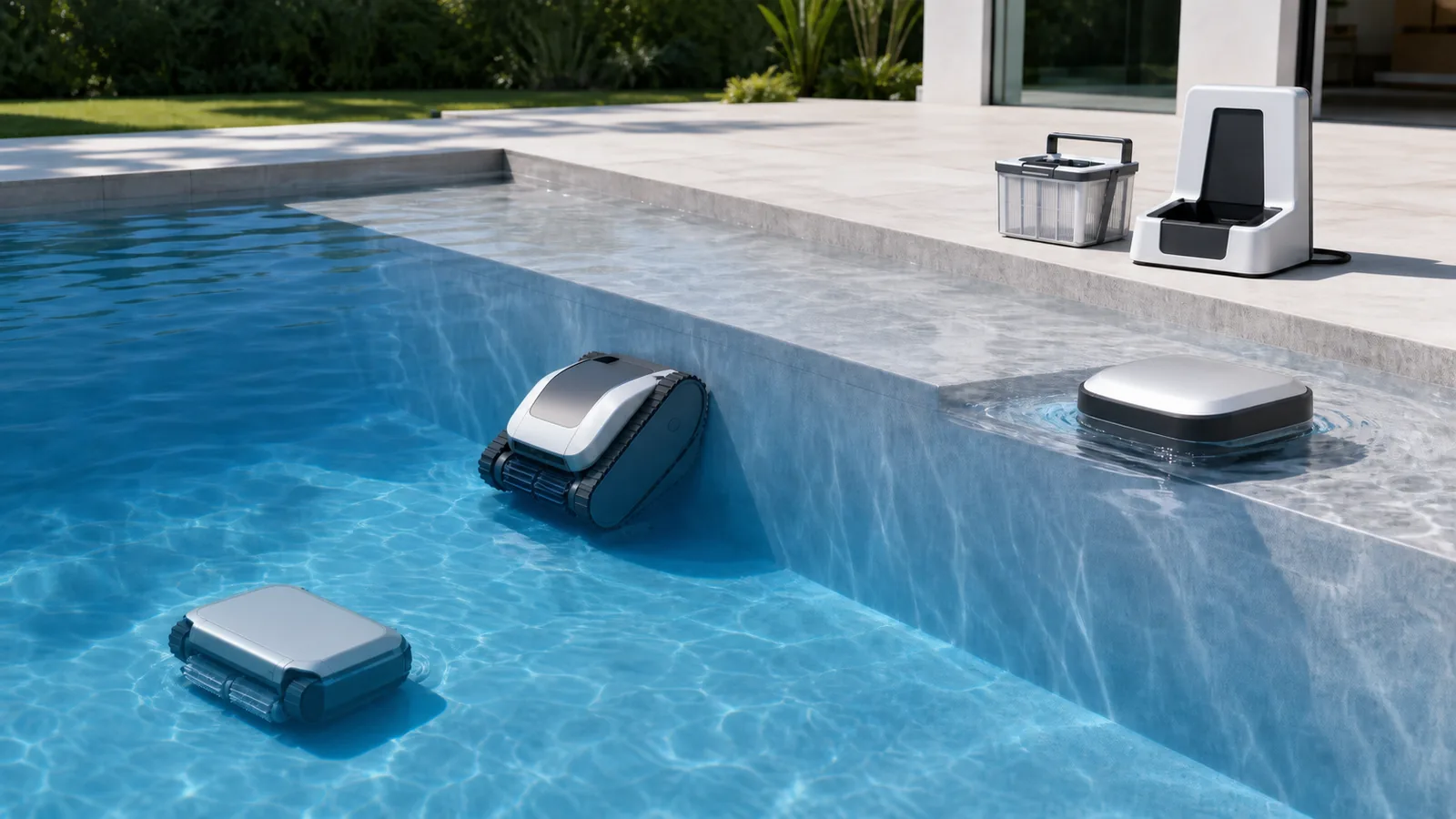
- AquaSense 2: floor, walls and waterline, plus water-surface parking for retrieval.
- AquaSense 2 Pro: adds water-surface cleaning and automatic clarifying-agent delivery.
- AquaSense 2 Ultra: adds AI-camera-assisted mapping, more sensors and higher-level path and debris functions.
- AquaSense X: adds an AstroRinse station that backflushes the robot’s filter, transfers debris to a larger station bag and then charges the robot.
Older AquaSense and AquaSense Pro models may remain in retail inventory. Treat them as separate generations. Do not assume that a clearance price includes the newer sensors, dock, warranty or accessories.
Quick Selection Matrix
| Pool need | Starting model | Important boundary |
|---|---|---|
| Core floor, wall and waterline cleaning | Sora 10 | No continuous surface skimming; shallow areas need roughly 12 in of water |
| Shallow platform down to about 8 in | Sora 30 | Platform should be large enough for the robot to turn |
| Floor-to-surface cleaning | Sora 70 | Fine 3μm filter is optional, not the standard basket |
| Three-zone cleaning with wireless dock | AquaSense 2 | Surface parking is not surface cleaning |
| Surface cleaning plus clarification | AquaSense 2 Pro | Clarifying agent is a consumable and not a substitute for pool chemistry |
| AI mapping and complex pool features | AquaSense 2 Ultra | Camera and sensor claims still require a real-pool fit test |
| Minimum filter handling | AquaSense X | Station needs power, water, drainage, ventilation and enough patio space |
Prices and bundles change faster than pool geometry. Choose the required zones first, then compare the current local price.
Pool Type and Size
Beatbot lists its mainstream robots for both in-ground and above-ground pools and for common concrete, tile, vinyl and fiberglass surfaces. That does not make every pool automatically compatible.
Record:
- pool-bottom area, not only length;
- deepest and shallowest operating depth;
- wall-to-floor radius;
- liner or surface material;
- drain height;
- step and bench dimensions;
- slope changes;
- salt concentration;
- infinity or overflow edges;
- ladder and cover obstacles.
Published maximum coverage is a screening number. Runtime is consumed by wall climbing, repeated waterline scrubbing, turns and obstacle avoidance. A complex 150m² pool can be a harder route than a simple 200m² rectangle.
AquaSense 2 documentation gives a working-depth range around 0.5–3m and salt compatibility below 5,000ppm. Confirm the exact model manual because regional products and firmware can differ.
Natural pools and ponds are a separate application. Biological growth, soft sediment and irregular banks can exceed the intended use of a residential chlorinated-pool robot.
Cleaning Zones: The Most Important Difference
Marketing can blur three separate functions:
- waterline cleaning: the robot scrubs the vertical band at the top of the wall;
- surface parking: the robot rises or floats for easier retrieval;
- surface cleaning: the robot actively travels on the water and captures floating leaves, insects and pollen.
Sora 10, Sora 30 and AquaSense 2 can reach the waterline and support easier retrieval, but they do not continuously skim floating debris. Sora 70, AquaSense 2 Pro, AquaSense 2 Ultra and AquaSense X are the relevant all-area choices.
If the pool sits under trees, surface debris may arrive every hour. A floor robot running twice a week cannot intercept those leaves before they sink. Consider an all-area model or a separate solar surface skimmer.
If floating debris is rare, paying for surface hardware may not improve the core floor-cleaning result. Put the budget into a better fit for ledges, filters, parts and warranty.
Platforms, Steps and Waterline
Shallow-water capability depends on buoyancy, intake submersion, track contact and turning space.
Beatbot’s current 2026 guide positions:
- Sora 10 at about 12 inches minimum shallow depth;
- Sora 30 and Sora 70 at about 8 inches;
- AquaSense 2 Ultra around 13.7 inches;
- AquaSense X around 14 inches.
Those figures do not guarantee every ledge. A narrow shelf may let the front enter but leave no room to turn. A curved bench may lift one track and break suction.
Measure both depth and usable platform area. Ask the seller to confirm the dimensions in writing. If possible, use a return period to test:
- entry onto the ledge;
- full turn without falling off;
- recovery after leaving the water;
- cleaning around umbrella sleeves;
- transition from slope to wall.
Steps are especially difficult. AquaSense 2 says it may clean sufficiently wide steps with enough water depth, but staircase cleaning should be treated as a pool-specific capability, not a universal promise.
Filtration and Debris
The standard filter answers a different question from the suction-flow headline.
Sora 10 uses a 5L basket with 150μm filtration. Current Sora 30 and Sora 70 specifications list a 6L basket, standard 150μm media and an optional 3μm fine filter. AquaSense 2 uses 150μm filtration. AquaSense 2 Pro and Ultra use multi-layer baskets for larger and smaller debris.
Use the debris profile:
- large leaves: prioritize inlet geometry, basket volume and anti-spill behavior;
- sand: prioritize brush contact, sealing and finer media;
- pollen or dead algae: consider optional fine filtration and more frequent rinsing;
- hair and needles: inspect brush ends, basket seams and intake clearance;
- oils and suspended cloudiness: filtration alone may not solve the chemistry problem.
A 3μm filter can capture much finer material, but it also loads faster and adds hydraulic resistance. It may require a separate fine-particle cycle rather than permanent use.
ClearWater clarification on higher AquaSense models releases an approved clarifying agent that binds fine suspended particles. It is not a disinfectant, does not balance pH or sanitizer, and does not remove the need for the pool’s primary filtration system.
Battery and Charging
Runtime claims are best-case planning inputs, not guaranteed job times.
Current official specifications list up to roughly five hours of floor cleaning for Sora 30 and Sora 70. Sora 10 has a smaller battery but a similar long floor-cleaning headline. AquaSense 2 lists up to four hours of floor cleaning, while AquaSense 2 Pro and Ultra use larger batteries for longer surface and floor modes.
Charging architecture differs:
- Sora models use a protected plug-in charging connection; the standard 65W adapter lists about 4.5 hours for Sora 30/70 and 3.5 hours for Sora 10.
- AquaSense 2-family robots use a wireless charging dock.
- AquaSense X docks on AstroRinse, completes its filter cycle and then begins wireless charging.
Place any charger away from splash and according to the manual. Let the robot drain, inspect the contacts or dock, and keep charging hardware ventilated.
Battery ownership also includes storage. Do not leave a lithium-ion pack fully discharged for an off-season. Follow the model’s temperature and maintenance-charge guidance.
Navigation, Sensors and the App
The Sora range uses systematic paths and ultrasonic obstacle sensing. AquaSense adds more sensors, while Ultra and X add camera-assisted functions and higher-level mapping.
More sensors can improve path decisions, but they do not remove mechanical constraints. Dark drains, reflective tile, strong sunlight, bubbles and irregular surfaces can alter detection.
Wi-Fi does not behave underwater as it does in a house. Official pages limit some remote navigation and parking commands to the water surface because radio signals attenuate in water. The robot still runs its selected program underwater using onboard controls and sensors.
Before purchase, check:
- whether a schedule can run without a persistent connection;
- what data the map stores;
- Bluetooth versus 2.4GHz/5GHz support;
- whether the pool area has reliable Wi-Fi;
- what happens after an app or account outage;
- firmware-update and end-of-support policy.
App features are useful, but a pool cleaner should still complete a basic cycle when the phone is unavailable.
Retrieval and Draining
A wet pool robot feels much heavier than its dry specification. Beatbot’s surface-parking and SmartDrain functions aim to reduce lifting.
Test the entire retrieval route:
- can the robot park on the reachable side;
- does a hook or handle remain accessible;
- can it drain before being lifted;
- is there a stable place to set it down;
- can one user move it without twisting;
- is the charging dock close enough without creating a trip hazard?
Do not pull a robot out by a charger cable or use an accessory not approved for that model.
AquaSense X reduces basket rinsing, but it does not eliminate ownership work. Its 22L station bag eventually needs replacement, and the station needs water supply, drainage, electrical power, Wi-Fi and weather-appropriate placement.
Parts, Warranty and Service
Beatbot’s current warranty table separates models:
- Sora 10 and Sora 30: 24 months for the main body in most listed markets;
- Sora 70, AquaSense 2, 2 Pro, 2 Ultra and X: 36 months;
- filter baskets and roller brushes: three months.
Spain and certain programs can differ. Proof of purchase, authorized sales channel, service region and household use matter. Commercial, industrial and rental use is generally excluded unless Beatbot approves it in writing.
Some eligible AquaSense products sold through specified channels and regions use replacement protection. Do not assume every country, seller or model has the same no-repair route. Read the current local policy before payment.
Price these items with the machine:
- standard and fine filter baskets;
- roller brushes;
- charger or dock;
- retrieval hook;
- clarifying-agent kits where applicable;
- AquaSense X debris bags;
- shipping for an out-of-warranty unit.
For a dealer, parts fill rate and claim turnaround can matter more than an extra sensor. Ask who owns first-line diagnosis, who pays inbound freight and whether a replacement is new or refurbished.
Regional Availability
Beatbot operates different US, EU and country storefronts. Product names may match while bundles, power supplies, app functions, warranty and launch timing do not.
Verify:
- local electrical plug and certification;
- shipping destination;
- authorized seller status;
- return address;
- replacement stock location;
- app availability in the country;
- battery transport restrictions;
- local-language support;
- tax and import responsibility.
An unofficial cross-border bargain can lose its advantage when warranty service is restricted to the original sales region.
Dealer SKU Strategy
A pool store does not need every Beatbot model on day one. A practical starting mix is:
- one core three-zone model;
- one shallow-platform model;
- one all-area surface-cleaning model;
- one premium demonstration model;
- standard filter, fine filter, brush and charger stock.
Build the display around pool problems rather than model numbers. Show a ledge-depth gauge, the standard and fine filters, a wet lifting demonstration and the post-cycle cleaning process.
The sales form should capture pool dimensions, ledges, trees, salt level and desired service route. That reduces returns caused by selling a surface-parking robot as a surface cleaner.
For the company behind the brand, read who owns Beatbot and where it manufactures. For brand alternatives, compare Aiper vs Beatbot and Beatbot vs Dolphin. For a brand-neutral decision, use our robotic pool cleaner buying guide.
Which Beatbot Should You Buy?
Choose Sora 10 for a standard pool that needs core floor, wall and waterline cleaning without surface skimming or advanced app control.
Choose Sora 30 when an approximately 8-inch shallow ledge is important and floating debris is not.
Choose Sora 70 when you want the Sora platform plus active water-surface cleaning and the option of a very fine filter.
Choose AquaSense 2 for three-zone cleaning, a wireless dock and a longer current warranty than Sora 10/30.
Choose AquaSense 2 Pro for surface cleaning and clarification; choose Ultra when camera-assisted mapping and complex-pool navigation justify the premium.
Choose AquaSense X when automatic filter handling is the priority and the patio can support its plumbed station.
FAQ
Does water-surface parking mean the robot skims leaves?
No. Parking brings the robot to the surface for retrieval. Active surface cleaning requires Sora 70, AquaSense 2 Pro/Ultra, AquaSense X or a separate surface skimmer.
Can Beatbot clean steps?
Some models can clean sufficiently wide, submerged steps or platforms. Measure water depth and turning area and confirm them against the exact model specification.
Is a 3μm filter always better?
It captures finer particles but loads faster and can reduce water flow as it clogs. Use it for fine-debris conditions and maintain it more frequently.
Can the app control the robot underwater?
Underwater radio communication is limited. Some commands work at the water surface; underwater cleaning is primarily controlled by onboard programming and sensors.
Which model needs the least manual filter cleaning?
AquaSense X has an AstroRinse station that backflushes the robot and transfers debris to a larger bag. The station and bag still require installation and periodic maintenance.
Are Beatbot warranties the same everywhere?
No. Model, country, seller, use and purchase date matter. Check the local policy and authorized seller before buying.